Year: 2008
Runtime: 104 min
Language: English
Director: John Patrick Shanley
Budget: $20M
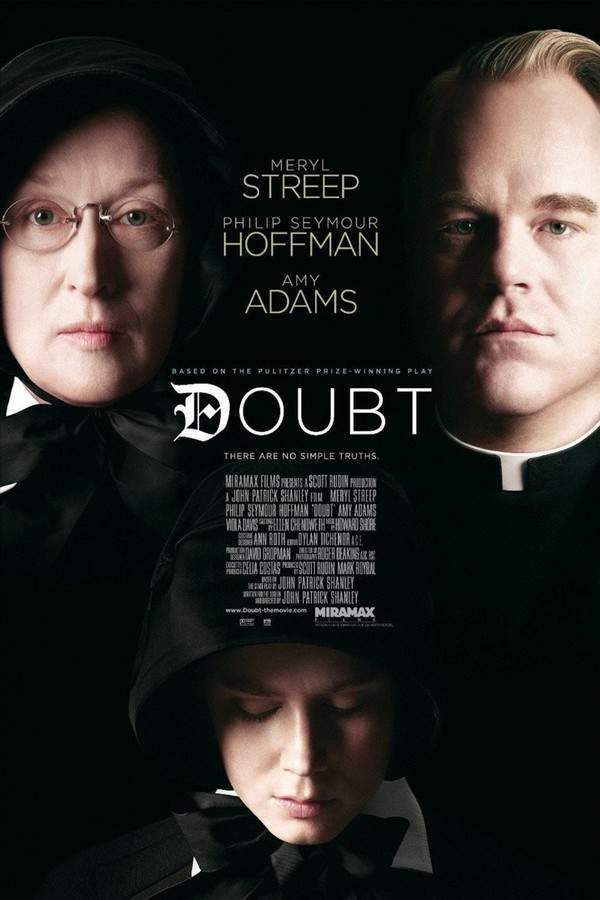
In 1964, St. Nicholas School in the Bronx faces upheaval as the progressive Father Flynn questions established norms, much to the dismay of the strict Principal Sister Aloysius Beauvier. The school's first black student, Donald Miller, arrives, intensifying racial tensions. When a young nun, Sister James, voices concerns about Father Flynn's behavior, Sister Aloysius becomes determined to investigate, leading to a tense confrontation that tests their beliefs and threatens to destroy the school community.
Warning: spoilers below!
Haven’t seen Doubt yet? This summary contains major spoilers. Bookmark the page, watch the movie, and come back for the full breakdown. If you're ready, scroll on and relive the story!
Read the complete plot breakdown of Doubt (2008), including all key story events, major twists, and the ending explained in detail. Discover what really happened—and what it all means.
The film Doubt unfolds against the backdrop of a working-class Irish/Italian Catholic neighborhood in the Bronx, New York, during the year 1964. The narrative begins with tranquil scenes that introduce us to a church garden, adorned with statues of saints and angels, and features a Russian immigrant, who plays a zither. We meet young Jimmy (Lloyd Clay Brown), who is awakened by his mother for Sunday mass, making a hasty exit as he races out of the house. En route to church, he passes the Russian man who inquires about a paper and coffee, yet Jimmy cannot afford to stop since he is already late for his duties as an altar boy, presumably on his first day serving mass.
Upon arriving at the church, Jimmy hastily changes into his cassock, preparing the essential elements for the mass including wine, water, and incense. Soon after, another altar boy named Donald Miller (Joseph Foster) arrives. As the first black student at the parochial school, Donald expresses his body insecurities by asking Jimmy if he thinks he is overweight. While Jimmy dismissively reassures him, we see Donald grappling with self-image issues, which highlight his isolation within the students.
In the sacristy, Father Flynn, portrayed by Philip Seymour Hoffman, conducts the mass before a full congregation. During his sermon, he reflects upon the tragic assassination of President Kennedy the prior year, noting the shared grief that ultimately unites people in times of despair, underscoring the idea that they are all “in this together.” His compelling words resonate deeply, inviting the audience to ponder their own crises of faith and the universal nature of doubt.
Among the attendees is Sister James (Amy Adams), a novice nun clad in traditional habit, who is closely engaged in Flynn’s message. As Father Flynn spins a narrative about a man lost at sea amidst a fire on his cargo ship, the film subtly cuts to the back of the church where Sister Aloysius Bouvier (Meryl Streep), the stern principal, discreetly observes the children, ready to enforce discipline as needed. Her strict demeanor is underscored when she rises to reprimand a child for misbehavior, revealing her role as an enforcer of order within the school.
As the storyline progresses, the film delves into the daily lives of the nuns and the students, intertwining their narratives with themes of vigilance and authority. Sister Aloysius becomes increasingly suspicious of Flynn, especially regarding Donald, whom she views as vulnerable. A series of dinner scenes among the nuns juxtaposes their rigid adherence to rules against the more jovial and relatable nature of Flynn, creating an atmosphere thick with tension.
Sister Aloysius’ suspicions deepen when she learns about Donald’s uncharacteristic behavior following his private chats with Father Flynn. The whispers of potential misconduct in Flynn’s interactions with Donald loom large over the narrative, leading Aloysius to investigate further. She and Sister James engage in conversations filled with veiled implications, speculating over parental concerns regarding Flynn’s influence over Donald.
The climax builds as Aloysius forces a confrontation with Flynn, embodying the struggle between authority and vulnerability, fear and courage. Their exchanges are layered with tension as Flynn attempts to defend his actions while Aloysius remains steadfast in her pursuit of the truth. The screenplay expertly navigates complex themes of morality, faith, and the vulnerability of youth within the walls of an institution that is meant to protect them.
As the story unfolds, it is revealed that Aloysius has taken it upon herself to protect her students, but at a significant personal cost. The narrative culminates in a heart-wrenching exploration of doubt. In a moment of introspection, Aloysius admits, “I have doubts, such doubts,” evoking feelings of uncertainty that resonate with the audience long after the credits roll.
Ultimately, Doubt captivates viewers through its rich character development, thought-provoking themes, and an intense examination of human nature under the lens of faith and morality. It raises pertinent questions about the responsibility of those in power, the fragility of trust, and the complex nature of truth.
Last Updated: December 31, 2024 at 18:09
Discover curated groups of movies connected by mood, themes, and story style. Browse collections built around emotion, atmosphere, and narrative focus to easily find films that match what you feel like watching right now.
Stories where suspicion festers within the rigid confines of a single location.If you liked the tense, confined atmosphere of Doubt, explore more films that trap suspicion and moral conflict within rigid institutional walls. These movies focus on psychological tension, authority figures under scrutiny, and the suffocating power dynamics of closed communities.
These narratives typically unfold within a single, restrictive setting where a suspicion or crisis arises, challenging the established order. The protagonist, often an insider, investigates the truth, leading to a tense confrontation that exposes the institution's flaws and tests personal convictions, often without a clear resolution.
They are grouped by their shared focus on tense, character-driven conflicts erupting in isolated, rule-bound environments. The similarity lies in the potent mix of psychological pressure, moral ambiguity, and the claustrophobic feeling of being trapped with a growing threat.
Films where the central conflict hinges on a truth that can never be fully confirmed.If you appreciated the unresolved central question of Doubt, you'll find similar films here that explore moral gray areas and leave the audience to draw their own conclusions. These stories challenge viewers with complex ethical dilemmas where right and wrong are not clearly defined.
The journey revolves around a central accusation or mystery that lacks definitive proof. Characters are driven by their own convictions, leading to a clash of perspectives. The story's power lies in its refusal to provide closure, instead focusing on the emotional and ethical fallout of living with uncertainty.
They share a defining narrative structure built around an unprovable accusation, creating a profoundly ambiguous experience. The similarity is in the thematic weight placed on doubt itself, exploring the psychological impact on characters and the audience when clear answers are denied.
Don't stop at just watching — explore Doubt in full detail. From the complete plot summary and scene-by-scene timeline to character breakdowns, thematic analysis, and a deep dive into the ending — every page helps you truly understand what Doubt is all about. Plus, discover what's next after the movie.
Track the full timeline of Doubt with every major event arranged chronologically. Perfect for decoding non-linear storytelling, flashbacks, or parallel narratives with a clear scene-by-scene breakdown.
Discover the characters, locations, and core themes that shape Doubt. Get insights into symbolic elements, setting significance, and deeper narrative meaning — ideal for thematic analysis and movie breakdowns.
Get a quick, spoiler-free overview of Doubt that covers the main plot points and key details without revealing any major twists or spoilers. Perfect for those who want to know what to expect before diving in.
Visit What's After the Movie to explore more about Doubt: box office results, cast and crew info, production details, post-credit scenes, and external links — all in one place for movie fans and researchers.
Discover movies like Doubt that share similar genres, themes, and storytelling elements. Whether you’re drawn to the atmosphere, character arcs, or plot structure, these curated recommendations will help you explore more films you’ll love.
Doubt (2008) Scene-by-Scene Movie Timeline
Doubt (2008) Movie Characters, Themes & Settings
Doubt (2008) Spoiler-Free Summary & Key Flow
Movies Like Doubt – Similar Titles You’ll Enjoy
The Catholic School (2022) Ending Explained & Film Insights
Novitiate (2017) Detailed Story Recap
The Sisterhood of Night (2015) Spoiler-Packed Plot Recap
Uncertainty (2009) Ending Explained & Film Insights
Blame (2018) Full Movie Breakdown
A Question of Faith (2017) Film Overview & Timeline
Agnes of God (1985) Ending Explained & Film Insights
Confession (2005) Spoiler-Packed Plot Recap
Suspicion (1987) Full Movie Breakdown
Requiem (2021) Full Summary & Key Details
Absolution (1978) Story Summary & Characters
The Trouble with Angels (1966) Ending Explained & Film Insights
Child’s Play (1972) Story Summary & Characters
The Devil’s Playground (1976) Movie Recap & Themes
A Shadow of a Doubt (1993) Film Overview & Timeline