Year: 2003
Runtime: 127 min
Language: English
Director: Gary Fleder
Budget: $60M
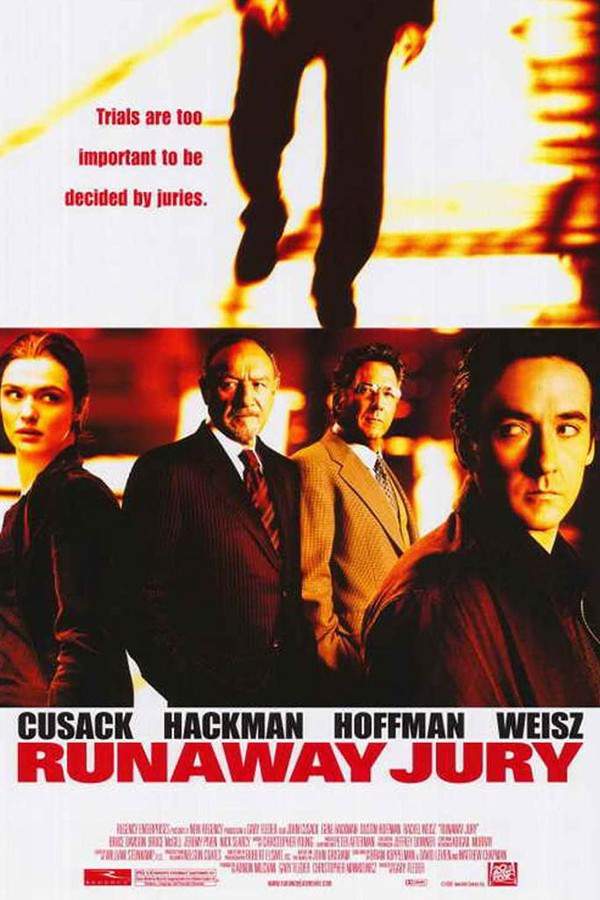
A high-stakes trial unfolds in a New Orleans courtroom as a lawyer fights for justice against a gun manufacturer. A jury consultant attempts to manipulate the proceedings, but a charming juror and his girlfriend have their own agenda, exploiting the legal system for personal gain. Their actions trigger a dangerous game of deception and pursuit, where everyone has something to hide and the pursuit of truth becomes increasingly perilous.
Find where to stream, rent, or buy Runaway Jury (2003) in the US with current JustWatch availability, up-to-date pricing, and platform listings for subscription, rental, and digital purchase options.
Warning: spoilers below!
Haven’t seen Runaway Jury yet? This summary contains major spoilers. Bookmark the page, watch the movie, and come back for the full breakdown. If you're ready, scroll on and relive the story!
Trace every key event in Runaway Jury (2003) with our detailed, chronological timeline. Perfect for unpacking nonlinear stories, spotting hidden connections, and understanding how each scene builds toward the film’s climax. Whether you're revisiting or decoding for the first time, this timeline gives you the full picture.
Last updated: November 19, 2024 at 16:48
Find frequently asked questions about the Runaway Jury (2003) timeline, including chronological order, nonlinear jumps, cause-and-effect links, and scene sequence clarifications. This timeline FAQ helps explain when key events happen, how moments connect, and why the story unfolds in that specific order.
Nick Easter was actually working to expose jury consultant Rankin Fitch's corruption rather than truly trying to manipulate the verdict for money. His goal was to demonstrate that the jury could reach an authentic decision based on empathy for Celeste's loss, rather than being coerced by Fitch's tampering. By inspiring the jury to vote with their hearts, Nick prevented Fitch from controlling the outcome.
Early in the trial, Nick's charm and unusual behavior toward the other jurors set him apart from typical jurors, hinting at an ulterior motive.
Nick Easter's real identity was Jeff Kerr, and he had a deep personal connection to Gardner, Indiana. Investigator Doyle discovered that Nick was tied to the community through a tragic school shooting that killed Gabby's sister. This traumatic event had profoundly affected the town and the families involved, which is why the $15 million fee was ultimately earmarked to help the families affected by that tragedy.
Doyle's investigation in Gardner, piecing together details about the community's painful past, foreshadows the revelation of Nick's true identity and motives.
Marlee was a neutral manipulator who sold her ability to control the jury to the highest bidder. She approached both Fitch (representing Vicksburg Firearms) and attorney Wendell Rohr (representing Celeste) with offers to deliver the verdict they wanted. Her actual loyalty belonged to whoever paid her price, but her ultimate play was to work with Nick Easter to expose the corruption in the system rather than truly deliver a verdict to either side.
Marlee's mysterious proposition to both sides from the start, demanding proof of their claims, establishes her as an opportunist with no genuine allegiance.
Nick outsmarted Fitch by inspiring the jury to make their decision based on genuine empathy for Celeste's loss rather than succumbing to any form of manipulation. While Fitch spent millions on surveillance, blackmail, and bribery to control individual jurors, Nick simply convinced them to vote with their hearts. This approach was something Fitch never anticipated because he couldn't conceive of people making decisions based on conscience rather than coercion.
Fitch's overconfidence in his elaborate manipulation schemes and his inability to understand Nick's true intentions allowed Nick to operate undetected.
The jury awarded $110 million in damages because Nick Easter persuaded them to base their decision on empathy for Celeste's devastating loss. Rather than getting caught up in complex legal arguments about gun manufacturer negligence, Nick asked the jurors to consider the human cost of the tragedy, the grieving widow and her son left behind. This emotional appeal resonated with the jury and led them to hold Vicksburg Firearms accountable.
The final jury deliberations focused heavily on the emotional testimony about Celeste's loss, shifting the trial's momentum decisively toward the plaintiff.
The Gardner school shooting, which killed Gabby's sister, served as the emotional core connecting Nick Easter to the case's stakes. This tragedy had devastated the community and created a personal dimension to Nick's involvement beyond just being a juror. The money ultimately awarded or promised was meant to help the families who had already suffered from such senseless violence, adding weight to the question of corporate responsibility for weapons that enable such attacks.
Doyle's investigation in Gardner gradually revealed how the community's trauma was intertwined with the larger legal battle over gun violence.
Wendell Rohr refused Marlee's $15 million offer because accepting it would have meant compromising his ethical principles and essentially buying a verdict. Rohr genuinely believed in holding Vicksburg Firearms accountable for their negligence and wanted to win the case through legitimate legal means rather than through the same kind of corruption Marlee represented. His refusal demonstrated his commitment to justice, even when faced with the temptation of an easy victory.
From his first appearance, Rohr is portrayed as an earnest attorney genuinely fighting for Celeste, contrasting with Fitch's manipulative tactics.
Nick and Marlee threatened to expose that Fitch had planned to bribe the jury to secure a favorable verdict for Vicksburg Firearms. They possessed evidence of his intended bribes and used this information to force Fitch to resign from his position as jury consultant. This confrontation occurred after the trial ended, when Nick revealed that he had outmaneuvered Fitch by ensuring the jury made their decision authentically rather than through coercion.
Fitch's escalating tactics throughout the trial, blackmailing jurors and attempting to rig the outcome, built toward his ultimate exposure.
Nick proposed an out-of-court settlement as a strategic move to expose Fitch's corruption. By offering to settle the case, Nick forced Fitch to reveal whether he was truly manipulating the jury for the defense. If Fitch agreed to the settlement, it would prove he was bought. The timing was meant to catch Fitch in the act, though Doyle's warning came too late to stop the payment from going through and triggering chaos among the jurors.
Nick's settlement proposal created tension in the juror deliberation room, with Herrera's passionate defense of the gun manufacturer further complicating the dynamics.
Marlee's exact methods for manipulating the jury remained somewhat mysterious, but she demonstrated clear influence over several jurors. She orchestrated the dismissal of one of Fitch's jurors and communicated directly with the jury foreman, suggesting she had developed relationships with multiple jury members. Her threats to expose Fitch's blackmail of other jurors further demonstrated her reach within the jury box.
Marlee's ability to approach both sides with confidence about delivering a verdict hinted at her direct access to juror communications throughout the trial.
Fitch attempted to have Rikki Coleman killed because he discovered she had previously had an abortion and he planned to use this information to blackmail her into voting according to his interests. When his team couldn't find other leverage against her, Fitch escalated to extreme measures, ordering an assassination attempt to remove her from the jury and prevent her from potentially voting against Vicksburg Firearms.
Fitch's escalating tactics throughout the trial, starting with surveillance and progressing to blackmail, built toward increasingly dangerous actions.
Frank Herrera, the Marine veteran juror, defended Vicksburg Firearms passionately because he represented a perspective that blamed individual responsibility rather than corporate negligence. His military background and worldview led him to believe that people, not gun manufacturers, were responsible for how weapons were used. This position put him at odds with Nick Easter and made him a natural ally for the defense's interests within the jury deliberations.
From the beginning, Herrera's hostility toward Nick's positive attitude and his grizzled demeanor established him as a stubborn, principled figure with strong opinions.
Discover curated groups of movies connected by mood, themes, and story style. Browse collections built around emotion, atmosphere, and narrative focus to easily find films that match what you feel like watching right now.
Stories where cunning players manipulate a system for immense personal or ideological gain.If you liked the cunning strategies and system manipulation in Runaway Jury, explore these movies featuring high-stakes games of deception. This list includes legal thrillers, corporate cons, and heist films where masterminds attempt to outwit powerful adversaries in a tense battle of intellect and nerve.
These narratives revolve around a central plot to manipulate a sophisticated system from within. The protagonist, often an anti-hero or someone with a hidden agenda, uses insider knowledge and psychological tactics to bend the rules. The story unfolds as a tense cat-and-mouse game, where each move is met with a countermove, escalating the risk and stakes until the final, unpredictable conclusion.
Movies in this thread are grouped by their focus on intellectual, systemic manipulation as the primary driver of suspense. They share a tense tone, fast pacing, and morally complex characters who operate in grey areas, creating a consistent feeling of high-risk, high-reward cerebral combat.
Legal thrillers where the pursuit of justice is tainted by personal motives and ethical compromise.For viewers who enjoyed the ethical ambiguity and personal vendettas fueling the case in Runaway Jury, this list highlights similar movies where courtroom battles are driven by morally grey characters. These films explore how personal trauma, greed, and corruption complicate the search for truth within the legal system.
The story follows a major trial where the lawyers, clients, or jurors are motivated by factors beyond the case itself—such as grief, revenge, or greed. The pursuit of a legal victory is intertwined with a personal mission, forcing characters to employ questionable tactics. The outcome often feels bittersweet, as justice is served but at a significant moral cost.
These films are connected by their setting within the legal world and their exploration of moral ambiguity. They share a heavy emotional weight, a tense atmosphere, and a focus on how personal demons and systemic flaws corrupt the idealized process of law, resulting in a complex and thought-provoking experience.
Don't stop at just watching - explore Runaway Jury in full detail. From the complete plot summary and scene-by-scene timeline to character breakdowns, thematic analysis, and a deep dive into the ending - every page helps you truly understand what Runaway Jury is all about. Plus, discover what's next after the movie.
Read a complete plot summary of Runaway Jury, including all key story points, character arcs, and turning points. This in-depth recap is ideal for understanding the narrative structure or reviewing what happened in the movie.
Discover the characters, locations, and core themes that shape Runaway Jury. Get insights into symbolic elements, setting significance, and deeper narrative meaning - ideal for thematic analysis and movie breakdowns.