










Plot Explained Spoilers guaranteed!
Plot Explained

Browse by genre

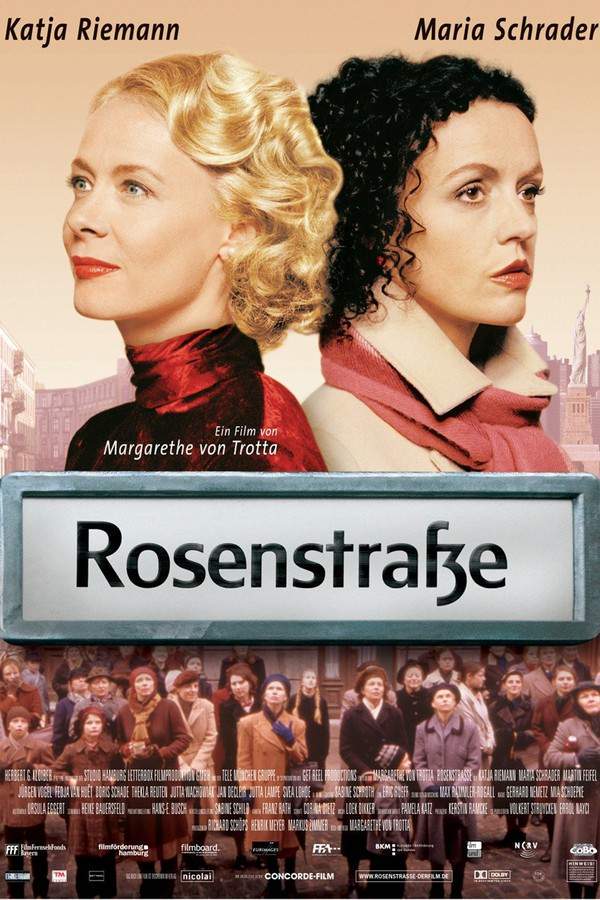
Rosenstrasse (2004) movie poster

Plot Summary

Rosenstrasse (2004) Plot Summary Explained

Release, runtime and language
2004 · 136 min · German
JustWatch #32,683
Starring
Katja Riemann, Jutta Lampe, Svea Lohde

During World War II, a woman named Hannah investigates her family's history and uncovers a remarkable story of resistance. Her mother, Ruth, participated in the Rosenstrasse protest, a courageous demonstration where women defied the Nazi regime to prevent Jewish men from being deported. This untold story reveals the bravery and sacrifice of those who risked their lives to fight against injustice and protect innocent people from persecution.

On this page (6)
  1. 1 Where to watch
  2. 2 What happens: full plot
  3. 3 Plot questions answered
  4. 4 Movie threads
  5. 5 Movies like Rosenstrasse
  6. 6 Every angle

Where to watch

Where to Watch Rosenstrasse (2004)

Where can you watch Rosenstrasse? Stream, rent or buy it in the US, including on Amazon Prime Video, Hoopla and Plex: current JustWatch availability with up-to-date prices.

Streaming availability powered by JustWatch

Full plot summary · contains spoilers

What Happens in Rosenstrasse: Full Plot Summary

The whole story of Rosenstrasse (2004) explained, from the opening scene to the final frame: every key event, every twist and what it all adds up to. Read it as a quick recap before the sequel, to check a scene you missed, or to finally understand what really happened.

In the present day, a widow mourns the loss of her husband and takes a private stance of shielding herself from the world by covering the TV set and every mirror in the house. This quiet ritual stands in stark contrast to the bustling life outside, hinting at a burden she has carried for decades and a privacy she has clung to as a way to cope with memory.

Her grown children are puzzled by this sudden shift in her behavior, wondering why their mother has seemingly embraced a new Orthodox Jewish routine. The mystery gnaws at them, and they press her for answers she is not ready to give. The tension between safeguarding the past and living in the present creates a quiet strain that threads through the family dynamics, inviting viewers to ponder how deeply history can shape intimate family bonds.

The daughter, driven by a longing to understand, learns of a woman who “saved” the widow’s mother during the war and travels to Germany to uncover the full story. There, she encounters a woman who bravely revisits the wartime years, sharing memories of a homeland under Nazi rule and of a mother who grew up as a Jew in those perilous times. The narrative also explores the widow’s own childhood, revealing how the persecution of Jewish families intersected with the lives of those in mixed marriages, and how the fates of generations can intertwine through love and loss.

A central thread runs through the film as it pieces together the Rosenstrasse protest, a remarkable moment in which women stood outside a Nazi jail for seven days and nights, demanding the freedom of their Jewish husbands. Set in Berlin during the winter of 1943, this sequence grounds the drama in a specific, historical act of collective courage. The film interleaves present-day revelations with this history, presenting a neutral, measured examination of memory, resilience, and the ethical complexities faced by those who lived through the era.

Throughout, the story emphasizes what happened to people in mixed marriages under the Nazi regime, painting a portrait of ordinary lives caught in extraordinary times. By weaving past and present, the film invites reflection on the personal costs of persecution, the power of solidarity among women, and the enduring importance of remembering the multitude of quiet, overlooked stories that history often leaves behind.

Last updated: February 17, 2026 at 19:57

Was this helpful?

Plot questions answered

Rosenstrasse Plot Explained: Your Questions Answered

The questions people ask most about Rosenstrasse (2004): what happens in the confusing scenes, why the characters do what they do, the twists, hidden details and what the ending means. Each answer contains spoilers.

Q1

Why does the widow cover all the mirrors and the TV in her house?

The widow covers mirrors and the TV as part of an Orthodox Jewish mourning ritual called "shiva," traditionally observed by sitting on low stools and covering mirrors to avoid focusing on physical appearance during grief. However, her extreme version, covering every mirror and the TV, also reflects a deeper psychological barrier: she is trying to block out her own reflection as a way to avoid confronting decades of suppressed memories about her past as a Jewish child in Nazi Germany and the trauma of losing her own mother to concentration camps.

Foreshadowing: The ritual hints at her hidden past as a Jewish survivor, which the film gradually reveals through her daughter's investigation.

  • mourning ritual
  • orthodox jewish
  • mirrors
  • grief
  • memory
Q2

Who is Lena and how did she save the widow's mother during World War II?

Lena is a German woman who was married to a Jewish man during the Nazi regime. She played a crucial role in rescuing the widow's mother, the daughter of a Jewish family, by helping her escape persecution. Lena's act of saving a Jewish person during the Holocaust created a bond between their families that spans generations. The exact details of the rescue are revealed when the daughter travels to Germany and interviews Lena, uncovering how individual acts of courage could alter fates during the genocide.

Foreshadowing: The daughter's journey to find Lena is foreshadowed early in the film when she learns that someone 'saved' her grandmother during the war.

  • lena
  • rescue
  • holocaust
  • saved
  • german woman
  • jewish family
Q3

What was the Rosenstrasse protest in Berlin during WWII?

The Rosenstrasse protest was a remarkable act of resistance in Berlin during the winter of 1943, where a group of non-Jewish German women gathered outside a Nazi jail for seven consecutive days and nights to demand the release of their Jewish husbands who were being held for deportation. Despite threats from the SS, the women refused to disperse, ultimately forcing the regime to release most of the Jewish men. The protest became a symbol of successful collective resistance and highlighted the unique vulnerability of couples in mixed marriages under Nazi rule.

Foreshadowing: The film's title directly references this protest, which serves as the historical centerpiece of the narrative.

  • rosenstrasse protest
  • berlin
  • women protest
  • 1943
  • jewish husbands
  • resistance
Q4

Why did the mother keep her Jewish heritage and wartime experiences hidden from her children?

The mother kept her past hidden because she carried deep trauma from growing up as a Jewish child in Nazi Germany, witnessing her own mother being taken to a concentration camp, and living in constant fear of persecution. This silence was a coping mechanism, a way to protect herself and her family from the painful memories of the Holocaust. She also likely wanted her children to grow up without the burden of that history, allowing them to assimilate into normal life without the weight of generational trauma. Her sudden adoption of Orthodox Jewish practices in widowhood represents her finally confronting and reclaiming that identity.

Foreshadowing: The tension between the mother's silence and the children's curiosity is established in the opening scenes, driving the mystery of her behavior.

  • hidden past
  • silence
  • trauma
  • Holocaust
  • Jewish heritage
  • family secrets
Q5

What happened to the widow's grandmother during the Holocaust?

The widow's grandmother, the mother of Ruth (the protagonist), was taken to a Nazi concentration camp where she perished. This loss is a central trauma that shapes the family's history. The grandmother's deportation represents the fates of countless Jewish families in mixed marriages who were targeted despite their partial Aryan heritage. Her death left a void that echoes through generations, influencing how the mother raised her own children and how she copes with her identity as a survivor.

Foreshadowing: The mother's childhood memories include the moment of her mother's disappearance, which returns as a painful flashback throughout the film.

  • grandmother
  • concentration camp
  • deportation
  • Holocaust
  • family loss
  • trauma
Q6

Why were mixed marriages particularly dangerous under Nazi rule?

Mixed marriages between Jewish and non-Jewish Germans existed in a legal and social gray area under the Nazi regime. Couples in these relationships faced constant surveillance, coercion, and the threat that the Jewish partner could be deported at any time. Their children occupied an ambiguous racial status according to Nazi laws, often referred to as "Mischlinge" (mixed-race). The regime used these families as political leverage, and even when the Jewish spouse was released, they lived under perpetual uncertainty. The Rosenstrasse protest specifically addressed this group, as the women demanded freedom for husbands who had been classified as Jewish despite their family connections to Aryan Germans.

Foreshadowing: The film's focus on the Rosenstrasse protest highlights the unique plight of these mixed marriage families.

  • mixed marriages
  • Nazi regime
  • persecution
  • Jewish husbands
  • deportation
  • discrimination
Q7

How does the daughter's investigation uncover her mother's hidden history?

The daughter learns that someone saved her mother during the war and decides to travel to Germany to find answers. There, she locates Lena, who recounts her own experiences as a German woman married to a Jewish man during the Nazi era. Through these conversations, the daughter discovers the truth about her mother's Jewish childhood, the loss of her grandmother to concentration camps, and Lena's role in rescuing her mother. This investigation transforms from a personal family mystery into a broader discovery of the Rosenstrasse protest and the women's resistance that helped save Jewish husbands, including possibly her own father.

Foreshadowing: The daughter's determination to understand her mother's behavior sets the entire narrative in motion.

  • daughter
  • investigation
  • truth
  • lena
  • discovery
  • family history
Q8

What is the significance of the widow adopting Orthodox Jewish practices after her husband's death?

The widow's adoption of Orthodox Jewish practices after her husband's death represents her reclamation of a religious and cultural identity she had suppressed for decades. Having grown up Jewish in Nazi Germany and lost her own mother to the Holocaust, she had likely buried this part of her identity to survive and protect her family. Her widowhood and the proximity to her own mortality seem to trigger a need to reconnect with her heritage. The rituals, not just covering mirrors but other Orthodox customs, become a way to honor her parents, process her trauma, and keep the memory of the Holocaust alive for her family.

Foreshadowing: This shift in behavior is the mystery that opens the film and drives the investigation.

  • orthodox jewish
  • identity
  • heritage
  • mourning
  • rituals
  • memory
Q9

How does the film connect the past trauma to the present-day behavior of the widow?

The film uses a non-linear structure that interweaves present-day scenes of the widow's grief with flashbacks to her childhood and the wartime years. The daughter's investigation provides the narrative bridge, as her questions force the widow to confront her silence. The present-day behavior, covering mirrors, adopting Orthodox rituals, withdrawing from the world, directly stems from unprocessed trauma from the Holocaust. The death of her husband, who may have been a source of stability and protection against those memories, triggers the breakdown of her emotional walls. The Rosenstrasse story becomes the key that helps reconcile her past with her present, allowing her to share her history rather than bury it.

Foreshadowing: The parallel editing between the widow's present-day isolation and the historical protests emphasizes the thematic connection between past and present.

  • past present connection
  • trauma
  • memory
  • non-linear narrative
  • generations
Q10

How did the Rosenstrasse protest succeed in freeing the Jewish husbands?

The protest succeeded because the women refused to leave despite SS threats, maintaining their vigil outside the detention facility for seven days and nights. Their persistence created an international incident and embarrassed the Nazi regime, which was simultaneously trying to project an image of order during wartime. The women's courage, particularly since they were non-Jewish German wives risking their own safety, put pressure on the authorities. Eventually, the regime caved and released most of the Jewish husbands, recognizing that the political cost of mass deportations from mixed families was too high at that moment in the war.

Foreshadowing: The film builds toward this historical event as the dramatic climax of the flashback narrative.

  • protest success
  • release
  • jewish husbands
  • resistance
  • women
  • berlin 1943
Q11

Why is the widow's grief so intense after her husband's death?

The widow's intense grief goes beyond typical mourning. Her husband's death removes the last person who fully understood her hidden past and protected her from it. As a survivor of Nazi persecution who lost her own mother to concentration camps, she relied on her husband, likely someone who shared or understood her trauma, as her primary connection to feeling safe. His death leaves her alone with decades of suppressed memories, triggering her withdrawal into Orthodox rituals as a way to cope. The covering of mirrors specifically may also relate to Jewish traditions around death, but her extreme version suggests a psychological need to literally block out her own identity and past.

Foreshadowing: The contrast between her extreme isolation and the bustling world outside hints at something more profound than ordinary widowhood.

  • widowhood
  • grief
  • loss
  • husband
  • trauma
  • isolation

Movie threads

More Movies Like Rosenstrasse, by Mood & Story

Curated lists built around what makes Rosenstrasse tick: the same mood, the same kind of story or the same emotional payoff. Each list explains why these movies belong together.

Movies about uncovering family secrets like Rosenstrasse

A present-day investigation uncovers a traumatic past that reshapes identity. If you were captivated by the investigative journey in Rosenstrasse, you'll find more movies like it here. These films explore how digging into family histories reveals untold stories of survival, trauma, and resilience, often connected to historical atrocity.

  • investigative
  • historical
  • reflective
  • revelatory
  • somber
  • grieving
  • Tone: reflective, melancholic, bittersweet
  • Pacing: slow, deliberate
Why these movies?

The story pattern: These stories typically follow a dual timeline structure, interweaving a present-day investigation with flashbacks to the past. The protagonist, often emotionally detached from the history at first, becomes personally invested as they uncover the truth, leading to a profound shift in their understanding of themselves and their family.

Why they belong together: They are grouped together because they share a core narrative engine of discovery and revelation. The emotional impact comes from connecting personal grief and identity with larger historical tragedies, creating a reflective and often bittersweet experience focused on memory and legacy.

Movies about civilian resistance like Rosenstrasse

Stories of personal courage and non-violent protest against oppressive regimes. For viewers who admired the quiet courage in Rosenstrasse, this collection features similar movies about ordinary people defying tyranny. These powerful dramas show that heroism isn't always loud, focusing on personal sacrifice and moral courage during war and persecution.

  • courageous
  • tense
  • hopeful
  • historical
  • somber
  • defiant
  • Tone: somber, tense, hopeful
  • Pacing: slow, tense
Why these movies?

The story pattern: The narrative follows characters who, despite the extreme danger, make a conscious choice to resist an unjust system. The tension builds from the constant threat of discovery, focusing on the psychological toll and moral conviction required to maintain their defiance. The endings are often bittersweet, acknowledging both the cost of resistance and the enduring value of the act itself.

Why they belong together: They share a core theme of moral courage in the face of atrocity. The focus is on the psychological and emotional experience of resistance rather than action set pieces, creating a tense, somber, yet ultimately hopeful mood centered on the power of individual conscience.

If you liked this

Movies Like Rosenstrasse

Similar movies to Rosenstrasse: the same genre, themes or kind of story. Each one comes with its own plot summary, timeline and ending explained.

Browse all movie summaries

Every angle

Rosenstrasse (2004) Explained: Plot, Timeline & Characters

Everything about Rosenstrasse in one place: what happens in the plot summary, the timeline in chronological order, the characters and meaning and a spoiler-free summary. What's After the Movie adds the cast, box office and post-credit scenes.

Coming soon on iOS and Android

The Plot Explained Movie Summary App

Plot summaries, endings explained and timelines on your phone. Catch up on any movie in minutes, save your favorites and never miss a twist again.

Be the first to know when we launch. Your email stays private, always.

Learn more about the app