In 1938 Munich, under the grim shadow of Nazi rule, a young Jewish girl named Elsbeth Bella Ramsey suffers a brutal intrusion when Nazi Brown Shirts invade her home and murder her parents, leaving a fragile safety net fraying around her.
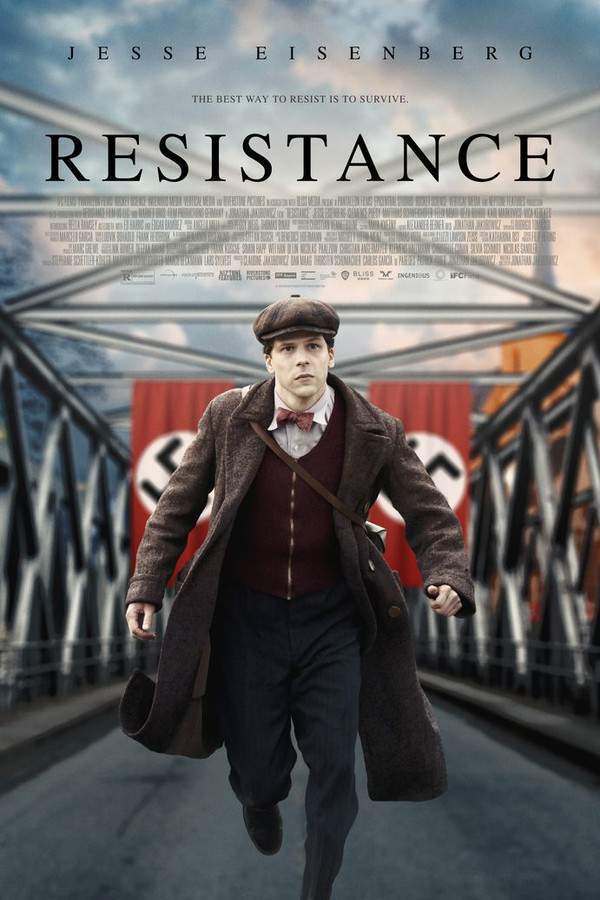
In Strasbourg, 1939, a restless, aspiring artist named Marcel Marceau Jesse Eisenberg toils in his father’s butcher shop, feeling the pull of the arts far more keenly than any family approval he might crave. He longs for a life of mime and painting, and he performs impressions of Charlie Chaplin at a local cabaret, a pastime that earns disapproval from his father yet fuels Marcel’s quiet defiance. Across this growing backdrop of fear, he notices a local girl, Emma Clémence Poésy, whose presence becomes a lifeline he hopes to weave into his future.
Marcel’s cousin Georges Géza Röhrig operates within the Jewish arm of the French Resistance, threading together danger and hope. Together with Emma, Georges brings a troop of 123 Jewish orphans to Strasbourg, taking up residence in a castle that becomes a makeshift sanctuary. The first tremors of terror tremble through the castle walls, but Marcel’s gift—his quiet, transforming mime—helps the children find moments of relief and daring in a cauldron of fear. He and Emma grow closer, their bond deepening as they navigate a world where every small act of courage could be a lifeline.
As Germany’s invasion of Poland redraws the map of Europe, the couple’s commitment to the Resistance intensifies. The orphans are dispersed into smaller groups, hidden in churches and among Jewish families, their safety carefully engineered by those who refuse to yield to despair. Marcel and Emma continue to stay in contact with Elsbeth, a reminder of what they are fighting to protect, even as each day becomes more perilous.
The story then threads into the brutal reality of Klaus Barbie, who arrives in Lyon in 1942 amid the Nazi occupation of southern France. Barbie—“The Butcher of Lyon”—administers brutal justice with bribery, manipulation, and brutal executions in Gestapo headquarters’ empty swimming pool, a chilling display of cruelty that foreshadows a ruthless man’s reign over the city. Barbie Matthias Schweighöfer becomes a menacing force straddling both fear and power, his presence casting a long shadow over every plan to resist.
Marcel and Emma relocate to Lyon to continue their work with the Resistance, joined by Marcel’s brother Alain Félix Moati and Emma’s sister Mila Vica Kerekes. Alain narrowly escapes a Nazi sweep at Lyon’s train station, and Marcel helps him slip away by a near-savage act of burning a German soldier as a cover. But Emma and Mila are not as fortunate. In a brutal round of Gestapo raids, Mila is captured and tortured to death by Barbie, who also pressures Emma for information about the Resistance. Emma survives the brutality by yielding to collaboration in a moment that leaves her devastated, and yet she survives with a resolve that becomes crystalline. Marceau refuses to abandon her, and the two vow to shield Jewish children from further harm, even as the cost climbs perilously high.
Driven by a renewed, unyielding resolve, Marcel and Emma set in motion a daring plan to shepherd children to safety. Disguised as a Scouts’ hiking trip, the small caravan—now including Elsbeth—is shepherded toward the French Alps by SNCF trains. Barbie and his SS units close in on the last checkpoint before the Franco-Swiss border, forcing Emma into hiding as the search intensifies. Marcel, posing as a collaborator, does his best to misdirect Barbie’s suspicions, and the pursuers miss the exact moment the children slip toward the border. Relief washes over the group as the Alpine air approaches, the border promising protection.
Yet Barbie’s vigilance is unyielding. He mobilizes his troops to chase the group through the icy forests that guard the Swiss frontier, and the distance between safety and catastrophe narrows with every heartbeat. A critical moment arrives when Barbie nearly unravels the ruse and confronts Marcel, but the escape endures. Emma is fatally wounded at the edge of the border, a blow that devastates Marcel but does not end their mission; the children, guided by his steady hand, cross into Switzerland, where a fragile new chapter can begin.
The film returns to the broader arc in 1945 at Nuremberg, where Marceau has become a Liaison Officer with the United States Army. It is here that his extraordinary courage is acknowledged by General George S. Patton Ed Harris, who helps illuminate the full scope of his wartime acts. The narrative closes with a final, quiet triumph: Marceau’s enduring gift as an entertainer—his signature mime—reaches a podium of remembrance as he performs before troops and civilians, a poignant reminder of the countless children saved through a combination of courage, creativity, and compassion. In the end, the screen lingers on Marceau in his iconic white-face costume, a vivid image of resilience and humanity amid the ashes of war.
This is a story of art meeting resistance, of a community’s refusal to surrender to cruelty, and of a man who used performance to heal and to protect the innocent. It paints a vivid panorama of fear and hope, of near-impossible choices, and of the quiet, stubborn bravery that can emerge when the world seems most dark. It invites viewers to reflect on the power of creativity to outlast tyranny and to imagine a future where, against all odds, children find pathways to safety and a life beyond survival.