












Year: 2016
Runtime: 106 min
Language: English
Director: Alejandro Amenábar
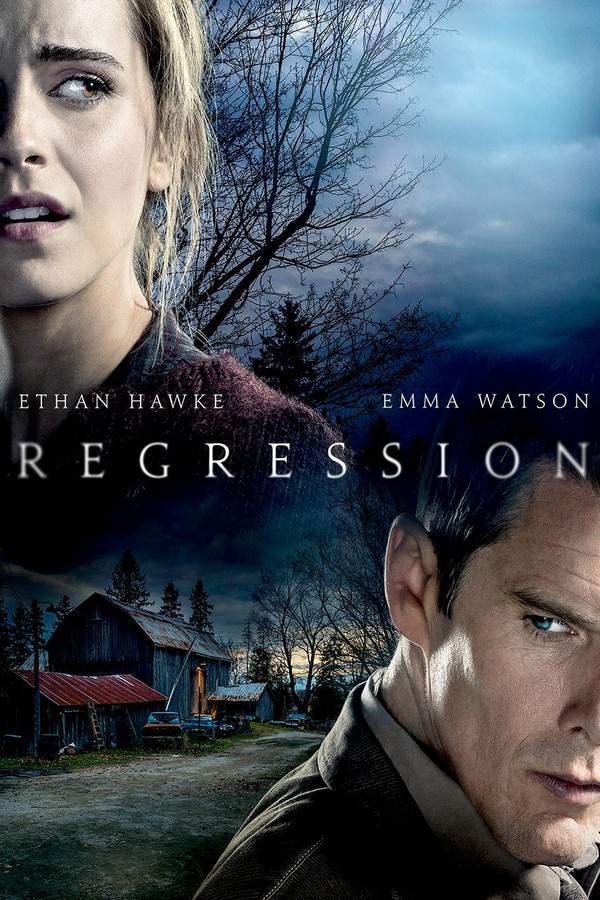
In 1990s Minnesota, Detective Bruce Kenner investigates the troubling allegations of a young girl accusing her father of a terrible crime. Following an unexpected confession by John Gray, a respected psychologist is brought in to examine the case. As the psychologist digs deeper, a disturbing truth emerges, suggesting a widespread and unsettling pattern. The investigation leads to a shocking national secret, challenging perceptions of memory and reality and revealing hidden horrors.
Get a spoiler-free look at Regression (2016) with a clear plot overview that covers the setting, main characters, and story premise—without revealing key twists or the ending. Perfect for deciding if this film is your next watch.
In the quiet suburbs of 1990s Minnesota, a community is shaken when a young woman’s accusations set off an unsettling investigation. The case draws Bruce Kenner, a seasoned detective whose methodical instincts clash with the murky undercurrents of memory and doubt. As he delves deeper, the atmosphere thickens with a blend of small‑town familiarity and an almost palpable sense of something hidden just out of sight, hinting at secrets that might stretch far beyond the immediate neighborhood.
To navigate the tangled testimonies, the authorities enlist Kenneth Raines, a respected psychologist known for his work with recovered memories. His clinical precision offers a stark contrast to Kenner’s gritty streetwise approach, creating a dynamic partnership where each must question the reliability of what they think they know. Together they confront a landscape where personal histories intertwine with broader cultural anxieties, evoking the lingering echoes of a nationwide panic that once gripped the nation’s collective imagination.
The film balances a brooding, introspective tone with moments of unsettling tension, inviting the audience to ponder how trauma, belief, and the power of suggestion can reshape reality. Shadows linger in familiar places—churches, cemeteries, even everyday advertisements—suggesting that the true horror may lie not in overt acts but in the fragile boundaries of perception itself. As the investigation unfolds, both Kenner and Raines are forced to confront the possibility that the truth they seek is more elusive than any single confession, setting the stage for a psychological journey that questions how we remember, how we trust, and what lies concealed beneath the surface of ordinary life.
Last Updated: October 05, 2025 at 16:55
Discover curated groups of movies connected by mood, themes, and story style. Browse collections built around emotion, atmosphere, and narrative focus to easily find films that match what you feel like watching right now.
Stories where reality is questioned and memory becomes the main antagonist.If you liked Regression's exploration of false memories and psychological manipulation, you'll find more unsettling thrillers here. These movies question reality, feature unreliable narrators, and delve into the dark side of the human psyche, creating a watching experience full of doubt and suspense.
Narratives in this thread typically center on a protagonist attempting to solve a mystery or understand a traumatic event, only to discover that their own memories or the accounts of others cannot be trusted. The plot often involves a gradual unraveling of a presumed truth, replaced by a more complex and disturbing reality.
These movies are grouped together because they share a core thematic focus on the unreliability of memory and perception. They create a similar viewing experience defined by psychological tension, a constant questioning of facts, and a climax that recontextualizes the entire story.

Methodical investigations that uncover societal horrors and systemic deception.Fans of Regression's steady build-up and its revelation of a national secret will appreciate these movies. They feature similar patterns of a methodical investigation leading to shocking truths about society, authority, or hidden networks, all delivered with a heavy, tense atmosphere.
The narrative follows a procedural structure, but the focus is on the psychological toll of the investigation. The protagonist faces increasing resistance and gaslighting as they get closer to the truth, culminating in a bittersweet or bleak revelation where the problem is systemic and cannot be easily solved.
These films are connected by their shared mood of pervasive dread built through a steady pace, a central investigation that reveals a horrifying truth, and a tone that is consistently dark and heavy. The experience is one of sinking deeper into a rabbit hole of paranoia.
Don't stop at just watching — explore Regression in full detail. From the complete plot summary and scene-by-scene timeline to character breakdowns, thematic analysis, and a deep dive into the ending — every page helps you truly understand what Regression is all about. Plus, discover what's next after the movie.
Read a complete plot summary of Regression, including all key story points, character arcs, and turning points. This in-depth recap is ideal for understanding the narrative structure or reviewing what happened in the movie.
Track the full timeline of Regression with every major event arranged chronologically. Perfect for decoding non-linear storytelling, flashbacks, or parallel narratives with a clear scene-by-scene breakdown.
Discover the characters, locations, and core themes that shape Regression. Get insights into symbolic elements, setting significance, and deeper narrative meaning — ideal for thematic analysis and movie breakdowns.
What really happened at the end of Regression? This detailed ending explained page breaks down final scenes, hidden clues, and alternate interpretations with expert analysis and viewer theories.
Visit What's After the Movie to explore more about Regression: box office results, cast and crew info, production details, post-credit scenes, and external links — all in one place for movie fans and researchers.