Plot Explained Spoilers guaranteed!
Plot Explained

Browse by genre

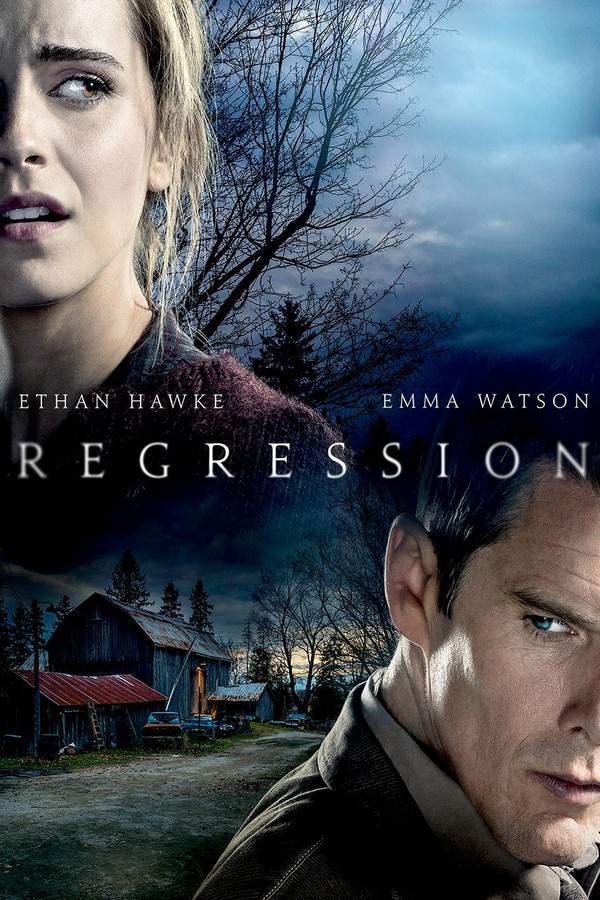
Regression (2016) movie poster

Plot Summary

Regression (2016) Plot Summary & Ending Explained

Release, runtime and language
2016 · 106 min · English
JustWatch #9,562 13
Directed by
Alejandro Amenábar
Starring
David Thewlis, Dale Dickey, Emma Watson

In 1990s Minnesota, Detective Bruce Kenner investigates the troubling allegations of a young girl accusing her father of a terrible crime. Following an unexpected confession by John Gray, a respected psychologist is brought in to examine the case. As the psychologist digs deeper, a disturbing truth emerges, suggesting a widespread and unsettling pattern. The investigation leads to a shocking national secret, challenging perceptions of memory and reality and revealing hidden horrors.

On this page (6)
  1. 1 Where to watch
  2. 2 What happens: full plot
  3. 3 Plot questions answered
  4. 4 How it ends
  5. 5 Movie threads
  6. 6 Every angle

Where to watch

Where to Watch Regression (2016)

Where can you watch Regression? Stream, rent or buy it in the US, including on Fawesome, Fandango at Home Free and Plex: current JustWatch availability with up-to-date prices.

Streaming availability powered by JustWatch

Full plot summary · contains spoilers

What Happens in Regression: Full Plot Summary

The whole story of Regression (2016) explained, from the opening scene to the final frame: every key event, every twist and what it all adds up to. Read it as a quick recap before the sequel, to check a scene you missed, or to finally understand what really happened.

In Hoyer, Minnesota, in 1990, Detective Bruce Kenner investigates the case of John Gray, who admits to sexually abusing his 17-year-old daughter Angela Gray Emma Watson but has no recollection of the abuse. They seek the help of Professor Kenneth Raines David Thewlis to use recovered-memory therapy on John Gray to retrieve his memories, and come to suspect that their colleague Detective George Nesbitt is involved. They detain him but fail to find evidence against him. Detectives suspect a satanic cult is involved because of Angela's testimony, in which Angela says that she was abused by people in masks and someone took pictures of it.

Bruce and Kenneth meet Angela's estranged brother Roy Gray in Pittsburgh, Pennsylvania to inquire about why he left the house. Using the regression technique on him, he recalls hooded figures entering his room while he was young. Bruce and Kenneth suspect Roy's grandmother, Rose Gray Dale Dickey has some involvement but find nothing after a search of her house.

Meanwhile, Bruce begins having nightmares involving satanic rituals. Angela tells him that the cult is out to kill her as she has shown her demonic mark to him and that he is in danger as well. She tells him that her mother received miscellaneous calls and saw strange figures staring at her in the street before she herself had an accident. Bruce starts to experience the same things and his nightmares increase in intensity.

Rose jumps from the window of her house after seeing ghostly figures, injuring herself. Bruce meets Angela in the church's cemetery to reassure her and after an emotional outburst, she kisses him. Shocked, Bruce leaves her there and returns to his home. He sees a soup advertisement on the street and recognizes the woman in it as the one he sees in his nightmares. He concludes that his imagination has run away with him. He tells Kenneth that all these past memories are induced by therapy and the whole situation is just the result of mass hysteria. Though the professor is initially resistant to the idea, he too comes to suspect that these memories were not real.

Bruce is attacked by two hooded figures who finally reveal themselves as George and their colleague, Farrell. George was seeking revenge after Bruce detained him as a child molester and ruined his career. Bruce offers to forget the whole situation if George tells him everything he knows. After George reveals things, Bruce confronts Angela about her abuse and she insists she told the truth. Finally Bruce concludes that she was fabricating everything from the beginning as she wanted to escape from her family, whom she believes to be responsible for her mother's death. She wanted to elope with George, as they had a sexual relationship for some time, but he refused to elope with a minor. Angela accused her father in order to escape the house. When Bruce confronts her, she tells him that no one is going to believe him, especially if she tells them that they kissed in the cemetery. Bruce tells John everything but John decides to take the blame and pleads guilty in order to rescue Angela and hopes that she will forgive him one day for being a bad father.

Many cases like this were reported before the satanic abuse hysteria faded, and that there was never any proof that such ritualistic abuse by organized Satanic cults existed (presumably referring to assertions made during the Satanic panic in the U.S. and other countries in the 1980s and early 1990s).
Last updated: October 09, 2025 at 16:19

Was this helpful?

Plot questions answered

Regression Plot Explained: Your Questions Answered

The questions people ask most about Regression (2016): what happens in the confusing scenes, why the characters do what they do, the twists, hidden details and what the ending means. Each answer contains spoilers.

Q1

Why does John Gray confess to abusing his daughter if he doesn't remember it?

John Gray admits to sexually abusing his 17-year-old daughter Angela during police interrogation, but he cannot recall any details of the abuse. Detective Bruce Kenner brings in Professor Kenneth Raines to use recovered-memory therapy to help John access these buried memories, believing that trauma can cause people to repress traumatic events.

  • john gray confession
  • recovered memory
  • sexual abuse allegations
Q2

Why does Angela Gray accuse her father of abuse?

Angela fabricated the entire abuse story to escape her family, whom she believes drove her mother to her death. She had been in a sexual relationship with Detective George Nesbitt, but he refused to elope with her because she was a minor. Accusing her father was a calculated plan to get out of the house.

Foreshadowing: Earlier hints include Angela's emotional volatility and her claim that the cult wanted her dead.

  • angela gray lies
  • false accusations
  • angela motive
Q3

Is there actually a satanic cult behind the abuse?

No, there is no satanic cult. The entire cult narrative was fabricated through false memories induced by recovered-memory therapy. The hooded figures and ritual abuse stories were products of suggestive therapy techniques that created memories of events that never happened.

Foreshadowing: Bruce realizes his nightmares stem from therapy when he recognizes the woman from a soup advertisement.

  • satanic cult
  • false memories
  • satanic panic
Q4

Who are the hooded figures that attack Bruce Kenner?

The hooded figures are Detective George Nesbitt and his colleague Farrell. They attack Bruce as revenge for wrongly detaining George as a child molester earlier in the investigation, which ruined his career and life.

Foreshadowing: George was previously detained but released due to lack of evidence.

  • george nesbitt attack
  • hooded figures
  • revenge
Q5

What does the soup advertisement reveal about Bruce's nightmares?

Bruce sees a soup advertisement featuring a woman he recognizes from his nightmares. This realization convinces him that his visions were artificially induced by therapy rather than genuine repressed memories, and the entire case may be based on mass hysteria.

  • soup ad
  • nightmare revelation
  • false memories therapy
Q6

Why does John Gray take the blame and plead guilty?

John decides to plead guilty to protect Angela, hoping she will forgive him someday for being a bad father. He,愿意承担虚假的罪名来挽救女儿的未来,即使这意味着他将失去自由。

  • john gray guilty plea
  • father sacrifice
  • takes blame
Q7

Why does Rose Gray jump from her window?

Rose Gray jumps from her house window after seeing ghostly figures, injuring herself. This incident is later revealed to be part of the psychological hysteria affecting the family, though the film leaves ambiguous whether she genuinely saw something or was affected by the spreading paranoia.

Foreshadowing: Rose's search earlier yielded no evidence of cult involvement.

  • rose gray jump
  • supernatural events
  • hysteria
Q8

What is the relationship between Angela and George Nesbitt?

Angela and George Nesbitt had a sexual relationship for some time before the investigation. When Angela wanted to elope with him, George refused because she was a minor. This relationship became the real motive behind Angela's false accusations, she needed a way to escape her family, and George was supposed to help her.

Foreshadowing: The detectives initially suspect George may be involved in the abuse case.

  • angela george relationship
  • affair
  • george nesbitt
Q9

What is recovered-memory therapy in the film?

Professor Raines uses regression therapy to help subjects access supposedly buried memories of childhood trauma. The film depicts how this technique, popular during the 1990s Satanic Panic era, can create false memories through suggestion, leading to erroneous accusations and ruined lives.

  • recovered memory therapy
  • regression therapy
  • memory recovery
Q10

What is the film saying about the Satanic Panic era?

The film is a critique of the Satanic Panic phenomenon of the 1980s and early 1990s. It shows how recovered-memory therapy led to false accusations, destroyed careers and families, and created mass hysteria, all without any proof that organized satanic cults engaged in ritualistic abuse.

  • satanic panic
  • mass hysteria
  • false memory syndrome
Q11

Why does Bruce start having nightmares about satanic rituals?

Bruce begins experiencing nightmares involving satanic rituals after being exposed to the recovered-memory therapy sessions. As he and Kenneth dig deeper into the case, the suggestive nature of the therapy begins affecting Bruce's own psyche, creating vivid nightmares that blur the line between reality and induced memories.

  • bruce nightmares
  • psychological effects
  • satanic rituals
Q12

Why does Professor Raines start doubting the recovered memories?

After Bruce points out that his nightmare figure was actually a woman from a soup advertisement, Kenneth begins to question whether the memories retrieved through his therapy were real. He eventually agrees with Bruce that these memories were likely induced by therapy and not genuine recollections of actual events.

Foreshadowing: The soup advertisement moment triggers his doubt.

  • kenneth raines doubts
  • professor doubts therapy
  • memory reliability

Ending explained

What Happens at the End of Regression?

How Regression (2016) ends, in short: the final scene, the last twist and what it means for the characters. The full ending explained, with every spoiler, lives on its own page.

Read the full ending explained

The ending of Regression reveals a dark and complex web of manipulation and misdirection. Angela, who initially appears to be a victim, turns out to have orchestrated her own story of abuse to seek revenge against her father, John, who she resents for his alcoholism. Her motivations are rooted in her desire to escape her troubled teenage life, and she cleverly manipulates those around her—planting false memories and influencing the investigation. This manipulation even extends to Detective Kenner, who becomes entangled in her web of lies, partly through her kiss, which was actually a ploy to blackmail him and ensure his silence. Meanwhile, Angela's father, John, despite being accused and tortured by the allegations, chooses to plead guilty and take responsibility for crimes he did not commit. His decision reflects his growth and willingness to atone, even through wrongful imprisonment. The film also explores the fragility of perception and the power of hysteria, exemplified by Kenner’s nightmares that reveal how easily ideas can be implanted through suggestion. The overall message critiques the hysteria of Satanic panic and regression therapy, illustrating how easily people can be led astray by disturbing stories and collective fear. The film ultimately leaves viewers questioning what is real and emphasizes that stories, especially the gruesome and salacious ones, are often accepted more readily than the truth. The ending underscores the idea that manipulation, falsehoods, and hysteria can cause even the most tragic and disturbing situations to be accepted as fact, revealing a disturbing truth about human psychology and societal hysteria.

Regression ending explained in full

Movie threads

More Movies Like Regression, by Mood & Story

Curated lists built around what makes Regression tick: the same mood, the same kind of story or the same emotional payoff. Each list explains why these movies belong together.

Movies about unreliable memory and fractured truth like Regression

Stories where reality is questioned and memory becomes the main antagonist. If you liked Regression's exploration of false memories and psychological manipulation, you'll find more unsettling thrillers here. These movies question reality, feature unreliable narrators, and delve into the dark side of the human psyche, creating a watching experience full of doubt and suspense.

  • unreliable narrator
  • psychological
  • paranoid
  • mind-bending
  • unsettling
  • tense
  • Tone: dark, paranoid, unsettling
  • Pacing: steady, methodical
Why these movies?

The story pattern: Narratives in this thread typically center on a protagonist attempting to solve a mystery or understand a traumatic event, only to discover that their own memories or the accounts of others cannot be trusted. The plot often involves a gradual unraveling of a presumed truth, replaced by a more complex and disturbing reality.

Why they belong together: These movies are grouped together because they share a core thematic focus on the unreliability of memory and perception. They create a similar viewing experience defined by psychological tension, a constant questioning of facts, and a climax that recontextualizes the entire story.

Slow-burn investigative thrillers with dark secrets like Regression

Methodical investigations that uncover societal horrors and systemic deception. Fans of Regression's steady build-up and its revelation of a national secret will appreciate these movies. They feature similar patterns of a methodical investigation leading to shocking truths about society, authority, or hidden networks, all delivered with a heavy, tense atmosphere.

  • investigation
  • conspiracy
  • paranoid
  • tense
  • dread
  • unsettling
  • Tone: dark, tense, melancholic
  • Pacing: steady, slow-burn
Why these movies?

The story pattern: The narrative follows a procedural structure, but the focus is on the psychological toll of the investigation. The protagonist faces increasing resistance and gaslighting as they get closer to the truth, culminating in a bittersweet or bleak revelation where the problem is systemic and cannot be easily solved.

Why they belong together: These films are connected by their shared mood of pervasive dread built through a steady pace, a central investigation that reveals a horrifying truth, and a tone that is consistently dark and heavy. The experience is one of sinking deeper into a rabbit hole of paranoia.

Every angle

Regression (2016) Explained: Plot, Ending, Timeline & Characters

Everything about Regression in one place: what happens in the plot summary, the timeline in chronological order, the characters and meaning, the ending explained and a spoiler-free summary. What's After the Movie adds the cast, box office and post-credit scenes.

Coming soon on iOS and Android

The Plot Explained Movie Summary App

Plot summaries, endings explained and timelines on your phone. Catch up on any movie in minutes, save your favorites and never miss a twist again.

Be the first to know when we launch. Your email stays private, always.

Learn more about the app