Plot Explained Spoilers guaranteed!
Plot Explained

Browse by genre

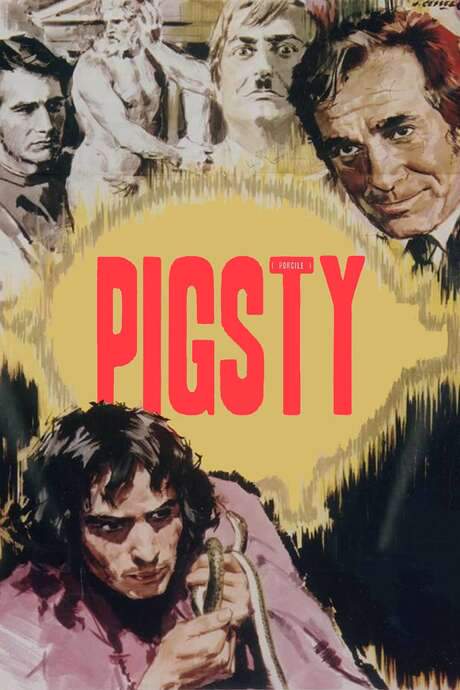
Pigsty (1969) movie poster

Characters & Themes

Pigsty (1969) Characters, Setting & Themes Explained

Release, runtime and language
1969 · 99 mins · Italian
Loading streaming availability…
Directed by
Pier Paolo Pasolini
Starring
Ugo Tognazzi, Anne Wiazemsky, Margarita Lozano, Ninetto Davoli, Pierre Clémenti, Jean-Pierre Léaud

Two stark, interwoven tales of isolation and brutality. In an indeterminate past a young cannibal, who killed his father, is condemned to be torn apart by feral beasts, reveling in his triumph. In a later era, Julian, the son of a post‑war German industrialist, rejects human connection, choosing instead to lie down among his farm’s pigs.

On this page (8)
  1. 1 Where to watch
  2. 2 Characters explained (8)
  3. 3 Where & when it takes place
  4. 4 Themes & meaning (3)
  5. 5 Character & meaning questions
  6. 6 Movie threads
  7. 7 Movies like Pigsty
  8. 8 Every angle
Loading streaming availability…

8 main characters · contains spoilers

Pigsty Characters Explained: Who Is Who

The main characters of Pigsty (1969), heroes and villains: what drives them, how they change over the course of the story and what each of them reveals about the film's bigger ideas.

  • Julian Klotz — Jean-Pierre Léaud

    A privileged young man living in a secluded German villa who masks his detachment with courtesy. He harbors a disturbing secret in a pigsty and pursues a radical, detached outlook that strains his relationship with Ida. His indecision and aloofness propel the tension between private appetites and public expectations.

    • repressed desire
    • bourgeois
    • secretive
  • Ida — Anne Wiazemsky

    Julian’s politically charged fiancée, whose idealism and commitment contrast with Julian’s apathy. She represents a competing current of social awareness and reform, challenging the void of meaning in Julian’s world. Her engagement and eventual choices illuminate the pressures of love within a morally complex milieu.

    • political engagement
    • idealism
    • independence
  • Signore Klotz — Alberto Lionello

    A wealthy industrialist and father figure who pushes his son toward marriage and social advancement. He becomes entangled in corporate intrigue when Herdhitze presents a disturbing opportunity, testing his willingness to compromise his values for profit and status.

    • patriarchal pressure
    • bourgeois power
    • business ethics
  • Herdhitze — Ugo Tognazzi

    A formidable rival and former associate who arrives with a chilling history of macabre experiments. He proposes a partnership that forces the Klotz family to confront hidden sins and the price of ambition. His presence links the postwar arc to the earlier brutal impulses at the heart of the story.

    • manipulative
    • secretive
    • power broker
  • Cannibale — Pierre Clémenti

    The central figure of the Etna sequence, a wanderer who advances from killing insects to cannibalizing humans. He catalyzes a cascading cascade of violence as others are drawn into his path, culminating in a public execution of their group.

    • cannibalism
    • primal violence
    • rebellion
  • Maracchione — Ninetto Davoli

    The gardener and narrator figure who observes the climactic acts and conveys the story’s grim verdicts. His presence helps bridge two eras, underlining themes of memory, silence, and the consequences of what is left unsaid.

    • observer
    • quiet witness
    • ceremonial role
  • Secondo Cannibale — Franco Citti

    An ally of the Cannibale who participates in the brutal acts during the Etna sequence. His involvement highlights the collective nature of the early carnage and the spreading of violence among groups.

    • participant
    • mob mentality
  • Madame Klotz — Margarita Lozano

    A figure within the Klotz household whose presence underscores the domestic sphere’s complicity in the unfolding drama. Her role helps to illustrate how private life can harbor dark truths beneath a veneer of propriety.

    • domestic complicity
    • social veneer

Last updated: October 04, 2025 at 18:03

Was this helpful?

Setting

Where and When Does Pigsty Take Place?

The setting of Pigsty (1969): the year and time period, the places and locations, and how they shape the characters, the mood and the tension of the story.

Time period

1500s and 1967

Two timelines anchor the narrative: a 1500s Sicily setting on Etna where mythic violence erupts, and a 1967 Germany setting within a bourgeois villa where business, marriage, and secrecy intertwine. The film contrasts a distant, legendary past with postwar Wirtschaftswunder Germany, linking ancient impulses to modern consumer society. Across both eras, parental influence and social expectations shape the characters’ fates and moral choices.

Location

Etna, Sicily, Godesberg, Germany

The action unfolds in two places: the volcanic slopes of Mount Etna in Sicily, where a young man begins by killing insects and evolves into cannibalism; and a secluded villa in Godesberg, Germany, where a privileged family hides a private, morally fraught world. The Etna setting presents a barren, primal landscape that mirrors brutality, while the German villa provides a pristine backdrop for power games and hidden appetites. Together, these locations frame a meditation on civilization, violence, and the limits of social order.

  • 🗺️ Volcanic landscapes
  • 🏛️ German villa setting
  • 🧭 Dual timelines

Last updated: October 04, 2025 at 18:03

Was this helpful?

3 major themes

Pigsty Meaning: Themes & Message Explained

What is Pigsty (1969) really about? The emotional, social and philosophical themes the film keeps returning to, its symbolism and the message beneath the surface.

  • Destruction & Rebellion

    The story probes humanity’s capacity for destruction when social limits crumble. In the Etna arc, violence erupts as a radical rejection of civilization; in the German arc, power struggles and taboo desires surface within a polished domestic world. The film asks whether rebellion frees individuals or destroys them, highlighting the seductive danger of breaking taboos.

  • Moral Ambiguity

    Across two timelines, characters make morally gray choices that defy simple judgment. Authority, wealth, and family legacy corrupt or empower different figures, showing that ethics are slippery within both savage and civilized contexts. The narrative suggests that clean lines between good and evil rarely exist in the social world it portrays.

  • Family Influence

    The film emphasizes how parental behavior shapes the next generation’s actions. The Klotz family environment becomes a microcosm for broader societal currents, where pressure to conform clashes with individual longing and rebellion. These dynamics drive the protagonists toward tragic choices and a destabilizing culmination.

Last updated: October 04, 2025 at 18:03

Was this helpful?

Character & theme questions

Pigsty Characters & Meaning: Your Questions Answered

The questions people ask about Pigsty (1969): who the characters really are, their relationships, what the symbols mean, where it takes place and what the movie is really about. Each answer contains spoilers.

Q1

Why does the film switch between Sicily and Germany?

The dual setting is central to the film's thematic purpose. The Sicilian Mount Etna sequences depict a mythic, prehistoric era of raw violence and cannibalism, while the German villa in 1967 represents postwar consumer society's polished surface hiding darker impulses. By juxtaposing these two timelines, the film argues that ancient brutal impulses persist beneath modern civilization's veneer.

Foreshadowing: The volcanic landscape of Etna is introduced first, establishing the primal violence that the German storyline will echo.

  • sicily
  • germany
  • etna
  • godesberg
  • dual narrative
  • setting
Q2

When is the German part of the story set?

The German storyline takes place in 1967, during postwar Germany's economic miracle known as the Wirtschaftswunder. This setting is deliberate, the film contrasts the ancient, legendary violence of the 1500s Sicilian sequences with a modern, prosperous European society that supposedly has moved beyond such primal brutality.

  • 1967
  • postwar germany
  • wirtschaftswunder
  • 1960s
Q3

What does the Mount Etna setting represent?

Mount Etna serves as a primal, volcanic landscape that strips away any pretense of civilization. The barren Sicilian slopes represent a return to a mythic state of nature where social constraints have collapsed. This environment allows the cannibalism to emerge not as aberration but as a logical extension of unchecked human impulses.

Foreshadowing: The opening scenes on Etna show the character killing insects before escalating to humans, establishing the setting's lawlessness.

  • etna
  • volcano
  • sicily
  • primal landscape
  • cannibalism setting
Q4

What does the German villa represent?

The secluded villa in Godesberg represents the privileged bourgeois家庭 that conceals secret sins behind a facade of respectability. Its pristine surroundings mirror the polished social order of postwar Germany, while inside, power struggles, corporate intrigue, and hidden taboos unfold, paralleling the raw violence of the Sicilian storyline.

  • godesberg
  • villa
  • bourgeois
  • germany
  • domestic setting
Q5

What is the film's message about destruction and rebellion?

The film explores whether rebellion against civilization leads to freedom or self-destruction. In both timelines, characters who reject social limits, through cannibalism in the Sicilian arc or through detachment and hidden secrets in the German arc, ultimately meet tragic ends. The film presents breaking taboos as seductive but ultimately destructive.

Foreshadowing: The Cannibale's path from killing insects to humans shows escalating rejection of civilization's limits.

  • destruction
  • rebellion
  • taboo
  • violence
  • freedom
Q6

Is the movie moralizing about good and evil?

No. The film deliberately avoids clear moral judgment. Characters across both timelines make morally gray choices that defy simple categorization. The wealthy industrialist Klotz compromises values for profit, the Cannibale finds twisted fulfillment in violence, and Julian pursues detachment that strains relationships. The film suggests ethics are slippery in both savage and civilized contexts.

  • moral ambiguity
  • ethics
  • gray morality
  • judgment
Q7

How does family shape the characters' choices?

Parental influence and family legacy drive the protagonists toward their tragic choices. In the German arc, pressure from Julian's industrialist father shapes his path, while the Klotz family environment represents broader societal pressures to conform. The film shows how family expectations clash with individual longing, ultimately leading to destabilizing consequences.

  • family
  • parents
  • legacy
  • generational
  • influence
Q8

Who is Julian Klotz and what does he represent?

Julian Klotz is a privileged young man living in a secluded German villa who represents modern alienation and detachment. He masks his emotional disconnection with courtesy while harboring a disturbing secret in the pigsty. His pursuit of radical apathy and rejection of human connection mirrors the Cannibale's rejection of civilization, linking the two timelines thematically.

Foreshadowing: Julian's aloofness and inability to connect with Ida establish his parallel to the isolated Cannibale.

  • julian klotz
  • alienation
  • detachment
  • privilege
Q9

Who is Ida and what is her significance?

Ida is Julian's politically charged fiancée who represents idealism and social awareness in contrast to Julian's apathy. Her commitment to reform and political engagement challenges the meaninglessness in Julian's world. Her choices and eventual departure illuminate the pressures of love within a morally complex environment and highlight the failure of connection across the film's narratives.

  • ida
  • fiancée
  • idealism
  • politics
  • reform
Q10

Who is Herdhitze and what is his function in the story?

Herdhitze is a formidable rival and former associate of the Klotz family who arrives with a history of macabre experiments. His proposal of a disturbing partnership forces the Klotz family to confront hidden sins and the price of ambition. He serves as the link connecting the postwar German arc to the earlier brutal impulses at the story's core.

  • herdhitze
  • rival
  • macabre
  • experiments
  • corporate
Q11

Who is the Cannibale in the Sicilian storyline?

The Cannibale is the central figure of the Etna sequence, a wanderer who progresses from killing insects to cannibalizing humans. He catalyzes cascading violence as others become drawn into his path. His story culminates in a public execution of the group, representing the ultimate rejection of civilization and its consequences.

  • cannibale
  • sicily
  • etna
  • violence
  • insects
Q12

What role does Maracchione play?

Maracchione is the gardener and narrator figure who observes the climactic acts in the Sicilian storyline and conveys the story's grim verdicts. His presence bridges the two eras, serving as a vehicle for themes of memory, silence, and the consequences of what remains unsaid across generations.

  • maracchione
  • narrator
  • gardener
  • observer
Q13

Why is postwar Germany significant to the story?

The 1967 German setting during the Wirtschaftswunder period is crucial because it represents a society that has supposedly moved beyond primitive violence into modern prosperity. The film uses this contrast to suggest that the brutal impulses depicted in the 1500s Sicilian storyline have not disappeared, they've merely been civilized, hidden behind bourgeois surfaces of wealth and propriety.

  • postwar
  • germany
  • wirtschaftsunder
  • prosperity
  • modern society
Q14

What does the pigsty symbolize in the German storyline?

The pigsty where Julian retreats represents a place of regression and hidden animalistic impulses within modern civilization, paralleling the Cannibale's descent on Mount Etna. Just as the Cannibale abandons civil society for raw nature, Julian's retreat to the pigsty symbolizes his rejection of human connection in favor of primal isolation, connecting both narratives thematically.

  • pigsty
  • regression
  • animal instincts
  • primal
  • isolation

Movie threads

More Movies Like Pigsty, by Mood & Story

Curated lists built around what makes Pigsty tick: the same mood, the same kind of story or the same emotional payoff. Each list explains why these movies belong together.

Bleak philosophical films like Pigsty

Stark, symbolic films that use extreme situations to dissect the human condition. Discover movies like Pigsty that use stark, allegorical storytelling to explore deep philosophical questions. If you appreciated the raw examination of human nature and societal violence in Pigsty, these films offer similarly challenging and thought-provoking cinematic experiences.

  • existential
  • allegorical
  • uncompromising
  • thought-provoking
  • disturbing
  • reflective
  • Tone: bleak, intellectual, disturbing
  • Pacing: slow, meditative
Why these movies?

The story pattern: Narratives in this thread are often structured as parables or allegories, where plot events serve a larger symbolic purpose. Characters may face extreme choices that reveal fundamental truths about human nature, and the story's structure prioritizes thematic resonance over conventional resolution.

Why they belong together: These films are grouped by their shared commitment to using cinema as a medium for philosophical exploration. They possess a bleak, uncompromising tone, a deliberate pacing that allows for reflection, and a high emotional weight derived from their existential themes.
Movies about isolation and desolation like Pigsty

Character studies where emotional or social isolation leads to a grim endpoint. Find films similar to Pigsty that explore themes of extreme social alienation and self-imposed isolation. These movies, like Pigsty, often feature characters who reject society and descend into a bleak, solitary existence, portrayed with a heavy emotional weight and slow, deliberate pacing.

  • isolated
  • desolate
  • oppressive
  • character study
  • psychological
  • bleak
  • Tone: bleak, oppressive, isolated
  • Pacing: slow, deliberate
Why these movies?

The story pattern: The narrative pattern follows a protagonist who consciously or unconsciously severs ties with the world, often as a form of rebellion or a response to trauma. The story focuses on the process of this disintegration, culminating in a bleak ending that offers no redemption, emphasizing the finality of their chosen path.

Why they belong together: These films share a specific emotional arc: a slow, deliberate journey towards complete isolation. They are united by a bleak tone, slow pacing that amplifies the sense of inevitability, and a heavy emotional weight centered on themes of alienation and the rejection of human norms.

If you liked this

Movies Like Pigsty

Similar movies to Pigsty: the same genre, themes or kind of story. Each one comes with its own plot summary, timeline and ending explained.

Browse all movie summaries

Every angle

Pigsty (1969) Explained: Plot, Timeline & Characters

Everything about Pigsty in one place: what happens in the plot summary, the timeline in chronological order, the characters and meaning and a spoiler-free summary. What's After the Movie adds the cast, box office and post-credit scenes.

Coming soon on iOS and Android

The Plot Explained Movie Summary App

Plot summaries, endings explained and timelines on your phone. Catch up on any movie in minutes, save your favorites and never miss a twist again.

Be the first to know when we launch. Your email stays private, always.

Learn more about the app