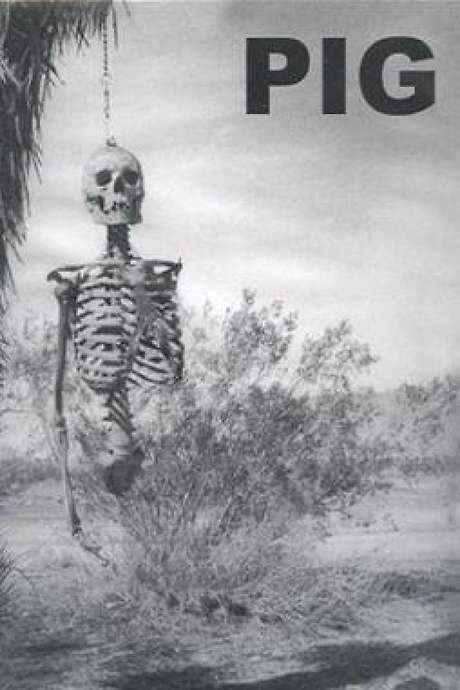
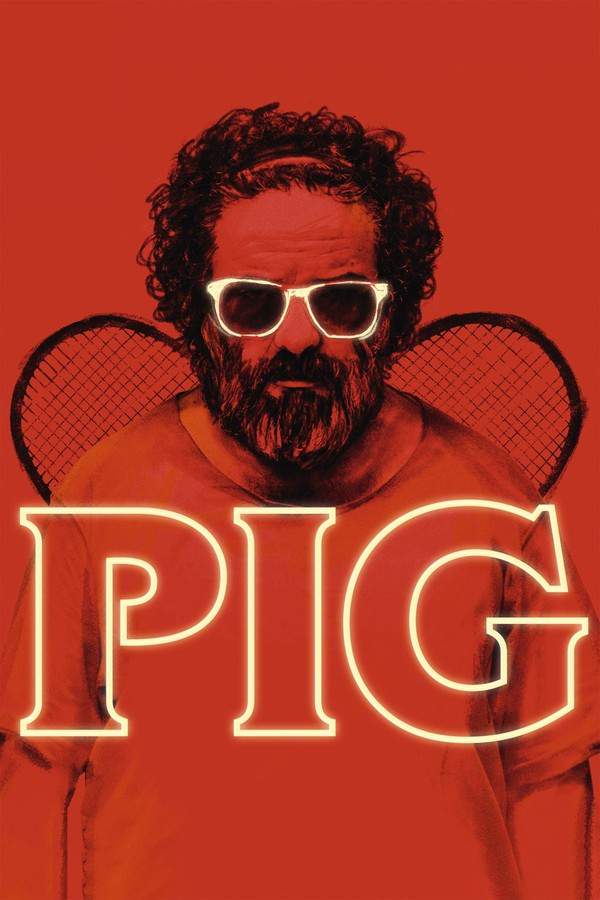
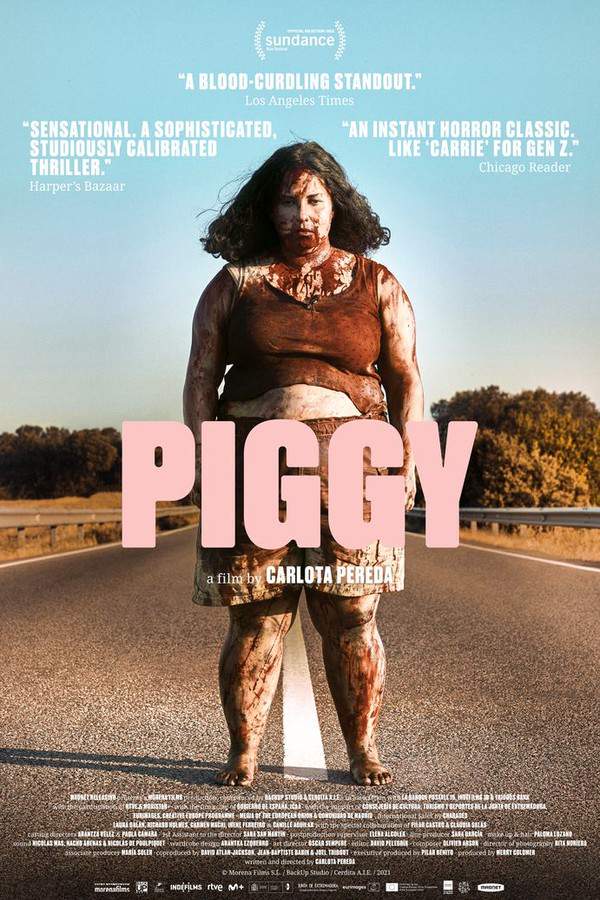
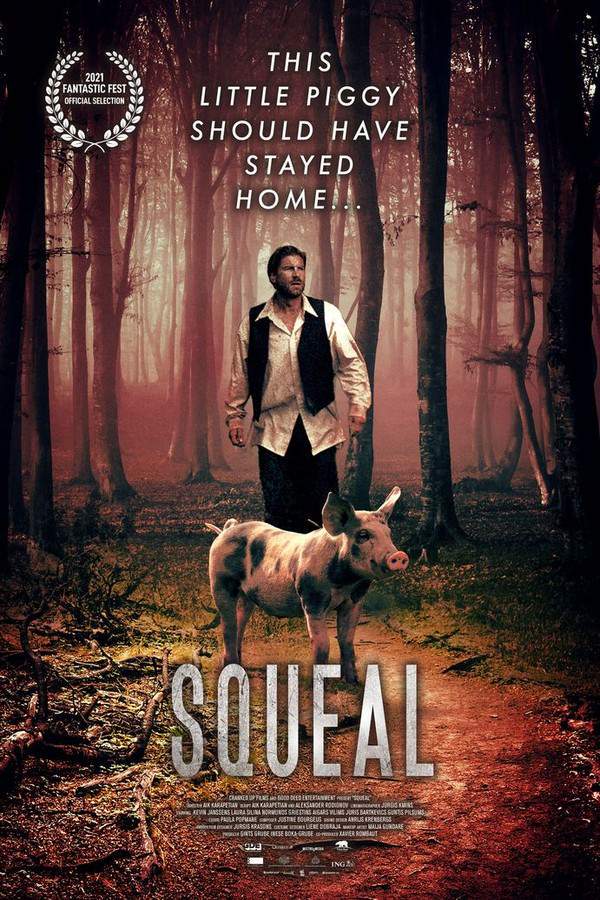
Pig opens on a tense, ceremonial quiet as a black-garbed killer Rozz Williams prepares to leave a small house. He methodically stuffs a briefcase with a curious assortment: a deck of cards, a notebook, and a copy of the children's book Mr. Pig and Sonny Too — a real 1977 publication by Lillian Hoban. The moment he closes the case, the camera reveals a bleeding, half-naked corpse on the floor. The living man kicks the body aside and climbs into a black car, driving away along a vacant road that stretches into a harsh desert.
The journey unfolds beneath endless power lines, the road flanked by barren landscape. A rocky outcrop bears an inscription that seems to read either "ELLE" or "ELLIE," and a nearby sign proclaims Dead Man’s Point, though much of it is hard to read. The film shifts to a second figure, an unidentified man cloaked in white bandages, who wanders the desert until he reaches a lone telephone pole and sits cross-legged, as if waiting for something.
The driver’s car stops, and the masked figure climbs into the passenger seat. They head toward a dilapidated house, where the killer leads the masked captive by a rope while carrying his briefcase. The doorway is a grim tableau of bones arranged around the number 1334, surrounded by dominoes, a crucifix, caution tape, a glove, a knife, and photographs of bound arms and heads. As the camera closes in, the captive’s arms are bound with gauze tape, and a door frame reveals a box of dominoes that hides a keyhole. Through that keyhole, a pig mask peeks through a broken wall, and the killer, now clearly wearing the mask, paces the room.
The scene moves to a corridor in the house where the word Look is spray-painted on the wall. The captive is hoisted by a rope to the ceiling, and the two men move outside to a cellar. There, the killer empties the entire briefcase: a deck of pornographic cards, a large metal key, a wig, a black die with a chaosphere, a bondage mask, gloves, a chain, a bowie knife and other blades, pliers, scissors, papers, a plastic funnel with a feeding tube, and, most notably, a book entitled Why God Permits Evil among the other items.
The killer rests a hand on the bound man’s head and peels away part of the bandage from his eye, exposing a darting gaze and palpable fear. Across the room, a jumble of tools—pliers, knives, syringes, and more—lurk just out of reach. In the next moment, the killer browses pages from Why God Permits Evil, discovering strange, graphic art and religious quotes, while the victim, still bound and with the feeding tube in his mouth, endures the terror of the moment.
The tension heightens as the camera cuts back and forth between the man’s frightened eyes and the killer’s calm, methodical ritual. The book’s pages seem to guide the killer’s disturbing actions, and the feeding tube becomes a conduit for a grisly, ritualized act: the killer pours what appears to be blood through the funnel into the victim’s mouth. The result is a harrowing sequence in which the victim gags and spits the crimson liquid onto his naked torso, a stark and unsettling image that lingers as the scene pulses with ritualistic dread.
The film lingers on the stark contrasts—the calm, almost scholarly ritual of the killer and the vulnerable, shrinking fear of the bound captive—creating a stark, unsettling meditation on control, belief, and pain.