Plot Explained Spoilers guaranteed!
Plot Explained

Browse by genre

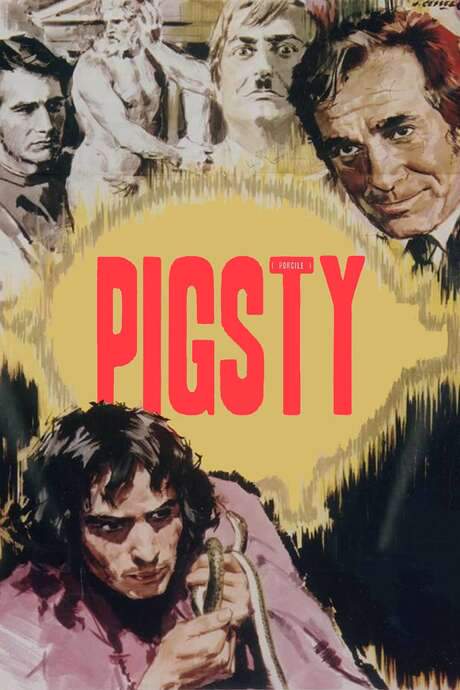
Pigsty (1969) movie poster

Timeline

Pigsty (1969) Timeline Explained – Every Event in Order

Release, runtime and language
1969 · 99 mins · Italian
Loading streaming availability…
Directed by
Pier Paolo Pasolini
Starring
Ugo Tognazzi, Anne Wiazemsky, Margarita Lozano, Ninetto Davoli, Pierre Clémenti, Jean-Pierre Léaud

Two stark, interwoven tales of isolation and brutality. In an indeterminate past a young cannibal, who killed his father, is condemned to be torn apart by feral beasts, reveling in his triumph. In a later era, Julian, the son of a post‑war German industrialist, rejects human connection, choosing instead to lie down among his farm’s pigs.

On this page (6)
  1. 1 Where to watch
  2. 2 Events in order (15)
  3. 3 Timeline questions answered
  4. 4 Movie threads
  5. 5 Movies like Pigsty
  6. 6 Every angle
Loading streaming availability…

15 events in order · contains spoilers

Pigsty Timeline: Events in Chronological Order

Every key event of Pigsty (1969) in order, scene by scene, with when and where it takes place. Use it to untangle flashbacks, time jumps and parallel storylines, to refresh your memory before the sequel or to find the exact scene you are thinking of.

  1. Opening sequence: Bonn vs Hitler

    The film opens with narration contrasting the Germany of Bonn with the Germany of Hitler. The opening credits play over images of a pigsty, underscored by an instrumental version of the Horst-Wessel-Lied.

    When
    Opening sequence
    Where
    Germany (Bonn)
  2. Cannibal tale begins on Etna

    A young man wanders the volcanic slopes of Etna, Sicily, killing and eating insects and small animals. The harsh landscape sets a tone of isolation and predation that frames his later acts.

    When
    circa 1500
    Where
    Etna, Sicily
  3. Fleeing garrisons and contemplates corpses

    He flees from garrisons, fearful of being spotted, and only approaches corpses. This period of avoidance shows his obsession taking shape.

    When
    circa 1500
    Where
    Etna, Sicily
  4. First act of cannibalism: soldier killed

    Not long after, he is no longer satisfied with animal flesh and desires human flesh. Seeing the same garrison again, he lures and kills a soldier, beginning his cannibalistic rampage.

    When
    circa 1500
    Where
    Etna, Sicily
  5. Others join the cannibals

    Following the initial kill, more people join the transformed journey, including some women. The group expands the scope of violence and predation.

    When
    circa 1500
    Where
    Etna, Sicily
  6. Cannibal raids reach a village

    News of the cannibal raids reaches a nearby village, provoking fear and a response from locals. The community begins to mobilize to confront the threat.

    When
    circa 1500
    Where
    Near Etna, Sicily
  7. Capture and proclamation

    The cannibals are surrounded and captured by the villagers. During the capture, one of the cannibals speaks a famous line about his acts, underscoring the brutality of the moment.

    When
    circa 1500
    Where
    Etna region
  8. Punishment and display

    Poles are erected and the cannibals are bound to them, left to be devoured by stray dogs. The grim spectacle serves as a stark moral statement about destruction.

    When
    circa 1500
    Where
    Etna region
  9. The German story begins: 1967 in Godesberg

    In 1967, a villa at Godesberg becomes the center of Julian's claustrophobic life. His radical fiancée Ida is neglected as he isolates himself.

    When
    1967
    Where
    Godesberg, Germany (villa)
  10. Julian's pigsty secret

    Julian secretly sneaks into a pigsty and lies with the pigs whenever he can. This secret act marks his radical rebellion against normal social constraints.

    When
    1967
    Where
    Godesberg, Germany (villa)
  11. Trance and apathy

    Julian slips into a trance, lying in an armchair and becoming indifferent to the world around him. His detachment deepens as external pressures mount.

    When
    1967
    Where
    Godesberg, Germany
  12. Guenther and Herdhitze arrive; the plan forms

    Two men arrive at the villa: Guenther introduces Herdhitze to Klotz, Julian's father figure. Herdhitze hints at a macabre background involving Jewish bodies used for experiments, unsettling Klotz.

    When
    1967
    Where
    Godesberg, Germany (villa)
  13. Blackmail and reconsideration

    Herdhitze's revelation pressures Klotz to reconsider joining his company. Klotz initially refuses, but the possibility of leveraging the scandal forces him to hesitate.

    When
    1967
    Where
    Godesberg, Germany
  14. Ida's departure and business alliance

    Julian tries to discuss his ideas about love with Ida, though not about the relationship itself. Meanwhile, Ida leaves the villa to marry someone else as Klotz and Herdhitze solidify a company.

    When
    1967
    Where
    Godesberg, Germany
  15. Julian's end: devoured by pigs

    Julian goes to the pigsty and allows himself to be devoured by the pigs. His end is not shown on screen and is instead revealed through a dialogue between Herdhitze and the gardener Maracchione.

    When
    1967
    Where
    Godesberg, Germany (pigsty)

Last updated: October 09, 2025 at 09:26

Was this helpful?

Timeline questions answered

Pigsty Timeline Explained: Your Questions Answered

When does it happen, and why in that order? The questions people ask about the chronology of Pigsty (1969): time jumps, flashbacks, cause and effect between scenes and the correct order of events, each answered with spoilers.

Q1

Why does Julian lie with the pigs in the pigsty?

Julian's secret visits to the pigsty represent his radical rejection of human society and social norms. After living a narrow, monastic life that isolates him from genuine connection, including pushing away his fiancée Ida, Julian finds solace in animalistic regression. His act is a deliberate choice to abandon humanity entirely, choosing animality over the moral compromises and complicity he sees in the adult world around him.

Foreshadowing: Earlier scenes show Julian's trance-like state and growing apathy toward human relationships, hinting at his eventual withdrawal into the pigsty.

  • julian
  • pigsty
  • pigs
  • rejection
  • alienation
  • regression
Q2

Why does Julian let the pigs devour him?

Julian's death by self-sacrifice to the pigs is the ultimate expression of his rejection of human civilization. Rather than living in a world of moral compromise, represented by his father's business dealings with the sinister Herdhitze, Julian chooses to become part of the animal kingdom completely. His death is not shown on screen, only implied through dialogue, emphasizing how completely he has abandoned human society.

Foreshadowing: Julian's secret pigsty visits throughout the film build toward this final act of complete transformation.

  • julian
  • death
  • pigs
  • sacrifice
  • ending
  • self-destruction
Q3

What is the connection between the two stories in the film?

The two narratives, one about a 16th-century cannibal and the other about 1960s German industrialist family, are thematically linked. Both explore how parental choices and societal norms shape their children's fates. The first story shows raw, primal violence when social constraints break down, while the second shows normalized, bureaucratic brutality in postwar Germany. The film suggests the violence is not gone but merely transformed, hidden in corporate deal-making and complicity rather than overt cannibalism.

Foreshadowing: The opening sequence that juxtaposes Bonn (postwar West Germany) with Hitler's Germany sets up the thematic connection between past and present brutality.

  • parallel stories
  • thematic connection
  • violence
  • society
  • parents
  • children
Q4

What is Herdhitze's background and why does it matter?

Herdhitze is introduced as a rival industrialist with a macabre past, he allegedly dealt with Jewish corpses for experiments during the Nazi era. This connection to Third Reich atrocities represents how postwar German prosperity was built on complicity with past horrors. Julian's father initially refuses to partner with him but hesitates when potential scandal looms, showing how easily moral boundaries dissolve for financial gain.

Foreshadowing: The opening sequence directly contrasts Bonn's postwar prosperity with Hitler's Germany, foreshadowing the dark historical connections that resurface in the story.

  • herdhitze
  • nazi
  • past
  • experiments
  • complicity
  • business
  • postwar germany
Q5

Why does Ida leave Julian?

Ida leaves because Julian has completely withdrawn from any meaningful human connection. Though she is a radical political activist pursuing her own commitments, Julian keeps her at arm's length and never engages with her about their relationship. His trance-like state and obsession with the pigsty leave no room for intimacy. She ultimately marries someone else, representing Julian's complete failure to engage with the human world.

Foreshadowing: Earlier scenes show Julian's growing indifference to Ida and his refusal to discuss their relationship meaningfully.

  • ida
  • julian
  • leaves
  • marriage
  • rejection
  • relationship
Q6

What does the opening sequence about Bonn vs Hitler represent?

The opening narration and imagery directly juxtapose the prosperous West Germany of the 1960s (Bonn was the West German capital) with the Nazi era under Hitler. The credits play over pigsty images with the Horst-Wessel-Lied (a Nazi-era song) underscoring them. This establishes the film's core thesis: that postwar German prosperity is morally complicit with past atrocities, and the violence has not disappeared but transformed.

Foreshadowing: This thematic setup prepares viewers for Herdhitze's reveal and the moral compromises of Julian's father.

  • opening
  • bonn
  • hitler
  • postwar
  • history
  • symbolism
  • pigsty
Q7

Why are the cannibals punished by being left for stray dogs?

The villagers' decision to tie the cannibals to poles and leave them for stray dogs reflects collective fear and a desire for brutal, primitive justice. Rather than executing them humanely, the community responds to the threat of cannibalism with equally savage punishment, turning the cannibals into prey. This stark tableau shows how communities resort to primal violence when confronted with acts that shatter civilization's rules.

Foreshadowing: Earlier scenes show the villagers' growing fear as cannibal raids approach the village, building to this violent response.

  • cannibals
  • punishment
  • dogs
  • village
  • justice
  • brutality
Q8

Why does Julian's father reconsider partnering with Herdhitze?

Herr Klotz initially refuses to join business with Herdhitze after learning of his grim background involvingcorpse experiments. However, when he discovers Julian has been secretly living with pigs, a scandal that could shame the family, he reconsideres partnering with Herdhitze, potentially to leverage the man's willingness to keep dark secrets. The father chooses business survival over moral standing, showing how easily complicity replaces principle when personal interests are threatened.

Foreshadowing: Earlier scenes establish Herdhitze's willingness to use scandalous information for business leverage.

  • klotz
  • herdhitze
  • business
  • partnership
  • reconsider
  • scandal
Q9

What does the film say about how parents influence their children?

Both narratives explore how parental choices shape children's destinies. In the first story, the cannibals' actions suggest a breakdown of familial or societal guidance. In the German story, Julian's isolation and ultimate fate stem from his father's coldness and moral compromises. The film argues that parental indifference or moral failure drives children toward extremes, either violent rebellion or complete withdrawal, as seen in Julian's choice to abandon humanity entirely.

Foreshadowing: The parallel construction of both stories emphasizes this theme of inherited consequence.

  • parents
  • children
  • influence
  • legacy
  • family
  • consequences
  • choices
Q10

What does the pigsty symbolize in the German story?

The pigsty symbolizes Julian's rejection of human society and all its moral compromises. While his father navigates shady business deals with men connected to Nazi atrocities, Julian finds purity in animal existence. The pigsty represents a space free from the corruption and complicity that defines the adult world. By choosing to live and die among animals, Julian rejects humanity's capacity for normalized brutality.

Foreshadowing: The opening sequence's pigsty imagery and Horst-Wessel-Lied establish this symbol from the very beginning.

  • pigsty
  • symbolism
  • pigs
  • rejection
  • society
  • corruption
  • innocence
Q11

What is the meaning of the cannibal's final line about killing his father?

When The Cannibale declares "I killed my father, I ate human flesh and I quiver with joy," he celebrates complete rupture from all social, moral, and familial constraints. Killing the father represents the ultimate rebellion against civilization's foundations. The chilling joy in this proclamation shows the character has embraced pure, amoral nature, stripped of all human connections and constraints.

Foreshadowing: Earlier scenes show the character progressively abandoning human society, from avoiding garrisons to eating only corpses to finally killing and eating people.

  • cannibale
  • father
  • killed
  • proclamation
  • quote
  • rebellion
Q12

What happens in the final scene with Maracchione and Herdhitze?

After Julian goes to the pigsty for the last time, Herdhitze and the gardener Maracchione discuss Julian's fate in quiet, knowing terms. They indicate Julian has been devoured and that nothing remains of him. The scandal is to be kept secret, Julian's complete disappearance serves the family's need to preserve their reputation. This quiet discussion of death underscores the moral emptiness at the story's heart, where a young man's disappearance is merely a business liability to be managed.

Foreshadowing: Earlier scenes establish Maracchione's presence around the villa and Herdhitze's willingness to handle sensitive matters.

  • maracchione
  • herdhitze
  • final scene
  • death
  • secret
  • scandal

Movie threads

More Movies Like Pigsty, by Mood & Story

Curated lists built around what makes Pigsty tick: the same mood, the same kind of story or the same emotional payoff. Each list explains why these movies belong together.

Bleak philosophical films like Pigsty

Stark, symbolic films that use extreme situations to dissect the human condition. Discover movies like Pigsty that use stark, allegorical storytelling to explore deep philosophical questions. If you appreciated the raw examination of human nature and societal violence in Pigsty, these films offer similarly challenging and thought-provoking cinematic experiences.

  • existential
  • allegorical
  • uncompromising
  • thought-provoking
  • disturbing
  • reflective
  • Tone: bleak, intellectual, disturbing
  • Pacing: slow, meditative
Why these movies?

The story pattern: Narratives in this thread are often structured as parables or allegories, where plot events serve a larger symbolic purpose. Characters may face extreme choices that reveal fundamental truths about human nature, and the story's structure prioritizes thematic resonance over conventional resolution.

Why they belong together: These films are grouped by their shared commitment to using cinema as a medium for philosophical exploration. They possess a bleak, uncompromising tone, a deliberate pacing that allows for reflection, and a high emotional weight derived from their existential themes.
Movies about isolation and desolation like Pigsty

Character studies where emotional or social isolation leads to a grim endpoint. Find films similar to Pigsty that explore themes of extreme social alienation and self-imposed isolation. These movies, like Pigsty, often feature characters who reject society and descend into a bleak, solitary existence, portrayed with a heavy emotional weight and slow, deliberate pacing.

  • isolated
  • desolate
  • oppressive
  • character study
  • psychological
  • bleak
  • Tone: bleak, oppressive, isolated
  • Pacing: slow, deliberate
Why these movies?

The story pattern: The narrative pattern follows a protagonist who consciously or unconsciously severs ties with the world, often as a form of rebellion or a response to trauma. The story focuses on the process of this disintegration, culminating in a bleak ending that offers no redemption, emphasizing the finality of their chosen path.

Why they belong together: These films share a specific emotional arc: a slow, deliberate journey towards complete isolation. They are united by a bleak tone, slow pacing that amplifies the sense of inevitability, and a heavy emotional weight centered on themes of alienation and the rejection of human norms.

If you liked this

Movies Like Pigsty

Similar movies to Pigsty: the same genre, themes or kind of story. Each one comes with its own plot summary, timeline and ending explained.

Browse all movie summaries

Every angle

Pigsty (1969) Explained: Plot, Timeline & Characters

Everything about Pigsty in one place: what happens in the plot summary, the timeline in chronological order, the characters and meaning and a spoiler-free summary. What's After the Movie adds the cast, box office and post-credit scenes.

Coming soon on iOS and Android

The Plot Explained Movie Summary App

Plot summaries, endings explained and timelines on your phone. Catch up on any movie in minutes, save your favorites and never miss a twist again.

Be the first to know when we launch. Your email stays private, always.

Learn more about the app