Plot Explained Spoilers guaranteed!
Plot Explained

Browse by genre

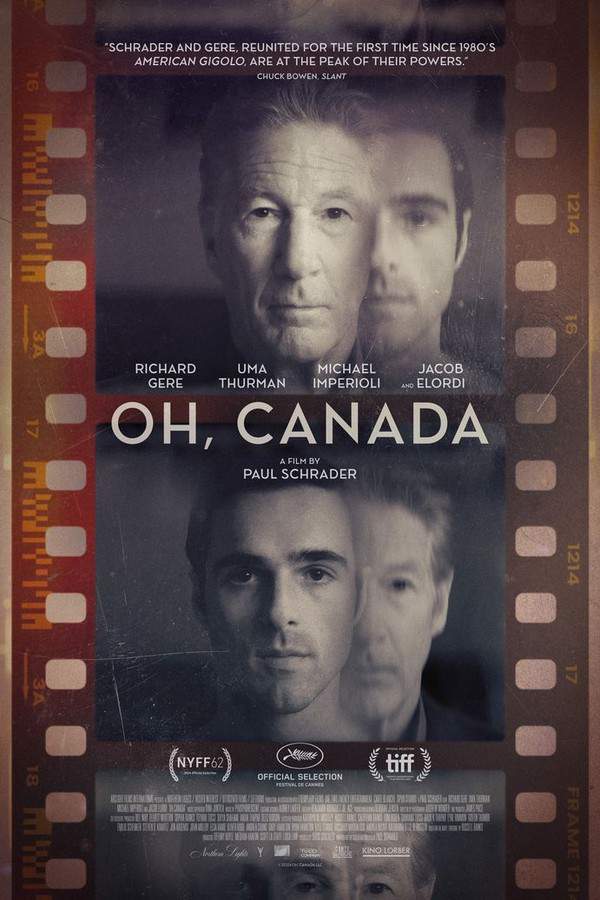
Oh, Canada (2024) movie poster

Ending Explained

Oh, Canada (2024) Ending Explained – Final Scene & Meaning

Release, runtime and language
2024 · 1 h 35 m · English
Echo score 61
Loading streaming availability…
Directed by
Paul Schrader
Starring
Richard Gere, Jacob Elordi, Caroline Dhavernas, Kristine Froseth, Uma Thurman, Jake Weary

Leonard Fife, an aging and ailing filmmaker, is determined to tell his life story in an unfiltered way before time runs out. A director known for acclaimed documentary exposés, he confronts difficult truths about his past, including his decision to avoid the Vietnam War draft and his past relationships.

On this page (7)
  1. 1 Where to watch
  2. 2 What happens at the end
  3. 3 Final events in order
  4. 4 Ending questions answered
  5. 5 Movie threads
  6. 6 Movies like Oh, Canada
  7. 7 Every angle
Loading streaming availability…

Ending explained · contains spoilers

What Happens at the End of Oh, Canada?

How Oh, Canada (2024) ends, what the final scene means, which earlier moments set it up and how to read the ending if the film leaves it open. The full ending explained, with every spoiler.

Leo Fife’s final moments reveal how deeply he has shared his life’s secrets during the interview, exposing both his vulnerabilities and his lies. As he talks openly about his past, Fife’s constructed image as a heroic filmmaker crumbles, revealing a man who fabricates stories to gain fame and admiration. His confessions include exaggerations and outright lies, such as the false story of fleeing to Cuba and pretending to be gay to dodge the Vietnam draft. These revelations show that Fife’s legendary persona is largely built on deception, and as he faces his own mortality due to cancer, he is finally unmasking the truth to himself and others.

Throughout the film, Schrader examines the idea that myths and legends about public figures are often crafted and maintained by personal stories—whether truthful or not—that hide the real person beneath. Fife’s honesty in these latter moments forces the audience to reconsider whether his artistic achievements can be separated from his flawed personal life. The movie leaves us pondering whether the art can still hold value despite the artist’s moral failings, or if his lies diminish everything he created. In the end, Fife’s final act of revealing his secrets signifies a moment of ultimate vulnerability, exposing the complex layers of identity, truth, and facade. The documentary concludes with the understanding that everyone, even those who seem heroic, carry hidden truths and contradictions, making Fife’s story a reflection on the human condition and the perilous nature of myth-making.

Last updated: June 25, 2025 at 09:03

Was this helpful?

The last 4 events

How Oh, Canada Ends: The Final Events in Order

The last events of Oh, Canada (2024) in chronological order, the run-up to the ending explained above. The complete timeline has all 15 events, scene by scene.

Open the full timeline
  1. The Proposition

    During a visit to his old friend Stanley, Leo finds himself propositioned by Stanley's wife, Gloria. This encounter highlights Leo's ongoing struggle with fidelity and moral integrity, even in the face of personal crisis.

  2. The Interview Ends

    As Leo's health deteriorates during the filming, Emma decides to end the interview to prevent further damage. This moment reflects both her care for Leo and the struggles she faces in confronting their shared past.

  3. Final Farewell

    In a poignant moment captured by a hidden camera, Leo utters his final words, 'Oh, Canada,' symbolizing both his deep connection to Canada and the bittersweet ending of his tumultuous journey. His life encapsulates a complex blend of art, regret, and identity.

  4. Crossing the Canadian Border

    Reflecting on his escape from America, Leo recalls dodging the draft by pretending to be gay, which adds complexity to the narratives of his flight. This crucial moment serves as a metaphorical and literal passage to a new life in Canada.

    Where
    Canadian Border

Ending questions answered

Oh, Canada Ending: Your Questions Answered

The questions people ask most about the ending of Oh, Canada (2024): what the final scene means, how the twist works, what happens to each character and how to read the ending. Each answer contains spoilers.

Q1

Why does Leonard Fife confess his lies at the end of the interview?

Facing terminal cancer and running out of time, Fife uses his final documentary interview to dismantle the heroic image he spent a lifetime constructing. The act of confession in Oh, Canada is not framed as absolution but as a refusal to let his carefully curated legend outlive the truth. By stripping away the myths in his dying moments, Fife is reclaiming authorship of his own story before he can no longer speak at all.

Foreshadowing: His earlier deflection during the interview hints that he is building toward a total unraveling.

  • leonard fife confession
  • why fife tells truth
  • dying confession
  • fife interview
Q2

What is the main message of the ending of Oh, Canada?

Oh, Canada closes on the argument that every public figure carries contradictions between who they are and the story they tell about themselves, and that even total honesty at the end of life cannot undo the harm caused along the way. Schrader frames Fife's death as both a private unmasking and a broader reflection on how myths, particularly about artists, are built, maintained, and eventually dismantled. The final message is less about forgiveness than about the perilous, unavoidable nature of myth-making itself.

Foreshadowing: Fife's lifelong habit of revising his own origin stories foreshadows the film's ultimate argument about constructed identity.

  • oh canada message
  • ending meaning
  • schrader theme
  • myth-making
Q3

What happens to Leonard Fife at the very end of Oh, Canada?

Oh, Canada ends with Fife succumbing to terminal cancer, his body finally giving out after years of illness and prescription fentanyl use. His death is framed not as a dramatic climax but as a quiet surrender, with the documentary's final moments implying that his secrets have finally been told. Schrader uses the absence of a conventional death scene to underscore that the true ending was the confession itself.

Foreshadowing: His gaunt appearance and reliance on fentanyl throughout the film signal that his body is failing long before the final scenes.

  • fife death ending
  • leonard fife dies
  • end of oh canada
Q4

What does the ending say about separating art from the artist?

Schrader deliberately leaves this unresolved, forcing viewers to weigh Fife's acclaimed documentaries against the harm he caused through lies, abandonments, and betrayals. The final act of confession in Oh, Canada suggests that the artist cannot be cleanly separated from the work, but also that honesty delivered too late does not erase the damage. The film implies that Fife's art may still hold value, but only if viewers can hold both truths at once.

Foreshadowing: The film's opening framing of Fife as an acclaimed documentarian already seeds the question of whether his reputation matches the man.

  • art vs artist
  • separating art from artist
  • schrader thesis
Q5

Is Leonard Fife's final confession genuine or another performance?

That ambiguity is the point of Oh, Canada's ending, and Schrader refuses to confirm whether even the act of unmasking is itself a constructed performance. Because Fife spent a lifetime mythologizing himself, the audience has no stable ground when he claims to finally be truthful. The film trusts viewers to sit with that uncertainty rather than resolve it, treating the unreliability itself as the final revelation.

Foreshadowing: Fife's earlier inconsistencies in telling the same story different ways hint that even his honesty cannot be fully trusted.

  • fife confession real
  • unreliable narrator
  • schrader ambiguity
Q6

Did Leonard Fife really fake being gay to avoid the Vietnam draft?

According to Oh, Canada's ending, the story of fleeing to Cuba and pretending to be gay to dodge the draft is revealed to be one of Fife's most carefully cultivated lies. By the closing interview, he admits that this widely repeated anecdote was an invention designed to make him appear more radical and persecuted than he actually was. The revelation undermines a cornerstone of the legend Fife built around his exile from the United States.

Foreshadowing: Fife's repeated, polished retellings of the Cuba story throughout the film hint at how rehearsed and constructed it really is.

  • fife draft dodge
  • fake gay draft story
  • vietnam war lie
Q7

Why does Cornel's voiceover matter in the ending?

Cornel, Fife's abandoned son, anchors the cost of Fife's self-mythology in actual human harm throughout Oh, Canada. By giving voice to the son who was left behind, the ending ensures that Fife's confessions are not received as catharsis alone but are weighed against the family he sacrificed for his image. Cornel's perspective is the film's quiet moral counterweight, refusing to let the audience treat Fife's unmasking as a purely redemptive moment.

Foreshadowing: Cornel's absence from the early interview segments signals that the reckoning with his abandonment is being deliberately deferred.

  • cornel fife
  • abandoned son
  • voiceover meaning
Q8

What does the title "Oh, Canada" mean in the context of the ending?

The title refers to the Canada that sheltered Fife and became the stage for his fabricated persona, and in the closing scenes it takes on a mournful, ironic tone. The country he claimed as his refuge was itself part of the legend he built, and the elegiac phrasing of the title reflects a self-constructed identity that finally collapses under the weight of his confessions. The phrase becomes less a geographic label than a farewell to the myth Fife spent a lifetime curating.

Foreshadowing: Fife's repeated insistence on his Canadian identity throughout the film signals how central that constructed geography is to his self-image.

  • oh canada title meaning
  • movie title explained
  • canada symbolism
Q9

What does the documentary interview format add to the ending of Oh, Canada?

The interview-within-a-film structure allows Schrader to interrogate the act of self-portraiture itself, turning Fife's attempt to control his narrative into the very mechanism that exposes his lies. As the documentary progresses, the format shifts from authorized autobiography to involuntary confession, with the camera capturing what Fife cannot hide even when he tries to perform honesty. By the closing scenes, the interview has become less a tribute to Fife's legacy than an autopsy of it.

Foreshadowing: Fife's initial eagerness to control the interview's framing hints at how brittle that control will become.

  • documentary format
  • interview structure
  • schrader metafilm
Q10

Why does Schrader focus on a filmmaker as the subject of Oh, Canada?

By making Fife a documentarian whose career was built on exposing other people's truths, Schrader creates an unbearable irony at the center of the film: the man who made a profession of unmasking others has built his own life on masks. This choice allows Schrader to interrogate the ethics of documentary filmmaking itself, asking what it means to record someone's story when that someone has spent decades distorting their own. The ending lands harder because the audience realizes that Fife's craft and his deception are inseparable.

Foreshadowing: Early references to Fife's most famous documentaries plant the seeds for the realization that his eye for others' truths blinded him to his own lies.

  • filmmaker protagonist
  • schrader irony
  • documentary ethics
Q11

Does Leonard Fife find any redemption by the end of Oh, Canada?

Fife achieves a kind of negative redemption in the final scenes, not forgiveness or repair, but the harder act of refusing to die behind his own lies. By telling the truth too late to undo the harm he caused, Fife at least ensures that the people he left behind and the audience watching finally see him clearly. Schrader frames this as a near-spiritual surrender rather than a triumphant redemption, suggesting that honesty at the end of life is necessary but never sufficient.

Foreshadowing: Fife's increasing willingness to answer harder questions as the interview progresses hints that he is moving toward this final act of surrender.

  • fife redemption
  • oh canada ending hope
  • dying honesty
Q12

What does the ending reveal about Fife's film legacy?

Oh, Canada suggests that Fife's documentaries will likely outlive his reputation, leaving viewers to decide whether to engage with the work on its own terms or to discount it entirely because of the man behind it. The film refuses to issue a final verdict, instead presenting Fife's legacy as an unresolved question that future audiences will have to navigate without his voice shaping the answer. This ambiguity is itself Schrader's commentary on how art and artist continue to be debated long after the creator is gone.

Foreshadowing: Clips and references to Fife's acclaimed early documentaries throughout the film foreshadow that his work will be the lasting trace he leaves behind.

  • fife film legacy
  • art without artist
  • schrader legacy

Movie threads

More Movies Like Oh, Canada, by Mood & Story

Curated lists built around what makes Oh, Canada tick: the same mood, the same kind of story or the same emotional payoff. Each list explains why these movies belong together.

Last confession dramas like in Oh, Canada

Stories where a dying voice finally unspools a lifetime of carefully constructed lies. Movies like Oh, Canada where a dying narrator unspools a lifetime of carefully constructed lies and unfiltered regrets. These films follow a documentary-style structure, often featuring terminal illness, painful honesty, and the reckoning that arrives only when time runs out and there is nothing left to protect.

  • confessional
  • reflective
  • mortality
  • regretful
  • somber
  • intimate
  • Tone: bittersweet, melancholic
  • Pacing: variable, reflective
Why these movies?

The story pattern: A protagonist with limited time left, often terminally ill or simply very old, chooses to record or share their life story without filters. The narrative typically shifts between present-day testimony and flashbacks to earlier decades, revealing how the narrator mythologized their life to survive. Other voices, including abandoned children or former partners, may enter the story and complicate the official truth. The arc moves from self-protective storytelling toward something approaching surrender, grace, or at last quiet honesty.

Why they belong together: These films share a confessional narrative structure built around mortality, unreliable memory, and the gap between self-image and reality. They tend to be quiet, character-driven dramas with heavy emotional weight and bittersweet endings, where catharsis arrives only at the cost of full honesty and never undoes the harm already done.


Absent parent and family estrangement stories like in Oh, Canada

Quietly devastating stories of children who grew up in the wake of a parent's choices. Movies like Oh, Canada that explore family estrangement, parental failure, and the long emotional aftermath of abandonment. These are quietly devastating dramas where absent or unreliable parents leave lasting scars, told through layered perspectives, intimate storytelling, and an emotional weight that lingers long after the credits roll.

  • familial
  • regretful
  • somber
  • intimate
  • weighty
  • estranged
  • Tone: melancholic, bittersweet
  • Pacing: slow, contemplative
Why these movies?

The story pattern: The story centers on a parent whose choices, sometimes principled, often selfish, occasionally both, have estranged them from their children. The narrative often toggles between the parent's self-justifying memory and the child's reckoning with that legacy. Truth emerges not as a single revelation but as an emotional archaeology across a non-linear timeline. Resolution, if it comes, is partial: an apology, a last visit, a quiet acknowledgment. Stories here tend to end without full repair.

Why they belong together: These films share a focus on the damage done by parents to their families and the impossibility of fully undoing it. They tend to use non-linear or multi-perspective storytelling, favor intimacy over spectacle, treat regret as a permanent condition rather than a problem to be solved, and ask viewers to sit with discomfort rather than resolve it neatly.

If you liked this

Movies Like Oh, Canada

Similar movies to Oh, Canada: the same genre, themes or kind of story. Each one comes with its own plot summary, timeline and ending explained.

Browse all movie summaries

Every angle

Oh, Canada (2024) Explained: Plot, Ending, Timeline & Characters

Everything about Oh, Canada in one place: what happens in the plot summary, the timeline in chronological order, the characters and meaning, the ending explained and a spoiler-free summary. What's After the Movie adds the cast, box office and post-credit scenes.

Coming soon on iOS and Android

The Plot Explained Movie Summary App

Plot summaries, endings explained and timelines on your phone. Catch up on any movie in minutes, save your favorites and never miss a twist again.

Be the first to know when we launch. Your email stays private, always.

Learn more about the app