Plot Explained Spoilers guaranteed!
Plot Explained

Browse by genre

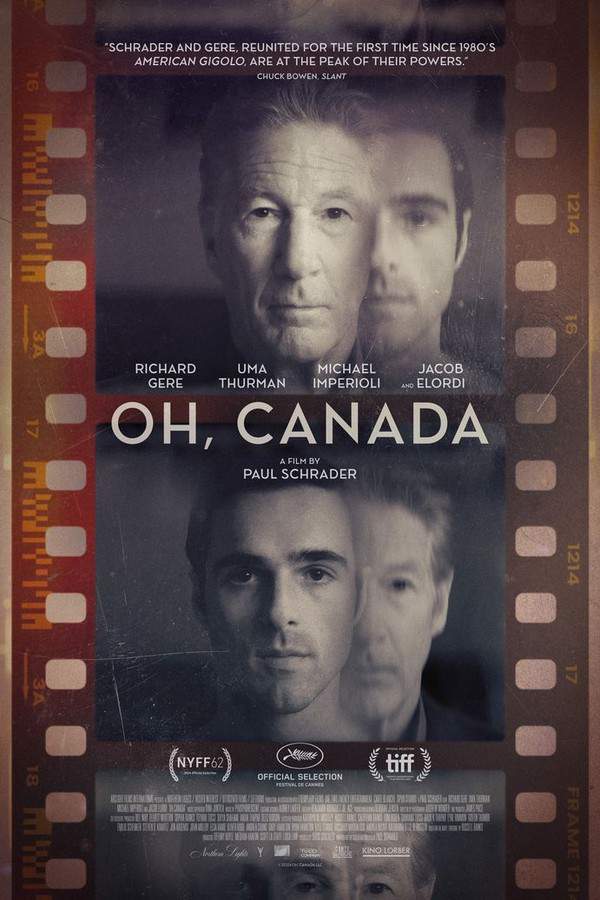
Oh, Canada (2024) movie poster

Plot Summary

Oh, Canada (2024) Plot Summary & Ending Explained

Release, runtime and language
2024 · 1 h 35 m · English
Echo score 61
Loading streaming availability…
Directed by
Paul Schrader
Starring
Richard Gere, Jacob Elordi, Caroline Dhavernas, Kristine Froseth, Uma Thurman, Jake Weary

Leonard Fife, an aging and ailing filmmaker, is determined to tell his life story in an unfiltered way before time runs out. A director known for acclaimed documentary exposés, he confronts difficult truths about his past, including his decision to avoid the Vietnam War draft and his past relationships.

On this page (7)
  1. 1 Where to watch
  2. 2 What happens: full plot
  3. 3 Plot questions answered
  4. 4 How it ends
  5. 5 Movie threads
  6. 6 Movies like Oh, Canada
  7. 7 Every angle
Loading streaming availability…

Full plot summary · contains spoilers

What Happens in Oh, Canada: Full Plot Summary

The whole story of Oh, Canada (2024) explained, from the opening scene to the final frame: every key event, every twist and what it all adds up to. Read it as a quick recap before the sequel, to check a scene you missed, or to finally understand what really happened.

Filmmaker Leonard "Leo" Fife, portrayed by Richard Gere, is facing the final stages of his battle with cancer. Revered as a hero by the progressive community in Canada, Leo is best known for his impactful muckraking documentaries that have captivated audiences and sparked conversation about important social issues. His life story is rich with intrigue and complexity, including the legend that he fled from the United States to Montreal to avoid the Vietnam War draft. Subsequently, he embarked on a Kerouac-inspired road trip to Castro's communist Cuba.

As he nears the end of his life, Leo consents to participate in a documentary being produced by his former students, Malcolm and Diana, played by Michael Imperioli and Victoria Hill, respectively. Malcolm assures Leo that the film aims to honor his career and legacy. However, aware of his own morally ambiguous past, Leo sees this documentary as a chance for personal redemption, particularly in the eyes of his wife Emma, who is also a former student of his, portrayed by Uma Thurman. Throughout his life, Leo has repeatedly misled the public and left a trail of abandoned relationships, making this confession all the more significant.

Years before his diagnosis, Leo, an aspiring novelist, resides in Virginia with his pregnant wife Alicia, played by Kristine Froseth, and their son Cornel, portrayed by Zach Shaffer. Despite his potential stability, Leo feels constrained by the conventional lifestyle and affluent in-laws that surround him. Yearning for a change, he accepts a teaching position at Goddard College in Vermont, while keeping this news a secret from Alicia, who values their life in Virginia. In an attempt to sway Leo to remain, his father-in-law even offers to guide him into the family business, which adds to Leo's turmoil as he wrestles with his decisions.

As the documentary unfolds, the narrative reveals Leo's abandonment of his family when he made the decision to escape to Canada. The adult Cornel, in a poignant voiceover presumably meant for the documentary, reflects on not having seen his father for thirty years. In a bid to shield Leo's image, Emma intervenes, expressing deep concerns over Leo's mental state due to his illness and reliance on prescription medication. Despite her worries, both Leo and Malcolm agree to continue the interview, leading to a confrontation with Leo's troubling history.

Throughout the film, Leo reveals various moments from his past that paint a picture of both his flaws and vulnerabilities—he recalls stealing from a family friend who had provided him with work after dropping out of college, seducing both Diana and Emma while in a position of authority, and even infidelity towards his first wife during her pregnancy. As Emma shares a painful memory of how her son Cornel approached Leo at a film festival, she reflects on how he brusquely informed Cornel that he had "no son," reinforcing the deep scars left by his choices.

Leo revisits critical events leading up to his flight to Canada, meeting with his old friend Stanley, played by Jake Weary, who reveals that life hasn't turned out as he hoped. The narrative intensifies when Leo receives devastating news of Alicia's miscarriage, yet finds himself entangled in an unexpected romantic advance from Stanley's wife, Gloria, further complicating his moral landscape.

As the interview unfolds, Emma eventually halts the proceedings as Leo's health declines. In a powerful moment captured on a hidden camera, Leo's last words ring out: "> Oh, Canada," echoing both a physical and emotional departure from the life he has known.

Finally, the audience learns of Leo’s true motivations for leaving America rather than the legend he has cultivated over the years—highlighting a complex interplay of self-identity and the search for authenticity. As he reflects on his journey, Leo recalls the moment he crossed the Canadian border, recalling his younger self raising his arms to the sun, stepping toward a new chapter in his life.
Last updated: September 18, 2026 at 08:59

Was this helpful?

Plot questions answered

Oh, Canada Plot Explained: Your Questions Answered

The questions people ask most about Oh, Canada (2024): what happens in the confusing scenes, why the characters do what they do, the twists, hidden details and what the ending means. Each answer contains spoilers.

Q1

Why did Leonard Fife really leave America for Canada?

The public legend claims Leo fled to Montreal to avoid the Vietnam War draft, but the film ultimately reveals his true motivation was personal dissatisfaction rather than political conscience. Leo had grown restless in Virginia, felt suffocated by his wealthy in-laws, and wanted to reinvent himself as a writer and artist. His escape to Canada was driven by a desire for freedom and reinvention, not by anti-war heroism, which is why the revelation undercuts his progressive reputation.

Foreshadowing: Early scenes show Leo rejecting the stable Virginia life his in-laws offered, including the father-in-law's attempt to recruit him into the family business.

  • leonard fife
  • vietnam draft
  • canada escape
  • real reason
  • motivation
  • oh canada
Q2

Why did Leo pretend to be gay to dodge the draft?

When Leo actually crossed into Canada, he dodged the draft by claiming to be gay, using a marginalized identity as a loophole to escape military service. This deception was easier and faster than building a full political-refugee case, and it allowed him to leave before his life in Virginia collapsed entirely. The fact that he later built a progressive hero persona on top of this lie becomes one of the film's sharpest critiques of self-mythology.

Foreshadowing: The film hints at Leo's willingness to construct identities, since he is already shown misleading the public about his past throughout his career.

  • leonard fife
  • draft dodging
  • pretended gay
  • canada
  • lie
  • identity
Q3

Why did Leo abandon his wife Alicia and his son Cornel?

Leo abandoned Alicia and Cornel because he felt trapped by the conventional, affluent Virginia life they shared and was desperate to pursue his creative ambitions elsewhere. The teaching offer at Goddard College gave him an excuse to leave, but the deeper reason was that domestic stability had become incompatible with his self-image as an artist. He chose reinvention over family, which Cornel describes in voiceover as a thirty-year absence that defined his childhood.

Foreshadowing: Leo hides the Goddard job offer from Alicia and accepts it in secret, showing the decision was already an emotional exit before the physical one.

  • leonard fife
  • alicia
  • cornel
  • abandonment
  • goddard college
  • family
Q4

Why did Leo tell Cornel he had 'no son' at the film festival?

At the film festival, Leo publicly denied being Cornel's father because admitting the relationship would have exposed the abandonment he had spent decades covering up. Acknowledging Cornel would unravel the heroic, self-made expatriate identity he had built in Canada. Emma recalls the moment as proof that Leo chose image over family even when directly confronted with the son he had left behind.

Foreshadowing: Emma's painful memory of the incident is revealed only after the documentary has already begun exposing Leo's pattern of denial.

  • leonard fife
  • cornel
  • film festival
  • no son
  • denial
  • emma
Q5

What do Leo's final words 'Oh, Canada' mean?

Leo's whispered 'Oh, Canada' on the hidden camera works as both a farewell to the country that gave him a second life and an acknowledgment of the identity he constructed there. The phrase echoes a literal departure from his American past while also mourning the mythology he built on lies. It captures the bittersweet tone of the ending, because Canada represented both his salvation and his longest-running self-deception.

Foreshadowing: The title phrase is planted throughout the documentary as a recurring refrain before it resurfaces as his literal last words.

  • oh canada
  • final words
  • ending
  • meaning
  • hidden camera
  • leonard fife
Q6

Why did Emma agree to the documentary about Leo?

Emma agreed to the documentary because she believed, along with Malcolm and Diana, that it would honor Leo's legacy as a celebrated documentary filmmaker. She wanted his career to be remembered properly before his death from cancer. It is only as the interviews progress and Leo begins confessing his infidelities and lies that she realizes the project could destroy the carefully maintained image she had helped protect.

Foreshadowing: Emma is introduced as a protective spouse who intervenes when the questions become too probing, suggesting she already sensed the risk.

  • emma
  • documentary
  • malcolm
  • diana
  • leonard fife
  • legacy
Q7

Why did Emma stop the documentary interview?

Emma halted the interview because Leo's health was deteriorating from cancer and his reliance on prescription fentanyl was clouding his judgment. She feared he would confess too much in a weakened state and damage both his reputation and the people he had hurt. Her decision reflects a dual motive: protecting Leo from himself and shielding the truth from becoming a public spectacle.

Foreshadowing: Earlier scenes show Emma repeatedly intervening when questions turn toward sensitive territory, foreshadowing that she would eventually pull the plug entirely.

  • emma
  • interview
  • stopped
  • fentanyl
  • cancer
  • protection
Q8

Why did Leo seduce Diana and Emma when they were his students?

Leo seduced Diana and Emma because the dynamic of authority and admiration gave him easy access to younger women who viewed him as a mentor. The pattern reveals how Leo exploited his position as a teacher to feed his ego and avoid genuine emotional accountability. These affairs later became part of the moral wreckage the documentary forces him to confront on camera.

Foreshadowing: The film hints at the pattern early by noting that Diana and Emma were both former students who remained close to Leo for decades.

  • leonard fife
  • diana
  • emma
  • students
  • affair
  • infidelity
Q9

Why did Leo accept the Goddard College job without telling Alicia?

Leo hid the Goddard College offer from Alicia because he already knew she wanted to keep their family rooted in Virginia and would have fought to keep him home. Keeping the decision secret let him avoid a direct confrontation about abandoning his pregnant wife and young son. The secrecy itself signals that the departure was less about the job and more about escaping the life Alicia had built for them.

Foreshadowing: Alicia's father tries to lure Leo into the family business as a counteroffer, showing the couple's stability was the very thing Leo was trying to leave.

  • leonard fife
  • goddard college
  • vermont
  • alicia
  • secret
  • teaching job
Q10

Why did Leo steal from a family friend who gave him work?

Leo stole from the family friend after dropping out of college because he was desperate for money and had already begun exploiting the people closest to him for survival. The theft is one of several early confessions that establish a lifelong pattern of betrayal disguised as self-interest. It also sets up the film's broader argument that Leo's heroic public image was always at odds with his private behavior.

Foreshadowing: This confession is framed as one of Leo's earliest moral failures, establishing the dishonesty that defined his later relationships.

  • leonard fife
  • stole
  • family friend
  • college dropout
  • confession
  • pattern
Q11

Why does Cornel narrate the documentary as an adult through voiceover?

Cornel's adult voiceover frames the documentary from the perspective of the child Leo abandoned, giving the audience an outside counterweight to Leo's self-serving回忆. By letting Cornel speak, the film refuses to let Leo fully control his own narrative, even in what is meant to be his final testimony. The voiceover turns the documentary into a dual confession: Leo's spoken version and Cornel's silent thirty-year accounting of the damage.

Foreshadowing: Cornel's voiceover is introduced before specific flashbacks to Virginia, signaling his perspective will anchor the film's judgments.

  • cornel
  • voiceover
  • abandoned son
  • leonard fife
  • perspective
  • documentary
Q12

Why did Leo feel trapped by his life in Virginia with Alicia's family?

Leo felt trapped in Virginia because his wealthy in-laws represented the kind of conventional, moneyed establishment he had always positioned himself against as an artist and progressive. Their financial support and career offers for him felt like a quiet absorption of his identity into their world. Combined with Alicia's pregnancy and the stability of their marriage, the situation felt creatively suffocating, which pushed him toward the Goddard job and ultimately Canada.

Foreshadowing: The father-in-law's offer to bring Leo into the family business is presented as a tipping point that crystallizes his desire to leave.

  • leonard fife
  • virginia
  • alicia
  • in-laws
  • trapped
  • creative freedom

Ending explained

What Happens at the End of Oh, Canada?

How Oh, Canada (2024) ends, in short: the final scene, the last twist and what it means for the characters. The full ending explained, with every spoiler, lives on its own page.

Read the full ending explained

Leo Fife’s final moments reveal how deeply he has shared his life’s secrets during the interview, exposing both his vulnerabilities and his lies. As he talks openly about his past, Fife’s constructed image as a heroic filmmaker crumbles, revealing a man who fabricates stories to gain fame and admiration. His confessions include exaggerations and outright lies, such as the false story of fleeing to Cuba and pretending to be gay to dodge the Vietnam draft. These revelations show that Fife’s legendary persona is largely built on deception, and as he faces his own mortality due to cancer, he is finally unmasking the truth to himself and others.

Throughout the film, Schrader examines the idea that myths and legends about public figures are often crafted and maintained by personal stories—whether truthful or not—that hide the real person beneath. Fife’s honesty in these latter moments forces the audience to reconsider whether his artistic achievements can be separated from his flawed personal life. The movie leaves us pondering whether the art can still hold value despite the artist’s moral failings, or if his lies diminish everything he created. In the end, Fife’s final act of revealing his secrets signifies a moment of ultimate vulnerability, exposing the complex layers of identity, truth, and facade. The documentary concludes with the understanding that everyone, even those who seem heroic, carry hidden truths and contradictions, making Fife’s story a reflection on the human condition and the perilous nature of myth-making.

Oh, Canada ending explained in full

Movie threads

More Movies Like Oh, Canada, by Mood & Story

Curated lists built around what makes Oh, Canada tick: the same mood, the same kind of story or the same emotional payoff. Each list explains why these movies belong together.

Last confession dramas like in Oh, Canada

Stories where a dying voice finally unspools a lifetime of carefully constructed lies. Movies like Oh, Canada where a dying narrator unspools a lifetime of carefully constructed lies and unfiltered regrets. These films follow a documentary-style structure, often featuring terminal illness, painful honesty, and the reckoning that arrives only when time runs out and there is nothing left to protect.

  • confessional
  • reflective
  • mortality
  • regretful
  • somber
  • intimate
  • Tone: bittersweet, melancholic
  • Pacing: variable, reflective
Why these movies?

The story pattern: A protagonist with limited time left, often terminally ill or simply very old, chooses to record or share their life story without filters. The narrative typically shifts between present-day testimony and flashbacks to earlier decades, revealing how the narrator mythologized their life to survive. Other voices, including abandoned children or former partners, may enter the story and complicate the official truth. The arc moves from self-protective storytelling toward something approaching surrender, grace, or at last quiet honesty.

Why they belong together: These films share a confessional narrative structure built around mortality, unreliable memory, and the gap between self-image and reality. They tend to be quiet, character-driven dramas with heavy emotional weight and bittersweet endings, where catharsis arrives only at the cost of full honesty and never undoes the harm already done.

Absent parent and family estrangement stories like in Oh, Canada

Quietly devastating stories of children who grew up in the wake of a parent's choices. Movies like Oh, Canada that explore family estrangement, parental failure, and the long emotional aftermath of abandonment. These are quietly devastating dramas where absent or unreliable parents leave lasting scars, told through layered perspectives, intimate storytelling, and an emotional weight that lingers long after the credits roll.

  • familial
  • regretful
  • somber
  • intimate
  • weighty
  • estranged
  • Tone: melancholic, bittersweet
  • Pacing: slow, contemplative
Why these movies?

The story pattern: The story centers on a parent whose choices, sometimes principled, often selfish, occasionally both, have estranged them from their children. The narrative often toggles between the parent's self-justifying memory and the child's reckoning with that legacy. Truth emerges not as a single revelation but as an emotional archaeology across a non-linear timeline. Resolution, if it comes, is partial: an apology, a last visit, a quiet acknowledgment. Stories here tend to end without full repair.

Why they belong together: These films share a focus on the damage done by parents to their families and the impossibility of fully undoing it. They tend to use non-linear or multi-perspective storytelling, favor intimacy over spectacle, treat regret as a permanent condition rather than a problem to be solved, and ask viewers to sit with discomfort rather than resolve it neatly.

If you liked this

Movies Like Oh, Canada

Similar movies to Oh, Canada: the same genre, themes or kind of story. Each one comes with its own plot summary, timeline and ending explained.

Browse all movie summaries

Every angle

Oh, Canada (2024) Explained: Plot, Ending, Timeline & Characters

Everything about Oh, Canada in one place: what happens in the plot summary, the timeline in chronological order, the characters and meaning, the ending explained and a spoiler-free summary. What's After the Movie adds the cast, box office and post-credit scenes.

Coming soon on iOS and Android

The Plot Explained Movie Summary App

Plot summaries, endings explained and timelines on your phone. Catch up on any movie in minutes, save your favorites and never miss a twist again.

Be the first to know when we launch. Your email stays private, always.

Learn more about the app