









Plot Explained Spoilers guaranteed!
Plot Explained

Browse by genre

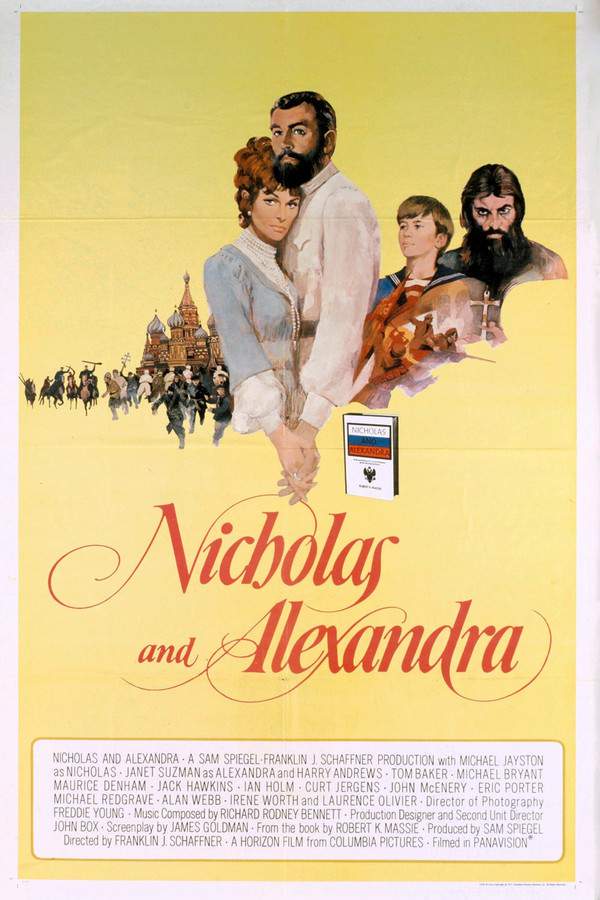
Nicholas and Alexandra (1971) movie poster

Timeline

Nicholas and Alexandra (1971) Timeline Explained – Every Event in Order

Release, runtime and language
1971 · 183 min · English
JustWatch #24,851 1
Directed by
Franklin J. Schaffner
Starring
Harry Andrews, Ania Marson, Janet Suzman, Candace Glendenning, Fiona Fullerton, Irene Worth

This biographical drama explores the marriage of Tsar Nicholas II and German princess Alexandra, an event that ignited tensions within Russia. Their initial years are marked by disappointment as they have four daughters before the arrival of a son, who is tragically afflicted with hemophilia. The couple's dependence on the controversial mystic Rasputin to treat their heir further complicates matters and fuels political instability, ultimately leading to a devastating downfall.

On this page (7)
  1. 1 Where to watch
  2. 2 Events in order (15)
  3. 3 Timeline questions answered
  4. 4 The book behind the movie
  5. 5 Movie threads
  6. 6 Movies like Nicholas and Alexandra
  7. 7 Every angle

Where to watch

Where to Watch Nicholas and Alexandra (1971)

Where can you watch Nicholas and Alexandra? Stream, rent or buy it in the US, including on fuboTV, Tubi TV and YouTube Free: current JustWatch availability with up-to-date prices.

Streaming availability powered by JustWatch

15 events in order · contains spoilers

Nicholas and Alexandra Timeline: Events in Chronological Order

Every key event of Nicholas and Alexandra (1971) in order, scene by scene, with when and where it takes place. Use it to untangle flashbacks, time jumps and parallel storylines, to refresh your memory before the sequel or to find the exact scene you are thinking of.

  1. Birth of Alexei

    Tsarina Alexandra Feodorovna gives birth to her fifth child, a son named Alexei. This joyous occasion is overshadowed by the ongoing Russo-Japanese War, which presents significant challenges for the Romanov dynasty.

  2. Nicholas II's Stubbornness

    Despite urgent appeals from Grand Duke Nicholas and Count Sergei Witte to end the Russo-Japanese War and consider constitutional reforms, Tsar Nicholas II refuses. His insistence on maintaining the status quo fuels public dissatisfaction and unrest in Russia.

    Where
    Winter Palace
  3. Workers' March to the Palace

    Growing discontent leads thousands of workers to march to the Winter Palace, seeking political representation. The peaceful protest escalates tragically when soldiers open fire on the crowd, resulting in numerous deaths, which incites further revolutionary fervor.

    Where
    Winter Palace
  4. Introduction to Rasputin

    During an extravagant gala, Tsarina Alexandra meets Grigori Rasputin, a self-proclaimed holy man. She turns to him for spiritual guidance, particularly concerning her son Alexei's hemophilia, inadvertently entwining him with the royal family.

  5. Rise of Rasputin’s Influence

    Over time, the close relationship between the Romanovs and Rasputin, along with his controversial contributions, ridicules the monarchy. Alexandra takes a strong stance against his dismissal, firmly believing in his powers as the family's protector.

  6. Romanov Tercentenary Celebration

    The Romanovs celebrate their Tercentenary with opulence, parading through Imperial Russia. However, the festivities are marred by the assassination of Prime Minister Stolypin, prompting Nicholas to execute the assailants to quell public dissent.

    Where
    Imperial Russia
  7. Alexei’s Critical Bleeding Episode

    While at the Spała Hunting Lodge, Alexei suffers a severe bleeding episode, raising fears for his life. Alexandra seeks Rasputin's assistance once more, following his advice to keep Alexei undisturbed, and the boy thankfully recovers.

    Where
    Spała Hunting Lodge
  8. Mobilization During July Crisis

    Following the assassination of Archduke Franz Ferdinand, Tsar Nicholas orders the mobilization of the Imperial Army against Austria-Hungary. This decision marks the beginning of Russia’s entry into a deeper conflict; however, Nicholas is soon caught off guard by escalating war declarations.

    When
    July Crisis
  9. Nicholas Takes Command

    As Russia faces losses on the Eastern Front, Alexandra persuades Nicholas to take command of the troops. Leaving Grand Duke Nicholas behind to manage affairs, this decision exposes the empire to public scrutiny and criticism.

  10. Alexandra’s Leadership Struggles

    With Nicholas away, Alexandra becomes the nominal leader but faces mounting challenges. Her unpopular decisions, compounded by rumors of Rasputin’s influence, damage her reputation and stoke public outrage.

    Where
    St. Petersburg
  11. Rasputin’s Assassination

    After a series of crises, Rasputin is assassinated by nobles seeking to save the monarchy from his perceived harmful influence. However, this act does not restore stability, and revolts erupt in St. Petersburg against Alexandra's rule.

  12. Abdication of Nicholas II

    As chaos unfolds, Nicholas is forced to abdicate while trying to return to Tsarskoye Selo. His abdication marks the end of the Romanov dynasty's rule in Russia, thrusting the country into political uncertainty.

    Where
    Tsarskoye Selo
  13. Exile to Siberia

    The provisional government, led by Alexander Kerensky, exiles the royal family to Siberia as no allies offer refuge. This exile signifies the complete fall of the monarchy as civil unrest grows throughout the nation.

    Where
    Siberia
  14. Bolshevik Takeover

    Following the Bolshevik Revolution, the provisional government collapses, leading to civil war in Russia. The royal family, now a target, faces imminent danger as the Bolsheviks intend to bring them back for trial.

  15. Execution of the Royal Family

    In a dark turn of events, the royal family is transported to Yekaterinburg where they are held under harsh conditions. In the dead of night, they are taken to a cellar and executed, ending the Romanov lineage.

    Where
    Yekaterinburg

Last updated: November 15, 2024 at 17:42

Was this helpful?

Timeline questions answered

Nicholas and Alexandra Timeline Explained: Your Questions Answered

When does it happen, and why in that order? The questions people ask about the chronology of Nicholas and Alexandra (1971): time jumps, flashbacks, cause and effect between scenes and the correct order of events, each answered with spoilers.

Q1

Why did Tsar Nicholas II refuse to end the Russo-Japanese War or establish a constitutional monarchy?

Nicholas feared that ending the war or granting constitutional reforms would make him appear weak and threaten the Romanov dynasty's stability. Despite urgent appeals from Grand Duke Nicholas and Count Sergei Witte, he chose to maintain the status quo, believing that concessions would undermine his authority and lead to greater unrest.

Foreshadowing: Earlier in the film, Nicholas's stubbornness is established as a character trait that prioritizes perceived strength over practical governance.

  • nicholas ii
  • russia
  • constitutional monarchy
  • romanov dynasty
  • weakness
Q2

How did Rasputin become so influential with the Romanov family?

After Alexandra gave birth to Alexei, the heir suffered from hemophilia. When court doctors could not treat the boy's condition, Alexandra sought spiritual help and turned to Rasputin, who claimed to have healing powers. His supposed ability to save Alexei during bleeding episodes created an unbreakable bond between the royal family and the mystic, giving him unprecedented access and influence at court.

Foreshadowing: The film introduces Rasputin at a gala where his self-styled holy man persona is first presented to the audience.

  • rasputin
  • alexandra
  • alexei
  • hemophilia
  • royal family
  • mystic
Q3

What was the significance of the workers' march to the Winter Palace?

Thousands of workers marched to the Winter Palace seeking political representation and reforms. When soldiers opened fire on the peaceful crowd, numerous people were killed. This tragic event directly ignited the revolution that forced Nicholas to establish the Duma, marking a major turning point in the decline of tsarist rule.

Foreshadowing: The buildup of public dissatisfaction from the ongoing war and Nicholas's refusal to make reforms plants the seeds for this violent confrontation.

  • workers
  • winter palace
  • revolution
  • duma
  • protest
  • casualties
Q4

What role did Alexei's hemophilia play in the family's downfall?

Alexei's life-threatening hemophilia created Alexandra's desperate dependence on Rasputin, whose alleged healing powers made him essential to the family. This intimate connection gave Rasputin unprecedented political influence, making him a target for nobles and fueling public hatred of the monarchy. The reliance on this controversial mystic undermined the royal family's credibility and accelerated their political isolation.

Foreshadowing: The film establishes Alexei's condition immediately after his birth, making clear this medical crisis will have lasting consequences.

  • alexei
  • hemophilia
  • rasputin
  • alexandra
  • heir
  • illness
Q5

Why did Nicholas II take command of the Russian army during World War I?

As Russia faced mounting losses on the Eastern Front, Alexandra convinced Nicholas to take personal command of the troops, believing strong leadership would reverse the tide. This decision left Grand Duke Nicholas in charge of affairs behind the scenes while Nicholas, untrained in military strategy, assumed direct control. The move exposed the empire to greater public scrutiny and criticism when the war continued to go poorly.

Foreshadowing: Earlier military setbacks during the Russo-Japanese War hinted at Russia's vulnerability and Nicholas's struggle with military leadership.

  • nicholas ii
  • world war i
  • army
  • eastern front
  • military command
  • alexandra
Q6

Why did Rasputin's assassination not save the monarchy?

Nobles assassinated Rasputin hoping to rid the monarchy of his damaging influence and restore public confidence. However, by the time of his death in 1916, the damage was already done. Alexandra had already become deeply unpopular, her perceived German connections and controversial decisions during Nicholas's absence had stoked public outrage, and revolts had already begun erupting in St. Petersburg. Removing Rasputin could not reverse these accumulated crises.

Foreshadowing: The film shows mounting public hatred of Rasputin throughout, with nobles growing increasingly desperate to eliminate him.

  • rasputin
  • assassination
  • monarchy
  • nobles
  • decline
  • revolution
Q7

Why did the provisional government exile the Romanov family to Siberia?

After Nicholas's abdication, Alexander Kerensky's provisional government sought to remove the former royal family from the capital. None of Russia's allies would accept them, fearing their presence would incite similar revolutionary movements in their own countries. With no other option, the family was exiled to Siberia under guard, effectively removing them from political consideration while the country descended into civil war.

Foreshadowing: Nicholas's abdication while attempting to return to Tsarskoye Selo marks the end of royal authority and sets the exile in motion.

  • romanov
  • siberia
  • kerensky
  • provisional government
  • exile
  • abdication
Q8

What circumstances led to the execution of the Romanov family in Yekaterinburg?

After the Bolsheviks seized power and civil war erupted, they feared pro-monarchist White forces might rescue the Romanovs and use them to rally support for restoration. The Bolsheviks ordered the family brought back to the capital for trial, but local revolutionary authorities in Yekaterinburg intercepted them. Under harsh conditions supervised by Yurovsky, they were awakened in the night, led to a cellar, and executed, ending the Romanov lineage completely.

Foreshadowing: The film's earlier establishment of the Whites' attempts to reinstate the monarchy provides the political context for this desperate Bolshevik action.

  • execution
  • yekaterinburg
  • romanov
  • bolsheviks
  • civil war
  • yurovsky
Q9

Why was Alexandra perceived as a German agent during World War I?

With Nicholas away commanding the army, Alexandra became the nominal leader in St. Petersburg. Her series of unpopular decisions, combined with her German heritage and continued connection to Rasputin despite his proven damage to the monarchy, led the public to view her as a German agent manipulating Russia from within. This perception severely damaged what remained of her and the monarchy's reputation during the war.

Foreshadowing: Alexandra's German origins were established early in the film, providing context for this later suspicion.

  • alexandra
  • german
  • st petersburg
  • rasputin
  • public perception
  • world war i
Q10

What were the consequences of Prime Minister Stolypin's assassination during the Tercentenary celebration?

During the lavish Romanov Tercentenary celebrations, Prime Minister Stolypin was assassinated. Nicholas responded by executing the assassins and allowing law enforcement to use fear tactics against peasants. He also closed the Duma, reversing the earlier concession made after the workers' massacre. This brutal response further alienated the public and intensified opposition to the monarchy.

Foreshadowing: The opulent Tercentenary celebration contrasts sharply with the suffering of the impoverished populace, setting up this violent interruption.

  • stolypin
  • assassination
  • tercentenary
  • duma
  • execution
  • consequences

Movie threads

More Movies Like Nicholas and Alexandra, by Mood & Story

Curated lists built around what makes Nicholas and Alexandra tick: the same mood, the same kind of story or the same emotional payoff. Each list explains why these movies belong together.

Epic royal downfalls like Nicholas and Alexandra

Epic stories of powerful figures undone by personal flaws and historical forces. Explore more epic historical dramas about royal families and rulers facing tragic downfalls. If you liked the somber, fatalistic tone of Nicholas and Alexandra, you'll find similar movies about political revolutions, personal crises, and the heavy weight of destiny in these grand-scale stories.

  • tragic
  • somber
  • fatalistic
  • historical
  • oppressive
  • melancholic
  • Tone: dark, tragic, fatalistic
  • Pacing: steady, epic
Why these movies?

The story pattern: The narrative follows a linear, chronological descent, where a powerful dynasty or individual is gradually isolated and weakened by a combination of internal frailties (such as illness, poor judgment, or family strife) and external pressures (like war, revolution, or social unrest). The story builds steadily towards an inescapable, bleak conclusion, emphasizing the futility of resisting historical change.

Why they belong together: These movies are grouped by their shared tone of tragic inevitability, their focus on the intersection of intimate family drama and monumental historical events, and their methodical pacing that builds an oppressive atmosphere of doom. They all deliver a heavy emotional experience centered on the fall from power.

Slow burning tragic dramas like Nicholas and Alexandra

Stories where a sense of unavoidable catastrophe steadily tightens its grip. Discover more movies with a slow, steady build of tension and a palpable sense of impending doom, similar to Nicholas and Alexandra. These films share a somber mood, heavy emotional weight, and a narrative that methodically leads characters towards a bleak and inevitable fate.

  • slow burn
  • somber
  • oppressive
  • tragic
  • fatalistic
  • melancholic
  • Tone: somber, oppressive, dark
  • Pacing: steady, slow burn, methodical
Why these movies?

The story pattern: The narrative structure is a linear progression of escalating misfortune, where each event subtly increases the pressure on the characters. There are few moments of relief, as the story focuses on the accumulation of small disasters and bad decisions that compound into a large-scale tragedy. The journey is characterized by a growing feeling of claustrophobia and helplessness.

Why they belong together: This thread connects films based on their distinct pacing and mood. The shared experience is one of relentless, building tension rather than fast-paced action. The similarity lies in the oppressive, somber atmosphere, the methodical unraveling of a situation, and the heavy emotional payoff of a tragic ending.

If you liked this

Movies Like Nicholas and Alexandra

Similar movies to Nicholas and Alexandra: the same genre, themes or kind of story. Each one comes with its own plot summary, timeline and ending explained.

Browse all movie summaries

Every angle

Nicholas and Alexandra (1971) Explained: Plot, Timeline & Characters

Everything about Nicholas and Alexandra in one place: what happens in the plot summary, the timeline in chronological order, the characters and meaning and a spoiler-free summary. What's After the Movie adds the cast, box office and post-credit scenes.

Coming soon on iOS and Android

The Plot Explained Movie Summary App

Plot summaries, endings explained and timelines on your phone. Catch up on any movie in minutes, save your favorites and never miss a twist again.

Be the first to know when we launch. Your email stays private, always.

Learn more about the app