Plot Explained Spoilers guaranteed!
Plot Explained

Browse by genre

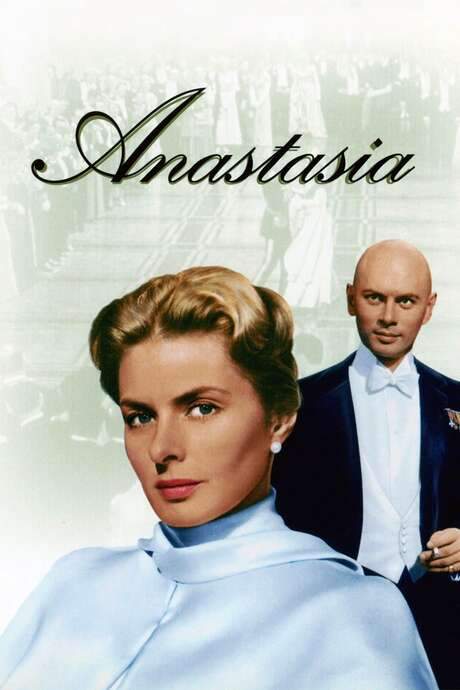
Anastasia (1956) movie poster

Plot Summary

Anastasia (1956) Plot Summary Explained

Release, runtime and language
1956 · 105 mins · English
Directed by
Anatole Litvak
Starring
Martita Hunt, Ingrid Bergman, Felix Aylmer, Yul Brynner, Peter Sallis, Helen Hayes

Russian exiles in Paris devise a scheme to steal ten million pounds from the Bank of England by training a impoverished, suicidal young woman to impersonate the lost Russian grand duchess Anastasia. As their instructor Bounin teaches her, he becomes convinced she truly is the heir, forcing the Empress to decide whether to recognize her claim.

On this page (7)
  1. 1 Where to watch
  2. 2 What happens: full plot
  3. 3 Plot questions answered
  4. 4 The book behind the movie
  5. 5 Movie threads
  6. 6 Movies like Anastasia
  7. 7 Every angle

Where to watch

Where to Watch Anastasia (1956)

Where can you watch Anastasia? Stream, rent or buy it in the US, including on Hoopla, Amazon Video and Apple TV Store: current JustWatch availability with up-to-date prices.

Streaming availability powered by JustWatch

Full plot summary · contains spoilers

What Happens in Anastasia: Full Plot Summary

The whole story of Anastasia (1956) explained, from the opening scene to the final frame: every key event, every twist and what it all adds up to. Read it as a quick recap before the sequel, to check a scene you missed, or to finally understand what really happened.

In 1928 Paris, Anna Koreff Ingrid Bergman, a frail woman who bears a striking resemblance to the legendary Anastasia, becomes the focal point of a carefully staged transformation. The plan is hatched by General Sergei Pavlovich Bounine, a former White Russian officer who now runs a successful Russian-themed nightclub. Though Anna initially resists, she is drawn into a web of identity, memory, and desire as Bounine schemes to present her as the long-lost grand duchess to secure a colossal fortune.

Bounine’s pitch is as much personal as it is financial. He has already funneled funds from stockholders who are eager to claim a £10 million fortune belonging to Czar Nicholas that sits with a British bank, and he insists he has found Anastasia—though privately he concedes the enterprise is a fraud. The stockholders’ eight-day deadline looms, threatening to collapse the whole scheme if he fails to produce the duchess.

To make the ruse convincing, Anna is coached to pass as Anastasia. As the work progresses, a strange bond grows between them, and the lines between performer and performed blur. Across a string of encounters with former courtiers and those who once knew the imperial family, Anna begins to move with a new confidence, her manner shifting from uncertain to dazzlingly poised. Some friends and rivals alike accept the transformation; others refuse to believe it, demanding the credibility of someone who could only be Anastasia.

With time running short, Bounine takes Anna on a nerve-wracking journey to Copenhagen to win over the highly skeptical Dowager Empress Maria Feodorovna, Anna’s supposed grandmother. The Dowager Empress, Helen Hayes, receives the pair with guarded reserve. Initially unmoved, she watches Anna closely, and a pivotal moment comes at a Tchaikovsky ballet, where Anna’s resemblance and demeanor begin to tilt her judgment. The Empress eventually makes an intimate, decisive appraisal, and then, in a private moment, she sees not a mere actress but the echo of her granddaughter. “You have come back, Anastasia!… but, oh please, if it should not be you, don’t ever tell me,” she whispers, though the truth of the matter remains unresolved.

A public confrontation follows. At a high-profile press conference presenting Anna as Anastasia, Mikhail Vlados, a former acquaintance who first met Anna in Bucharest, steps forward to challenge the ruse. Karl Stepanek as Vlados accuses Anna of continuing to use the name Anna Koreff, a claim she acknowledges with a tremor of uncertainty. She recalls being in a train explosion and the possibility of being wounded more than once, suggesting a life tangled in a series of revolutions and memories.

Bounine’s suspicions grow as Anna’s personal ambitions shift. Where she once only yearned to know who she was, she now contemplates marriage to Prince Paul and the accompanying wealth and status. He rebukes her for aiming at both the nobility and the fortune, hinting that her motive has evolved—perhaps beyond their original agreement.

The Danish capital hosts a grand ball where Anna’s engagement to Ivan Desny is to be announced. The Dowager Empress confides in Bounine in private, testing his emotions and the depth of his commitment. Anna and Bounine’s dynamic reaches a fever pitch as the Empress orchestrates a staged encounter in the Green Room, nudging them toward a moment of truth.

When the moment arrives to announce Anastasia, an attendant reveals that Anastasia is nowhere to be found. The Empress checks the Green Room, searches the shadows, and then makes a bold, final pronouncement to the court: “Wasn’t she?… I will say the play is over, go home” — a line that seals the ambiguity at the heart of the film.

Across these twists, the film leaves unsettled the essential question: is Anastasia real, or is she a perfect reflection conjured by memory, longing, and manipulation? The ending refuses a firm answer, inviting lingering doubt about identity, provenance, and the power of belief.

- As the cast deepens the mood and momentum, the crosscurrents of loyalty, love, and the lure of wealth ripple through every scene, from Paris salons to Copenhagen ballrooms. The tale moves with a patient, deliberate rhythm, letting the tension between memory and invention breathe as the characters wrestle with what it means to be seen, to be believed, and to belong.

- In the background, a chorus of figures—Chamberlain Felix Aylmer, Piotr Petrovin Sacha Pitoëff, Marusia Ina De La Haye, and others—shadow the main plot, offering cautionary perspectives on fame, fortune, and the price of a second chance. The film’s lush visuals and restrained drama sustain a tone of measured elegy, even as the question at its center remains unresolved.

Last updated: October 09, 2025 at 09:22

Was this helpful?

Plot questions answered

Anastasia Plot Explained: Your Questions Answered

The questions people ask most about Anastasia (1956): what happens in the confusing scenes, why the characters do what they do, the twists, hidden details and what the ending means. Each answer contains spoilers.

Q1

Why does General Bounin choose Anna Koreff for his scheme?

Bounin selects Anna because she bears a striking physical resemblance to the lost Grand Duchess Anastasia and suffers from amnesia, making her an ideal candidate to impersonate the dead royal. Her lack of memory about her past allows Bounin to shape her identity, and her desperate circumstances, she was suicidal and living in poverty, make her willing to participate in the deception. Bounin privately acknowledges the plan is a fraud but proceeds anyway to access the £10 million fortune belonging to the Czar.

  • anna koreff
  • general bounin
  • impostor
  • amnesia
  • royal heir
  • fortune
Q2

What convinces the Dowager Empress that Anna might really be Anastasia?

The Empress is initially skeptical and refuses to meet Anna, but her opinion shifts after seeing Anna at a Tchaikovsky ballet in Copenhagen. Anna's nickname "Malenkaya" (Little), which was Anastasia's childhood name, and her fear-induced cough trigger something in the Empress. In a private meeting, the Empress sees not just a resemblance but "the echo" of her granddaughter, leading her to whisper, "You have come back, Anastasia!" Though she maintains doubt, she chooses to believe, possibly out of desperate hope rather than certainty.

  • dowager empress maria feodorovna
  • grand duchess
  • belief
  • identity
  • royal family
Q3

Why does Anna want to marry Prince Paul when she's already set to inherit the fortune?

Anna's motivation evolves throughout the film. Initially, she only wanted to know who she truly was, but as she gains confidence and experiences life among the aristocracy, she desires the wealth, status, and legitimacy that come with marrying into nobility. Bounin criticizes her for wanting both the fortune and the title, suggesting her ambitions have surpassed their original agreement. This conflict highlights how the line between performance and genuine desire has blurred.

  • prince paul
  • marriage
  • ambition
  • wealth
  • nobility
  • status
Q4

What does the Empress mean when she announces "the play is over" at the end?

When the Empress declares "Wasn't she? I will say the play is over, go home," she is deliberately leaving the question of Anastasia's true identity unresolved. After Anna disappears from the ball, the Empress chooses ambiguity over confirmation. The statement suggests she recognizes the performance but may be protecting either Anna (if real) or the family's legacy (if fake). It reinforces the film's central theme that truth about identity may be unknowable or irrelevant.

Foreshadowing: The Empress earlier whispered to Anna, "if it should not be you, don't ever tell me," showing she preferred uncertainty to a potentially painful truth.

  • final scene
  • ambiguous ending
  • identity
  • truth
  • disappearance
Q5

Why does Bounin's attitude toward Anna change from skeptic to believer?

During the coaching process, Bounin develops genuine feelings for Anna, and the lines between instructor and subject blur. What began as a calculated scam becomes complicated by real emotion. He starts to believe Anna might truly be Anastasia because he wants to believe it, a transformation from cynical manipulator to hopeful lover. His private admission that the enterprise is a fraud early on contrasts sharply with his later emotional investment.

  • bounin
  • feelings
  • belief
  • deception
  • romance
  • coaching
Q6

What happens to Anna and Bounine at the end of the film?

Anna disappears from the ball before the scheduled announcement, and Bounin also vanishes. The Empress informs the court that both have fled, but their exact fate is never revealed. The film ends with them gone, leaving their future unknown, whether they escaped together, whether Anna's true identity was finally exposed, or whether the disappearance was orchestrated remains intentionally unclear.

  • disappearance
  • flight
  • ending
  • ball
  • copenhagen
Q7

Who is Mikhail Vlados and why does he challenge Anna's identity?

Mikhail Vlados is a former acquaintance who met Anna Koreff in Bucharest in 1920. At the press conference announcing Anna as Anastasia, he steps forward to expose the fraud, accusing her of still using the name Anna Koreff. Anna acknowledges this but then recalls being in a train explosion and suggests she may have been wounded more than once, hinting at a fragmented past involving multiple revolutions and traumas. This public challenge forces her claimed identity into direct scrutiny.

  • mikhail vlados
  • exposed
  • fraud
  • press conference
  • bucharest
Q8

Why does Anna Koreff attempt suicide at the beginning of the film?

Anna is introduced as a frail, mentally fragile woman living in poverty in Paris. When General Bounin pursues her, she flees and attempts to throw herself into the River Seine. This act of desperation suggests she was overwhelmed by her circumstances, her amnesia, poverty, and lack of identity made her feel she had nothing to live for. Her near-death experience becomes the entry point for Bounin's scheme.

  • suicide
  • paris
  • river seine
  • desperation
  • amnesia
Q9

What is the £10 million fortune and why does it matter so much?

The fortune belongs to Czar Nicholas and is held by a British bank. General Bounin has already raised funds from stockholders who believe he has found the heir to this fortune. There is an eight-day deadline to produce Anastasia, otherwise the scheme collapses and investors will demand their money back. This creates urgent pressure driving the entire plot forward.

  • ten million pounds
  • czar nichols
  • fortune
  • bank
  • investors
  • deadline
Q10

Why does Anna's cough matter to the Empress?

During the ballet in Copenhagen, Anna develops a fear-induced cough. The Empress notes this detail because the real Anastasia reportedly had a similar distinctive cough. Combined with Anna's physical resemblance and her childhood nickname "Malenkaya," the cough becomes one of several small details that begin to convince the Empress that Anna might be genuine, or at least enough to risk believing.

  • cough
  • childhood
  • malenkaya
  • recognition
  • detail
Q11

What role do figures like Chamberlain and Piotr Petrovin play in the story?

These secondary characters represent the broader ecosystem of Russian exiles in Paris. They serve as cautionary perspectives on fame, fortune, and the price of a second chance. They watch the main scheme unfold, offering commentary on the ethics of the deception and the desperation of displaced aristocrats seeking restoration of their lost world.

  • chamberlain
  • piotr petrovin
  • russian exiles
  • paris
  • supporting characters

Movie threads

More Movies Like Anastasia, by Mood & Story

Curated lists built around what makes Anastasia tick: the same mood, the same kind of story or the same emotional payoff. Each list explains why these movies belong together.

Movies about identity mysteries and imposters like Anastasia

Stories where a character's true identity is the central, high-stakes mystery. If you enjoyed the central mystery of Anastasia, you'll find similar suspense in these movies about identity puzzles and high-stakes impersonations. This collection features stories where characters, often haunted by trauma, are plunged into schemes or situations that force them to question their very sense of self, creating a compelling and often bittersweet drama.

  • suspenseful
  • psychological
  • uncertain
  • melancholic
  • romantic tension
  • high-stakes
  • Tone: bittersweet, suspenseful, melancholic
  • Pacing: steady, character-driven
Why these movies?

The story pattern: These stories typically follow a character, often vulnerable or with a fractured past, who is coached or coerced into impersonating someone else—a missing heir, a wealthy individual, or a person of status. The plot revolves around maintaining the deception under intense scrutiny, leading to a blurring of lines between performance and reality, and often concluding with an ambiguous resolution about the truth.

Why they belong together: Movies are grouped here because they share a core narrative engine driven by a identity crisis. They mix psychological drama with elements of suspense and often romance, exploring themes of memory, belonging, and the seductive power of a new life, all while maintaining a steady, character-driven pace and a emotionally resonant, bittersweet tone.

Melancholic dramas of exile and longing like Anastasia

Melancholic stories about displacement, lost worlds, and the search for belonging. Fans of the melancholic, nostalgic atmosphere in Anastasia will appreciate these movies that explore themes of exile, displacement, and the haunting pull of the past. These films often feature a steady pace and a bittersweet tone, creating a deeply poignant viewing experience centered on characters grappling with loss and searching for a sense of belonging.

  • melancholic
  • nostalgic
  • poignant
  • elegiac
  • uncertain
  • romantic
  • Tone: melancholic, poignant, bittersweet
  • Pacing: steady, measured
Why these movies?

The story pattern: The narrative pattern involves characters grappling with the aftermath of a life-altering event—often war, revolution, or personal tragedy—that has severed them from their previous existence. The story unfolds as a slow reckoning with this loss, exploring how the past informs the present through memories, encounters, and the difficult, often ambiguous, process of building a new life.

Why they belong together: These films are united by their dominant mood of melancholic reflection and their central theme of exile—both physical and emotional. They share a similar emotional texture, blending sadness with moments of hope or romance, and are characterized by a measured pacing that allows the weight of the characters' circumstances to fully resonate with the viewer.

If you liked this

Movies Like Anastasia

Similar movies to Anastasia: the same genre, themes or kind of story. Each one comes with its own plot summary, timeline and ending explained.

Browse all movie summaries

Every angle

Anastasia (1956) Explained: Plot, Timeline & Characters

Everything about Anastasia in one place: what happens in the plot summary, the timeline in chronological order, the characters and meaning and a spoiler-free summary. What's After the Movie adds the cast, box office and post-credit scenes.

Coming soon on iOS and Android

The Plot Explained Movie Summary App

Plot summaries, endings explained and timelines on your phone. Catch up on any movie in minutes, save your favorites and never miss a twist again.

Be the first to know when we launch. Your email stays private, always.

Learn more about the app