Plot Explained Spoilers guaranteed!
Plot Explained

Browse by genre

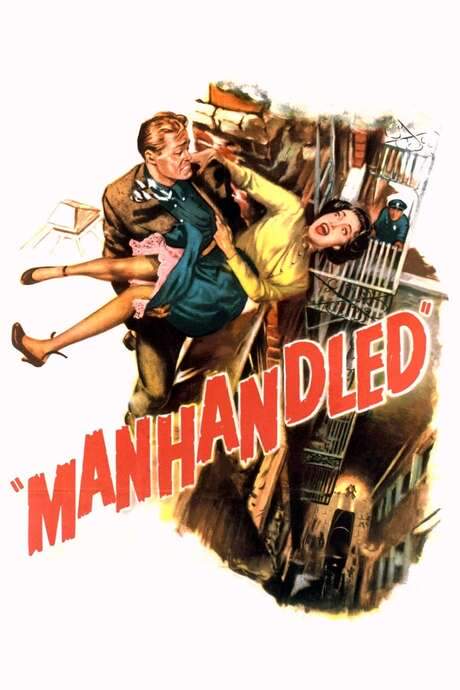
Manhandled (1949) movie poster

Plot Summary

Manhandled (1949) Plot Summary Explained

Release, runtime and language
1949 · 97 mins · English
Loading streaming availability…
Directed by
Lewis R. Foster
Starring
Alan Napier, Irving Bacon, Sterling Hayden, Ian Wolfe, Dorothy Lamour, Maidie Norman

Merle Kramer, a stenographer for a psychiatrist, dates ex‑cop‑turned‑private‑eye Karl Benson. She notes a patient—an author haunted by recurring dreams of murdering his jeweled‑laden wife. When that wife is found dead exactly as in the dream, the husband becomes the prime suspect. Police and insurance investigator Joe Cooper delve into the case, uncovering a tangled web of deception that shows many involved, including Merle, are not who they appear to be.

On this page (6)
  1. 1 Where to watch
  2. 2 What happens: full plot
  3. 3 Plot questions answered
  4. 4 Movie threads
  5. 5 Movies like Manhandled
  6. 6 Every angle
Loading streaming availability…

Full plot summary · contains spoilers

What Happens in Manhandled: Full Plot Summary

The whole story of Manhandled (1949) explained, from the opening scene to the final frame: every key event, every twist and what it all adds up to. Read it as a quick recap before the sequel, to check a scene you missed, or to finally understand what really happened.

Struggling writer Alton Bennet sits with psychiatrist Dr. Redman, Harold Vermilyea, and reveals a troubling pattern: he is tormented by nightmares in which he murders his wealthy wife. His fear intensifies as he describes Ruth Bennet Irene Hervey, the woman he married, who owns very valuable jewels and seems to be the center of a dangerous secret.

Merl Kramer, Bennet's private secretary, Dorothy Lamour casually mentions Bennet's problems to her boyfriend, private eye Karl Benson. She also notes that Ruth Bennet is due to drop into Dr. Redman's office that evening for a session concerning her husband. Seizing an opportunity, Benson steals Merl's keys and makes duplicates, then waits outside Redman's office to learn Ruth's address from clues posted in the car. He later visits his pawnbroker contact, Charlie, and shows him the jewels, hoping for a quick valuation. The pawnbroker, having overheard police radio chatter, warns that there’s a “murder rap hanging over this junk” and pays only a small amount, advising Benson to dispose of the rest. Benson spies a chance to secure the rest later and hides the jewels in the water cooler of his office.

Ruth Bennet is found murdered, precisely in the manner Bennet has been dreaming. The case is assigned to Detective Lt. Bill Dawson and Insurance Investigator Joe Cooper, who begin interviewing Redman while searching for the missing transcripts of Bennet’s nightmare conversations. Redman reveals a bump on his head from a park fall, suggesting he might be hiding something. The detectives grow suspicious when they learn that Bennet’s transcript records have vanished, and Merl’s forged references for her job with Redman come under scrutiny.

Benson works to tilt suspicion toward Merl, showing Dawson and Cooper her bankbook and insinuating that the recent large deposit comes from the Bennet affair. He then re-enters Merl’s life, intending to plant evidence and implicate her for the crime. Redman, realizing Benson has the jewels, confronts him; Benson had previously knocked Redman unconscious, causing the head injury and stealing the gems.

A tense arrangement unfolds: Benson agrees to locate the jewels and hand them over to Dawson and Cooper, in exchange for sharing any insurance payout. He heads to Merl’s apartment and then to the station, where he tries to influence the investigation. In a dramatic turn, Redman appears at the scene, demanding the items, and Benson hands them over. But once Redman leaves, Benson uses Redman’s own car to kill him, stoking the gears of a deeper conspiracy.

Back at Merl’s place, Benson hides the jewels in Merl’s chair and phones Dawson with a confident claim that he has found the loot. When Merl returns, Benson reveals that she is going to pay for the murder she’s accused of committing. A struggle ensues; Benson knocks Merl out and transports her to the roof in a bid to stage a suicide. The arriving police, alerted by Cooper and Dawson, intervene just in time to save Merl from a fatal fall. In the aftermath, Charlie is arrested for possession of the stolen property, and the web of deception gradually unravels as the case closes with Merl cleared and the true culprits exposed.
Last updated: October 07, 2025 at 09:53

Was this helpful?

Plot questions answered

Manhandled Plot Explained: Your Questions Answered

The questions people ask most about Manhandled (1949): what happens in the confusing scenes, why the characters do what they do, the twists, hidden details and what the ending means. Each answer contains spoilers.

Q1

Who actually killed Ruth Bennet?

Ruth Bennet was murdered by Dr. Redman, her psychiatrist. After knocking himself unconscious in a fall, he went to the Bennet residence and killed Ruth to obtain her valuable jewels, making it appear to match the nightmares that her husband Alton had been describing in therapy. The murder was actually committed by Redman, not Alton Bennet as the police initially suspected.

Foreshadowing: Bennet's nightmares of killing his wife, which tormented him throughout the film, were actually prophetic visions of someone else's crime, not his own subconscious guilt.

  • ruth bennet murder
  • dr redman killer
  • who killed ruth
Q2

Why does Karl Benson frame Merl for murder?

Karl Benson frames Merl because he is the actual thief who stole the jewels from Ruth Bennet after Dr. Redman committed the murder. To divert suspicion away from himself and recover the gems, Benson plants evidence, including one of Ruth's rings and a suspicious bankbook showing a large deposit, to make Merl appear guilty. He wants the police to arrest Merl so he can retrieve the jewels and claim the insurance payout.

Foreshadowing: Benson's early scheme to obtain duplicate keys and track Ruth's address shows his willingness to manipulate others for financial gain.

  • karl benson frame merl
  • why frame secretary
  • jewelry theft frame
Q3

How did Karl Benson obtain the jewels?

Karl Benson stole the jewels after Dr. Redman committed murder. When Benson saw Redman leave the Bennet apartment with the gems, he knocked Redman unconscious and took the jewelry for himself. He hid them in his office water cooler, then later moved them to Merl's apartment to frame her for the crime.

Foreshadowing: Benson's earlier surveillance outside Dr. Redman's office and his attempt to get the jewels valued by pawnbroker Charlie reveal his criminal intent from the start.

  • karl benson jewels
  • how stolen gems
  • jewel theft manhandled
Q4

Why does the police suspect Merl of the murder?

Merl becomes a suspect because Karl Benson deliberately frames her. He plants one of Ruth Bennet's rings under her sofa cushion and shows police her bankbook containing a large deposit (which actually came from his own payments to her). These false clues lead Detective Dawson and Investigator Cooper to believe Merl was involved in the jewel theft and murder.

Foreshadowing: Benson's early manipulation of Merl's financial records and his offer to help her 'solve' the case foreshadow his scheme to turn her into a scapegoat.

  • merl kramer suspect
  • police suspicion
  • framed for murder
Q5

What happens to Dr. Redman in the end?

Dr. Redman is killed by Karl Benson. After the two men make a deal to share the insurance payout, Benson uses Redman's own car to run him down, eliminating him to prevent exposure of his crimes. Redman's death appears to be a payoff gone wrong, but his murder ultimately helps unravel the conspiracy when police investigate his death.

Foreshadowing: The bump on Redman's head from the park fall, revealed early in the investigation, was actually caused by Benson when he knocked Redman unconscious to steal the jewels.

  • dr redman death
  • redman killed
  • psychiatrist murder manhandled
Q6

Why does Benson try to kill Merl at the end?

Benson attempts to kill Merl to complete his frame-up and silence her. When Merl returns home and discovers the hidden jewels, Benson knows she can expose him. He knocks her unconscious, takes her to the rooftop, and stages it as a suicide to cover up both the framing and his crimes. The police arrive in time to save her before she falls.

Foreshadowing: Benson's earlier threat that Merl will 'pay for the murder she's accused of' hints at his willingness to eliminate her to protect his scheme.

  • benson kills merl
  • attempted murder
  • rooftop scene
Q7

What is the connection between Bennet's nightmares and Ruth's murder?

Alton Bennet's nightmares about killing his wife turned out to be psychic premonitions of the actual murder, not hidden desires. The nightmares precisely predicted how and when Ruth would die, including her valuable jewelry. This eerie coincidence initially made Bennet the prime suspect, though he was actually innocent of the crime.

Foreshadowing: The film establishes Bennet's genuine torment over these dreams early on, showing his horror at the visions rather than any guilty knowledge.

  • alton bennet nightmares
  • prophetic dreams
  • murder prediction
Q8

How do the police uncover the truth about the murder?

The police piece together the真相 through multiple leads: they investigate the missing transcripts from Dr. Redman's office, discover Merl's forged job references, and track the stolen jewels to Charlie the pawnbroker. When Benson tries to frame Merl and then kills Redman, his scheme becomes unstable. The police arrest Charlie for possession of stolen property and interrogate Benson, eventually exposing the entire conspiracy.

Foreshadowing: Redman's head injury and the vanished transcripts early in the investigation hint that something was being hidden by someone close to the case.

  • police investigation
  • case solved
  • truth revealed
Q9

Why does Karl Benson become a suspect in the investigation?

Karl Benson becomes suspect because his connection to Merl and his knowledge of the Bennet case raise police suspicion. When Merl reveals she got her job through Benson, investigators realize he had the opportunity and motive to orchestrate the jewel theft. His attempts to manipulate the investigation and redirect suspicion toward Merl ultimately make him the prime focus.

Foreshadowing: Benson's theft of Merl's keys and his surveillance of Ruth's address establish his early involvement in the criminal plot.

  • karl benson suspect
  • private eye crime
  • benenson investigation
Q10

What role does the pawnbroker Charlie play in the story?

Charlie is Karl Benson's fence who valuations the stolen jewels early in the film. When he overhears police radio chatter about a murder connected to the jewelry, he warns Benson and pays only a small amount, advising him to dispose of the rest. At the film's end, Charlie is arrested for possession of the stolen property, providing a crucial link in exposing the criminal chain.

Foreshadowing: Charlie's warning about the 'murder rap' on the jewels foreshadows the deadly consequences of the theft scheme.

  • charlie pawnbroker
  • stolen jewels
  • fence manhandled

Movie threads

More Movies Like Manhandled, by Mood & Story

Curated lists built around what makes Manhandled tick: the same mood, the same kind of story or the same emotional payoff. Each list explains why these movies belong together.

Thrillers of Psychological Framing like in Manhandled

Stories where a character's nightmares or delusions become the blueprint for a real crime. If you enjoyed the chilling premise of 'Manhandled', where a man's nightmares are used to frame him for murder, you'll find similar tension in these movies. This collection features stories of psychological manipulation, characters being framed for crimes they didn't commit, and investigations that unravel complex deceptions. Discover films that master the art of turning inner turmoil into external, life-threatening danger.

  • sinister
  • paranoid
  • psychological
  • investigative
  • high-stakes
  • deceptive
  • Tone: tense, paranoid, sinister
  • Pacing: fast, investigative
Why these movies?

The story pattern: The narrative typically begins with a character experiencing psychological distress, such as nightmares or hallucinations, which is then exploited by a cunning antagonist. A real crime occurs, meticulously staged to mimic the protagonist's inner turmoil, making them the prime suspect. The story unfolds as a race against time to uncover the truth and expose the mastermind behind the elaborate frame-up, often involving shocking betrayals.

Why they belong together: These films are grouped by their shared core plot device: the weaponization of psychology to commit and conceal a crime. They create a unique form of suspense where the protagonist must fight not only external forces but also the damning evidence of their own mind, leading to a tense, intellectually stimulating, and often paranoid viewing experience.

Cynical Crime Noirs with Fast Pacing like in Manhandled

Fast-paced crime stories where no one can be trusted and deception runs deep. Fans of the deceptive, fast-paced world of 'Manhandled' will appreciate this selection of cynical film noirs. These movies share a tense atmosphere, a web of betrayals, and a narrative that moves quickly from one dangerous revelation to the next. Explore similar stories of crime investigations, flawed characters, and a pervasive sense that everyone has a hidden agenda, perfect for viewers who enjoy morally complex thrillers.

  • cynical
  • suspenseful
  • double-crossing
  • noir
  • tense
  • sinister
  • Tone: tense, cynical, bleak
  • Pacing: fast, relentless
Why these movies?

The story pattern: Stories in this thread often follow an investigative structure, pulling an ordinary person or a jaded detective into a complex criminal conspiracy. The plot advances quickly through a series of confrontations and revelations, exposing layers of deception among a cast of untrustworthy characters. The journey is emotionally heavy, culminating in a resolution that may stop the immediate threat but leaves a lasting sense of cynicism about the world.

Why they belong together: These movies are united by their distinct noir vibe—a combination of a tense, fast-paced narrative, a high-stakes cynical outlook, and a heavy emotional weight driven by betrayal. The shared experience is one of being plunged into a dangerous game where the rules are unclear and the players are all potential antagonists.

If you liked this

Movies Like Manhandled

Similar movies to Manhandled: the same genre, themes or kind of story. Each one comes with its own plot summary, timeline and ending explained.

Browse all movie summaries

Every angle

Manhandled (1949) Explained: Plot, Timeline & Characters

Everything about Manhandled in one place: what happens in the plot summary, the timeline in chronological order, the characters and meaning and a spoiler-free summary. What's After the Movie adds the cast, box office and post-credit scenes.

Coming soon on iOS and Android

The Plot Explained Movie Summary App

Plot summaries, endings explained and timelines on your phone. Catch up on any movie in minutes, save your favorites and never miss a twist again.

Be the first to know when we launch. Your email stays private, always.

Learn more about the app