Plot Explained Spoilers guaranteed!
Plot Explained

Browse by genre

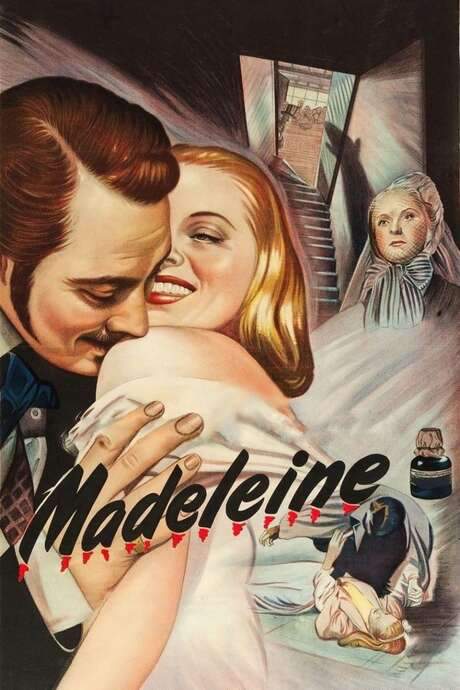
Madeleine (1950) movie poster

Plot Summary

Madeleine (1950) Plot Summary Explained

Release, runtime and language
1950 · 114 mins · English
Loading streaming availability…
Directed by
David Lean
Starring
John Laurie, Elizabeth Sellars, Leslie Banks, Patricia Raine, André Morell, Ivan Desny

Virile, violent facts behind the most famous jury verdict in history are revealed as a middle‑class family struggles to understand why their daughter postpones marriage to a respectable suitor. Unaware of her decades‑long affair with a Frenchman, they are blindsided by the hidden passion that drives the case.

On this page (6)
  1. 1 Where to watch
  2. 2 What happens: full plot
  3. 3 Plot questions answered
  4. 4 Movie threads
  5. 5 Movies like Madeleine
  6. 6 Every angle
Loading streaming availability…

Full plot summary · contains spoilers

What Happens in Madeleine: Full Plot Summary

The whole story of Madeleine (1950) explained, from the opening scene to the final frame: every key event, every twist and what it all adds up to. Read it as a quick recap before the sequel, to check a scene you missed, or to finally understand what really happened.

The film opens in a contemporary Glasgow setting at 7 Blythswood Square, then shifts back to the early 19th century to follow Madeleine Smith, a young woman from an upper-middle-class family, and her relationship with Emile L'Angelier, a French draper's assistant who becomes her lover. The story unravels the quiet drama of a romance that must navigate strict social expectations and hidden desires.

In the new family home, the eldest daughter makes a bold choice: she claims the basement bedroom so she can access the servants' entrance and entertain her lover without her family’s knowledge, planting the seeds for a tension-filled secret. The romance deepens as the couple become secretly engaged, yet L'Angelier presses Madeleine to reveal the relationship to her father so they can marry openly. Madeleine, frightened by her authoritarian father, wrestles with the idea of losing him and the life she’s been groomed to lead. Eventually, she visits L'Angelier in his room and says she will elope rather than face telling her father, but he makes clear he could never marry her this way. He loves her, but he also wants to restore his own standing in society, and she realizes the relationship has become entangled with more than love alone.

During this period Madeleine’s father pushes for a different match, encouraging her to accept the attentions of a wealthy society gentleman, William Minnoch. The plan is to secure a respectable future, and Madeleine agrees to consider Minnoch’s proposal, even as she continues to see L'Angelier. L'Angelier, not content to be pushed aside, shows up threatening to expose the compromising letters in his possession unless she remains in contact with him. Madeleine agrees to continue seeing him, keeping her engagement to Minnoch under wraps.

Weeks after these tensions unfold, L'Angelier falls gravely ill, recovers, then relapses and dies of arsenic poisoning. A friend points the finger at Madeleine, and authorities discover that she had arsenic in her possession at the time of L'Angelier’s death. The remainder of the film follows the ensuing court case, culminating in the unique Scottish verdict of “not proven”, which releases Madeleine from custody as neither clearly guilty nor clearly innocent.

The drama unfolds with careful attention to character, motive, and the social pressures of Victorian Glasgow, offering a measured look at how appearances often clash with intimate truth. The film ultimately leaves viewers contemplating the stakes of reputation, desire, and the fraught path to justice in a society that guards its proprieties as fiercely as its secrets.
Last updated: October 09, 2025 at 09:24

Was this helpful?

Plot questions answered

Madeleine Plot Explained: Your Questions Answered

The questions people ask most about Madeleine (1950): what happens in the confusing scenes, why the characters do what they do, the twists, hidden details and what the ending means. Each answer contains spoilers.

Q1

Why did Madeleine keep her relationship with Emile L'Angelier secret?

Madeleine hid the relationship because Emile was a French draper's assistant, a social mismatch that would scandalize her respectable upper-middle-class family in Victorian Glasgow. She feared her authoritarian father would reject the match entirely, and exposing the affair could destroy both her reputation and her place in the family.

Foreshadowing: Earlier scenes show Madeleine strategically claiming the basement bedroom to access the servants' entrance, establishing her willingness to deceive her family to preserve the secret.

  • emile l angelier
  • secret relationship
  • victorian glasgow
  • class differences
  • family honour
Q2

Why did Madeleine break up with Emile after initially agreeing to elope?

Madeleine agreed to elope, but when Emile revealed he could never marry her by running away, he wanted a respectable marriage that would restore his standing in society, she realized the relationship was about status as much as love. She ended things and demanded her letters back, understanding he would never accept her without social legitimacy.

Foreshadowing: The earlier pressure from L'Angelier for her to reveal the relationship to her father showed his desire for proper recognition, not a clandestine marriage.

  • elope
  • emile l angelier
  • breakup
  • marriage
  • social status
Q3

Why did Madeleine agree to marry William Minnoch?

Madeleine agreed to consider Minnoch's proposal primarily to satisfy her family's expectations and secure her future in respectable society. Her father actively pushed the match as a way to elevate the family's status, and accepting Minnoch offered Madeleine protection from the social consequences of her secret affair.

Foreshadowing: The family's pressure toward a respectable match was established early when Madeleine's father encouraged her to accept Minnoch's attentions while she was still secretly engaged to Emile.

  • william minnoch
  • arranged marriage
  • family pressure
  • victorian marriage
  • social climbing
Q4

What was Emile L'Angelier threatening to do when he returned?

L'Angelier returned to threaten Madeleine, demanding she continue seeing him or he would expose her compromising letters to her father. The letters from their secret engagement could ruin her reputation and prevent her marriage to Minnoch, giving him leverage to coerce her into compliance.

Foreshadowing: Earlier tension points showed L'Angelier pressing Madeleine to reveal the relationship publicly, establishing his willingness to use the letters as leverage.

  • blackmail
  • compromise letters
  • threat
  • emile l angelier
  • exposure
Q5

How did Emile L'Angelier die?

Emile L'Angelier died from arsenic poisoning. He fell seriously ill, briefly recovered, then suffered a fatal relapse. Investigators confirmed arsenic as the cause of death, and authorities later discovered Madeleine had possessed arsenic at the time of his death.

Foreshadowing: The timeline shows Emile falling ill, recovering, then relapsing, a pattern consistent with poisoning rather than natural illness.

  • arsenic poisoning
  • death
  • emile l angelier
  • murder
  • poison
Q6

Why was Madeleine suspected of poisoning Emile?

Madeleine became the prime suspect because she had both motive and means: she wanted to escape L'Angelier's blackmail to marry Minnoch, and investigators found she had purchased arsenic around the time of his death. A friend directly accused her, and the circumstantial evidence pointed to her as the most likely perpetrator.

Foreshadowing: The buildup of tension, from the breakup to the blackmail to her engagement to Minnoch, created a clear motive timeline that investigators followed.

  • arsenic
  • suspicion
  • motive
  • evidence
  • trial
Q7

What does the 'not proven' verdict mean in Scottish law?

The 'not proven' verdict is a unique Scottish verdict that means the jury believes the accused is probably guilty but is not convinced beyond reasonable doubt. It results in acquittal, the defendant goes free, but carries a social stigma of unresolved suspicion, leaving the question of guilt legally unanswered.

Foreshadowing: The trial's presentation of circumstantial evidence and competing narratives built toward an ambiguous resolution rather than clear innocence.

  • scottish law
  • not proven verdict
  • verdict
  • acquittal
  • legal system
Q8

Why was Madeleine released despite the suspicion around her?

Madeleine was released because the Scottish 'not proven' verdict functions as an acquittal, even when doubt remains. The prosecution failed to prove her guilt beyond reasonable doubt, so she walked free, but the verdict left the question of whether she actually poisoned L'Angelier unresolved in the eyes of the law.

Foreshadowing: The trial presented evidence and letters but never reached definitive proof of murder, setting up the ambiguous legal outcome.

  • release
  • acquittal
  • trial outcome
  • freedom
  • not proven
Q9

What made the relationship between Madeleine and Emile so complicated?

Their romance was entangled with class differences, hidden desires, and competing ambitions. Madeleine craved passion but feared her father's authority; Emile wanted both love and social respectability. Their secret engagement forced them into deception, and when their goals diverged, the relationship became a source of blackmail rather than affection.

Foreshadowing: Early scenes established the clandestine nature of their meetings and the pressure Emile placed on Madeleine to make the relationship legitimate.

  • relationship
  • dynamic
  • love
  • class
  • desire
Q10

How did Victorian society contribute to the events of the story?

Victorian Glasgow's rigid class system and emphasis on propriety created the conditions for tragedy: Madeleine hid her relationship because revealing it would shame her family, Emile used the social stakes to pressure her, and the pressure to marry 'up' to Minnoch gave her a motive to silence her blackmailer. The same society that judged her also determined her choices.

Foreshadowing: The constant tension between public appearances and private desires runs throughout the film, from Madeleine's secret bedroom to the courtroom scrutiny.

  • victorian society
  • class
  • propriety
  • social expectations
  • glasgow

Movie threads

More Movies Like Madeleine, by Mood & Story

Curated lists built around what makes Madeleine tick: the same mood, the same kind of story or the same emotional payoff. Each list explains why these movies belong together.

Dramas of Forbidden Love and Social Pressure like in Madeleine

Stories where forbidden desires clash with rigid social expectations. If you liked the tension of hidden affairs and high-society scandal in Madeleine, discover more movies that explore forbidden love, the weight of family expectations, and the immense pressure to protect a public reputation at all costs.

  • secretive
  • tense
  • dramatic
  • oppressive
  • melancholic
  • suspenseful
  • Tone: tense, dramatic, melancholic
  • Pacing: steady, deliberate
Why these movies?

The story pattern: These narratives typically follow a protagonist trapped between personal desire and societal duty. A secret, often a forbidden romance, creates a dual life that becomes increasingly difficult to maintain. The plot builds as the secret risks exposure, leading to blackmail, emotional turmoil, and potential public ruin or tragedy.

Why they belong together: They are grouped by their shared focus on the conflict between private passion and public propriety, creating a consistently tense and dramatic atmosphere. The viewing experience is defined by suspense, moral dilemmas, and a deep exploration of the constraints imposed by social class.

Mysterious Courtroom Dramas with Ambiguous Endings like in Madeleine

Courtroom stories where the verdict leaves more questions than answers. For viewers fascinated by the ambiguous trial in Madeleine, this collection features movies where courtroom proceedings reveal complex characters and moral gray areas, often concluding with an unresolved verdict that prompts deep reflection on guilt and justice.

  • suspenseful
  • thought-provoking
  • tense
  • melancholic
  • dramatic
  • ambiguous
  • Tone: tense, thought-provoking, heavy
  • Pacing: steady, methodical
Why these movies?

The story pattern: The narrative often unfolds through flashbacks and courtroom testimony, presenting conflicting perspectives on a central crime. The journey is not toward a clear resolution but toward a deeper understanding of human complexity. The ending typically leaves the audience to ponder the true nature of guilt, innocence, and justice.

Why they belong together: They share a structural focus on a trial as the narrative engine, but more importantly, they are united by a thematic commitment to moral ambiguity. The experience is intellectually engaging and emotionally heavy, prioritizing thought-provoking uncertainty over tidy conclusions.

If you liked this

Movies Like Madeleine

Similar movies to Madeleine: the same genre, themes or kind of story. Each one comes with its own plot summary, timeline and ending explained.

Browse all movie summaries

Every angle

Madeleine (1950) Explained: Plot, Timeline & Characters

Everything about Madeleine in one place: what happens in the plot summary, the timeline in chronological order, the characters and meaning and a spoiler-free summary. What's After the Movie adds the cast, box office and post-credit scenes.

Coming soon on iOS and Android

The Plot Explained Movie Summary App

Plot summaries, endings explained and timelines on your phone. Catch up on any movie in minutes, save your favorites and never miss a twist again.

Be the first to know when we launch. Your email stays private, always.

Learn more about the app