Plot Explained Spoilers guaranteed!
Plot Explained

Browse by genre

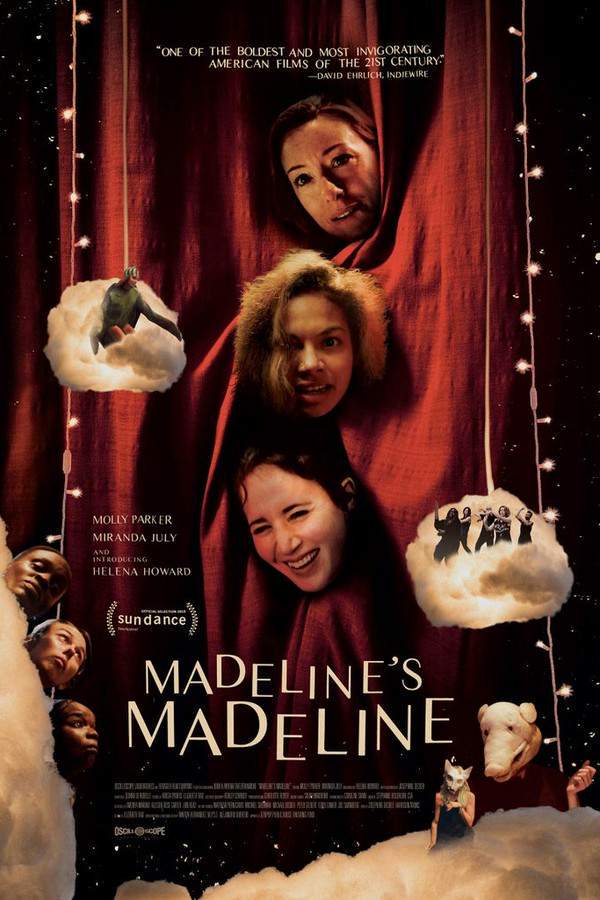
Madeline's Madeline (2018) movie poster

Plot Summary

Madeline's Madeline (2018) Plot Summary & Ending Explained

Release, runtime and language
2018 · 93 min · English
Echo score 77
JustWatch #23,526 1
Directed by
Josephine Decker
Starring
Sunita Mani, Myra Lucretia Taylor, Molly Parker, Curtiss Cook, Blake Baumgartner, Dana Eskelson

A young actress named Madeline is part of a renowned physical theater company where her emotional struggles are explored and utilized by the director. As the group delves deeper into their art, Madeline's mother's history emerges, complicating their creative process. This entanglement sparks a power struggle for artistic control, profoundly impacting the lives of Madeline, her mother, and the director, and leading them on a turbulent journey of self-discovery and fractured relationships.

On this page (7)
  1. 1 Where to watch
  2. 2 What happens: full plot
  3. 3 Plot questions answered
  4. 4 How it ends
  5. 5 Movie threads
  6. 6 Movies like Madeline's Madeline
  7. 7 Every angle

Where to watch

Where to Watch Madeline's Madeline (2018)

Where can you watch Madeline's Madeline? Stream, rent or buy it in the US, including on Philo, Kanopy and Plex: current JustWatch availability with up-to-date prices.

Streaming availability powered by JustWatch

Full plot summary · contains spoilers

What Happens in Madeline's Madeline: Full Plot Summary

The whole story of Madeline's Madeline (2018) explained, from the opening scene to the final frame: every key event, every twist and what it all adds up to. Read it as a quick recap before the sequel, to check a scene you missed, or to finally understand what really happened.

Madeline, a solitary teenager, finds herself immersed in a dynamic world of professional acting as part of an experimental theater troupe staging an improv performance based on The Three Little Pigs. She relishes the camaraderie with her fellow actors and their director, Evangeline, yet she dreads returning home to her mother, Regina, who often fails to grasp Madeline's complexities and initiates arguments. One fateful day during rehearsal, Madeline confides in Evangeline about a troubling dream where she imagines placing a hot iron on her mother. Disturbed yet intrigued by this disturbing imagery, Evangeline suggests they explore the dream through an improv exercise. The emotional weight of blending her life and her art overwhelms Madeline, prompting her to leave the theater, leading to a frantic search by Regina.

Upon reuniting with her daughter, Regina learns about Madeline's expired prescriptions for a mental health condition, intensifying her struggle to secure a swift refill. As the creative process unfolds, Evangeline shifts her attention towards Madeline’s experiences, steering the artistic focus of their performance towards her life. During a promotional photoshoot, she invites Regina to join Madeline, further entrenching their familial ties in the project. When Madeline is invited to Evangeline’s birthday celebration post-rehearsal, she showcases her acting prowess amongst bewildered guests, even flirtatiously engaging with Evangeline's husband.

Striking a chord of vulnerability, Madeline and Evangeline discuss their personal insecurities, leading Madeline to express a desire to step back from acting. Evangeline supports this choice, fostering a sense of relief in Madeline as she contemplates her newfound creative freedom. However, this reprieve feels short-lived when Evangeline unexpectedly visits Madeline’s home. Over shared glasses of wine, Evangeline encourages Regina to explore acting, suggesting she attend rehearsal the next day.

During rehearsal, tensions rise as Evangeline orchestrates a workshop where the cast is instructed to embody Regina, unknowingly igniting deep-seated emotions in Madeline. Her portrayal strikes a nerve, prompting Regina to exit the rehearsal in tears. Unfazed, Evangeline revels in the authenticity of the emotions, pushing for a reenactment of the scene while stepping outside for a crucial phone call. In her absence, the cast grows disenchanted by Evangeline’s perceived manipulation of Madeline’s feelings and bond together to stage a provocative performance designed to confront her.

At first, Evangeline resists the shoving and prodding, but ultimately, she becomes integrated into this unconventional performance. The confrontation leads to an impromptu expression of freedom as the entire troupe spills into the street, dancing joyfully in the sunlight, while Madeline strides away in the opposite direction, navigating the complexities of her life.
Last updated: November 15, 2024 at 19:46

Was this helpful?

Plot questions answered

Madeline's Madeline Plot Explained: Your Questions Answered

The questions people ask most about Madeline's Madeline (2018): what happens in the confusing scenes, why the characters do what they do, the twists, hidden details and what the ending means. Each answer contains spoilers.

Q1

Why does Madeline dream about placing a hot iron on her mother?

The dream reflects Madeline's suppressed anger and resentment toward her mother Regina, who constantly fails to understand her emotional needs and triggers arguments. This disturbing imagery reveals the depth of tension in their relationship, showing Madeline's unconscious desire to hurt the person who causes her emotional pain. Evangeline recognizes this raw emotion as powerful material for authentic performance.

Foreshadowing: The tension between Madeline and Regina is established early in the film during home scenes where arguments erupt over trivial matters.

  • madeline dream
  • hot iron
  • mother daughter tension
  • subconscious anger
  • psychological trauma
Q2

How does Evangeline manipulate Madeline's emotions for the play?

Evangeline exploits Madeline's personal struggles by incorporating her disturbing dream and family conflicts directly into the improvisation and final performance. She encourages Madeline to share vulnerable details, then uses them as artistic material without proper boundaries. This manipulation becomes most apparent when Evangeline brings Regina into rehearsals, using their fraught relationship as dramatic content.

Foreshadowing: Evangeline's initial interest in Madeline's dream signals her willingness to use personal trauma as art.

  • evangeline
  • manipulation
  • artistic exploitation
  • boundaries
  • director
Q3

Why does Evangeline bring Regina into the theater production?

Evangeline invites Regina to join the promotional photoshoot and eventually attend rehearsal to deepen the artistic exploration of Madeline's life. By incorporating the mother directly into the performance, Evangeline believes this will create more authentic emotional content. This decision blurs the boundaries between art and reality, ultimately causing emotional harm when the cast is asked to embody Regina.

Foreshadowing: The shift in the play's focus toward Madeline's personal experiences sets the stage for Regina's involvement.

  • regina
  • evangeline
  • photoshoot
  • rehearsal
  • family involvement
Q4

What happens when the cast portrays Regina in the workshop?

During the emotional workshop, Evangeline instructs the cast to embody Regina, forcing Madeline to watch strangers reenact her mother's behavior. This triggers intense emotional responses, Madeline's portrayal strikes a nerve, and Regina herself leaves the rehearsal in tears after witnessing how she is perceived. Evangeline treats this as successful 'authentic' emotion rather than recognizing the harm caused.

Foreshadowing: The tension between Madeline and Regina has been building throughout the film, leading to this emotional explosion.

  • workshop
  • regina
  • emotional manipulation
  • cast
  • tears
Q5

Why do the other actors confront Evangeline?

The cast becomes disillusioned with Evangeline's methods of manipulating Madeline's feelings and personal trauma for artistic purposes. When she leaves the room to take a phone call, they stage a provocative performance designed to confront her about crossing ethical boundaries. They push back against her exploitation of their emotions and her disregard for their well-being.

Foreshadowing: The cast's growing discomfort with Evangeline's direction has been building as her methods become increasingly invasive.

  • cast confrontation
  • rebellion
  • artistic ethics
  • manipulation ending
Q6

What does Madeline walking away at the end represent?

Madeline's decision to walk away while the others dance in the street represents her rejection of the theatrical world that exploited her personal pain. Unlike the cast who found release in their rebellious performance, Madeline realizes she cannot continue participating in an environment that weaponizes her trauma. Her solitary walk signifies her need to separate from both her mother and the director to find her own identity.

Foreshadowing: Earlier, Madeline expresses desire to step back from acting, showing her internal conflict about the theater world.

  • ending
  • walking away
  • solitude
  • self-discovery
  • independence
Q7

Why does Evangeline encourage Regina to try acting?

When Evangeline visits Madeline's home unexpectedly, she encourages Regina to explore acting, suggesting she attend rehearsal the next day. This appears to be another attempt to blur boundaries and extract more 'authentic' emotional material from the family dynamic. It also represents Evangeline's pattern of drawing vulnerable people into her artistic experiments without considering the consequences.

Foreshadowing: This moment follows Evangeline's pattern of using personal relationships as artistic material.

  • regina acting
  • wine
  • home visit
  • boundary crossing
Q8

Why is Madeline's expired prescription significant?

After Madeline leaves the theater overwhelmed, Regina discovers her daughter has expired prescriptions for a mental health condition. This reveals that Madeline has been struggling with her mental health outside what her mother knows, adding complexity to their relationship. Regina's urgency to get a refill shows her attempting to care for Madeline, even as their communication remains flawed.

Foreshadowing: This explains Madeline's emotional volatility and why she might be drawn to the intense theater environment.

  • expired prescription
  • mental health
  • medication
  • regina concern
Q9

How does the movie blur the line between performance and reality?

The film uses its meta-theatrical structure to constantly confuse when characters are performing and when they are being genuine. Evangeline's improv exercises bleed into real emotions, the play incorporates actual family conflicts, and characters struggle to distinguish artistic expression from personal truth. This ambiguity is central to the movie's exploration of artistic manipulation and emotional authenticity.

Foreshadowing: The entire narrative structure, starting with the Three Little Pigs improv, establishes this blend of art and life.

  • meta-theatrical
  • performance
  • reality
  • improv
  • blurring boundaries
Q10

What is the significance of Madeline flirting with Evangeline's husband?

During Evangeline's birthday celebration, Madeline demonstrates her acting skills among the guests and flirtatiously engages with Evangeline's husband. This moment shows Madeline testing boundaries and exploring power dynamics within the theater world. It also highlights how she has absorbed the group's willingness to cross personal lines, using proximity to authority figures as a form of experimentation.

Foreshadowing: This boundary-testing foreshadows the later ethical violations in the rehearsal space.

  • birthday party
  • flirtation
  • husband
  • boundary testing

Ending explained

What Happens at the End of Madeline's Madeline?

How Madeline's Madeline (2018) ends, in short: the final scene, the last twist and what it means for the characters. The full ending explained, with every spoiler, lives on its own page.

Read the full ending explained

That the film's ending is intentionally ambiguous leaves room for interpretation, but at its core, it suggests a complex cycle of cause and effect shaped by Madeline's experimental actions. In the final scene, a version of Madeline from the future arrives just as the original Madeline is about to start her experiment, preventing her from pressing the button. This moment implies that someone from the future—possibly Madeline herself—has intervened to stop the chaos caused by the time experiments, potentially to prevent Owen’s death or the spiral of violence among the multiple Madelines. It hints at the idea that the cycle of creation, violence, and destruction might be ultimately futile or endless, driven by attempts to control time. Owen's fate seems sealed in the future, where he is killed by Madeline (or her future self), and the multiple versions of her that spawn from the loop continue to exist across different times and realities. The film suggests that time is not linear but tangled, with each Madeline's consciousness connected and aware of the others’ existence, fueling their actions—whether they want to undo the experiment or embrace their multiple selves. Ultimately, the ending leaves viewers questioning whether the chaos is inevitable, whether any real resolution exists, or if perhaps this entire cycle of creation and destruction is simply an unbreakable loop dictated by the twisted fabric of time itself.

Madeline's Madeline ending explained in full

Movie threads

More Movies Like Madeline's Madeline, by Mood & Story

Curated lists built around what makes Madeline's Madeline tick: the same mood, the same kind of story or the same emotional payoff. Each list explains why these movies belong together.

Movies about artistic boundary violation like Madeline's Madeline

Stories where the creative process becomes a minefield of personal trauma. If you liked the tense exploration of artistic ethics in Madeline's Madeline, you'll find similar stories here. These movies, often intense dramas and psychological thrillers, examine the complex power dynamics between creators and their muses, where therapy and performance dangerously intersect.

  • psychologically intense
  • unsettling
  • raw
  • claustrophobic
  • anxious
  • cathartic
  • Tone: tense, psychologically intense
  • Pacing: variable, deliberate
Why these movies?

The story pattern: The narrative pattern follows a creator figure—a director, writer, or artist—who becomes obsessed with drawing authentic emotion from a subject, often a young or vulnerable person. As the work deepens, the subject's personal life and mental state are co-opted, leading to a fracturing of reality, a power struggle, and an emotionally charged confrontation about ownership and exploitation.

Why they belong together: Movies are grouped here because they share a core focus on the ethics of creation, the violation of personal boundaries in the name of art, and the resulting intense psychological tension. They feature volatile, character-driven conflicts and an atmosphere of claustrophobic manipulation.

Movies with blurred reality like Madeline's Madeline

Journeys where the line between a character and a person dissolves. For viewers who appreciated the complex, meta-narrative structure of Madeline's Madeline, this section collects films where performance and personal life dangerously intertwine. Discover similar psychologically intense stories about identity crises, presented with a dreamlike, ambiguous feel that challenges perception.

  • dreamlike
  • unsettling
  • psychologically intense
  • identity crisis
  • meta
  • cathartic
  • Tone: unsettling, ambiguous, dreamlike
  • Pacing: variable, introspective
Why these movies?

The story pattern: The narrative structure is inherently complex, often folding in on itself as rehearsals, improvisations, and real-life trauma become indistinguishable. The protagonist's journey is one of losing their sense of self to a role or a collective artistic process, leading to a climax that is cathartic yet ambiguous, leaving their ultimate state uncertain.

Why they belong together: These films are connected by their shared use of performance as a lens to examine mental states and identity. They create a specific, unsettling vibe through variable pacing, dreamlike sequences, and a constant questioning of what is real, resulting in a heavy, intellectually demanding viewing experience.

If you liked this

Movies Like Madeline's Madeline

Similar movies to Madeline's Madeline: the same genre, themes or kind of story. Each one comes with its own plot summary, timeline and ending explained.

Browse all movie summaries

Every angle

Madeline's Madeline (2018) Explained: Plot, Ending, Timeline & Characters

Everything about Madeline's Madeline in one place: what happens in the plot summary, the timeline in chronological order, the characters and meaning, the ending explained and a spoiler-free summary. What's After the Movie adds the cast, box office and post-credit scenes.

Coming soon on iOS and Android

The Plot Explained Movie Summary App

Plot summaries, endings explained and timelines on your phone. Catch up on any movie in minutes, save your favorites and never miss a twist again.

Be the first to know when we launch. Your email stays private, always.

Learn more about the app