





Plot Explained Spoilers guaranteed!
Plot Explained

Browse by genre

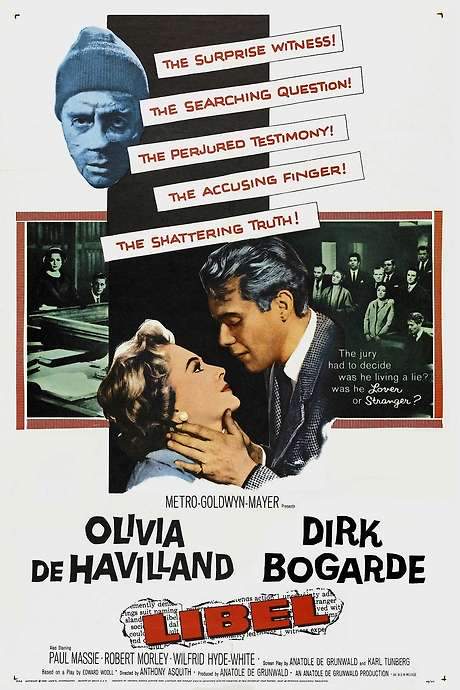
Libel (1959) movie poster

Timeline

Libel (1959) Timeline Explained – Every Event in Order

Release, runtime and language
1959 · 100 mins · English
Directed by
Anthony Asquith
Starring
Robert Morley, Joyce Carey, Olivia de Havilland, Anthony Dawson, Robert Shaw, Richard Pearson

An unsettling series of clues—unexpected witness, relentless questioning, false testimony, accusations, and a devastating revelation—unfolds when a California commercial pilot watches a London broadcast of an interview with Sir Mark Lodden at his estate. Convinced the aristocrat is an impostor, the pilot believes the baronet is actually a look‑alike actor, Frank Welney.

On this page (6)
  1. 1 Where to watch
  2. 2 Events in order (13)
  3. 3 Timeline questions answered
  4. 4 Movie threads
  5. 5 Movies like Libel
  6. 6 Every angle

Where to watch

Where to Watch Libel (1959)

Where can you watch Libel? Stream, rent or buy it in the US, including on Amazon Video, Apple TV Store and Fandango At Home: current JustWatch availability with up-to-date prices.

Streaming availability powered by JustWatch

13 events in order · contains spoilers

Libel Timeline: Events in Chronological Order

Every key event of Libel (1959) in order, scene by scene, with when and where it takes place. Use it to untangle flashbacks, time jumps and parallel storylines, to refresh your memory before the sequel or to find the exact scene you are thinking of.

  1. Buckenham spots Loddon on TV in London and suspects impersonation

    While travelling in London, Buckenham sees Sir Mark Sebastian Loddon on television and immediately recalls his wartime memories. He believes the famous baronet may be an impostor who is actually Frank Wellney. The moment seeds a plan to uncover the truth about Loddon's identity.

    When
    Present day
    Where
    London
  2. Buckenham confronts Loddon and writes tabloid challenge

    He confronts Loddon and, with the encouragement of Loddon’s scheming cousin Gerald, writes to a tabloid accusing Wellney of posing as Loddon. The confrontation deepens Buckenham’s belief that a deception is underway and pushes him to take action. Their exchange reveals old wartime resentments and a potential motive.

    When
    Present day
    Where
    London
  3. Libel suit filed

    Loddon sues Buckenham and the newspaper for libel, arguing that his identity has been slandered. The memory gaps from wartime trauma complicate the case, making it hard for both sides to separate fact from fear. The threat of reputational ruin intensifies the courtroom stakes.

    When
    Present day
    Where
    London court
  4. Libel trial opens with wartime recollections

    During the trial, both men recount their versions of wartime imprisonment and their escape in spring 1945. The atmosphere blends courtroom procedure with raw wartime recollections as the truth-search unfolds. The audience learns how each man perceived the other in the POW camp.

    When
    Present day
    Where
    London court
  5. Spring 1945 escape toward the Dutch border

    Spring 1945 marks the escape from the German POW camp as the three prisoners head toward the Dutch border. Loddon wears his British army uniform while Wellney disguises himself in civilian clothes. The march captures the tension between duty, disguise, and the worsening hunger.

    When
    Spring 1945
    Where
    German POW camp and route toward Dutch border
  6. Night raid for food and a suspected murder

    One night, after days without food, Buckenham leaves Loddon and Wellney to steal from a farm. He returns to hear gunfire and sees two men: one in a British uniform lying still, and another fleeing in civilian clothes. Buckenham suspects Wellney has murdered Loddon and stolen his identity.

    When
    Spring 1945 night
    Where
    Countryside near the POW camp, en route to the Dutch border
  7. Physical clues fuel the identity mystery

    During the trial, Buckenham notes that Loddon is missing part of his right index finger as did Wellney. The two men also share other subtle similarities—like hair color and lack of a childhood scar—that cast doubt on their identities. The evidence clues begin to form a puzzle that only the witnesses can resolve.

    When
    Present day
    Where
    London court
  8. Personal-life probing raises impersonation doubts

    Wellney's questions about Loddon's personal life during their imprisonment highlight the resemblance between them and plant seeds of doubt about identity. The courtroom discussions show how memory and appearance can be manipulated by trauma. The atmosphere grows tense as the truth remains elusive.

    When
    Present day
    Where
    London court
  9. Number Fifteen surfaces: the living prison escapee

    Defence introduces Number Fifteen, the living, disfigured man from a German asylum. In the courtroom, Loddon recognizes him, and his memory begins to return as the past refuses to stay buried. The case pivots on the truth hidden behind scars and a battered past.

    When
    Present day
    Where
    German asylum (Number Fifteen) brought into courtroom
  10. Margaret testifies to Wellney’s impersonation

    Margaret states she now believes her husband to be Wellney, the impostor, implying that Number Fifteen is the real Loddon. Her testimony shifts the emotional and factual balance of the libel case. The jury weighs the possibility that love and loyalty have clouded judgment.

    When
    Present day
    Where
    London court
  11. Canal reflection unlocks buried memories

    Margaret confronts her husband, who struggles to remember more. Seeing his reflection in a canal unlocks his memories, revealing the moment when Wellney attempted to kill him and how he survived. The canal scene becomes a turning point in his personal truth.

    When
    Present day
    Where
    Canal at night
  12. Medallion proves the truth and verdict is reached

    In court, Loddon recalls a medallion hidden in his jacket lining that Margaret had given him in 1939. Proving the medallion had been in Wellney's possession all along confirms his true identity, and Loddon wins the libel case. Margaret realizes her husband is the person she believed him to be.

    When
    Present day
    Where
    London court
  13. Reconciliation and damages finalize the case

    Buckenham and Loddon reconcile after the truth is established, though the couple and the tabloid must pay damages. The resolution brings closure to a tangled history of memory, deception, and identity, with both men choosing a path forward. The case ends on a note of hard-won understanding rather than triumph.

    When
    Present day
    Where
    London court / outside court

Last updated: October 09, 2025 at 11:16

Was this helpful?

Timeline questions answered

Libel Timeline Explained: Your Questions Answered

When does it happen, and why in that order? The questions people ask about the chronology of Libel (1959): time jumps, flashbacks, cause and effect between scenes and the correct order of events, each answered with spoilers.

Q1

Why does Buckenham believe Sir Mark Loddon is Frank Wellney?

Buckenham recognizes Loddon from his time in a German POW camp during WWII. He knows that Loddon bore a striking resemblance to British actor Frank Wellney, and after seeing Loddon on television, becomes convinced the baronet is actually Wellney using a stolen identity. The resemblance between the two men, combined with Buckenham's wartime memories, fuels his suspicion.

  • buckenham
  • loddon
  • wellney
  • impersonation
  • pow camp
  • ww2
Q2

What happened during the 1945 escape from the POW camp?

In spring 1945, three prisoners, Loddon, Wellney, and Buckenham, escaped from a German POW camp heading toward the Dutch border. Loddon wore his British army uniform while Wellney disguised himself in civilian clothes. After days without food, Buckenham left to steal from a farm and returned to hear gunfire, finding a man in uniform lying still and another fleeing in civilian clothes. Buckenham believed Wellney had murdered Loddon and stolen his identity.

  • escape
  • pow camp
  • 1945
  • wellney
  • loddon
  • dutch border
  • murder
Q3

Who is Number Fifteen and why is he important to the case?

Number Fifteen is a scarred, deranged man living in a German asylum who was revealed during the libel trial. The defense introduced him as the uniformed man Buckenham claimed to have seen die. When brought into court, Number Fifteen recognizes Loddon, causing Loddon's buried memories to resurface. The revelation shifts the case entirely, suggesting Number Fifteen might actually be the real Loddon who survived.

  • number fifteen
  • asylum
  • german
  • scar
  • defense witness
  • trial twist
Q4

Why does Margaret doubt her husband's identity?

Margaret, Loddon's wife, is called to testify and under pressure states she now believes her husband could be Wellney, the impostor. This implies Number Fifteen might be the real Loddon. Her doubt stems from the overwhelming evidence presented in court and the psychological toll of the trial, forcing her to reconsider everything she thought she knew about her marriage.

  • margaret
  • wife
  • testimony
  • doubt
  • impersonation
  • loddon
Q5

How does Loddon recover his memory after seeing his reflection?

After a night of reflection following Margaret's confrontation, Loddon sees his reflection in a canal at night. This visual trigger unlocks his buried memories, revealing how Wellney tried to kill him but failed. By switching their clothes, Loddon managed to escape with his life while Wellney took on his identity. The reflection scene becomes the turning point in recovering his true self.

  • canal
  • reflection
  • memory
  • wellney
  • clothes switch
  • survival
Q6

How does the medallion prove Loddon's identity?

Loddon recalls a medallion hidden in his jacket lining that Margaret gave him in 1939. When the jacket is examined, the medallion is found in Wellney's possession, confirming that Wellney had stolen both the identity and the personal effects. This physical proof finally establishes Loddon's true identity and wins him the libel case.

  • medallion
  • 1939
  • jacket lining
  • proof
  • evidence
  • margaret
Q7

What is the outcome of the libel trial?

Loddon wins the libel case after the medallion proof confirms his identity. Margaret realizes her husband is indeed the man she married. Buckenham and Loddon reconcile, though both must face practical consequences, Buckenham and the tabloid must pay damages. The case concludes with a quiet affirmation of identity and hard-won understanding.

  • verdict
  • win
  • damages
  • reconciliation
  • buckenham
  • loddon
Q8

Why does Gerald Loddon encourage Buckenham's accusations?

Gerald Loddon is Loddon's scheming cousin who manipulates the situation for his own benefit. He encourages Buckenham to write to the tabloid accusing Wellney of posing as Loddon, likely hoping to benefit from the chaos and potentially inherit the baronetcy if Loddon's identity were successfully challenged. His self-serving motives drive much of the early conflict.

  • gerald
  • cousin
  • scheme
  • inherit
  • tabloid
  • manipulate
Q9

Why does Buckenham claim he witnessed Loddon's murder?

Buckenham genuinely believes he witnessed Wellney murder Loddon and flee in Loddon's uniform on that night in 1945. His testimony is based on what he saw in the mist, the body of a uniformed man and a figure fleeing in civilian clothes. However, his memory is complicated by wartime trauma, hunger, and the chaos of the escape, making his perception unreliable.

  • witness
  • murder
  • uniform
  • mist
  • buckenham
  • 1945
Q10

Why does Loddon sue Buckenham for libel?

Loddon files a libel suit because Buckenham's accusations, published in a tabloid, claim that the baronet is actually an impostor actor. This threatens Loddon's entire identity, reputation, and social standing. Despite his memory being clouded by wartime trauma, Loddon decides to fight the claim in court to protect his name and prove his true identity.

  • libel
  • lawsuit
  • reputation
  • court
  • tabloid
  • accuse

Movie threads

More Movies Like Libel, by Mood & Story

Curated lists built around what makes Libel tick: the same mood, the same kind of story or the same emotional payoff. Each list explains why these movies belong together.

Courtroom identity dramas like Libel

Legal battles where a person's entire identity becomes the evidence on trial. If you liked the tense identity investigation in Libel, you'll enjoy these movies where a person's very existence is put on trial. These similar legal thrillers and courtroom dramas focus on high-stakes cases of impersonation, amnesia, and contested pasts, creating suspenseful stories about truth and self.

  • tense
  • cerebral
  • anxious
  • legal drama
  • unsettling
  • investigative
  • Tone: tense, cerebral, uncertain
  • Pacing: steady, methodical
Why these movies?

The story pattern: The narrative follows a legal case, typically a libel suit or similar proceeding, where one party claims another is an impostor or living a false life. The plot unfolds through the presentation of conflicting evidence and witness testimony, delving into themes of memory, trauma, and deception, building towards a climactic revelation that confirms or shatters the contested identity.

Why they belong together: These movies are grouped by their unique blend of legal thriller structure and deep psychological mystery. They share a tense, cerebral tone, a steady pacing that mirrors the methodical nature of a trial, and a high-intensity focus on the existential threat of having one's identity publicly dismantled.
Movies with psychological unmasking like Libel

Stories where the truth about a person is slowly and relentlessly uncovered. Fans of Libel's methodical reveal of a hidden truth will appreciate these similar movies. Discover tense thrillers and dramatic investigations where a character's facade is slowly dismantled, exploring themes of betrayal, war trauma, and the fragility of memory in a consistently suspenseful and cerebral way.

  • suspenseful
  • anxious
  • cerebral
  • unsettling
  • investigative
  • psychological drama
  • Tone: tense, suspenseful, anxious
  • Pacing: steady, deliberate, slow burn
Why these movies?

The story pattern: The narrative pattern involves a protagonist or investigator doggedly pursuing the truth about a suspicious individual. The story unfolds at a steady pace, relying on dialogue, deduction, and the re-examination of past events rather than action. The central conflict is intellectual and psychological, building towards a climax where the hidden truth is definitively revealed, resolving the mystery but often leaving emotional scars.

Why they belong together: These films share a cohesive vibe defined by a tense, anxious mood, a steady and deliberate pacing that builds suspense, and a moderate narrative complexity centered on a psychological puzzle. They are united by the core experience of watching a carefully constructed identity or secret come undone under pressure.

If you liked this

Movies Like Libel

Similar movies to Libel: the same genre, themes or kind of story. Each one comes with its own plot summary, timeline and ending explained.

Browse all movie summaries

Every angle

Libel (1959) Explained: Plot, Timeline & Characters

Everything about Libel in one place: what happens in the plot summary, the timeline in chronological order, the characters and meaning and a spoiler-free summary. What's After the Movie adds the cast, box office and post-credit scenes.

Coming soon on iOS and Android

The Plot Explained Movie Summary App

Plot summaries, endings explained and timelines on your phone. Catch up on any movie in minutes, save your favorites and never miss a twist again.

Be the first to know when we launch. Your email stays private, always.

Learn more about the app