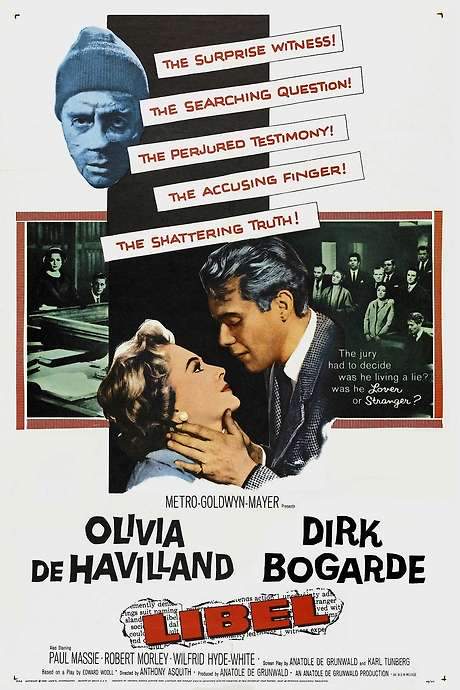
While traveling in London, the Canadian World War II veteran and pilot Jeffrey Buckenham, Paul Massie, sees on television baronet Sir Mark Loddon, Dirk Bogarde, leading a tour of his ancestral home in England. Buckenham recalls that he was held in a German POW camp with Loddon during the Dunkirk evacuation, and he becomes convinced that Loddon is Frank Wellney, a British actor who bore a striking resemblance to him. This suspicion sets off a dangerous game of identity, memory, and deception that tests Buckenham’s resolve and the truth behind wartime bonds.
As Buckenham presses his claim, Loddon—whose memory is muddied by the traumas of war—retains the defense of his scheming cousin Gerald Loddon and decides to sue Buckenham and the tabloid for libel. The courtroom drama unfolds with Buckenham and Loddon each presenting their own versions of their wartime imprisonment and escape. Buckenham describes a harsh escape toward the Dutch border in 1945, where Loddon wore a British army uniform and Wellney tried to vanish into civilian clothes. A tense moment in the mist leads Buckenham to believe he witnessed Wellney fleeing the scene of Loddon’s murder after days of hunger.
During the libel trial, the defense reveals a startling twist: the uniformed man Buckenham claims died did not die at all. He lives, scarred and deranged, in a German asylum known only as "Number Fifteen." When the man is brought into the courtroom, he recognizes Loddon, and Loddon’s memory begins to return. The dramatic moment shifts the balance of the case, and the courtroom buzzes with a new possibility: Could Number Fifteen really be the real Loddon?
Margaret, Loddon’s wife, is called to testify and, under pressure, expresses doubt about her husband’s identity. The tension peaks as she weighs the possibility that Number Fifteen is the true Loddon, casting doubt on the life she believes she has shared. In a desperate turn, Loddon’s memory starts to click into place after a night of reflection, including a pivotal moment when he sees his own reflection in a canal. The realization comes: Wellney’s attempts to kill him were thwarted, and by switching their clothes, Loddon managed to escape with his life.
A crucial clue emerges: a medallion hidden in the lining of Loddon’s jacket, given to him by Margaret in 1939, proves that Wellney had carried it all along. With this evidence, Loddon’s identity is reaffirmed, and he wins the libel case. Margaret, now certain of whom she has stood beside all along, comes to terms with the truth. Buckenham and Loddon, though relieved, must face the practical consequences of their revelations, and the pair reconcile, even as Buckenham and the newspaper that carried the tale must answer for damages. The courtroom drama resolves with a quiet, restrained affirmation of identity, memory, and the bonds that survive the fog of war.