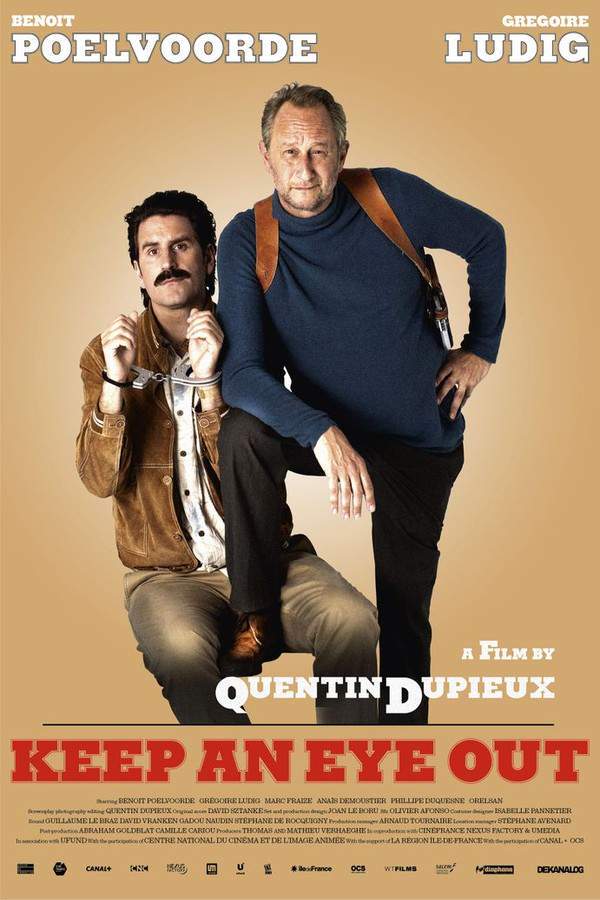
In a large office, Commissaire Buron, Benoît Poelvoorde, continues the interrogation of Louis Fugain, Grégoire Ludig seated before him, even denying him a break to eat. Fugain had found a man bathed in blood outside his home, searched the corpse, and then called for help—a detail that surprises Buron and keeps the questioning going as the tension thickens.
Buron steps out for a moment to speak with his son, Orelsan Sylvain Buron, and to grab a hot dog, a small pause that contrasts with the intensity back in the room. Meanwhile, another part of the case unfolds: Philippe, Marc Fraize, a rookie one-eyed policeman, is assigned to shadow Fugain and see whether he truly fits the night’s puzzling tale. Philippe tries to connect by showing his badge and starting a conversation, but he clumsily trips over an open drawer and dies right there, a square object piercing his eye as he falls. The shock of the moment leaves Fugain panicked, and he quickly hides the body in a cupboard, scrubbing away any blood traces.
When Buron returns, the interrogation resumes with his usual calm, slow cadence. Fugain’s narrative becomes tangled as his neighbor’s testimony surfaces: Narta, Jeanne Rosa, swears she saw Fugain leave her apartment seven times during the night. Fugain proceeds to recount his movements in meticulous detail, while Buron smokes and listens, even describing a strange vision of a hole in his own chest as if the two of them share a surreal bond through memory and reality.
As the questioning continues, Fugain’s memories begin to mingle with his reality. He sees Philippe, now a figure from his recollections, appear and interact with him, and then Philippe’s wife also materializes in the stream of memories. Fugain even hints that he will rendezvous with them again in a few days, asserting that Philippe will die accidentally. Hunger gnaws at Fugain, and Buron, irritated by the complaint, recalls his own hunger after a harrowing helicopter crash on a desert island, a memory that bleeds into Fugain’s impression of the case.
Fugain’s hunger and discomfort give way to more unsettling visions: Buron materializes in Fugain’s apartment, and the interrogation scene spirals into a collage of memories and imagined conversations. Outside, a colleague, Champonin, presents the forensic report: the dead man was the victim of a digestive hemorrhage, an accident that would suggest Fugain’s release. Yet Champonin soon discovers an eye on the floor, a clue that points to Philippe’s involvement.
As the truth begins to blur, the curtain literally rises: the police station reveals itself as a stage, and the audience rises to its feet, applauding the performance. Philippe, still alive, emerges from a closet, shedding his disguise because, in this moment, he and the others are revealed to be actors, not real police at all. Fugain remains the sole person convinced he’s the prime suspect, and the others acknowledge their roles in the elaborate play.
With the confounding reveal, the group heads to a brewery to debrief and joke about acting and the critics’ reviews they’ve earned. They share a quiet, reflective bite of dinner, discussing how performances shape perception and memory, and how lines between truth and illusion can blur when life imitates art. When they part ways, Fugain expresses gratitude to Buron for the strange, enlightening experience, while Buron resumes his stern authority, handcuffs in place, and informs him that the interrogation will resume in the morning. Fugain is taken back to the police station, and Buron returns home, leaving the case—and the night—to linger in the memory of what was real, and what was merely performed.