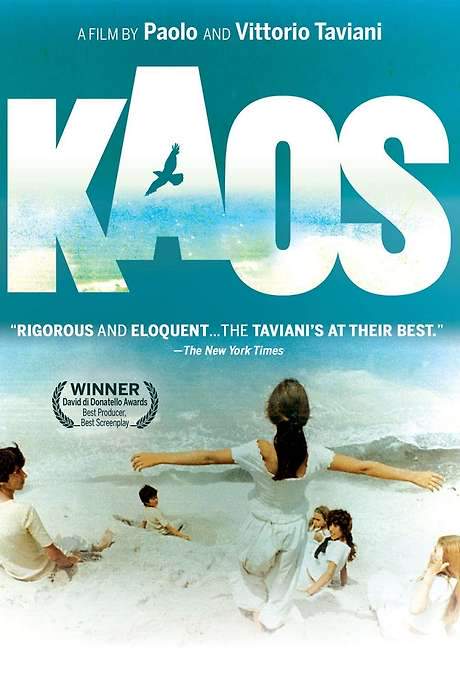
Kaos

Kaos

Year: 1984

Runtime: 188 mins

Language: Italian

Directors: Paolo Taviani, Vittorio Taviani

FantasyDramaRomance

Five stories center on a werewolf, a feudal landlord, peasants, a ghost, and a mother and her sons.

Where to Watch Kaos?

Find where to stream, rent, or buy Kaos (1984) in the US with current JustWatch availability, up-to-date pricing, and platform listings for subscription, rental, and digital purchase options.

Warning: spoilers below!

Haven’t seen Kaos yet? This summary contains major spoilers. Bookmark the page, watch the movie, and come back for the full breakdown. If you're ready, scroll on and relive the story!

Timeline & Setting – Kaos (1984)

Explore the full timeline and setting of Kaos (1984). Follow every major event in chronological order and see how the environment shapes the story, characters, and dramatic tension.

Time period

Late 19th century to early 20th century

The film places its episodes in a period of transition for Sicily, when old customs meet new social pressures. Life moves at the pace of the seasons, and moments of change arrive quietly, contrasting with the rural rhythms. The repeated luck-and-curse motif emerges within a community-sized frame, highlighting how time preserves memory and shapes identity.

Location

Sicily

The stories unfold across rural Sicilian communities in the second half of the 19th century, where agrarian life and traditional customs shape everyday existence. The landscapes—olive groves, small farms, and dusty lanes—reflect a close-knit society with clear social hierarchies. The narrative ties the different episodes to a shared Sicilian mood of resilience and communal memory.

🗺️ Sicily 🏡 Rural villages

Last updated: February 18, 2026 at 23:13

Was this helpful?

Main Characters – Kaos (1984)

Meet the key characters of Kaos (1984), with detailed profiles, motivations, and roles in the plot. Understand their emotional journeys and what they reveal about the film’s deeper themes.

Mariagrazia (Margarita Lozano)

A central figure in the L'altro figlio segment, Mariagrazia embodies the complex dynamics of family and community pressure. Her actions reflect the tension between personal agency and social expectation, contributing to the story’s arc toward reconciliation.

🧭 L'altro figlio 🤝 Family dynamics

Batà (Claudio Bigagli)

Batà appears in Mal di luna as a member of a tight-knit rural circle. His choices and interactions reveal the community’s norms and the way marginal figures navigate within them, contributing to the arc of renewal.

🌾 Mal di luna 🔗 Community ties

Saro (Massimo Bonetti)

Saro features in two segments and acts as a bridge between events, illustrating how personal hardship can lead to renewal or resilience in the face of social constraints.

🪨 Renewal 🌙 Night life

Character (Tony Sperandeo)

A figure in the ensemble, Tony Sperandeo's role adds tension within the communal setting, helping to showcase collective dynamics and the film’s balance between realism and occasional surreal moments.

🎭 Supporting role 🫂 Community

Luigi Pirandello (Omero Antonutti)

The apparent portrayal of the famous writer Luigi Pirandello situates the film in a meta-narrative context, reflecting on storytelling, perception, and the social fabric of the era.

📚 Literature 🎨 Meta-narrative

Salvatore (Biagio Barone)

Salvatore participates in Requiem, contributing to the exploration of community rituals and the impact of tragedy on everyday life in the village.

🕯️ Rituals 🧩 Grief

The girl / Francesca (Laura Mollica)

Francesca appears in L'altro figlio and Requiem as a young presence that reflects the changing social mood and the human desire for renewal within the constraints of tradition.

🧒 Youth 💬 Dialogue

Domenico Gennaro

Domenico Gennaro is part of the ensemble cast contributing to the mosaic of villagers. His scenes contribute to the tapestry of social interactions and the film’s delicate balance between realism and subtle surrealism.

🌾 Village life 🧵 Tapestry

Mother of Pirandello (Regina Bianchi)

The mother figure appears in the Pirandello segment, representing family ties and the weight of tradition on individual choices.

👵 Family 🏛️ Tradition

Sidora (Enrica Maria Modugno)

Sidora appears in Mal di luna, contributing to the film’s exploration of community roles and the impact of collective life on individual fate.

🧭 Community roles 🪶 Collective life

Sara (Mariella Lo Sardo)

Sara from La giara frames part of the village tableau, adding to the social textures central to the film’s humanist focus.

🧭 Village life 🪞 Social textures

The Young Doctor (Carlo Cartier)

The Young Doctor in L'altro figlio scenario adds an element of care, science, and new social roles within the old-world setting.

🩺 Medicine 🏥 Social change

Zi' Dima (Franco Franchi)

Zi' Dima contributes to the La giara segment with a distinct local color, enriching the village’s everyday life and its humor and resilience.

🏡 Local color 🎶 Folklore

Don Lollò (Ciccio Ingrassia)

Don Lollò is a figure in La giara whose actions influence the social dynamics, illustrating the film’s focus on community authority and superstition.

👥 Authority 🕯️ Ritual

Comizzi (Orazio Torrisi)

Comizzi appears in L'altro figlio, contributing to the narrative’s network of relationships and the study of marginal lives within a traditional village.

🧩 Social networks 🧭 Marginalized

Jeli (Giovanni Marsala)

Jeli is part of La giara’s ensemble, adding to the village mosaic and the film’s exploration of communal bonds and fate.

🧭 Village life 🧩 Interconnected fates

Last updated: February 18, 2026 at 23:13

Was this helpful?

Major Themes – Kaos (1984)

Explore the central themes of Kaos (1984), from psychological, social, and emotional dimensions to philosophical messages. Understand what the film is really saying beneath the surface.

🫂 Social Outcasts

The first three stories center on marginalized figures who live on the edge of the village’s social order. Their struggles for dignity and acceptance drive the narratives, and their eventual reconciliation or renewal underlines the possibility of redemption. The community’s gaze and the characters’ inner resilience reveal the human capacity to endure stigma.

🐦 Crow as Herald

A crow acts as a recurring herald of misfortune and fortune, tying the episodes together with a visual and musical leitmotif. Its capture, tagging with a bell, and release become a symbolic chorus on fate and social judgment. The bird’s presence comments on marginalization and the thin line between luck and misfortune.

🕰️ Time and Place

The setting in Sicily across the late 19th to early 20th century anchors the stories in a concrete historical moment. Rural life, tradition, and evolving social norms shape characters’ choices and constraints. The time frame provides a backdrop for cycles of hardship, renewal, and communal memory.

🌗 Subtle Surrealism

Although predominantly realistic, the film injects brief surreal moments that interrupt the flow of action. These quiet, almost dreamlike interludes invite viewers to read deeper into characters’ moods and the underlying connections between episodes. The surreal touches heighten the sense of mystery and moral ambiguity in ordinary events.

Last updated: February 18, 2026 at 23:13

Was this helpful?

Kaos (1984) Character & Theme Questions Answered – Info FAQ

Browse frequently asked questions about Kaos (1984) focused on characters, relationships, themes, symbols, setting, and story context. This movie info FAQ gives spoiler-aware explanations for character arcs, world details, and thematic interpretation so readers can better understand what the film is really about.

Q1

Where is the film set?

A.

The film takes place in rural Sicilian communities in the second half of the 19th century. The settings include olive groves, small farms, and dusty village lanes that reflect a close-knit society with clear social hierarchies.

sicilyrural settingvillagesouthern italylocation
Q2

What time period does the movie depict?

A.

The movie is set in the late 19th century to early 20th century, a period of transition for Sicily when old customs met new social pressures. Life moves at the pace of the seasons, and the era provides a backdrop for cycles of hardship and renewal.

time period19th centuryhistoricalsicilyera
Q3

What does the crow symbolize in the film?

A.

The crow acts as a recurring herald of both misfortune and fortune, tying the five stories together as a visual and musical leitmotif. Its capture, tagging with a bell, and release become a symbolic commentary on fate and social judgment, highlighting the thin line between luck and misfortune for marginalized figures.

crowsymbolfateluckleitmotifsymbolism
Q4

What are the main themes explored in the movie?

A.

The film explores several interconnected themes: social outcasts struggling for dignity on the margins of village life, the recurring crow motif as a symbol of fate, the historical context of Sicilian rural life, and subtle surrealist moments that interrupt the realistic narrative to reveal deeper emotional truths.

themessocial outcastsfatesurrealismredemption
Q5

Who is Luigi Pirandello in the film?

A.

Luigi Pirandello, played by Omero Antonutti, appears as a figure within the anthology, situating the film in a meta-narrative context. His presence reflects on storytelling, perception, and the social fabric of the Sicilian era, adding a layer about the relationship between narrative and reality.

luigi pirandellowritermeta narrativestorytelling
Q6

What role does Mariagrazia play in the story?

A.

Mariagrazia, played by Margarita Lozano, appears in the L'altro figlio segment and embodies the tension between personal agency and social expectation within family and community dynamics. Her character represents the complex pressures faced by individuals striving for reconciliation while navigating traditional norms.

mariagraziafamilysocial expectationreconciliation
Q7

Why is the film structured as five separate stories?

A.

The five stories are tied together through shared Sicilian setting, the recurring crow motif, and thematic links around marginalized characters and fate. This anthology structure allows the film to explore different aspects of rural Sicilian life while building a mosaic of communal memory and resilience.

anthologystructurefive storiesconnected themes
Q8

How does the film balance realism and surrealism?

A.

The film is primarily rooted in social realism, depicting rural Sicilian life with authentic detail. However, it incorporates brief surreal moments, quiet, dreamlike interludes, that invite viewers to read deeper into characters' moods and the connections between episodes, adding mystery and moral ambiguity to ordinary events.

realismsurrealismvisual stylenarrative techniquedreams
Q9

What does the Social Outcasts theme explore?

A.

The first three stories center on marginalized figures living on the edge of the village's social order. Their struggles for dignity and acceptance drive the narratives, and their eventual reconciliation or renewal underlines the possibility of redemption. The theme reveals the human capacity to endure stigma and find renewal.

social outcastsmarginalizationdignityredemptioncommunity
Q10

What is the tone and pacing of the film?

A.

The primary tone is melancholic and reflective, stemming from its focus on marginalized characters. The pacing is slow, emphasizing atmosphere and character introspection over rapid plot progression. This deliberate pace allows for contemplative moments amidst realistic but occasionally surreal narrative.

tonepacingmelancholyatmospherereflective
Q11

Who are the key characters in the film?

A.

The film features an ensemble cast including Mariagrazia, who faces family and community pressure; Luigi Pirandello as a meta-narrative figure; Batà and Sidora from Mal di luna exploring community norms; and Saro, who appears in two segments as a bridge between events. Each represents different aspects of Sicilian village life.

charactersensemblecastsicilian villagerskey figures
Q12

What historical context shapes the story?

A.

The film is anchored in Sicily during the late 19th to early 20th century, a time of transition when old customs met new social pressures. Rural life, tradition, and evolving social norms shape characters' choices and constraints, providing a backdrop for cycles of hardship, renewal, and communal memory.

historical contextsicilytraditionsocial change1800s
Mobile App Preview

Coming soon on iOS and Android

The Plot Explained Mobile App

From blockbusters to hidden gems - dive into movie stories anytime, anywhere. Save your favorites, discover plots faster, and never miss a twist again.

Sign up to be the first to know when we launch. Your email stays private, always.

Explore Movie Threads

Discover curated groups of movies connected by mood, themes, and story style. Browse collections built around emotion, atmosphere, and narrative focus to easily find films that match what you feel like watching right now.

Poetic Anthologies of Marginalized Lives like Kaos

Interwoven stories exploring the quiet struggles and dreams of society's forgotten.If you enjoyed the interconnected stories in Kaos, explore more movies like it. This collection features similar anthology films that use a poetic lens to examine the lives of social outcasts with a slow, melancholic pace.

anthologyreflectivemelancholicpoeticsymboliccontemplativeatmosphericsurreal

Narrative Summary

Narratives in this thread are composed of multiple, loosely connected stories that share a common setting or theme. They unfold at a deliberate pace, emphasizing character introspection and symbolic moments over conventional plot progression, often culminating in a mixed or contemplative conclusion.

Why These Movies?

These films are grouped together for their shared structure and thematic focus. They use the anthology format to explore themes of marginalization and rural life through a lens of surrealism and social realism, creating a uniquely meditative and reflective viewing experience.
Slow-Burn Magical Realism movies like Kaos

Where everyday life is punctuated by surreal and symbolic moments of magic.Fans of the dreamlike and surreal atmosphere in Kaos will enjoy these similar films. Discover movies that blend realistic rural drama with poetic fantasy elements, creating a contemplative and symbolic vibe.

surrealdreamlikeatmosphericsymboliccontemplativemelancholicruralmagical realism

Narrative Summary

Stories in this thread unfold gradually in a world that looks like our own, but where the rules are softly bent. Fantastical events are presented matter-of-factly, serving as metaphors for internal struggles or social commentary. The narrative prioritizes mood and symbolism over fast-paced action.

Why These Movies?

These movies share a specific blend of tone and style: a slow, deliberate pace, a melancholic or reflective mood, and the seamless integration of surreal elements into a socially realistic framework. They create a unique, dreamlike atmosphere that feels both familiar and strangely magical.

Unlock the Full Story of Kaos

Don't stop at just watching - explore Kaos in full detail. From the complete plot summary and scene-by-scene timeline to character breakdowns, thematic analysis, and a deep dive into the ending - every page helps you truly understand what Kaos is all about. Plus, discover what's next after the movie.

Kaos Summary

Read a complete plot summary of Kaos, including all key story points, character arcs, and turning points. This in-depth recap is ideal for understanding the narrative structure or reviewing what happened in the movie.

Kaos Summary

Kaos Timeline

Track the full timeline of Kaos with every major event arranged chronologically. Perfect for decoding non-linear storytelling, flashbacks, or parallel narratives with a clear scene-by-scene breakdown.

Kaos Timeline

Kaos Spoiler-Free Summary

Get a quick, spoiler-free overview of Kaos that covers the main plot points and key details without revealing any major twists or spoilers. Perfect for those who want to know what to expect before diving in.

Kaos Spoiler-Free Summary

More About Kaos

Visit What's After the Movie to explore more about Kaos: box office results, cast and crew info, production details, post-credit scenes, and external links - all in one place for movie fans and researchers.

More About Kaos

Similar Movies to Kaos

Discover movies like Kaos that share similar genres, themes, and storytelling elements. Whether you’re drawn to the atmosphere, character arcs, or plot structure, these curated recommendations will help you explore more films you’ll love.