



Plot Explained Spoilers guaranteed!
Plot Explained

Browse by genre

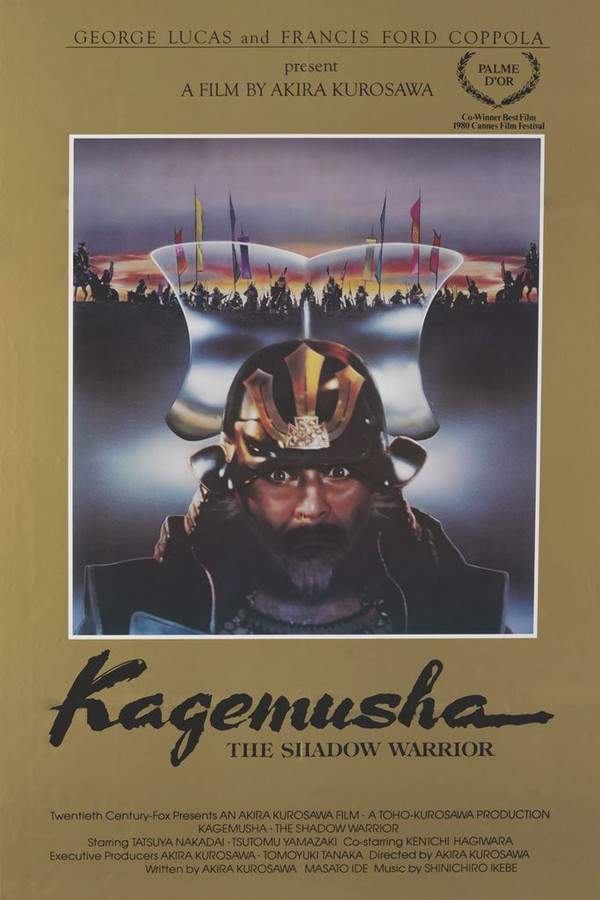
Kagemusha (1980) movie poster

Timeline

Kagemusha (1980) Timeline Explained – Every Event in Order

Release, runtime and language
1980 · 180 min · Japanese
Directed by
Akira Kurosawa
Starring
Daisuke Ryû, Jinpachi Nezu, Tatsuya Nakadai, Tsutomu Yamazaki, Hideji Ôtaki, Hideo Murota
Budget
$6M

During a time of war, a petty criminal’s uncanny resemblance to a deceased powerful warlord leads him to be recruited to impersonate the man. As the Kagemusha, or "shadow warrior," he’s tasked with deceiving enemies and maintaining the illusion of the warlord’s continued presence. However, he soon finds himself entangled in genuine political intrigue and must grapple with the immense responsibility and danger of his deception, all while fearing exposure and the consequences it would bring.

On this page (6)
  1. 1 Where to watch
  2. 2 Events in order (15)
  3. 3 Timeline questions answered
  4. 4 Movie threads
  5. 5 Movies like Kagemusha
  6. 6 Every angle

Where to watch

Where to Watch Kagemusha (1980)

Where can you watch Kagemusha? Stream, rent or buy it in the US, including on Google Play Movies, YouTube and Apple TV Store: current JustWatch availability with up-to-date prices.

Streaming availability powered by JustWatch

15 events in order · contains spoilers

Kagemusha Timeline: Events in Chronological Order

Every key event of Kagemusha (1980) in order, scene by scene, with when and where it takes place. Use it to untangle flashbacks, time jumps and parallel storylines, to refresh your memory before the sequel or to find the exact scene you are thinking of.

  1. Takeda Shingen Meets the Thief

    In 1571, during the Sengoku period, the powerful daimyō Takeda Shingen encounters a thief whose life had recently been spared from crucifixion by Shingen's brother, Nobukado. Captivated by the thief's remarkable resemblance to him, Shingen considers using the thief as a *kagemusha*, or political decoy.

    When
    1571
  2. Engagement in Siege Against Tokugawa

    The Takeda army engages in a military siege against a castle governed by Tokugawa Ieyasu. As the battle intensifies, Shingen remains focused on his strategic goals, but his life is about to take a tragic turn.

    Where
    Tokugawa's Castle
  3. Shingen's Fatal Injury

    During the siege, Shingen is unexpectedly shot while captivated by the haunting sound of a flute from the enemy camp. The injury proves fatal, prompting him to order a retreat and conceal his death for three years.

  4. The Concealment of Shingen's Death

    Shingen's order for his generals to conceal his death for three years sets a complex plan into motion. As rivals including Oda Nobunaga and Tokugawa Ieyasu speculate on the implications of Shingen's withdrawal, they remain unaware that he has already succumbed to his injuries.

  5. Introducing the Thief to the Generals

    Nobukado introduces the thief to Shingen’s generals, advocating for the idea of the thief impersonating Shingen. Initially, the generals are skeptical but accept the plan as a necessary strategy to maintain their advantage.

  6. Discovery of Shingen's Body

    In a fateful moment, the thief mistakenly discovers Shingen's preserved body encased in a jar, believing it to be treasure. This surreal encounter leaves the thief shocked, as he realizes the gravity of the situation he has entered.

  7. The Incident at Lake Suwa

    As tensions mount, the jar containing Shingen's body is accidentally dropped into Lake Suwa, witnessed by spies from Tokugawa and Oda. This incident ignites suspicion among rival forces regarding Shingen's fate.

    Where
    Lake Suwa
  8. Kagemusha's Offer to Continue Impersonation

    Overhearing the spies, the clever thief offers to continue serving as *kagemusha* to the Takeda army. His quick decision solidifies his position in the clan, while the Takeda spin a story about a ritual honoring the lake's god to assuage suspicions.

  9. Kagemusha's First Clan Meeting

    Now at the Takeda stronghold, the kagemusha begins to emulate Shingen’s mannerisms to deceive his retinue. He is strategically advised by Nobukado to remain silent during council meetings until a consensus is reached, showcasing his adaptability.

  10. Katsuyori's Challenge to the Kagemusha

    In a crucial moment, Katsuyori challenges the kagemusha's capabilities during a clan meeting, testing his knowledge as Shingen's son grows increasingly frustrated. Despite the pressure, the kagemusha rises to the occasion and impresses the generals.

  11. Nobunaga's Campaign Against Azai

    By 1573, Nobunaga intensifies his efforts against Azai Nagamasa, continuing his campaign to secure Kyoto against rising opposition. This sets off a chain of events that impacts the already fragile Takeda clan.

    When
    1573
  12. Battle of Takatenjin

    In a bold move, Katsuyori disregards the counsel of his generals and leads a counter-attack against enemy forces in the Battle of Takatenjin. The kagemusha steps up to lead the troops, leveraging his newfound confidence to inspire a victorious rally.

  13. Kagemusha's Unmasking

    Despite a victorious battle, the kagemusha's overconfidence leads him to ride Shingen’s unpredictable horse and he is unceremoniously thrown off. Observers notice he lacks Shingen's battle scars, ultimately revealing his identity as the impostor.

  14. Katsuyori Takes Command

    Following the kagemusha’s unmasking, Katsuyori seizes the opportunity to assert his leadership over the Takeda clan. This shift contributes to the clan's instability as rival forces sense a weakness to exploit.

  15. The Tragic End of the Kagemusha

    In 1575, during a desperate counterattack against Nobunaga at Nagashino, the kagemusha, now fully aware of the stakes, charges bravely into battle. Mortally wounded, he struggles to recover the clan's fūrinkazan banner, ultimately succumbing to injuries as his body is swept away in a turbulent river.

    When
    1575
    Where
    Nagashino

Last updated: November 16, 2024 at 18:01

Was this helpful?

Timeline questions answered

Kagemusha Timeline Explained: Your Questions Answered

When does it happen, and why in that order? The questions people ask about the chronology of Kagemusha (1980): time jumps, flashbacks, cause and effect between scenes and the correct order of events, each answered with spoilers.

Q1

Why was the thief recruited to impersonate Takeda Shingen?

The thief was recruited because he bore an uncanny resemblance to the powerful daimyō Takeda Shingen. Shingen's brother Nobukado had spared the thief from crucifixion, and recognizing the physical similarity, the brothers decided the thief could serve as a kagemusha, a political decoy to deceive enemies and maintain the illusion of Shingen's continued strength.

Foreshadowing: Earlier, Nobukado spares the thief's life, establishing the connection that later enables the impersonation.

  • thief
  • kagemusha
  • impersonation
  • Takeda Shingen
  • Nobukado
  • decoy
Q2

How did Takeda Shingen die?

Shingen was shot during a siege against Tokugawa Ieyasu's castle. He was unexpectedly killed while being captivated by the haunting sound of a flute played from the enemy camp. This fatal injury prompted him to order a retreat and devise the plan to conceal his death.

Foreshadowing: The mysterious flute music that draws Shingen's attention hints at the fatal gunshot that follows.

  • Shingen death
  • gunshot
  • siege
  • Tokugawa Ieyasu
  • flute
Q3

Why did Shingen order his death to be concealed for three years?

Shingen ordered his death concealed for three years to maintain political stability and prevent rival clans from exploiting the Takeda clan's vulnerability during the transition of power. His son Katsuyori was not yet ready to assume leadership, so the deception allowed time for the clan to prepare without appearing weak to enemies like Oda Nobunaga and Tokugawa Ieyasu.

Foreshadowing: The three-year charade directly sets up the entire kagemusha storyline and Katsuyori's frustration.

  • concealment
  • death
  • three years
  • Katsuyori
  • transition
  • power
Q4

What happened at Lake Suwa with the jar?

Shingen's preserved body was placed in a large jar, which was accidentally dropped into Lake Suwa during the chaos of maintaining the deception. Spies from Tokugawa and Oda forces witnessed the incident and suspected Shingen may have died. The clever kagemusha overheard the spies discussing this and offered to continue his impersonation, convincing the Takeda to claim they were performing a sake ritual for the lake's god.

Foreshadowing: The dropped jar creates the first major crisis that tests the kagemusha's adaptability.

  • Lake Suwa
  • jar
  • body
  • spies
  • Oda
  • Tokugawa
  • ritual
Q5

Why did the kagemusha offer to continue impersonating Shingen after hearing the spies?

The kagemusha realized that if the rival clans discovered Shingen was dead, they would attack the weakened Takeda clan. By continuing the deception, he saw an opportunity to maintain his own safety and position within the powerful Takeda clan, rather than being discarded or killed.

Foreshadowing: His eavesdropping on the spies demonstrates his cunning and self-preservation instinct.

  • kagemusha
  • spies
  • deception
  • continue
  • opportunity
  • survival
Q6

What was Katsuyori's test for the kagemusha at the clan meeting?

Katsuyori, frustrated with the three-year charade that postponed his ascension to leadership, deliberately challenged the kagemusha during a council meeting where many generals still believed Shingen was alive. The kagemusha, following Shingen's characteristic style of letting generals reach consensus first before agreeing, impressed the council with responses that matched Shingen's mannerisms perfectly.

Foreshadowing: Katsuyori's impatience with the deception sets up the power struggle that defines the second half of the film.

  • Katsuyori
  • test
  • council
  • generals
  • impersonation
  • challenge
Q7

Why was the kagemusha unmasked after the Battle of Takatenjin?

The kagemusha, riding on his wave of confidence after leading a victorious battle, attempted to ride Shingen's notoriously unpredictable horse. He was thrown off, and observers noticed he lacked Shingen's distinctive battle scars. This physical proof exposed him as an impostor, leading to his disgrace and allowing Katsuyori to finally take command of the Takeda clan.

Foreshadowing: The horse that only Shingen could control was established earlier as a symbol of the warlord's unique identity.

  • kagemusha unmasked
  • battle scars
  • horse
  • Takatenjin
  • Katsuyori
  • exposure
Q8

What happened to the Takeda forces at the Battle of Nagashino?

In 1575, Katsuyori led a counter-assault against Oda Nobunaga at Nagashino. Despite bravery, multiple waves of Takeda cavalry and infantry were devastated by the relentless musket fire from Oda's arquebusiers. The Takeda forces were nearly annihilated, marking the beginning of the clan's collapse.

Foreshadowing: The film's melancholic tone and the earlier mentions of Oda's military strength foreshadow this catastrophic defeat.

  • Nagashino
  • Takeda defeat
  • Oda Nobunaga
  • arquebusiers
  • cavalry
  • annihilation
Q9

Why did the kagemusha charge into battle at Nagashino knowing he'd die?

After the kagemusha was exposed and discarded, he was driven by desperation and a desire for redemption. At Nagashino, seeing the Takeda forces being slaughtered, he seized a spear and charged into the Oda lines, fully aware it was suicidal. His final act was an attempt to recover the fallen fūrinkazan banner, symbolizing his loyalty to the clan he had served, even though he was never truly accepted as one of them.

Foreshadowing: The kagemusha's earlier statement about serving the Takeda clan hints at his ultimate sacrifice.

  • kagemusha death
  • Nagashino
  • charge
  • fūrinkazan banner
  • redemption
  • sacrifice
Q10

Why did Katsuyori ignore the generals' counsel at Takatenjin?

Katsuyori was frustrated by the imposed three-year deception that delayed his claim to leadership. Eager to prove himself as a capable warlord and impatient with the cautious strategies of his father's old generals, he launched a counter-attack against counsel, leading to the kagemusha being put in command of troops for the first time.

Foreshadowing: Katsuyori's impatience was established earlier when he tested the kagemusha, showing his desire for power.

  • Katsuyori
  • generals
  • counsel
  • Takatenjin
  • impatience
  • leadership
Q11

How did the rival clans react to Shingen's unexpected withdrawal from battle?

Rival daimyō including Oda Nobunaga, Tokugawa Ieyasu, and Uesugi Kenshin began speculating about the implications of Shingen's withdrawal. They were uncertain whether it was a strategic maneuver, a sign of weakness, or something else entirely. Crucially, they remained unaware that Shingen had actually died, which prevented them from immediately exploiting the Takeda clan's vulnerability.

Foreshadowing: This uncertainty creates the political tension that allows the kagemusha deception to work.

  • Oda Nobunaga
  • Tokugawa Ieyasu
  • Uesugi Kenshin
  • withdrawal
  • rivals
  • reaction
Q12

What was the significance of the fūrinkazan banner in the story?

The fūrinkazan was the distinctive battle banner of the Takeda clan, symbolizing their identity and military tradition. At Nagashino, the kagemusha desperately tried to recover this fallen banner before dying, making it a poignant symbol of his ultimate loyalty to the clan he had impersonated for years.

Foreshadowing: The banner appears throughout battles as a symbol of Takeda presence and pride.

  • fūrinkazan
  • banner
  • Takeda
  • symbol
  • identity
  • battle
Q13

How did the kagemusha learn to imitate Shingen's mannerisms so well?

After being brought to the Takeda stronghold, the kagemusha studied Shingen's behavior by observing his retinue and possessions. He was also advised by Nobukado to remain silent during council meetings until the generals reached consensus, then simply agree with their plans, mirroring Shingen's characteristic leadership style. Through careful observation and practice, he became convincing enough to fool most of the court.

Foreshadowing: Nobukado's advice about council behavior reveals how Shingen actually governed, helping the kagemusha succeed.

  • imitation
  • mannerisms
  • learning
  • Nobukado
  • council
  • Shingen

Movie threads

More Movies Like Kagemusha, by Mood & Story

Curated lists built around what makes Kagemusha tick: the same mood, the same kind of story or the same emotional payoff. Each list explains why these movies belong together.

Movies about reluctant impostors like Kagemusha

Ordinary individuals trapped in dangerous webs of lies, forced to become someone they're not. If you liked Kagemusha's story of a criminal forced to impersonate a warlord, explore these movies about similar deceptions. This collection features films where ordinary people must maintain a dangerous lie, leading to stories filled with political intrigue, personal sacrifice, and intense psychological tension.

  • tense
  • anxious
  • claustrophobic
  • somber
  • psychological
  • high-stakes
  • Tone: tense, melancholic
  • Pacing: steady, deliberate
Why these movies?

The story pattern: The narrative follows an unlikely protagonist who must take on a powerful identity, often against their will. The story unfolds with a steady buildup of pressure as the deception becomes more complex, forcing the character to grow into their role while grappling with the moral and emotional weight of their actions, typically culminating in a tragic or bittersweet conclusion.

Why they belong together: These films are grouped together because they share a core premise of forced impersonation, creating a unique blend of psychological tension, character-driven drama, and high-stakes situational conflict. The shared experience is one of claustrophobic pressure and an exploration of identity under duress.


Somber historical war epics like Kagemusha

Grand-scale historical conflicts depicted with a heavy, melancholic focus on tragedy and sacrifice. For viewers who appreciated Kagemusha's melancholic and oppressive portrayal of feudal warfare, this list highlights similar epic war dramas. These movies share a bleak outlook on conflict, focusing on honor, duty, and the tragic futility of war rather than glorifying battle.

  • somber
  • tragic
  • oppressive
  • epic
  • reflective
  • heavy
  • Tone: melancholic, bleak, tragic
  • Pacing: steady, epic
Why these movies?

The story pattern: Stories in this thread unfold on a large canvas, following military leaders or key figures through pivotal historical conflicts. The narrative is less about individual heroism and more about the strategic, political, and personal tragedies that unfold. The pacing is steady, building towards climactic battles that often result in devastating losses, emphasizing the bleak realities of war.

Why they belong together: These movies are united by their shared tone and thematic focus. They possess a consistent melancholic and somber atmosphere, a high level of emotional weight, and a steadfast commitment to exploring the tragic, rather than heroic, aspects of warfare and leadership.

If you liked this

Movies Like Kagemusha

Similar movies to Kagemusha: the same genre, themes or kind of story. Each one comes with its own plot summary, timeline and ending explained.

Browse all movie summaries

Every angle

Kagemusha (1980) Explained: Plot, Timeline & Characters

Everything about Kagemusha in one place: what happens in the plot summary, the timeline in chronological order, the characters and meaning and a spoiler-free summary. What's After the Movie adds the cast, box office and post-credit scenes.

Coming soon on iOS and Android

The Plot Explained Movie Summary App

Plot summaries, endings explained and timelines on your phone. Catch up on any movie in minutes, save your favorites and never miss a twist again.

Be the first to know when we launch. Your email stays private, always.

Learn more about the app