Kagemusha

Kagemusha

Year: 1980

Runtime: 180 min

Language: Japanese

Director: Akira Kurosawa

Budget: $6M

DramaHistoryWar

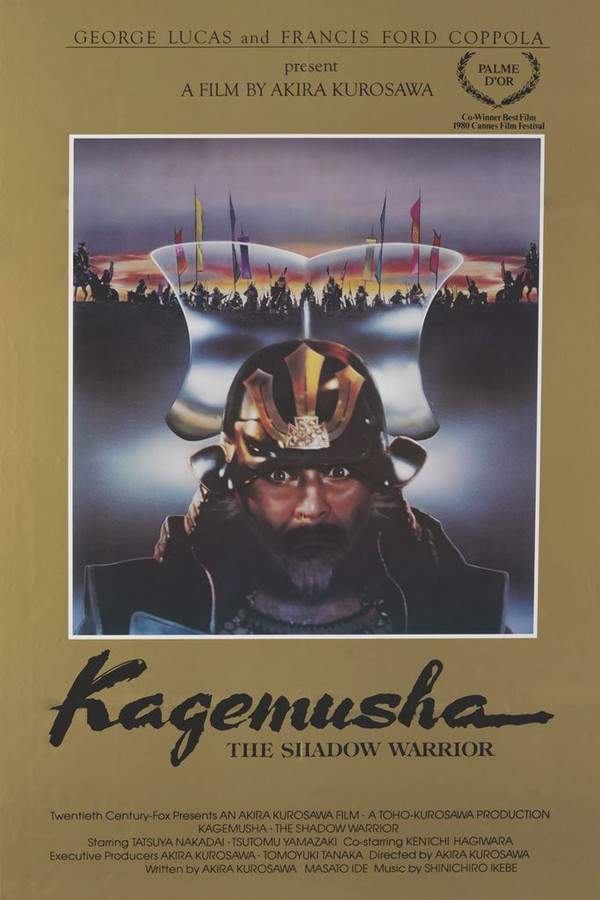
During a time of war, a petty criminal’s uncanny resemblance to a deceased powerful warlord leads him to be recruited to impersonate the man. As the Kagemusha, or "shadow warrior," he’s tasked with deceiving enemies and maintaining the illusion of the warlord’s continued presence. However, he soon finds himself entangled in genuine political intrigue and must grapple with the immense responsibility and danger of his deception, all while fearing exposure and the consequences it would bring.

Warning: spoilers below!

Haven’t seen Kagemusha yet? This summary contains major spoilers. Bookmark the page, watch the movie, and come back for the full breakdown. If you're ready, scroll on and relive the story!

Kagemusha (1980) – Full Plot Summary & Ending Explained

Read the complete plot breakdown of Kagemusha (1980), including all key story events, major twists, and the ending explained in detail. Discover what really happened—and what it all means.

During the tumultuous Sengoku period in 1571, the powerful daimyō of the Takeda clan, Takeda Shingen, encounters a thief whose life was spared from crucifixion by his brother Nobukado, due to the remarkable resemblance the thief bears to Shingen. A strategic decision follows—the brothers agree that the thief can serve as a kagemusha, or political decoy. As the Takeda army is engaged in a siege against a castle governed by Tokugawa Ieyasu, Shingen is tragically shot while enraptured by the haunting sound of a flute from the enemy camp. In a desperate move, he orders a retreat and instructs his generals to conceal his death for a mere three years before he ultimately succumbs to his injury. Meanwhile, rivals including Oda Nobunaga, Tokugawa Ieyasu, and Uesugi Kenshin begin to ponder the ramifications of Shingen’s withdrawal, blissfully ignorant of his demise.

Nobukado introduces the thief to Shingen’s generals with the proposal to have him impersonate Shingen continuously. Initially unaware of the gravity of Shingen’s condition, the thief inadvertently discovers the warlord’s preserved body encased in a large jar, mistakenly presuming it to be a treasure trove. As mistrust arises among the generals, they decide to release the impostor. In a turn of events, the jar is carelessly dropped into the depths of Lake Suwa, witnessed by spies from Tokugawa and Oda forces who quickly suspect that Shingen may have passed away. However, the clever thief, eavesdropping on the spies, returns to the Takeda army with an offer to continue serving as kagemusha. The Takeda clan spins a tale, claiming that they were merely performing a ritual of sake for the lake’s god, and the spies are ultimately convinced of the deception by the thief’s performance.

Returning to the Takeda stronghold, the kagemusha adeptly fools Shingen’s retinue through imitation of the late warlord’s mannerisms while increasingly learning about him. When faced with a clan meeting, Nobukado advises the kagemusha to remain silent until a consensus is reached among the generals. The kagemusha would then simply agree with their plans and dismiss the council. However, Shingen’s son Katsuyori, frustrated with the imposed three-year charade that postpones his claim to leadership, tests the kagemusha in front of the council where many still remain oblivious to Shingen’s demise. The kagemusha, rising to the occasion, provides answers in Shingen’s characteristic style, leaving the generals even more impressed.

By 1573, Nobunaga mobilizes his forces against Azai Nagamasa, continuing his campaign to secure Kyoto amid rising opposition. As the Tokugawa and Oda forces strike at the Takeda, Katsuyori disregards the counsel of his generals and launches a counter-attack. In a gripping moment, the kagemusha is compelled to lead the troops in the Battle of Takatenjin, where his charismatic leadership inspires a victorious outcome. However, caught in a surge of overconfidence, the kagemusha attempts to ride Shingen’s notoriously unpredictable horse and is unceremoniously thrown off. Observers quickly recognize he lacks Shingen’s battle scars, and he is subsequently unmasked as an impostor, leading to his disgrace and Katsuyori’s ascendancy to clan leadership. Sensing an opportunity in the Takeda clan’s weakened state, the Oda and Tokugawa forces boldly launch a full-scale offensive into Takeda territory.

By 1575, with Katsuyori firmly at the helm of the Takeda army, he spearheads a counter-assault against Nobunaga at Nagashino. Despite the bravery displayed in their attack, multiple waves of Takeda cavalry and infantry face devastation from the relentless musket fire of the Oda arquebusiers, leading to the near annihilation of the Takeda forces. Following closely behind, the kagemusha, driven by desperation, seizes a spear and charges toward the Oda lines, only to be struck down. Mortally wounded, he struggles to recover the distinguished fūrinkazan banner that has fallen into a turbulent river, but ultimately succumbs to his injuries, his body swept away by the current.

Last Updated: November 16, 2024 at 18:01

Mobile App Preview

Coming soon on iOS and Android

The Plot Explained Mobile App

From blockbusters to hidden gems — dive into movie stories anytime, anywhere. Save your favorites, discover plots faster, and never miss a twist again.

Sign up to be the first to know when we launch. Your email stays private — always.

Explore Movie Threads

Discover curated groups of movies connected by mood, themes, and story style. Browse collections built around emotion, atmosphere, and narrative focus to easily find films that match what you feel like watching right now.

Movies about reluctant impostors like Kagemusha

Ordinary individuals trapped in dangerous webs of lies, forced to become someone they're not.If you liked Kagemusha's story of a criminal forced to impersonate a warlord, explore these movies about similar deceptions. This collection features films where ordinary people must maintain a dangerous lie, leading to stories filled with political intrigue, personal sacrifice, and intense psychological tension.

tenseanxiousclaustrophobicsomberpsychologicalhigh-stakesidentity crisis

Narrative Summary

The narrative follows an unlikely protagonist who must take on a powerful identity, often against their will. The story unfolds with a steady buildup of pressure as the deception becomes more complex, forcing the character to grow into their role while grappling with the moral and emotional weight of their actions, typically culminating in a tragic or bittersweet conclusion.

Why These Movies?

These films are grouped together because they share a core premise of forced impersonation, creating a unique blend of psychological tension, character-driven drama, and high-stakes situational conflict. The shared experience is one of claustrophobic pressure and an exploration of identity under duress.

Somber historical war epics like Kagemusha

Grand-scale historical conflicts depicted with a heavy, melancholic focus on tragedy and sacrifice.For viewers who appreciated Kagemusha's melancholic and oppressive portrayal of feudal warfare, this list highlights similar epic war dramas. These movies share a bleak outlook on conflict, focusing on honor, duty, and the tragic futility of war rather than glorifying battle.

sombertragicoppressiveepicreflectiveheavyhistoricalwar

Narrative Summary

Stories in this thread unfold on a large canvas, following military leaders or key figures through pivotal historical conflicts. The narrative is less about individual heroism and more about the strategic, political, and personal tragedies that unfold. The pacing is steady, building towards climactic battles that often result in devastating losses, emphasizing the bleak realities of war.

Why These Movies?

These movies are united by their shared tone and thematic focus. They possess a consistent melancholic and somber atmosphere, a high level of emotional weight, and a steadfast commitment to exploring the tragic, rather than heroic, aspects of warfare and leadership.

Unlock the Full Story of Kagemusha

Don't stop at just watching — explore Kagemusha in full detail. From the complete plot summary and scene-by-scene timeline to character breakdowns, thematic analysis, and a deep dive into the ending — every page helps you truly understand what Kagemusha is all about. Plus, discover what's next after the movie.

Kagemusha Timeline

Track the full timeline of Kagemusha with every major event arranged chronologically. Perfect for decoding non-linear storytelling, flashbacks, or parallel narratives with a clear scene-by-scene breakdown.

Kagemusha Timeline

Characters, Settings & Themes in Kagemusha

Discover the characters, locations, and core themes that shape Kagemusha. Get insights into symbolic elements, setting significance, and deeper narrative meaning — ideal for thematic analysis and movie breakdowns.

Characters, Settings & Themes in Kagemusha

Kagemusha Spoiler-Free Summary

Get a quick, spoiler-free overview of Kagemusha that covers the main plot points and key details without revealing any major twists or spoilers. Perfect for those who want to know what to expect before diving in.

Kagemusha Spoiler-Free Summary

More About Kagemusha

Visit What's After the Movie to explore more about Kagemusha: box office results, cast and crew info, production details, post-credit scenes, and external links — all in one place for movie fans and researchers.

More About Kagemusha

Similar Movies to Kagemusha

Discover movies like Kagemusha that share similar genres, themes, and storytelling elements. Whether you’re drawn to the atmosphere, character arcs, or plot structure, these curated recommendations will help you explore more films you’ll love.