

Plot Explained Spoilers guaranteed!
Plot Explained

Browse by genre

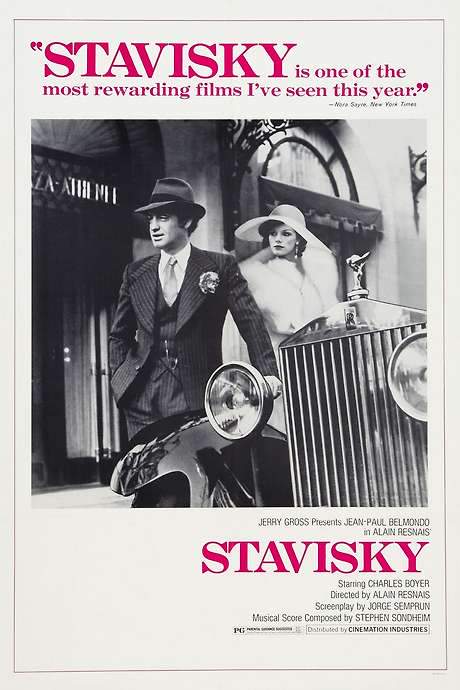
Stavisky… (1974) movie poster

Plot Summary

Stavisky… (1974) Plot Summary Explained

Release, runtime and language
1974 · 120 mins · French
Directed by
Alain Resnais
Starring
Paul Villé, Michael Lonsdale, François Périer, Niels Arestrup, Charles Boyer, Gérard Depardieu

Biarritz, 1933. With charm and talent, small‑time swindler Serge Alexandre—known as Stavisky—manipulates bribes to infiltrate the heart of French political power. When his massive fraud involving millions is uncovered, his actions destabilize the government, pushing the nation to the edge of collapse and a looming civil war.

On this page (6)
  1. 1 Where to watch
  2. 2 What happens: full plot
  3. 3 Plot questions answered
  4. 4 Movie threads
  5. 5 Movies like Stavisky…
  6. 6 Every angle

Where to watch

Where to Watch Stavisky… (1974)

Where can you watch Stavisky…? Stream, rent or buy it in the US, including on Kanopy: current JustWatch availability with up-to-date prices.

Streaming availability powered by JustWatch

Full plot summary · contains spoilers

What Happens in Stavisky…: Full Plot Summary

The whole story of Stavisky… (1974) explained, from the opening scene to the final frame: every key event, every twist and what it all adds up to. Read it as a quick recap before the sequel, to check a scene you missed, or to finally understand what really happened.

Set in the final months from late 1933 to January 1934, the film follows Serge Alexandre Stavisky, a controversial figure whose public image as a savvy financier masks a sprawling scheme. He operates as a “financial consultant,” founding a shadowy company that trades in international bonds, while secretly laundering stolen jewellery and shuffling funds to keep fraudulent bonds—sold through the Crédit Municipal in Bayonne—from being exposed. He also acts as a theatre impresario in Paris, gambles in casinos, and buys influence with the press, the police, and politicians, all while sustaining a lifestyle that aims to dazzle and intimidate.

At the center of the narrative is his devotion to his glamorous wife Arlette, and his use of her beauty to draw in funds from a Spanish revolutionary fascist. He tells his friends different versions of his past, mixing hints of a genuine political idealism with calculated self-justifications designed to keep his web of deception intact.

Between these strands, the film inserts brief flashes backward to his teenage awakening to a life of excess, a 1926 arrest as the petty crook Stavisky, and the suicide of his father after the family honor is tarnished. It also offers glimpses of his later rise and fall, punctuated by flash-forwards to his funeral and to the parliamentary inquiry into the Stavisky affair, where friends and allies testify with varying degrees of candor.

Parallel to the Stavisky saga are scenes portraying the arrival of Trotsky in France, seeking asylum, and his stay in country houses and hotels while left-wing activists visit him. These passages initially feel tangential, connected only by a police inspector who monitors Trotsky and later investigates Stavisky—until the end ties them more closely to the broader political tremors of the era. As Stavisky's crimes unravel, Trotsky's position becomes precarious, and ultimately he is expelled as a new government of national unity takes the stage.

The film closes on the unresolved death of Serge Alexandre Stavisky in a chalet in Chamonix, leaving the viewer with a stark question: was it a suicide akin to his father's act, or an assassination carried out to silence him for good?

Last updated: October 09, 2025 at 09:32

Was this helpful?

Plot questions answered

Stavisky… Plot Explained: Your Questions Answered

The questions people ask most about Stavisky… (1974): what happens in the confusing scenes, why the characters do what they do, the twists, hidden details and what the ending means. Each answer contains spoilers.

Q1

How did Stavisky's bonds scheme actually work?

Stavisky ran a fraudulent bonds operation through the Crédit Municipal in Bayonne. He founded a shadowy company that posed as a legitimate international bond trading business, but used it to sell fake bonds to investors. To keep the scheme afloat, he laundered stolen jewelry and shuffled funds between accounts, creating a continuous cycle of deception that masked the underlying fraud until it unraveled.

  • fraud
  • bonds
  • crédit municipal
  • bayonne
  • scheme
  • financial scheme
Q2

Why did Stavisky use his wife Arlette to lure the Spanish fascist?

Stavisky leveraged his wife Arlette's beauty and charm as a strategic tool to attract wealthy financiers. By persuading her to seduce the Spanish revolutionary fascist, he secured a significant source of funds for his fraudulent operations. This manipulation demonstrated how he intertwined his personal relationships with his financial schemes, treating personal intimacy as another asset in his web of deception.

  • arlette
  • spanish fascist
  • manipulation
  • funds
  • seduction
  • financial scheme
Q3

What is the connection between Stavisky and Trotsky's storylines in the film?

The film weaves Stavisky's financial crimes together with Trotsky's political exile in France during 1933-1934. A police inspector who monitors Trotsky's movements later investigates Stavisky, connecting the two narratives. Both men ultimately face expulsion and downfall as France forms a government of national unity, Stavisky through exposure of his fraud, Trotsky through deportation. The parallel suggests how the era's political instability affected figures across the spectrum.

Foreshadowing: The inspector's surveillance of Trotsky early in the film foreshadows his later investigation of Stavisky.

  • trotsky
  • police inspector
  • political asylum
  • exile
  • connection
  • investigation
Q4

Why did Stavisky's father commit suicide?

Stavisky's father killed himself after the family suffered dishonor, likely related to Serge's early criminal activities as a petty crook in 1926. This family tragedy deeply affected Stavisky, creating an obsession with reputation and image management. The traumatic loss mirrored his own ambiguous death, as the film suggests he too may have taken his own life rather than face exposure and scandal.

Foreshadowing: The 1926 arrest as a petty crook planted the seeds of the family dishonor that led to his father's suicide.

  • father
  • suicide
  • dishonor
  • family trauma
  • 1926 arrest
  • image management
Q5

What caused Stavisky's downfall and exposure?

Stavisky's downfall began when authorities uncovered the true extent of his fraudulent bonds scheme. He was then exposed as a Ukrainian immigrant and a Jew, and his connection to members of the left-of-centre government was revealed. These revelations shattered the network of protection he had built through bribes and political influence, leading to his collapse and triggering a national political crisis.

Foreshadowing: His elaborate network of influence over press, police, and politicians initially kept the scheme hidden but ultimately could not withstand thorough investigation.

  • downfall
  • exposure
  • ukrainian
  • jewish
  • government
  • political crisis
  • fraud exposed
Q6

Did Stavisky commit suicide or was he assassinated?

The film deliberately leaves Stavisky's death in a Chamonix chalet ambiguous. The uncertainty mirrors his father's suicide following family dishonor, suggesting he may have chosen to end his life rather than face the shame of exposure. Alternatively, he could have been assassinated to silence him and prevent testimony implicating political allies. The film presents both possibilities without confirming either.

Foreshadowing: The parallel to his father's suicide, shown in flashbacks, hints at the possibility of a similar end.

  • death
  • chamonix
  • suicide
  • assassination
  • ambiguous ending
  • mystery
Q7

How did Stavisky maintain influence over press, police, and politicians?

Stavisky systematically bought influence through bribery and cultivated relationships with key figures in media, law enforcement, and government. He used his charm, theatrical persona, and financial resources to create a protective network. His role as a theatre impresario in Paris and his extravagant lifestyle helped him appear legitimate and respectable, allowing him to delay detection of his frauds for years.

  • bribery
  • corruption
  • influence
  • press
  • police
  • politicians
  • network protection
Q8

Why was the Stavisky affair politically significant for France?

The Stavisky affair destabilized the French government in 1934, exposing deep corruption and eroding public trust in political institutions. His fraud, involving millions, revealed how a single individual could infiltrate the highest levels of power through bribery and manipulation. The scandal contributed to the fall of the government and the formation of a national unity administration, while also providing cover for Trotsky's expulsion from France.

  • political crisis
  • government collapse
  • corruption
  • scandal
  • 1934
  • france
  • national unity
Q9

Why did Stavisky tell different versions of his past to different people?

Stavisky presented contradictory accounts of his history to construct a flexible narrative that served his immediate needs. To some friends, he hinted at genuine political idealism; to others, he offered self-justifying stories about resilience and ambition. This pattern of deception allowed him to maintain different relationships and kept his true origins hidden. The film reveals his 1926 arrest as a petty crook, showing how he built a mythology around himself to obscure his humble and troubled beginnings.

  • deception
  • biography
  • mythology
  • contradictions
  • manipulation
  • backstory

Movie threads

More Movies Like Stavisky…, by Mood & Story

Curated lists built around what makes Stavisky… tick: the same mood, the same kind of story or the same emotional payoff. Each list explains why these movies belong together.

Movies about charismatic conmen like Stavisky…

The tragic unraveling of a charming swindler whose ambitions threaten everything. If you liked the story of Serge Stavisky's rise and fall, explore more movies like Stavisky… that follow charismatic swindlers. These films blend crime, drama, and history, focusing on the glamorous but anxious downfall of figures whose deceptive talents lead to catastrophic consequences.

  • glamorous
  • anxious
  • deceptive
  • corrosive
  • ominous
  • reflective
  • Tone: tense, melancholic, deceptive
  • Pacing: variable, reflective
Why these movies?

The story pattern: These narratives typically trace an arc from ambition to implosion. A charming protagonist uses wit and deception to climb social or political ladders, creating a facade of success. The central conflict arises from the threat of exposure, building immense tension as their meticulously constructed world begins to crack and ultimately crumbles.

Why they belong together: They are grouped by their focus on a specific character archetype—the tragic conman—and a shared tone that mixes glamour with deep-seated anxiety. The pacing often involves a slow build towards a catastrophic failure, creating a heavy, reflective mood centered on themes of corruption and the fragility of illusion.

Political corruption dramas with ominous tension like Stavisky…

Stories where personal scandal exposes the rot within a fragile political system. Find more movies like Stavisky… that explore political corruption and historical instability. These complex dramas use a personal story, often a crime or scandal, to illuminate wider societal decay, creating a tense and ominous atmosphere as a nation teeters on the brink of collapse.

  • political
  • ominous
  • corrosive
  • anxious
  • reflective
  • melancholic
  • Tone: ominous, tense, political
  • Pacing: variable, complex
Why these movies?

The story pattern: The narrative structure often weaves a personal story of ambition or crime with a parallel political narrative. The personal downfall of the protagonist directly impacts the fragile political order, revealing how interconnected they are. The plot is complex, requiring viewers to see the links between individual actions and their vast historical repercussions.

Why they belong together: This thread groups films by their shared setting—a politically volatile era—and their central theme: how a personal drama can trigger a systemic crisis. They share a heavy emotional weight, a tense and ominous tone, and a complex narrative that explores the corrosive effects of power and deception on a grand scale.

If you liked this

Movies Like Stavisky…

Similar movies to Stavisky…: the same genre, themes or kind of story. Each one comes with its own plot summary, timeline and ending explained.

Browse all movie summaries

Every angle

Stavisky… (1974) Explained: Plot, Timeline & Characters

Everything about Stavisky… in one place: what happens in the plot summary, the timeline in chronological order, the characters and meaning and a spoiler-free summary. What's After the Movie adds the cast, box office and post-credit scenes.

Coming soon on iOS and Android

The Plot Explained Movie Summary App

Plot summaries, endings explained and timelines on your phone. Catch up on any movie in minutes, save your favorites and never miss a twist again.

Be the first to know when we launch. Your email stays private, always.

Learn more about the app