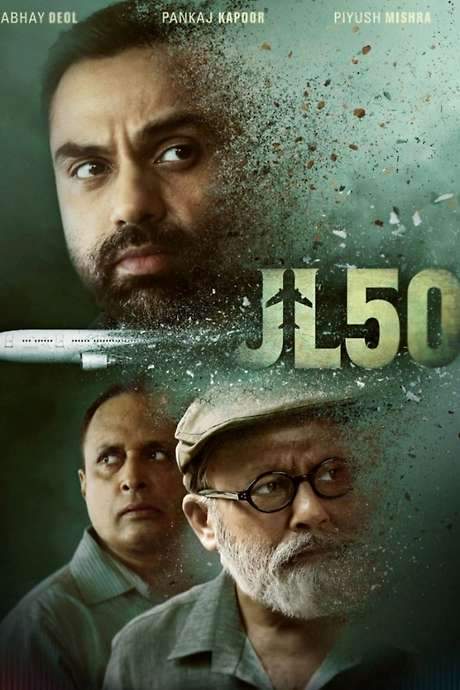
Shantanu, a Central Bureau of Investigation (CBI) officer, is summoned to investigate a plane crash in a remote corner of West Bengal. The news cycle erupts with headlines claiming a militant group hijacked a plane carrying a large group of dignitaries. At first, Shantanu and his colleague Gourango suspect that the wrecked aircraft might be the hijacked jet itself. Yet their investigation takes a baffling turn when they discover the shattered aircraft is Flight JL50, a plane that vanished 35 years earlier. Even as the evidence seems to point to a 35-year-old craft, Shantanu senses that something about the whole incident has been staged or manipulated in ways that defy straightforward explanation.
In the crash itself, the cockpit detaches from the main fuselage and crashes separately, leaving only two survivors: Bihu Ghosh, the pilot, and Professor Biswajit Mitra. When Bihu regains consciousness, she is struck by how drastically the world has changed in her absence. Mitra, meanwhile, is jubilant about his discovery and theories, and medical staff soon suspect he may be mentally unstable, leading to his sedation as doctors try to de-escalate the situation.
As Shantanu digs into Mitra’s past, he uncovers Mitra’s professional work and his strong leanings toward communist ideals. A home visit uncovers plan drawings of the plane in Mitra’s old files, hinting at a larger project. Through a university professor, Shantanu learns that Mitra was involved in something called "Project A." The story then threads back through history: centuries ago, after witnessing the Kalinga War, Emperor Ashoka adopted non-violent Buddhism—often recalled as Dhamma Vijaya—and compiled information on science and technology that he believed could be dangerous if left in the wrong hands. In this lineage, Mitra’s father is said to have worked on time-travel research, though funding dried up after independence, and Mitra carried the thread forward. Shantanu also learns that Mitra’s longtime confidant was Subroto Das.
During further inquiry, [Subroto Das] reveals Mitra’s plan, which involved hijacking a plane and traversing a wormhole. By decoding "Project A," Mitra supposedly identified the coordinates of a wormhole in the sky. But due to a miscalculation, the plane jumped 35 years into the future and landed in the present day, setting off the mystery that Shantanu and his allies face. Das, a quantum physics expert, tries to persuade Shantanu that what happened is a matter of time travel, and that they might be able to go back to the past through the same wormhole to prevent the hijacking. He promises proof if they return to the same coordinates where Bihu Ghosh had flown in. He further asserts that if they can go back and stop the hijack, the present would be rewritten to erase the crisis and the demands of the hijackers would never arise again. Bihu agrees, and together they embark on a perilous journey back in time, only to discover that their actions have ripple effects that alter the future.
The trio travels back to August 1984, where they manage to intervene and stop Professor Mitra—from boarding JL50—in a tense shootout inside a ramshackle factory godown. By preventing the hijack, they also avert the plane’s crash in 2019, triggering a cascade of changes that reshape the present in profound ways. This makes for an entirely different future than the one Shantanu initially knew.
The narrative then threads into Shantanu’s own origins. It is revealed that he was left at an orphanage as a newborn. While visiting the orphanage, he encounters an elderly man who once abandoned an infant and realizes that he himself was the baby in question. Earlier episodes show Bihu having learned she had given birth to a stillborn child out of wedlock, but in the final arc it is revealed that Bihu is Shantanu’s mother, and the older man was his grandfather. This revelation reframes the events that led to the original disappearance of JL50 and the fate of Bihu, intertwining their destinies in surprising ways. The hijack and JL50’s disappearance in 1984 are erased in the alternate timeline, allowing Bihu to remain with her own child rather than vanishing into the future.
As the alternate reality settles, Shantanu and a now elder Bihu are depicted in 2019, a version of life where both are more hopeful and content. They are shown distributing gifts to orphans at the same orphanage where Shantanu was once found, symbolizing a quiet happiness and a sense of gratitude for the second chance they’ve been granted. Shantanu is portrayed as the only person who retains memory of both parallel timelines, preserving a unique cognitive link between the divergent paths that could have unfolded. The final credits gently hint at the lingering, unresolved elements of the original timeline—an unnamed figure associated with the evolving papers appears in the 1984 sequence, underscoring the idea that time and choice continue to ripple through their world.
Overall, the story blends mystery, science fiction, and questions about fate and family. It follows a careful, methodical investigation that evolves into a speculative journey through time, where the consequences of stopping a hijack reach far beyond a single plane and alter the very fabric of personal histories and relationships. The tone remains measured and grounded, even as it traverses extraordinary concepts, inviting viewers to consider how small acts in the past could reshape futures in ways that are both hopeful and morally complex.
![Investigation of a Citizen Above Suspicion [re-release] movie poster](https://whats-after-the-movie-ti152.sevalla.storage/movies/investigation-of-a-citizen-above-suspicion.jpg)