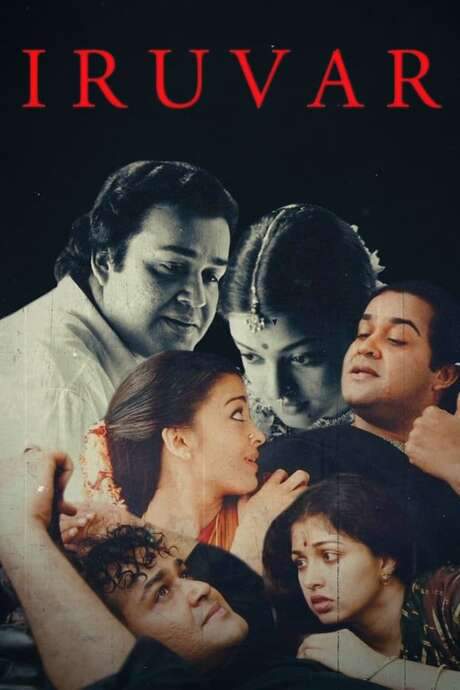
In the late 1940s, Anandan, an aspiring actor, roams the bustling studios of Madras in search of a break, his eyes bright with ambition and a hunger to perform. He crosses paths with Tamizhselvan, a rationalist writer whose Dravidian ideas he deeply respects. Through Tamizhselvan’s eloquent prose and Anandan’s impassioned delivery, he lands the title roles in a series of films, setting the stage for a rise that blends cinema with politics.
Tamizhselvan introduces him to Ayya Veluthambi, the charismatic leader of a Dravidian political party, and Anandan finds himself drawn to the movement’s causes. He marries Pushpavalli, while Tamizhselvan marries Marathagam. When the pair return to Madras, Anandan’s film is cancelled due to financial troubles, and Tamizhselvan’s party swiftly becomes the main opposition. Anandan’s fortunes dip as he is reduced to minor roles, and he sends Pushpavalli back to their village, even considering enlisting in the army. A short time later, Pushpavalli succumbs to illness, and Tamizhselvan consoles a despondent Anandan, smoothing over the personal loss as public life beckons.
Weeks pass, and Anandan’s luck reverses as he is offered the lead in a new project. He convinces the director to hire Tamizhselvan as the screenwriter, and the film’s release proves a tremendous success, catapulting Anandan into Tamil cinema stardom within a few years. As his fame grows, Tamizhselvan urges him to use his popularity to bolster their political cause. Anandan then marries Ramani, a fellow actress who has endured hardship at the hands of her family, deepening his ties to both the industry and the movement.
Five years later, Veluthambi asks Anandan to contest the elections, although Tamizhselvan believes other devoted workers deserve the chance. A filming accident briefly tests him when a prop gun shoots near his neck, but the party wins decisively, taking 152 seats out of 234. Veluthambi refuses to become chief minister, instead asking Anandan and Madhivannan to decide who should hold the post. Tamizhselvan feels sidelined by the decision, yet he is chosen as chief minister with Anandan’s full support. Anandan later requests to become health minister, but Tamizhselvan refuses, arguing that an executive committee rule bars ministers from continuing to act on screen while in office. He offers Anandan any portfolio if he suspends his acting career, but Anandan declines.
Senthamarai, who had once admired Tamizhselvan’s daring protests, moves in with him after a poetic letter and the couple’s daughter together. Anandan’s next film co-stars Kalpana, who resembles his late wife; though initially distant, Kalpana’s lively nature draws him closer, even as he remains married to Ramani. Kalpana’s playful candor unsettles him, and she ultimately leaves when his hesitation to take another wife festers into tension.
At a memorial function for Veluthambi’s death, Anandan publicly accuses the party of corruption, triggering a split in the movement and the formation of a new faction under Anandan’s leadership. For the next four years, Anandan uses his films to expose governance corruption, riding a wave of public support to win the next election with 145 of 234 seats. Yet the new government mirrors the old in many ways, and Tamizhselvan’s furious denunciations spark protests that Anandan answers with arrests, even as he searches for Kalpana at a disaster-relief site. A car bringing Kalpana to safety is involved in an accident, and she dies, deepening Anandan’s grief.
In the aftermath, at Veluthambi’s granddaughter’s wedding, a visibly ailing Anandan meets Tamizhselvan. They exchange a silent handshake but scarcely speak, a poignant moment of shared history. The following morning, Ramani discovers Anandan dead in his bed, and Tamizhselvan, in a final, mournful monologue set in the place where they once envisioned ruling Tamil Nadu, recites poetry that mourns his death.