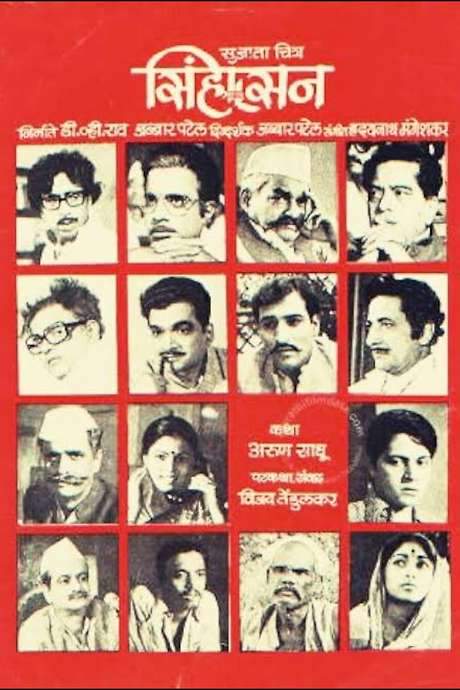
Drought and hunger, power and prestige—the film places Maharashtra’s political arena under a bright, scrutinizing light, showing how easily the corridors of power bend when media attention, labor unrest, and business interests align. At the center is Digu Tipnis, a relentless journalist who uncovers a hidden web of telephone tapping, covert alliances between trade unions and politicians, and a pattern of corruption that links Mumbai’s booming entrepreneurial scene to the state’s ruling class. What begins as investigative curiosity quickly spirals into a high-stakes game where every phone call can tilt the balance of power.
The action shifts to the legislative floor and backroom deals, where the Chief Minister, Arun Sarnaik, finds his grip on the chair strained after a provocative late-night call. The anonymous informer claims that members within his own party are secretly plotting to unseat him, a revelation that rattles the state’s political machinery and sets off a chain of maneuvers behind closed doors. Suspicion naturally falls on the Finance Minister, Shreeram Lagoo, who begins compiling MLA support in a bid to position himself as the next CM, while the larger drama of power unfolds through a chorus of players—police, party loyalists, and ambitious rivals.
The film layers its political intrigue with a vibrant cast of recurring figures. A fearless Union Leader, known as D’casta, becomes a pivotal voice in the conflict, challenging smugglers and exposing the underbelly of corruption. In the margins of this drama, a young criminal, portrayed by Nana Patekar, enters the scene as a reminder that violence and crime can also shape the political landscape. The media facet—embodied by Digu Tipnis as a journalist named Digambar—drives the public narrative and keeps the pressure on those who wield power.
Interwoven with the political stratagems are the private entanglements that complicate loyalties. Digambar’s relationship with his maid and the tumult within his own personal life mirror the broader theme: the personal and the political are inseparable in a system where every alliance is transactional. The Finance Minister’s affair with his daughter-in-law, played by Reema Lagoo, adds another layer of tension to the corridors of influence, as loyalties and reputations become instruments in the power game. A memorable moment unfolds in a barber shop, where the barber presses Digambar about the future of Maharashtra’s CM, and the journalist bluntly responds: > who ever becomes the CM, how will that make any changes in your life as a common man?
The narrative also foregrounds the relentless jockeying among ministers. The film shows ministers, including Madhukar Toradmal and Shreeram Lagoo, maneuvering behind the scenes, trading favors, and using phone lines as tools to pit one cabinet member against another. This behind-the-scenes warfare culminates in a dramatic sequence where hunger strikes, worker protests, famine, and malnutrition deaths become a pressure point that tests every party’s resolve. The pace intensifies as the CM’s supporters and the FM’s faction brace for a final, decisive round of political theater.
Towards the end, the film paints a stark picture of how systemic corruption corrodes even the strongest voices. Digambar witnesses a cascade of decisions and counter-decisions that threaten to topple the government, while the CM, already strained by anonymous warnings, finds his health and judgment fraying under the weight of orchestrated pressure. The party’s inner circle—illustrated by performances from Madhukar Toradmal and Shreeram Lagoo—offers counsel that veers from caution to calculation, urging the CM to “take it easy” even as the clock ticks toward a potentially explosive unraveling.
In the end, the film offers a solemn meditation on the cost of greed and self-interest. Digu Tipnis’s sense of disillusionment grows into a state of fracturing reality, and the story makes explicit how the voracious appetite of white-collar power infects the lives of ordinary people. The political spectacle—captured in tense assembly scenes, dramatic press conferences, and quiet, revealing moments—serves as a mirror to a system where ambition sometimes outruns accountability. The emotional core is anchored by the haunting song Usha kaal hota hota, a reminder of the fragility and endurance of human aspirations in the face of corrupt structures.












![Investigation of a Citizen Above Suspicion [re-release] movie poster](https://whats-after-the-movie-ti152.sevalla.storage/movies/investigation-of-a-citizen-above-suspicion.jpg)
