Plot Explained Spoilers guaranteed!
Plot Explained

Browse by genre

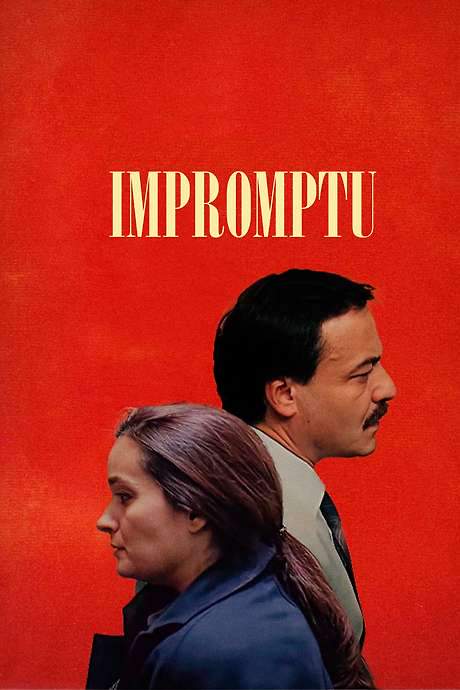
Impromptu (1991) movie poster

Timeline

Impromptu (1991) Timeline Explained – Every Event in Order

Release, runtime and language
1991 · 107 mins · English
Loading streaming availability…
Directed by
James Lapine
Starring
Emma Thompson, Mandy Patinkin, Hugh Grant, Anna Massey, Julian Sands, Judy Davis

In 1830s France, renowned pianist and composer Frédéric Chopin becomes the object of affection of the determined, independent writer known as George Sand, a woman famed for her scandal‑defying lifestyle. Their budding romance pits artistic passion against societal expectations, charting the turbulent courtship that would shape both their lives.

On this page (6)
  1. 1 Where to watch
  2. 2 Events in order (14)
  3. 3 Timeline questions answered
  4. 4 Movie threads
  5. 5 Movies like Impromptu
  6. 6 Every angle
Loading streaming availability…

14 events in order · contains spoilers

Impromptu Timeline: Events in Chronological Order

Every key event of Impromptu (1991) in order, scene by scene, with when and where it takes place. Use it to untangle flashbacks, time jumps and parallel storylines, to refresh your memory before the sequel or to find the exact scene you are thinking of.

  1. George Sand's Paris life after divorce

    Baroness Sand lives in Paris under the male pseudonym George Sand after completing her memoirs. She is driven and provocative, wearing men's clothing and pursuing a string of lovers. She sets her sights on the young composer Frédéric Chopin.

    When
    1830s
    Where
    Paris, France
  2. Countess d'Agoult's manipulative guidance

    Sand's friend Countess Marie d'Agoult advises her to pursue Chopin with the tenacity of a hunter, suggesting a masculine approach. She works to keep Chopin and Sand apart, resenting Sand's independence and her own past with Liszt. The tension sets the moral battlefield for their entanglement.

    When
    1830s
    Where
    Paris, France
  3. First meeting: 1836 at Duchess d'Antan's house

    Sand meets Chopin in 1836 at the French country house of the Duchess d'Antan. The gathering also includes Liszt, de Musset, Delacroix, and others drawn to the fabled salon. The setting promises artistic glitter but also social undercurrents.

    When
    1836
    Where
    Duchess d'Antan's country house, French countryside
  4. Luminaries invited, staying for luxury

    The duchess idolizes her celebrated guests and they accept the arrangement to live in luxury with only brilliance required at dinner. The scene blurs lines between patrons and artists, nurturing extravagant pretensions. Sand's presence adds a note of audacious daring to the party.

    When
    1836
    Where
    Duchess d'Antan's house
  5. Sand arrives with children, uninvited rivals

    Sand brazenly invites herself and her children to the house party, alongside former lovers de Musset and Mallefille, who also show up uninvited. The dynamic becomes a crowded tinderbox of egos and unresolved rivalries. The strain foreshadows the social fireworks to come.

    When
    1836
    Where
    Duchess d'Antan's house
  6. Riding accident reveals Sand's disguise

    During a riding accident, the duke is grateful to the 'young lad' who helps by shooting the injured horse. The twist is that the 'lad' is actually George Sand herself in disguise. The revelation heightens the guests' embarrassment and the tension between host and guests.

    When
    1836
    Where
    Duchess d'Antan's estate
  7. Love note to Chopin and its misdelivery

    Sand writes a passionate letter to Chopin and has it delivered by d'Agoult, who signs Sand's name. Chopin is alarmed by the boldness and wary of being overwhelmed by Sand. The moment crystallizes the misunderstandings fueling their attraction.

    When
    1836
    Where
    Duchess d'Antan's house
  8. Dress and seduction: Polish colors

    The duchess mimics Sand by dressing in her husband's clothes, while Sand wears a dress in the colors of the Polish flag to catch Chopin's eye. The visual gambit underscores their gender politics and Chopin's confusion about Sand's intent. The tension between restraint and pursuit intensifies.

    When
    1836
    Where
    Duchess d'Antan's house
  9. The satirical play and the fireplace incident

    The luminaries stage a short play satirizing the aristocracy, which Chopin protests as bad manners. A prank by Sand's children triggers a fireplace explosion, injuring their hosts and souring the gathering. The party collapses as guests overstay their welcome.

    When
    1836
    Where
    Duchess d'Antan's house
  10. D'Agoult's rumor and the letter's signature revealed

    Afterward, d'Agoult falsely tells Chopin that Sand gambled for money to seduce him, pushing him away. He later buys a copy of Sand's memoir and finds the phrase from the signed letter, confirming the deception. The incident exposes the treachery and intensifies mistrust.

    When
    1836-1837
    Where
    Paris, France
  11. Chopin's rebuke and Sand's resolve

    Chopin declares that his weak and failing body is separate from his spirit, implying he is not fit for a romance with Sand. Sand insists she can bolster his health and resolve, keeping the flame alive. The moment marks a shift from pursuit to care.

    When
    1836-1837
    Where
    Paris, France
  12. Duel and Sand's intervention

    Mallefille, once Sand's rival for her tutor position, challenges Chopin; before the duel, Sand intervenes and shoots Mallefille with his pistol, ending the duel. She then tends to Chopin, nursing him back to health and calming their fraught relationship.

    When
    1836
    Where
    Paris, France
  13. Études dedication and Liszt's quarrel

    Sand convinces Chopin to dedicate his Études to d'Agoult, an act Liszt interprets as infidelity and sparks a quarrel with his mistress. The artistic and personal rivalries come to a head, altering tensions among the circle. Chopin's gesture complicates loyalties.

    When
    1836
    Where
    Paris, France
  14. Flight to Majorca for convalescence

    With the entanglements set aside temporarily, Sand and Chopin depart for Majorca for convalescence, seeking space away from Parisian artistic competitiveness. The trip signals a new phase of their relationship, grounded in care rather than public drama. The journey ends the immediate salon scene.

    When
    Post-1836
    Where
    Majorca, Spain

Last updated: October 09, 2025 at 14:22

Was this helpful?

Timeline questions answered

Impromptu Timeline Explained: Your Questions Answered

When does it happen, and why in that order? The questions people ask about the chronology of Impromptu (1991): time jumps, flashbacks, cause and effect between scenes and the correct order of events, each answered with spoilers.

Q1

Why does George Sand pursue Chopin so aggressively?

George Sand is immediately captivated by Chopin's musical talent and sees in him a rare artistic brilliance she wants to claim as her own. As a woman who defies convention by wearing men's clothing and pursuing multiple lovers, Sand approaches romance as she does her writing, with relentless determination and a willingness to break social boundaries. Her pursuit is also a test of her own power; she wants to prove she can win over someone as fragile and revered as Chopin.

Foreshadowing: Early in the film, Sand declares she fixes on things that are dangerous, setting up her fixation on Chopin as both an artistic and personal challenge.

  • george sand
  • chopin
  • pursuit
  • romance
  • artist relationship
Q2

Why does Countess d'Agoult lie to Chopin about Sand?

Countess d'Agoult advises Sand to pursue Chopin with masculine aggression, but her true motive is revenge and jealousy. She was once Franz Liszt's mistress and resents Sand's independence and confidence. By telling Chopin that Sand gambled money to seduce him, d'Agoult plants distrust and attempts to sabotage their connection, using treachery to protect her own wounded pride and maintain power within the artistic circle.

Foreshadowing: d'Agoult's counsel to 'act like a pursuer' is revealed as a strategic manipulation rather than genuine friendship.

  • countess dagoult
  • lie
  • manipulation
  • jealousy
  • liszt
Q3

What happens to Sand's love letter to Chopin?

Sand writes a passionate letter to Chopin and entrusts it to d'Agoult for delivery. However, d'Agoult removes Sand's signature before giving it to Chopin, making the letter appear anonymous and suspiciously bold. Chopin, alarmed by the aggressive tone and unsure of the sender, becomes wary of Sand's intentions. The missing signature creates unnecessary doubt and misunderstanding between them.

Foreshadowing: d'Agoult's role as messenger early on establishes her as an untrustworthy intermediary.

  • love letter
  • signature
  • misunderstanding
  • courtship
Q4

Why does Sand wear men's clothing and the Polish flag dress?

Sand wears men's clothing throughout the party as a deliberate statement of her defiance of gender norms, she refuses to be confined by society's expectations of women. When she appears in a dress colored like the Polish flag, she is making a specific gesture toward Chopin, who was Polish. It's a calculated seduction attempt, signaling her respect for his heritage while still challenging conventional femininity. The duchess imitates Sand by wearing her husband's clothes, showing how Sand's boldness influences others.

Foreshadowing: Sand's earlier statement about wearing men's clothing establishes her identity as a social rebel.

  • mens clothing
  • polish flag
  • seduction
  • gender
  • fashion
Q5

Why does Sand shoot Mallefille in the duel?

Mallefille, a former rival for Sand's affection and her children's tutor, challenges Chopin to a duel out of jealousy and resentment. Sand intervenes because she has already developed genuine feelings for Chopin and cannot bear to see him harmed. By taking the pistol and firing at Mallefille, she stops the duel and demonstrates that her pursuit of Chopin is serious, not a game. This act of protection marks the turning point where her attraction transforms into genuine care.

Foreshadowing: Mallefille's uninvited arrival at the party signals unresolved rivalry that would later escalate.

  • duel
  • mallefille
  • sand
  • protection
  • jealousy
Q6

What causes the fireplace explosion at the party?

The fireplace explosion is triggered by a prank orchestrated by Sand's children. During the lavish house party, the children cause a mishap with the fireplace that results in an explosion, injuring the Duchess d'Antan and her husband. This incident symbolizes the chaos that surrounds Sand wherever she goes, it marks the end of the party's elegance and forces the guests to leave in embarrassment. The explosion becomes a memorable scandal that taints everyone's recollection of the gathering.

Foreshadowing: Sand's uninvited arrival with her children establishes the family as disruptive forces at the party.

  • fireplace
  • explosion
  • prank
  • children
  • scandal
Q7

Why does Chopin dedicate his Études to d'Agoult?

Despite d'Agoult's betrayal in spreading the false rumor about Sand, Chopin agrees to dedicate his Études to her at Sand's urging. Sand believes this dedication will smooth over tensions within the artistic circle and perhaps even make d'Agoult feel guilty. However, Liszt interprets the dedication as a personal betrayal, leading to a heated quarrel. The decision reveals Sand's political intelligence but also creates new conflicts, showing how the web of relationships among artists remains volatile.

Foreshadowing: The earlier betrayal sets up the irony of Chopin's later dedication.

  • etudes
  • dedication
  • dagoult
  • liszt
  • artistic circle
Q8

Why do Sand and Chopin flee to Majorca?

After the duels, rumors, and artistic rivalries in Paris reach a breaking point, Sand and Chopin retreat to Majorca to recover both their health and their relationship. Chopin is physically fragile, and the cold Parisian winter aggravates his tuberculosis. Majorca offers warmer climate for his health and provides space away from the constant social competition and drama of the Parisian salon. Their journey represents a shift from public pursuit to private intimacy, seeking happiness away from society's judgment.

Foreshadowing: Chopin's fragile health and Sand's promise to strengthen his resolve foreshadow their need for retreat.

  • majorca
  • convalescence
  • health
  • retreat
  • paris
Q9

Why is Chopin wary of Sand's affection?

Chopin is naturally delicate in both health and temperament, making him hesitant to commit to anyone, especially someone as bold and demanding as Sand. The unsigned love letter alarms him because it suggests aggressive intent. Then d'Agoult's false rumor that Sand gambled money to seduce him plants deep distrust. Additionally, Chopin fears being overwhelmed, his weak body makes him protective of his limited energy and independence. He ultimately decides his failing body is unfit for romance, though Sand insists she can strengthen his resolve.

Foreshadowing: Chopin's initial wariness about being overwhelmed is established when he receives the unsigned letter.

  • chopin
  • wariness
  • trust
  • health
  • romance
Q10

What role does the Duchess d'Antan play in the story?

The Duchess d'Antan hosts the pivotal house party where Sand and Chopin first meet. An aspiring socialite, she dreams of creating a Parisian-style salon in the countryside and lavishly hosts famous artists like Liszt, de Musset, and Delacroix. Though financially strained, she maintains the illusion of luxury by requiring her guests to perform brilliantly at dinners. Her husband's resistance to the social whirlwind provides comic tension, while the duchess's own imitation of Sand's men's clothing demonstrates Sand's influence on those around her.

Foreshadowing: The duchess's desire for a salon establishes the gathering that brings all key characters together.

  • duchess dantan
  • house party
  • salon
  • hosting
  • socialite

Movie threads

More Movies Like Impromptu, by Mood & Story

Curated lists built around what makes Impromptu tick: the same mood, the same kind of story or the same emotional payoff. Each list explains why these movies belong together.

Movies about scandalous artistic love affairs like Impromptu

Passionate, turbulent romances that clash genius with societal conventions. If you liked the passionate and defiant romance in Impromptu, explore more movies about famous artists and writers whose love lives defied convention. These films capture the bittersweet blend of creative genius and societal scorn, offering similar sophisticated and romantic dramas.

  • romantic
  • passionate
  • defiant
  • sophisticated
  • melancholic
  • historical
  • Tone: bittersweet, passionate
  • Pacing: steady, character-driven
Why these movies?

The story pattern: These narratives follow brilliant, often controversial figures as they embark on love affairs that challenge the strictures of their time. The central conflict arises from the friction between personal desire and public expectation, charting a course of passionate highs and melancholic sacrifices.

Why they belong together: They are grouped by their shared focus on a specific type of historical romance—one fueled by artistic genius and societal rebellion. The mood is consistently passionate, sophisticated, and bittersweet, with a steady pace that allows for deep character exploration amidst turbulent relationships.
Bittersweet historical romance movies like Impromptu

Elegant love stories where profound connection is tempered by poignant sacrifice. Find more films like Impromptu that deliver a sophisticated and emotionally resonant period romance. These movies feature compelling characters in elegant settings, whose love stories are deeply felt but ultimately tinged with a realistic, bittersweet poignancy.

  • bittersweet
  • romantic
  • sophisticated
  • melancholic
  • witty
  • elegant
  • Tone: bittersweet, romantic
  • Pacing: steady, deliberate
Why these movies?

The story pattern: The journey typically involves two strong-willed individuals from different worlds finding a deep, intellectual, and emotional bond. Their romance unfolds with sophistication and wit, but is persistently challenged by societal norms, past entanglements, or personal circumstances, leading to an ending that is fulfilling yet realistically complex.

Why they belong together: They share a specific emotional mix: the earnestness of true romance balanced by the melancholy of real-world limitations. The pacing is steady, allowing the relationship to develop naturally, and the tone consistently blends witty, romantic moments with a underlying sense of poignant reality.

If you liked this

Movies Like Impromptu

Similar movies to Impromptu: the same genre, themes or kind of story. Each one comes with its own plot summary, timeline and ending explained.

Browse all movie summaries

Every angle

Impromptu (1991) Explained: Plot, Timeline & Characters

Everything about Impromptu in one place: what happens in the plot summary, the timeline in chronological order, the characters and meaning and a spoiler-free summary. What's After the Movie adds the cast, box office and post-credit scenes.

Coming soon on iOS and Android

The Plot Explained Movie Summary App

Plot summaries, endings explained and timelines on your phone. Catch up on any movie in minutes, save your favorites and never miss a twist again.

Be the first to know when we launch. Your email stays private, always.

Learn more about the app