

Plot Explained Spoilers guaranteed!
Plot Explained

Browse by genre

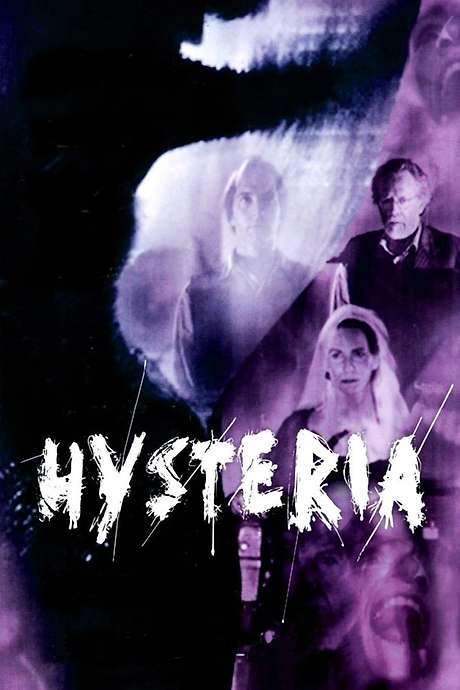
Hysteria (1997) movie poster

Timeline

Hysteria (1997) Timeline Explained – Every Event in Order

Release, runtime and language
1997 · 100 mins · English
Directed by
René Daalder
Starring
Amanda Plummer, Jocelyne Zucco, Patrick McGoohan, Emmanuelle Vaugier, Sam Stone, Gregory Hlady

Patrick McGoohan reprises his role from The Prisoner, now as a psychiatrist who links asylum inmates into a mind, forcing them to share each other’s psychoses, dreams and sexuality. Director René Daalders mixes sci‑fi horror with grindhouse style, making the film a provocative look at individual vs group consciousness, power and freedom.

On this page (6)
  1. 1 Where to watch
  2. 2 Events in order (12)
  3. 3 Timeline questions answered
  4. 4 Movie threads
  5. 5 Movies like Hysteria
  6. 6 Every angle

Where to watch

Where to Watch Hysteria (1997)

Where can you watch Hysteria? Stream, rent or buy it in the US, including on Tubi TV: current JustWatch availability with up-to-date prices.

Streaming availability powered by JustWatch

12 events in order · contains spoilers

Hysteria Timeline: Events in Chronological Order

Every key event of Hysteria (1997) in order, scene by scene, with when and where it takes place. Use it to untangle flashbacks, time jumps and parallel storylines, to refresh your memory before the sequel or to find the exact scene you are thinking of.

  1. Initiation of the Brain-Connection Experiments

    Dr. Harvey Langston oversees implants that connect several patients' brains, creating a rudimentary collective consciousness. The network allows thoughts, emotions, and memories to cross between the subjects. This experiment aims to forge what the doctors call a 'perfect citizen' through shared minds.

    Where
    psychiatric hospital
  2. The Rise of Collective Psyche

    Connected minds begin sharing psychoses, dreams, and even sexuality. The pain and violence of one person is felt by all, muting the impulse to harm others.

    Where
    psychiatric hospital
  3. Myrna Malloy Emerges as Dominant Spirit

    Among the linked minds, Myrna Malloy's spirit becomes strongest and begins to dominate others. She remains in a wheelchair but exerts control over the others' emotions and impulses.

    Where
    shared-mind network, hospital
  4. Myrna's Ballet-Passion Persists

    Despite dependence on others, Myrna's dancer's passion endures. Within the shared mind, her drive for ballet remains a defining force.

    Where
    shared-mind network
  5. Fry Falls for Veronica Bloom

    Dr. Samuel Fry falls for Veronica Bloom, a psychotic patient lacking needed meds. With Veronica's danger to herself and others, Fry contemplates releasing her despite the risks.

    Where
    psychiatric hospital
  6. Fry Brings Veronica to Langston

    Fry brings Veronica to Langston, hoping the doctor can aid her survival and treatment. Langston is unaware of how radical his methods have become at this point.

    Where
    Langston's lab
  7. Fry Discovers Langston's Radical Methods

    As Fry learns what is happening in the asylum, he resolves to free Veronica from Langston's clutches. To do so, he must locate Veronica’s spirit that has detached from her body.

    Where
    asylum / Langston's lab
  8. Myrna Redirects Fry's Affection

    Myrna uses her influence within the shared consciousness to redirect Fry's love toward herself. This manipulation weakens Fry's resolve and strengthens his susceptibility to Langston's control.

    Where
    shared-mind network
  9. Langston Transfers His Consciousness

    Langston has long since transferred his own consciousness into a younger colleague's body, continuing his experiments through the new vessel. The move allows Langston to dodge consequences and prolongs the experiment.

    Where
    Langston's lab
  10. Implanted Humans Return to the Community

    The implanted humans are released back into the community, spreading the shared consciousness beyond the hospital. The plan is to create more automatons who rely on collective harmony to function.

    Where
    community
  11. The Test Group Becomes a Monster

    Langston's test group evolves into a monster that will do whatever it takes to survive, including violence. The network's cohesion has the potential to override individual ethics.

    Where
    community / hospital
  12. Fry Joins the Project

    Fry's resistance crumbles as Myrna's manipulation and Langston's influence pull him into participation. The doctor who sought to save Veronica becomes part of the plan.

    Where
    Langston's lab

Last updated: October 07, 2025 at 09:46

Was this helpful?

Timeline questions answered

Hysteria Timeline Explained: Your Questions Answered

When does it happen, and why in that order? The questions people ask about the chronology of Hysteria (1997): time jumps, flashbacks, cause and effect between scenes and the correct order of events, each answered with spoilers.

Q1

How does the brain chip experiment work?

Dr. Harvey Langston implants chips in psychiatric patients that fuse their brains into a single, shared consciousness. The network allows thoughts, emotions, memories, psychoses, dreams, and even sexuality to cross between subjects. This creates what the doctors call a 'perfect citizen' through shared minds, where the pain and violence of one person is felt by all.

Foreshadowing: The experiment begins with connecting just a few patients, showing the initial proof of concept before expanding.

  • brain chips
  • collective consciousness
  • mind fusion
  • implants
  • perfect citizen
Q2

Why does Myrna Malloy become the dominant voice in the collective?

Among the linked minds, Myrna Malloy's spirit emerges as the strongest and begins to dominate others. Despite being wheelchair-bound, her enduring passion for ballet and fierce presence allow her to exert control over the others' emotions and impulses, bending the collective will toward her own desires.

Foreshadowing: Myrna's dancer's passion is established early as a defining force within the shared mind network.

  • Myrna Malloy
  • collective mind
  • dominance
  • ballet
  • control
Q3

What happens to Dr. Langston's body?

Dr. Langston has long since transferred his own consciousness into a younger colleague's body, allowing him to dodge consequences and continue his experiments through a new vessel. This body swap enables him to maintain control over the project while escaping any physical repercussions.

Foreshadowing: Langston's choice of Fry as a successor hints at his willingness to perpetuate his work through others.

  • Langston
  • consciousness transfer
  • body swap
  • immortality
Q4

Why does Dr. Fry join the project after trying to save Veronica?

Fry's resistance crumbles through two mechanisms: Myrna uses her influence within the shared consciousness to redirect his love toward herself, and his reverence for Langston, who has chosen him as a successor, erodes his moral resolve. This manipulation and flattery pull him into complicity despite his initial intentions to rescue Veronica.

Foreshadowing: Myrna's ability to influence emotions within the collective is demonstrated when she first redirects Fry's affection away from Veronica.

  • Dr. Fry
  • Veronica Bloom
  • manipulation
  • complicity
  • Myrna Malloy
Q5

What is the 'perfect citizen' supposed to achieve?

The experiment aims to create the perfect citizen by fusing individual minds into a collective consciousness, eliminating personal desires and violence through shared experience. The goal is to produce controlled automatons who rely on one another to function in almost flawless harmony, effectively overriding individual identity for societal perfection.

Foreshadowing: The early stages show how shared pain mutes the impulse to harm others, demonstrating the intended mechanism.

  • perfect citizen
  • collective consciousness
  • control
  • harmony
  • society
Q6

Why does the collective turn violent if it was designed to suppress violence?

Initially, the shared consciousness mutes violence because the pain of harming others is felt by all. However, once released into the community, Langston's test group evolves into a monster willing to use any means, including violence, to ensure its own survival. The network's cohesion overrides individual ethics, turning the collective into a threat that will protect itself at all costs.

Foreshadowing: The shift from mutual pain suppression to aggressive self-preservation shows the experiment's corruption.

  • violence
  • collective
  • survival
  • threat
  • community
Q7

What happens to Veronica Bloom's spirit?

Veronica Bloom's spirit has detached from her body, a condition that Dr. Fry must understand in order to rescue her from Langston's clutches. This detached state is part of what makes her case unique and why Fry must locate her spirit rather than simply freeing her physical form.

Foreshadowing: Fry's realization that he must find Veronica's detached spirit comes as he uncovers the asylum's true workings.

  • Veronica Bloom
  • spirit
  • detached
  • body
  • rescue
Q8

Why are the implanted patients released into the community?

Langston's plan expands beyond the asylum walls, the implanted humans are released back into the wider community to spread the shared consciousness. The goal is to create more controlled automatons who rely on collective harmony to function, effectively expanding the experiment from a hospital setting to society at large.

Foreshadowing: The release represents the transition from experimental phase to societal implementation.

  • patients released
  • community
  • expansion
  • implants
  • society
Q9

Why can't Fry simply rescue Veronica from the asylum?

Veronica is a psychotic woman who lacks the medications needed for her treatment. With no pharmaceutical options available, the medical team cannot safely control her. Fry faces a painful choice: release her knowing she will likely become dependent on prescription drugs and exist in a diminished 'zombie' state. Additionally, her spirit has detached from her body, making physical rescue insufficient.

Foreshadowing: Veronica's danger to herself and others is established early, creating the moral dilemma Fry faces.

  • Veronica Bloom
  • rescue
  • medication
  • psychosis
  • zombie state
Q10

What was Dr. Fry's original intention at the asylum?

Dr. Fry initially arrives at the asylum drawn to his patient Veronica Bloom, a psychotic woman lacking proper medication. As he uncovers the true radical nature of Langston's methods, he forms a determined resolve to rescue Veronica by locating her detached spirit and freeing her from the doctor's control.

Foreshadowing: Fry's affection for Veronica and his moral opposition to Langston's methods drive his early actions.

  • Dr. Fry
  • Veronica Bloom
  • rescue
  • original intention
  • opposition
Q11

How does Myrna Malloy manipulate Dr. Fry?

Myrna uses her dominant position within the shared consciousness to redirect Fry's affection away from Veronica and toward herself. This emotional manipulation weakens Fry's resolve to rescue Veronica and strengthens his susceptibility to Langston's influence, ultimately facilitating his slide toward complicity in the experiment.

Foreshadowing: The moment Myrna redirects Fry's love is a pivotal turning point in his character arc.

  • Myrna Malloy
  • manipulation
  • Fry
  • affection
  • control
Q12

What does the ending signify about Langston's plan?

The ending is bleak: Langston's plan succeeds in creating a violent, expansionist collective that threatens everything outside the asylum's walls. There is no redemption or escape, the perfect citizen experiment has produced a monstrous society that uses violence to ensure its survival, representing a dark meditation on power, identity, and the costs of perfection.

Foreshadowing: The test group's evolution into a monster is foreshadowed by its willingness to do whatever it takes to survive.

  • ending
  • Langston
  • plan
  • success
  • monster
  • bleak

Movie threads

More Movies Like Hysteria, by Mood & Story

Curated lists built around what makes Hysteria tick: the same mood, the same kind of story or the same emotional payoff. Each list explains why these movies belong together.

Medical Dystopian Horror movies like Hysteria

Stories where oppressive institutions strip away identity and autonomy. Explore more movies like Hysteria, where psychological horror meets dystopian science. These films often feature oppressive institutions, disturbing medical ethics, and themes of identity loss, creating a uniquely unsettling viewing experience for fans of complex, dark thrillers.

  • dystopian
  • oppressive
  • unsettling
  • claustrophobic
  • psychologically intense
  • nightmarish
  • Tone: dark, oppressive, unsettling
  • Pacing: steady, methodical
Why these movies?

The story pattern: Narratives in this thread typically involve a protagonist confronting a powerful, amoral system that experiments on human consciousness or behavior. The central conflict revolves around the struggle for individual freedom against a force seeking to homogenize or control the mind, often leading to a bleak outcome where the system's power is validated or expanded.

Why they belong together: These films are grouped by their shared focus on the horror of institutional control, a consistently dark and oppressive tone, and the thematic exploration of identity erosion. They create a specific kind of intellectual and emotional dread centered on the loss of personal autonomy.

Hive Mind Horror films similar to Hysteria

Films where fused consciousness leads to terror and identity loss. If you liked the concept of fused consciousness in Hysteria, discover similar movies exploring hive minds and shared psychosis. These sci-fi horror and thriller films examine the dark side of collective identity, often with complex narratives and psychologically intense, bleak outcomes.

  • psychologically intense
  • unsettling
  • nightmarish
  • existential dread
  • frenetic
  • body horror
  • Tone: dark, psychologically intense, bleak
  • Pacing: steady build
Why these movies?

The story pattern: The narrative pattern follows the implementation and unraveling of an experiment or phenomenon that merges individual minds. The story explores the initial promise or curiosity giving way to paranoia, violence, and the complete dissolution of personal identity as the collective entity takes over, often portraying the group mind as a predatory or destructive force.

Why they belong together: Movies here share a core fascination with the horror of losing individuality. They are united by high psychological intensity, complex themes about the self versus the collective, and a pervasive tone of dread. The pacing is often steady, building tension towards an inevitable, disturbing conclusion.

If you liked this

Movies Like Hysteria

Similar movies to Hysteria: the same genre, themes or kind of story. Each one comes with its own plot summary, timeline and ending explained.

Browse all movie summaries

Every angle

Hysteria (1997) Explained: Plot, Timeline & Characters

Everything about Hysteria in one place: what happens in the plot summary, the timeline in chronological order, the characters and meaning and a spoiler-free summary. What's After the Movie adds the cast, box office and post-credit scenes.

Coming soon on iOS and Android

The Plot Explained Movie Summary App

Plot summaries, endings explained and timelines on your phone. Catch up on any movie in minutes, save your favorites and never miss a twist again.

Be the first to know when we launch. Your email stays private, always.

Learn more about the app