Plot Explained Spoilers guaranteed!
Plot Explained

Browse by genre

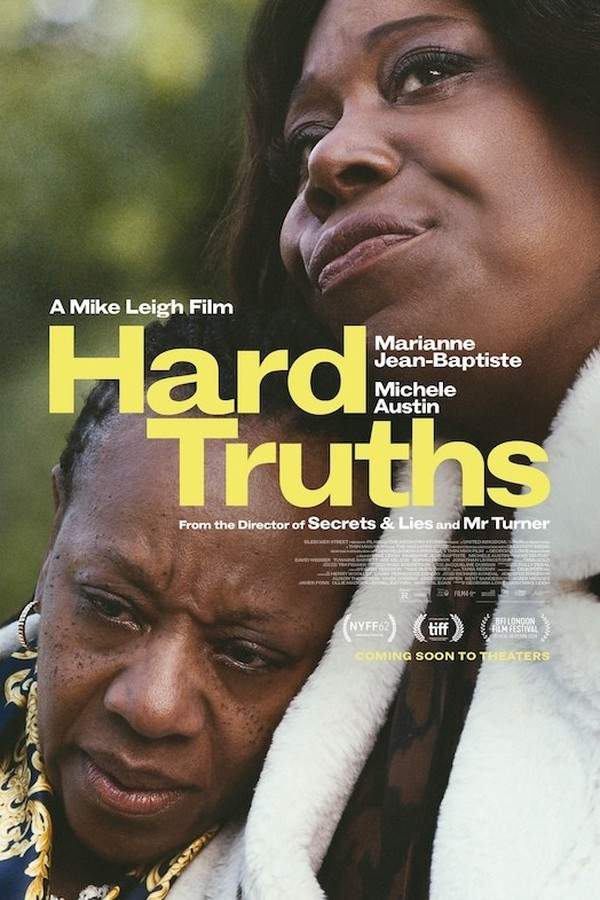
Hard Truths (2024) movie poster

Plot Summary

Hard Truths (2024) Plot Summary & Ending Explained

Release, runtime and language
2024 · 1 h 37 m · English
Echo score 69
JustWatch #17,101 7
Directed by
Mike Leigh
Starring
Elliot Edusah, Marianne Jean-Baptiste, Bryony Miller, Jo Martin, Jonathan Livingstone, Sophia Brown

Pansy, portrayed by Marianne Jean-Baptiste, is a troubled woman struggling with fear and various afflictions. She often lashes out in anger, directing her frustrations towards her husband, son, and those around her. In contrast, her younger sister, played by Michele Austin, is a relaxed and single mother living a vastly different life, full of warmth and a supportive community.

On this page (7)
  1. 1 Where to watch
  2. 2 What happens: full plot
  3. 3 Plot questions answered
  4. 4 How it ends
  5. 5 Movie threads
  6. 6 Movies like Hard Truths
  7. 7 Every angle

Where to watch

Where to Watch Hard Truths (2024)

Where can you watch Hard Truths? Stream, rent or buy it in the US, including on fuboTV, Paramount Plus Premium and Hoopla: current JustWatch availability with up-to-date prices.

Streaming availability powered by JustWatch

Full plot summary · contains spoilers

What Happens in Hard Truths: Full Plot Summary

The whole story of Hard Truths (2024) explained, from the opening scene to the final frame: every key event, every twist and what it all adds up to. Read it as a quick recap before the sequel, to check a scene you missed, or to finally understand what really happened.

Pansy Deacon is a troubled and anxious woman whose life is dominated by her meek plumber husband, Curtley and their lazy adult son, Moses, whom she continually criticizes for lacking ambition. Her short temper leads her to confront and argue with everyone around her, from family members to strangers. Deeply affected by anxiety, she finds it tremendously challenging to step outside her home, harboring a strong dislike for animals and flowers alike.

As Mother's Day approaches, her sister, Chantelle, a single mother working as a hairdresser, urges Pansy to visit their mother Pearl's grave to mark the fifth anniversary of her passing. Despite Chantelle's insistence, Pansy is hesitant and resists the idea, overwhelmed by her own fears and insecurities.

In the days leading up to this memorial occasion, Pansy's emotional turmoil causes her to clash with various individuals. Ultimately, she accompanies Chantelle to their mother’s grave, where emotions run high. Pansy expresses her bitterness, feeling that Pearl favored Chantelle after their father left, a claim that Chantelle firmly refutes. In a heartfelt moment, Pansy confesses her deep fear that her family harbors contempt for her. In response, Chantelle reassures her sister of her love, despite the challenges Pansy faces.

Shifting to the Mother's Day celebration at Chantelle's apartment, Pansy struggles to connect with her family, remaining distant and withdrawn. In a moment of vulnerability, she reveals to Chantelle that her marriage to Curtley was born out of desperation, and she finds herself stuck in a relationship that contributes to her loneliness. However, a surprising gesture from Moses—a bouquet of flowers for Mother’s Day—shatters her initial beliefs about his indifference. The unexpected gesture causes Pansy to erupt into tears of joy, expressing gratitude to her son in an emotional breakdown.

As the Deacon family returns home, Pansy faces her anxieties head-on. She carefully arranges the flowers in a vase and leaves the patio door ajar, hopeful. However, unbeknownst to her, Curtley discards the flowers outside and shuts the door, reflecting his own unacknowledged pain. The following day brings more distress as Curtley injures his back at work, prompting him to send a coworker to check on Pansy. This interaction only heightens her anxiety to the point of immobilization, preventing her from going downstairs.

Amidst this turmoil, a young woman approaches Moses during his walk, and for the first time, he shows a hint of happiness. Meanwhile, Pansy remains confined within the house, unaware of the silent sorrow of her husband as he weeps below her. Thus, the cycle of anxiety, familial strain, and the search for connection continues, painting a poignant picture of everyday struggles within the Deacon household.
Last updated: February 26, 2025 at 09:00

Was this helpful?

Plot questions answered

Hard Truths Plot Explained: Your Questions Answered

The questions people ask most about Hard Truths (2024): what happens in the confusing scenes, why the characters do what they do, the twists, hidden details and what the ending means. Each answer contains spoilers.

Q1

Why does Pansy refuse to visit her mother's grave at first?

Pansy's refusal stems from overwhelming anxiety and unresolved grief. She harbors deep bitterness toward her mother Pearl, believing Pearl favored her sister Chantelle after their father left. This resentment, combined with her general fear of leaving home, makes confronting her mother's grave emotionally unbearable.

Foreshadowing: Earlier scenes show Pansy's general aversion to the outside world and her tense relationship with Chantelle, hinting at deeper family wounds.

  • anxiety
  • grief
  • mother
  • grave
  • family tension
Q2

Why does Pansy think her family hates her?

Pansy's anxiety manifests as a deep-seated fear that those closest to her harbor contempt for her. This belief is reinforced by her constant conflicts with her husband and son, leading her to interpret neutral or even positive actions as evidence of underlying resentment.

Foreshadowing: Her continuous criticism of Moses and Curtley throughout the film reflects her projection of her own self-loathing onto her family.

  • family
  • contempt
  • fear
  • anxiety
  • relationships
Q3

What does Pansy confess to Chantelle about her marriage?

Pansy reveals that her marriage to Curtley was born out of desperation rather than love. She feels trapped in a relationship that contributes to her overall loneliness, admitting that she settled for someone who would have her despite her own emotional struggles.

Foreshadowing: Earlier scenes showing Pansy's critical behavior toward Curtley hint at this underlying resentment and lack of genuine connection.

  • marriage
  • desperation
  • loneliness
  • confession
Q4

Why does Moses give Pansy flowers on Mother's Day?

Moses surprises everyone, including Pansy, by giving her flowers for Mother's Day. This gesture contradicts Pansy's belief that her son is lazy and indifferent toward her. It represents a moment of unexpected emotional connection and challenges her negative perception of her family.

Foreshadowing: This moment directly contradicts Pansy's earlier complaints about Moses lacking ambition and caring nothing for her.

  • moses
  • flowers
  • mother's day
  • gesture
  • emotional moment
Q5

Why does Curtley throw away the flowers after Pansy puts them in a vase?

Curtley acts out of frustration and unacknowledged pain. After returning home, he discards the flowers and shuts the patio door, reflecting his own emotional suffering that he cannot express. This act symbolizes the ongoing breakdown of communication within the marriage.

Foreshadowing: Curtley's silent demeanor throughout the film and his eventual breakdown hint at underlying resentment he cannot voice.

  • curtley
  • flowers
  • frustration
  • communication breakdown
Q6

What causes Pansy to become paralyzed with anxiety?

When Curtley sends a coworker to check on her, Pansy's anxiety reaches a breaking point. The intrusion of a stranger into her home triggers severe panic, preventing her from leaving her bedroom. This moment demonstrates the severity of her mental health struggles and how they isolate her completely.

Foreshadowing: Earlier scenes establish her intense fear of the outside world and strangers, making this reaction consistent with her character.

  • anxiety
  • paralysis
  • panic
  • immobility
  • mental health
Q7

Why does Curtley weep silently at the end of the movie?

Curtley cries silently downstairs while Pansy remains confined to her bedroom, unable to move due to her anxiety. His tears reflect his own accumulated pain, his injury, his unexpressed frustration with the flowers, and his helplessness watching his wife struggle without being able to reach her.

Foreshadowing: Curtley's quiet demeanor throughout the film masks his deep emotional pain, which finally surfaces in this final moment.

  • curtley
  • crying
  • silent pain
  • helplessness
  • emotion
Q8

What does Pansy accuse her mother of at the grave?

At Pearl's grave, Pansy accuses her mother of favoring Chantelle after their father left the family. This accusation reveals the deep-seated resentment Pansy has carried since childhood, believing she was always secondary to her sister in their mother's eyes.

Foreshadowing: Chantelle's continuous efforts to help Pansy despite her resistance hints at this historical dynamic.

  • grave
  • favoritism
  • accusation
  • childhood
  • resentment
Q9

Why does Pansy lash out at everyone around her?

Pansy's anger stems from her severe anxiety and depression. She directs her internal turmoil outward, attacking those closest to her. Her short temper creates conflict with family and strangers alike, though these outbursts are expressions of her internal struggle rather than genuine hatred.

Foreshadowing: The opening scenes establish her pattern of confrontation with both family and strangers, setting up her psychological profile.

  • anger
  • anxiety
  • depression
  • outbursts
  • lashing out
Q10

What does the ending suggest about the family's future?

The ending leaves the family in a cycle of isolation and unresolved pain. While Pansy briefly experiences hope through Moses's gesture, this is undercut by Curtley's action and subsequent injury. Both partners remain emotionally trapped, Pansy confined to her bedroom, Curtley weeping silently below, suggesting the family's struggles will continue without intervention.

Foreshadowing: The mother's day flowers symbolize the fleeting nature of hope in this family, quickly destroyed by miscommunication and emotional walls.

  • ending
  • cycle
  • isolation
  • future
  • bittersweet

Ending explained

What Happens at the End of Hard Truths?

How Hard Truths (2024) ends, in short: the final scene, the last twist and what it means for the characters. The full ending explained, with every spoiler, lives on its own page.

Read the full ending explained

In the closing moments of Hard Truths, the family members are left uncertain about the future of their relationships. When Curtley injures his back at work and waits for Pansy to come downstairs to help him, we see that she is at a crossroads. If she chooses to descend and engage with him, it might signify her willingness to confront her pain and rebuild their relationship. However, her decision to stay in her room suggests she might be retreating further into her emotional shell, possibly indicating a decision to distance herself from Curtley and her family. Regardless of her choice, the lingering question emphasizes that their family struggles remain unresolved. The film hints that honesty and emotional openness are essential for healing, yet consistent communication has never been fully established among them.

The ending also leaves Moses in a moment of quiet vulnerability, possibly sitting beside a stranger who shows him kindness—perhaps a symbol of hope and connection. This small act of empathy could represent a crucial turning point for him, suggesting he might find the strength to open up or seek help to address his loneliness and feelings of failure. Ultimately, Hard Truths closes with the idea that confronting these unspoken, painful realities is necessary for healing, but it requires courage from each family member to share their true feelings and break free from the cycle of silence and misunderstanding. The family’s future remains uncertain, but the possibility of reconciliation and self-awareness lingers, hinting that the road to healing begins with honesty and vulnerability.

Hard Truths ending explained in full

Movie threads

More Movies Like Hard Truths, by Mood & Story

Curated lists built around what makes Hard Truths tick: the same mood, the same kind of story or the same emotional payoff. Each list explains why these movies belong together.

Slow-burn family dramas of quiet desperation like Hard Truths

Stories where emotional turmoil simmers beneath the surface of everyday life. For viewers seeking movies like Hard Truths, this list features slow-paced, character-driven family dramas. If you liked the focus on internal anxiety and fractured relationships in Hard Truths, you'll appreciate these similar stories of emotional struggle and everyday hardship.

  • somber
  • family drama
  • emotional turmoil
  • claustrophobic
  • gritty
  • anxious
  • Tone: melancholic, somber
  • Pacing: slow, deliberate
Why these movies?

The story pattern: These narratives typically follow a linear path centered on a family unit, unfolding at a deliberate pace. The conflict is largely internal and interpersonal, focusing on the slow erosion of connections under the strain of mental health issues, grief, or generational trauma, rather than external plot events.

Why they belong together: They are grouped by their shared melancholic tone, heavy emotional weight, and slow pacing. All prioritize a gritty, realistic portrayal of family life and emotional isolation, creating a cohesive viewing experience defined by somber reflection and psychological depth.

Intimate portraits of mental health struggles like in Hard Truths

Character studies focusing on the internal battle with anxiety and isolation. This collection highlights films similar to Hard Truths that explore mental health with raw honesty. If you appreciated the portrayal of Pansy's anxiety and emotional isolation, these movies offer comparable character studies of psychological struggle and its effect on daily life.

  • anxious
  • vulnerable
  • emotional turmoil
  • claustrophobic
  • gritty
  • somber
  • Tone: melancholic, gritty
  • Pacing: slow, observational
Why these movies?

The story pattern: The narrative pattern is a straightforward, inward-looking journey. The plot serves to illuminate the protagonist's psychological state, often through their strained interactions with close family or partners. The arc is less about resolution and more about gaining a deeper understanding of the character's internal world.

Why they belong together: They share a central thematic focus on mental health, depicted with emotional heaviness and a grounded, often bleak or bittersweet, sensibility. The similarity lies in the vulnerable character perspective and the serious, respectful treatment of psychological themes.

If you liked this

Movies Like Hard Truths

Similar movies to Hard Truths: the same genre, themes or kind of story. Each one comes with its own plot summary, timeline and ending explained.

Browse all movie summaries

Every angle

Hard Truths (2024) Explained: Plot, Ending, Timeline & Characters

Everything about Hard Truths in one place: what happens in the plot summary, the timeline in chronological order, the characters and meaning, the ending explained and a spoiler-free summary. What's After the Movie adds the cast, box office and post-credit scenes.

Coming soon on iOS and Android

The Plot Explained Movie Summary App

Plot summaries, endings explained and timelines on your phone. Catch up on any movie in minutes, save your favorites and never miss a twist again.

Be the first to know when we launch. Your email stays private, always.

Learn more about the app