Plot Explained Spoilers guaranteed!
Plot Explained

Browse by genre

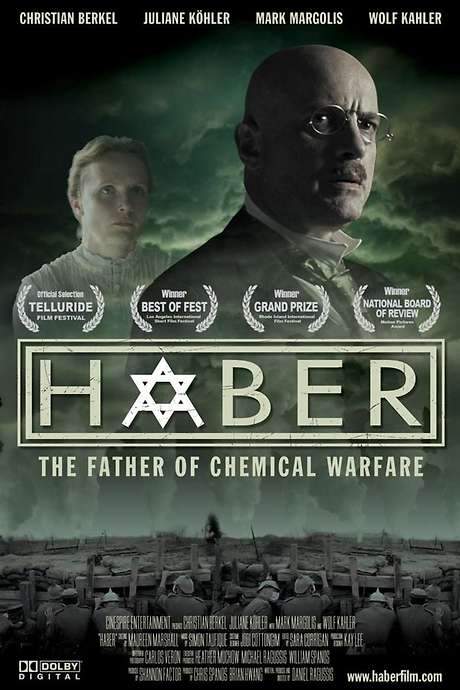
Haber (2008) movie poster

Timeline

Haber (2008) Timeline Explained – Every Event in Order

Release, runtime and language
2008 · 34 mins · English
Loading streaming availability…
Directed by
Daniel Ragussis
Starring
Juliane Köhler, Mark Margolis, Christian Berkel, Wolf Kahler, Maury Cooper

During World War I, Fritz Shimon Haber, a chemist and Nobel laureate for synthetic fertilizers, is pressed by the military to create chemical weapons. After renouncing his Jewish heritage, he invents a poison‑gas arsenal, a weapon of mass destruction. His personal life collapses: his wife Clara commits suicide and his invention aids Nazi genocide.

On this page (6)
  1. 1 Where to watch
  2. 2 Events in order (12)
  3. 3 Timeline questions answered
  4. 4 Movie threads
  5. 5 Movies like Haber
  6. 6 Every angle
Loading streaming availability…

12 events in order · contains spoilers

Haber Timeline: Events in Chronological Order

Every key event of Haber (2008) in order, scene by scene, with when and where it takes place. Use it to untangle flashbacks, time jumps and parallel storylines, to refresh your memory before the sequel or to find the exact scene you are thinking of.

  1. Birth in Germany and Jewish origins; the push to belong

    Fritz Haber was born in Germany into a Jewish family, and his origin shaped the choices he faced in early life. He longed to be accepted as a true German, a drive that influenced his personal and professional decisions. To fit in, he converted to Lutheranism, a step that would echo through his life and career.

    Where
    Germany
  2. Nobel Prize for the Haber process

    In 1918 Haber was awarded the Nobel Prize for the Haber process, a breakthrough in fixing atmospheric nitrogen on an industrial scale. The prize recognized a major advancement with wide-reaching implications for agriculture and war. The ceremony in Stockholm solidified his reputation as a leading scientist.

    When
    1918
    Where
    Stockholm, Sweden
  3. Industrial impact: fertilizers and explosives

    The Haber process enabled synthetic fertilizers and provided the precursors for explosives used in conflict. This dual-use invention massively increased short-term crop yields worldwide, reshaping agriculture. It also bound scientific progress to the devastation of war.

    When
    Early 20th century
    Where
    Global
  4. Drafted to develop chlorine gas

    Haber was drafted by the German government to develop chlorine gas for warfare, marking a shift from peaceful science to weapons design. The project placed him at the center of an escalating arms race on the Western Front. It reflected the era's moral and strategic pressures on scientists.

    When
    1914-1915
    Where
    Germany
  5. Chlorine gas used on the Western Front

    Chlorine gas was deployed at Ypres and other fronts, signaling a horrific new form of warfare. The attacks demonstrated the lethal potential of gas and sparked international condemnation and debate. This work would later be scrutinized under evolving conventions on chemical weapons.

    When
    1915
    Where
    Ypres, Belgium
  6. Clara Immerwahr: a brilliant chemist in the background

    Clara Immerwahr, Haber's wife, was a talented chemist who sacrificed her own career to support him and raise a family. She resented the domineering dynamic of their marriage and disapproved of science being used for war. Her perspective highlights the personal costs behind scientific ambition.

    Where
    Germany
  7. Clara Immerwahr's suicide

    Clara Immerwahr committed suicide, an event that exposed the intimate costs of Haber’s path. Her death cast a long shadow over Haber and the meaning of his achievements. The film uses this moment to foreground the human consequences of scientific pursuit.

    Where
    Germany
  8. Immediate aftermath: Haber moves to the front

    The day after Clara's death, Haber left to supervise the introduction of chemical warfare to the Eastern Front. This relocation marked a brutal turn in his career and in the war’s history. It underscored the personal costs of his professional choices.

    When
    Just after Clara's death
    Where
    Eastern Front
  9. Moral conflict at the heart of the scientist

    The film foregrounds Haber’s internal struggle between scientific genius and the human cost of his inventions. He confronts whether knowledge should be pursued without regard to its uses. This tension drives the narrative and ethical questions it raises.

    Where
    Germany
  10. Long-term consequences: fertilizer vs war

    Haber’s nitrogen chemistry helped feed growing populations but also strengthened militaries and industry worldwide. Over time, the fertilizer system contributed to corporate agribusiness and soil depletion. The film highlights the environmental and ethical tradeoffs of his work.

    When
    20th century
    Where
    Global
  11. Legacy and controversy: a Nobel laureate with a dark side

    Haber's life presents a paradox: a Nobel laureate whose work enabled both life-sustaining agriculture and mass destruction. The film frames his achievements against the human costs and historical consequences of chemical warfare. This duality invites reflection on responsibility in science.

    Where
    Global
  12. Closing thought: science's moral responsibility

    The narrative asks what accountability scientists owe society for how discoveries are used. Haber’s story becomes a cautionary tale about ambition, identity, and the ethics of research. It invites ongoing reflection on balancing progress with humanitarian considerations.

    Where
    Global

Last updated: February 17, 2026 at 19:56

Was this helpful?

Timeline questions answered

Haber Timeline Explained: Your Questions Answered

When does it happen, and why in that order? The questions people ask about the chronology of Haber (2008): time jumps, flashbacks, cause and effect between scenes and the correct order of events, each answered with spoilers.

Q1

Why did Fritz Haber convert to Lutheranism?

Fritz Haber converted to Lutheranism to gain acceptance in German society and advance his scientific career. Despite being born into a Jewish family, he desperately wanted to be seen as a true German, and converting was the price he paid for professional advancement in a society that excluded Jews from prominent positions.

Foreshadowing: His early choice to abandon his Jewish identity sets up the moral compromises that follow throughout his career.

  • conversion
  • lutheranism
  • assimilation
  • german society
  • jewish identity
Q2

Why did Haber agree to develop chemical weapons for Germany?

Haber was drafted by the German government to translate his scientific knowledge into weapons during World War I. He was essentially conscripted to apply his chemistry expertise to create chlorine gas for the battlefield, a decision that placed him at the center of the emerging chemical warfare arms race.

Foreshadowing: This decision marks the moment where pure scientific discovery becomes entangled with mass destruction.

  • chemical weapons
  • chlorine gas
  • world war i
  • german military
  • conscription
Q3

Why did Clara Immerwahr commit suicide?

Clara Immerwahr, Haber's wife, was a talented chemist who sacrificed her own career to support him. She strongly opposed his work developing chemical weapons and felt trapped in a domineering marriage. Her suicide was a devastating protest against the path his research was taking and the personal cost of his ambition.

Foreshadowing: Earlier scenes show Clara's growing resentment as she witnesses Haber's willingness to weaponize science.

  • clara immerwahr
  • suicide
  • protest
  • chemical weapons
  • marriage conflict
Q4

Why did Haber go to the front the day after Clara's death?

The day after Clara's suicide, Haber left to supervise the deployment of chemical warfare on the Eastern Front. This brutal decision demonstrated his commitment to his work over personal grief, illustrating the extent to which he had prioritized his scientific and military role over his family life.

Foreshadowing: This moment reveals the complete abandonment of personal morality in service of professional duty.

  • eastern front
  • chemical warfare deployment
  • personal consequences
  • grief
Q5

What was the Haber-Bosch process and why was it important?

The Haber-Bosch process, for which Haber won the Nobel Prize in 1918, is an industrial method to fix atmospheric nitrogen into ammonia. This breakthrough enabled synthetic fertilizers that dramatically increased agricultural yields, but it also provided the key precursor for explosives used in warfare, making it a dual-use invention with profound consequences.

Foreshadowing: The Nobel Prize ceremony in Stockholm marks the apex of his career before the moral descent becomes undeniable.

  • nobel prize
  • nitrogen fixation
  • ammonia
  • fertilizers
  • explosives
  • habER-BOSCH
Q6

How were Haber's fertilizer discoveries connected to chemical warfare?

The same nitrogen chemistry that produced synthetic fertilizers also produced the chemicals needed for explosives and poison gas. The Haber-Bosch process created ammonia, which could be converted into both agricultural nutrients and munitions, making his scientific work intrinsically linked to both feeding populations and killing them.

Foreshadowing: This dual-use nature was apparent even as the Nobel Prize celebrated the agricultural benefits.

  • nitrogen chemistry
  • ammonia
  • dual-use
  • fertilizers
  • explosives
  • poison gas
Q7

What was the moral conflict at the center of Haber's story?

Haber grappled with whether scientific knowledge should be pursued without regard to its applications. He confronted the question of whether a scientist bears responsibility for how their discoveries are used, torn between the thrill of breakthrough discoveries and the human cost of their military applications.

Foreshadowing: This internal struggle intensifies as his weapons work directly leads to civilian casualties.

  • moral responsibility
  • scientific ethics
  • genius
  • accountability
  • dual-use technology
Q8

Why is Fritz Haber considered a controversial historical figure?

Haber represents the paradox of a Nobel laureate whose work enabled both life-sustaining agriculture and mass destruction. While his fertilizers helped feed millions, his chemical weapons contributed to wartime atrocities and later Nazi genocide, making his legacy a cautionary tale about the unintended consequences of scientific ambition.

Foreshadowing: The film frames his achievements against the human costs and historical consequences of chemical warfare.

  • controversial legacy
  • nobel prize
  • chemical warfare
  • genocide
  • responsibility
  • paradox
Q9

How did Haber's Jewish background affect his career in Germany?

Despite his scientific brilliance, Haber faced discrimination as a Jew in German society. This exclusion drove him to convert to Lutheranism in pursuit of acceptance and advancement, representing the personal cost of anti-Semitism and the compromises Jewish intellectuals made to succeed in pre-Nazi Germany.

Foreshadowing: This context of forced assimilation makes his later work for the German military even more ethically complex.

  • anti-semitism
  • discrimination
  • assimilation
  • career
  • germany
  • lutheran conversion
Q10

Does the film present Haber as a hero or villain?

The film presents Haber as a morally complex figure rather than a clear hero or villain. It explores his genuine scientific genius and ambition while unflinching showing the devastating consequences of his choices, ultimately inviting viewers to weigh the thrill of discovery against its human cost without offering easy answers.

Foreshadowing: The steady, chronological narrative forces viewers to confront each moral compromise as it happens.

  • moral complexity
  • biopic
  • protagonist
  • ethics
  • ambivalence
  • portrayal

Movie threads

More Movies Like Haber, by Mood & Story

Curated lists built around what makes Haber tick: the same mood, the same kind of story or the same emotional payoff. Each list explains why these movies belong together.

Movies about tragic geniuses like Haber

Stories where intellectual ambition leads to devastating ethical collapse. For viewers who found the ethical dilemma in Haber compelling, this list features movies like Haber that explore the dark side of brilliance. These are stories of scientists, inventors, and thinkers whose groundbreaking work comes with a heavy moral price.

  • moral conflict
  • tragic
  • thought-provoking
  • somber
  • tense
  • oppressive
  • Tone: somber, morally conflicted
  • Pacing: steady, deliberate
Why these movies?

The story pattern: Narratives in this thread typically follow a linear progression where a character's initial noble or ambitious goals become corrupted. The central conflict is internal, pitting intellectual pride against growing moral unease, often culminating in a personal tragedy that highlights the cost of their choices.

Why they belong together: These films are grouped by their shared focus on a brilliant protagonist whose intellectual journey is inseparable from a moral one. They create a similar viewing experience of somber reflection and intense ethical tension, making them resonate with audiences interested in the responsibility that comes with genius.
Somber historical dramas with tragic stories like Haber

Heavy dramas based on true events, where history's weight crushes personal lives. If you were captivated by the blend of history and personal tragedy in Haber, explore these movies like Haber. They are serious, fact-based dramas set against the backdrop of war or conflict, where the historical narrative amplifies a deeply sad human story.

  • somber
  • tragic
  • war
  • historical
  • grief
  • based on a true story
  • Tone: dark, tragic, serious
  • Pacing: steady, chronological
Why these movies?

The story pattern: These stories unfold against a well-documented historical canvas, using the inevitability of historical events to create a sense of impending doom. The personal narrative is often a microcosm of the larger tragedy, showing how individuals are broken by forces beyond their control.

Why they belong together: They share a specific mood: a combination of educational gravitas and profound sadness. The viewing experience is one of learning about a dark chapter in history while witnessing its crushing impact on relatable characters, resulting in a heavy, thought-provoking tone.

If you liked this

Movies Like Haber

Similar movies to Haber: the same genre, themes or kind of story. Each one comes with its own plot summary, timeline and ending explained.

Browse all movie summaries

Every angle

Haber (2008) Explained: Plot, Timeline & Characters

Everything about Haber in one place: what happens in the plot summary, the timeline in chronological order, the characters and meaning and a spoiler-free summary. What's After the Movie adds the cast, box office and post-credit scenes.

Coming soon on iOS and Android

The Plot Explained Movie Summary App

Plot summaries, endings explained and timelines on your phone. Catch up on any movie in minutes, save your favorites and never miss a twist again.

Be the first to know when we launch. Your email stays private, always.

Learn more about the app