Plot Explained Spoilers guaranteed!
Plot Explained

Browse by genre

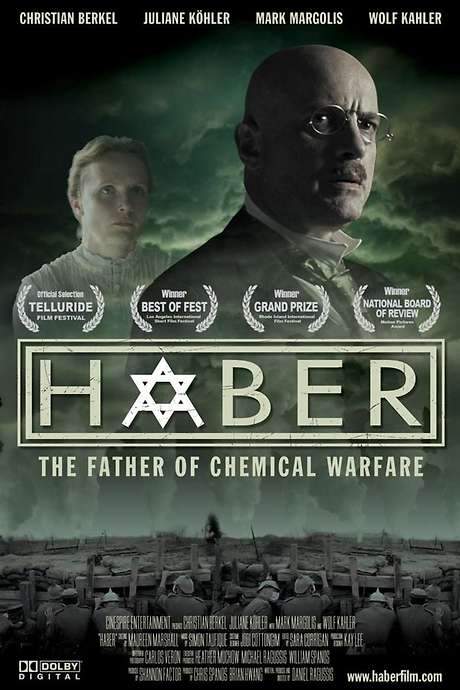
Haber (2008) movie poster

Characters & Themes

Haber (2008) Characters, Setting & Themes Explained

Release, runtime and language
2008 · 34 mins · English
Loading streaming availability…
Directed by
Daniel Ragussis
Starring
Juliane Köhler, Mark Margolis, Christian Berkel, Wolf Kahler, Maury Cooper

During World War I, Fritz Shimon Haber, a chemist and Nobel laureate for synthetic fertilizers, is pressed by the military to create chemical weapons. After renouncing his Jewish heritage, he invents a poison‑gas arsenal, a weapon of mass destruction. His personal life collapses: his wife Clara commits suicide and his invention aids Nazi genocide.

On this page (8)
  1. 1 Where to watch
  2. 2 Characters explained (4)
  3. 3 Where & when it takes place
  4. 4 Themes & meaning (3)
  5. 5 Character & meaning questions
  6. 6 Movie threads
  7. 7 Movies like Haber
  8. 8 Every angle
Loading streaming availability…

4 main characters · contains spoilers

Haber Characters Explained: Who Is Who

The main characters of Haber (2008), heroes and villains: what drives them, how they change over the course of the story and what each of them reveals about the film's bigger ideas.

  • Fritz Shimon Haber (Christian Berkel)

    A brilliant German-born scientist with a dual legacy, Haber is driven by ambition and a longing to be accepted as a true German. He converts to Lutheranism to fit in, and he earns the 1918 Nobel Prize for nitrogen fixation that fuels both agriculture and warfare. The film portrays him wrestling with ethical implications as he leads chemical warfare efforts and grapples with the consequences of his work.

    • 🎓 Scientist
    • 🧭 Identity
    • ⚗️ Power
  • Clara Immerwahr (Juliane Köhler)

    A promising chemist who sacrifices her own career to support Haber and raise a family. She disapproves of his use of science to engineer death in war and resents the gendered constraints of her time. Her sense of oppression and her suicide become a central moral counterpoint in the film.

    • 💂‍♀️ Gender
    • 🧪 Female scientist
    • 🛰️ Oppression
  • Ludendorff (Wolf Kahler)

    A German general who embodies wartime authority and the relentless push for victory. He represents political and military pressure that shapes Haber’s work, including where science should be applied in combat. His presence emphasizes the collision between scientific aspiration and military exigency.

    • 🏛️ Military
    • ⚖️ Authority
    • 🛡️ War
  • Siegfried Haber (Maury Cooper)

    Haber’s son, a figure who embodies the personal stakes and collateral impact of his father’s controversial choices. He stands as a reminder of the human cost behind scientific ambition and wartime decisions.

    • 👶 Family
    • 🧠 Personal stakes
    • 👨‍👩‍👧‍👦 Children

Last updated: February 17, 2026 at 17:28

Was this helpful?

Setting

Where and When Does Haber Take Place?

The setting of Haber (2008): the year and time period, the places and locations, and how they shape the characters, the mood and the tension of the story.

Time period

1910s (World War I era)

The story unfolds during the 1910s, a period defined by total war and rapid scientific advancement. It reaches a turning point in 1918 with Haber's Nobel Prize and the intensification of chemical warfare. The era is marked by international treaties, like the Hague Conventions, that contrast with wartime drive for technological edge.

Location

Germany, Ypres, Eastern Front

The action centers in Germany, home to Haber and his scientific circle, while sequences move to the Western Front at Ypres and to the Eastern Front. The settings show laboratories, government offices, and battlefield scenes, highlighting the pressure to translate scientific breakthroughs into military advantage. These locations frame the ethical stakes of Haber’s work within the broader context of World War I.

  • 🇩🇪 Germany
  • 🧭 Industrial era
  • ⚗️ Science
  • ⚔️ War

Last updated: February 17, 2026 at 17:28

Was this helpful?

3 major themes

Haber Meaning: Themes & Message Explained

What is Haber (2008) really about? The emotional, social and philosophical themes the film keeps returning to, its symbolism and the message beneath the surface.

  • Science and Morality

    The film follows Haber’s dual legacy as a groundbreaking chemist and a man entangled in warfare. It questions whether scientific achievement can be separated from its consequences for human life. Haber's ambition clashes with ethical concerns as he faces the choice between progress and harm. The narrative uses his Nobel Prize and his work on nitrogen fixation to explore the costs of genius.

  • Ethics of War

    State pressure and national pride push science toward weapons development, exemplified by the chlorine gas project. The film places a spotlight on the dilemmas scientists face when their discoveries are weaponized. It also critiques the personal and political accountability behind decisions made in wartime. The ban on chemical weapons contrasts with the reality of wartime experimentation.

  • Gender and Sacrifice

    Clara Immerwahr’s story highlights the cost of gender expectations in science and marriage. She sacrifices her own career to support Haber and disapproves of his use of science for killing. Her oppression and eventual suicide reveal the personal toll of the era’s hierarchical norms. The film uses her perspective to challenge the idea that scientific progress is value-free.

Last updated: February 17, 2026 at 17:28

Was this helpful?

Character & theme questions

Haber Characters & Meaning: Your Questions Answered

The questions people ask about Haber (2008): who the characters really are, their relationships, what the symbols mean, where it takes place and what the movie is really about. Each answer contains spoilers.

Q1

Where is the movie Haber set?

The film takes place primarily in Germany, where Haber and his scientific circle work in laboratories and government offices. Key sequences also occur at the Western Front near Ypres and on the Eastern Front, showcasing the battlefield conditions that drove the demand for chemical weapons.

  • germany setting
  • ypres
  • locations
  • western front
  • eastern front
Q2

What time period does the movie cover?

Haber is set during the 1910s, specifically the World War I era. The narrative spans from the early years of the war through 1918, when Haber receives his Nobel Prize for nitrogen fixation, marking a turning point in both his career and the film's timeline.

  • 1910s
  • world war 1 era
  • time period
  • 1918
Q3

What motivates Fritz Haber in the film?

Fritz Haber is driven by intense ambition and a deep desire to be accepted as a true German. He converts from Judaism to Lutheranism to fit in, and he pursues scientific breakthroughs that will prove his worth. His motivation stems from both professional ambition and a personal need for acceptance during a period of rising nationalism.

  • fritz haber motivation
  • ambition
  • german acceptance
  • national identity
Q4

Who is Clara Immerwahr in the story?

Clara Immerwahr is Haber's wife, a brilliant chemist who sacrificed her own career to support his work and raise their family. She strongly disapproves of his involvement in chemical warfare and represents the personal cost of scientific ambition. Her story highlights the gender expectations that constrained women in science during that era.

  • clara immerwahr
  • wife
  • chemist
  • sacrifice
  • gender expectations
Q5

What is the main theme of science and morality in Haber?

The film explores the conflict between scientific achievement and its human consequences. Haber's dual legacy as a Nobel-winning chemist who also created weapons of mass destruction raises the question of whether science can be separated from its moral implications. His work on nitrogen fixation, meant to advance agriculture, also enabled deadly chemical warfare.

  • science morality
  • ethics
  • nobel prize
  • consequences
  • dual legacy
Q6

What does the film say about the ethics of chemical warfare?

Haber examines the moral dilemma of scientists whose discoveries are weaponized. The film shows how state pressure and national pride push researchers toward developing weapons like chlorine gas, while international treaties like the Hague Conventions prohibit such methods. It critiques the personal and political accountability scientists face when their work serves wartime aggression.

  • chemical warfare
  • ethics
  • weaponization
  • hague conventions
  • wartime responsibility
Q7

How does the film portray gender and sacrifice?

Through Clara Immerwahr's tragic arc, the film illustrates the cost of gender expectations in early 20th-century science. Clara sacrifices her own promising career to support Haber and is trapped by the hierarchical norms of the era. Her oppression and eventual suicide serve as a moral counterpoint, challenging the notion that scientific progress is value-neutral.

  • gender
  • sacrifice
  • clara suicide
  • women in science
  • marriage
Q8

Who is General Ludendorff in the film?

General Ludendorff represents the military and political pressure that drives Haber's work toward chemical warfare. As a German general, he embodies the wartime demand for technological advantage, pushing scientists to translate laboratory breakthroughs into combat weapons. His presence highlights the collision between scientific ambition and military necessity.

  • ludendorff
  • general
  • military pressure
  • authority
  • weapon development
Q9

What is Haber's Nobel Prize about in the film?

Fritz Haber receives the 1918 Nobel Prize in Chemistry for his discovery of nitrogen fixation, a process crucial for creating synthetic fertilizers that helped address global food scarcity. However, the same process also enabled the production of explosives and chemical weapons. The film uses this prize to explore the paradoxical legacy of scientific genius.

  • nobel prize
  • nitrogen fixation
  • chemistry
  • fertilizer
  • 1918
Q10

Who is Siegfried Haber in the movie?

Siegfried Haber is Fritz Haber's son, representing the personal and familial consequences of his father's controversial choices. Through Siegfried, the film illustrates the human cost behind scientific ambition and wartime decisions, showing how the younger generation inherits the moral weight of their parents' actions.

  • siegfried
  • son
  • family
  • personal cost
  • collateral impact
Q11

Why does Fritz Haber convert religions in the film?

Fritz Haber converts from Judaism to Lutheranism because he desperately wants to be accepted as a fully German citizen in a time of growing anti-Semitism. This conversion reflects his deep yearning to belong and succeed in German society, even as he pursues scientific achievements that ultimately serve a nation that still marginalizes him.

  • jewish
  • conversion
  • lutheranism
  • assimilation
  • discrimination
Q12

What makes Fritz Haber a controversial historical figure?

Fritz Haber remains controversial because his scientific achievements had profoundly contradictory impacts. His nitrogen fixation process helped feed millions through synthetic fertilizers while also enabling chemical weapons that killed thousands in World War I. The film portrays him as a genius whose work for human progress was inextricably linked to mass destruction.

  • controversial
  • legacy
  • historical figure
  • chemical weapons
  • fertilizer

Movie threads

More Movies Like Haber, by Mood & Story

Curated lists built around what makes Haber tick: the same mood, the same kind of story or the same emotional payoff. Each list explains why these movies belong together.

Movies about tragic geniuses like Haber

Stories where intellectual ambition leads to devastating ethical collapse. For viewers who found the ethical dilemma in Haber compelling, this list features movies like Haber that explore the dark side of brilliance. These are stories of scientists, inventors, and thinkers whose groundbreaking work comes with a heavy moral price.

  • moral conflict
  • tragic
  • thought-provoking
  • somber
  • tense
  • oppressive
  • Tone: somber, morally conflicted
  • Pacing: steady, deliberate
Why these movies?

The story pattern: Narratives in this thread typically follow a linear progression where a character's initial noble or ambitious goals become corrupted. The central conflict is internal, pitting intellectual pride against growing moral unease, often culminating in a personal tragedy that highlights the cost of their choices.

Why they belong together: These films are grouped by their shared focus on a brilliant protagonist whose intellectual journey is inseparable from a moral one. They create a similar viewing experience of somber reflection and intense ethical tension, making them resonate with audiences interested in the responsibility that comes with genius.

Somber historical dramas with tragic stories like Haber

Heavy dramas based on true events, where history's weight crushes personal lives. If you were captivated by the blend of history and personal tragedy in Haber, explore these movies like Haber. They are serious, fact-based dramas set against the backdrop of war or conflict, where the historical narrative amplifies a deeply sad human story.

  • somber
  • tragic
  • war
  • historical
  • grief
  • based on a true story
  • Tone: dark, tragic, serious
  • Pacing: steady, chronological
Why these movies?

The story pattern: These stories unfold against a well-documented historical canvas, using the inevitability of historical events to create a sense of impending doom. The personal narrative is often a microcosm of the larger tragedy, showing how individuals are broken by forces beyond their control.

Why they belong together: They share a specific mood: a combination of educational gravitas and profound sadness. The viewing experience is one of learning about a dark chapter in history while witnessing its crushing impact on relatable characters, resulting in a heavy, thought-provoking tone.

If you liked this

Movies Like Haber

Similar movies to Haber: the same genre, themes or kind of story. Each one comes with its own plot summary, timeline and ending explained.

Browse all movie summaries

Every angle

Haber (2008) Explained: Plot, Timeline & Characters

Everything about Haber in one place: what happens in the plot summary, the timeline in chronological order, the characters and meaning and a spoiler-free summary. What's After the Movie adds the cast, box office and post-credit scenes.

Coming soon on iOS and Android

The Plot Explained Movie Summary App

Plot summaries, endings explained and timelines on your phone. Catch up on any movie in minutes, save your favorites and never miss a twist again.

Be the first to know when we launch. Your email stays private, always.

Learn more about the app