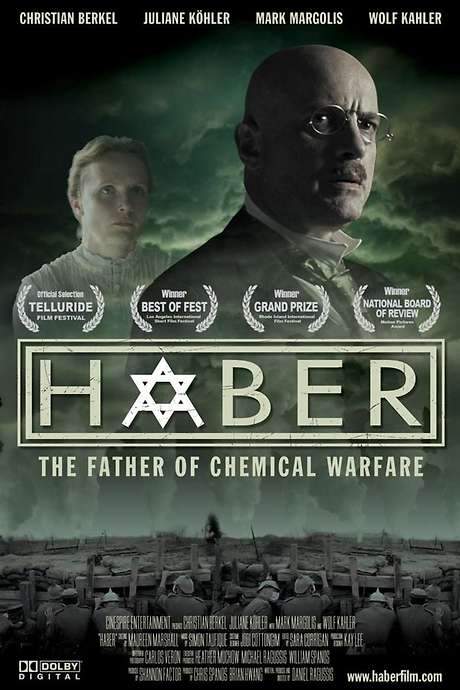
Fritz Shimon Haber Christian Berkel sits at the center of this meticulous biopic, a German-born scientist whose Jewish origins and fierce ambition pull him between belonging and achievement. Born and raised in a world that asks for assimilation, he longs to be seen as a true German even as his scientific fire drives him toward ever-bolder discoveries. To gain acceptance and advance his career, Haber makes a defining choice: he converts to Lutheranism, a decision the film uses to explore the delicate balance between personal identity, loyalty, and the costs of ambition.
In 1918, Haber reaches the pinnacle of scientific recognition when he receives the Nobel Prize for developing an industrial process to fix nitrogen from the atmosphere into ammonia. This breakthrough, known to history as the Haber-Bosch method, turns out to be a double-edged sword. On one hand, it enables synthetic fertilizers that boost agricultural yields and promise food security for a growing world. On the other hand, it foreshadows a future where industry, agriculture, and wealth become tightly intertwined, while concerns about soil depletion, environmental impact, and corporate power begin to loom large. The film does not shy away from these consequences, painting a nuanced picture of a discovery that reshapes society even as it reshapes ethical boundaries.
The quiet moral tension at the heart of the story intensifies when Haber is drafted by the German government to translate his science into weapons. He becomes involved in the development of chlorine gas for use on the battlefield, a disastrous form of chemical warfare that would be banned by the Hague Conventions. The shocks of this decision ripple through Haber’s personal life and political world, forcing him to confront the idea that genius may bear responsibility for harm beyond the laboratory walls. The film juxtaposes the elegance of theoretical breakthroughs with the grim calculus of wartime innovation, inviting viewers to weigh the thrill of discovery against the human cost of its applications.
Clara Haber, Juliane Köhler, Haber’s wife, is depicted as a talented chemist in her own right who sacrifices her career to support him and raise a family. Her perspective grows increasingly pivotal as she witnesses Haber’s ascent and his willingness to weaponize science. She feels the strain of living under a domineering partnership and comes to oppose the path his research travels, a tension that culminates in a devastating personal tragedy. Her suicide marks a turning point that reframes Haber’s world and underscores the film’s relentless examination of duty, love, and consequence. The day after her death, Haber heads to the front to oversee the deployment of chemical warfare, a moment that crystallizes the moral complexity the film anatomizes—how a life devoted to science can simultaneously illuminate and darken the world.
Across its careful, character-driven narrative, the film remains unflinching about the paradox of a man whose contributions revolutionized industry and warfare alike. It does not offer easy answers; instead, it invites reflection on how identity, ambition, and ethical choices intersect in the crucible of history. The result is a thoughtful, multi-faceted portrait that honors the human drama behind a century-defining scientific legacy while insisting on the fragile line between genius and responsibility.