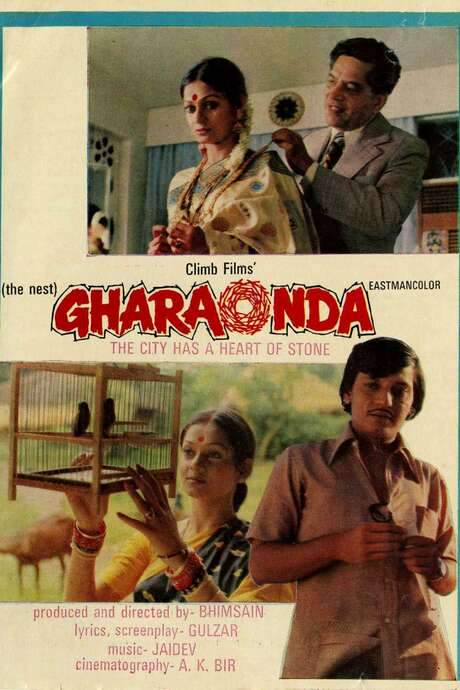
Gharonda follows the lives of Sudip Amol Palekar and Chhaya Zarina Wahab, two middle-class office workers in Mumbai who share a quiet, aspirational dream of building a life together. They meet and fall in love while navigating the pressures of a city that never stops moving, both of them working in the same bustling office and juggling responsibilities in modest, cramped living spaces.
Chhaya shares a small one-room flat with her younger brother, her elder brother, and sister-in-law, while Sudip rents a room with three other men. Their bond grows as they save every penny with the shared goal of owning a home of their own, a symbol of stability and security in a city that tests every beginner’s ambition. They embark on a search for a new place to live, hopeful that a home will soon become a tangible reality.
Their efforts pay off briefly when they invest in a flat in a single building and feel a surge of excitement about the future. But hope quickly encounters a harsh setback: the builder turns out to be a fraud and disappears with the investors’ money. The blow is magnified when Sudip’s roommate, Guha [Sadhu Meher], who also put his funds into the project, dies by suicide, a devastating reminder of how fragile people’s lives and dreams can be when confronted with deceit and loss. The entire project collapses, and all the money they saved seems to vanish, leaving the couple staring at a blank slate and the daunting task of starting over from scratch.
In the midst of this upheaval, the firm’s owner, Mr. Modi [Shreeram Lagoo], emerges as a disruptive force in their lives. He is a rich, aging widower and a heart patient who becomes fascinated with Chhaya, largely because she bears a striking resemblance to his late wife. He proposes marriage, a proposal that unsettles Chhaya but also presents Sudip with a troubling opportunity. With Modi’s health as a wildcard, Sudip suggests that Modi’s potential early death could clear the path for the couple to be together, a drastic shortcut that contrasts with their earlier, more principled resolve.
Chhaya is unsettled by Sudip’s calculation, yet she reluctantly contemplates Modi’s proposal because it could secure her brother’s education abroad and change their prospects in dramatic ways. The marriage begins awkwardly, though Chhaya soon takes on the role of a dutiful wife. Sudip continues to visit, both under the pretext of concern for Modi’s health and as a way to remain close to Chhaya, but he is disappointed by Modi’s surprising vitality. Modi’s improvement brings a glimmer of hope to Sudip, but it also complicates their plan and tests their loyalties.
As Modi’s health stabilizes, Sudip makes a decisive choice to leave his current life behind and seek a fresh start. Chhaya, meanwhile, endures the emotional tension of their arrangement and the strain it places on her own desires and dreams. A confrontation between Sudip and Chhaya, overheard by Modi, triggers a heart attack in Modi, a dramatic turn that rekindles Sudip’s naive optimism. Yet Chhaya’s patient, steady care helps Modi recover, and the couple faces the reality that shortcuts rarely lead to a lasting future.
At the railway station, Modi reveals one final possibility: a chance for Sudip to marry Chhaya after a divorce. But Sudip does not accept this compromise. He declares his commitment to the city and to rebuilding his life honestly, without taking any shortcuts. The story closes by reaffirming the film’s central meditation: Mumbai’s relentless pace can be brutal for ordinary people who pursue ordinary dreams—chief among them, marriage and owning a home.
Gharonda, through its intimate focus on two ordinary people navigating love, loss, and the temptations of quick fixes, paints a nuanced portrait of a city that never stops demanding more from its residents. It remains a patient study of aspiration and resilience, showing how even the most well-intentioned plans can be tested by betrayal, circumstance, and the stubborn, hopeful drive to begin anew.