










Plot Explained Spoilers guaranteed!
Plot Explained

Browse by genre

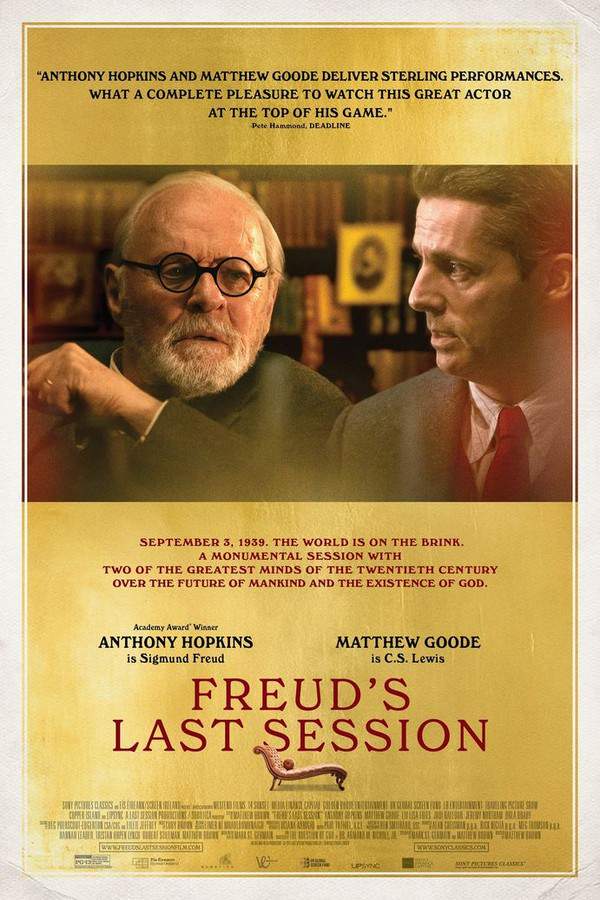
Freud's Last Session (2023) movie poster

Ending Explained

Freud's Last Session (2023) Ending Explained – Final Scene & Meaning

Release, runtime and language
2023 · 1 h 48 m · English
Echo score 40
JustWatch #8,525 12
Directed by
Matt Brown
Starring
Anthony Hopkins, Matthew Goode, Orla Brady, Liv Lisa Fries, Jodi Balfour, Stephen Campbell Moore
Budget
$10M

With war approaching, Sigmund Freud and C.S. Lewis find themselves in a compelling intellectual exchange concerning the existence of God. The drama explores their lives and beliefs, interweaving past and present with surreal elements, as they debate within Freud's study. The film is a thought-provoking examination of faith and reason.

On this page (7)
  1. 1 Where to watch
  2. 2 What happens at the end
  3. 3 Final events in order
  4. 4 Ending questions answered
  5. 5 Movie threads
  6. 6 Movies like Freud's Last Session
  7. 7 Every angle

Where to watch

Where to Watch Freud's Last Session (2023)

Where can you watch Freud's Last Session? Stream, rent or buy it in the US, including on fuboTV, FXNow and Hulu: current JustWatch availability with up-to-date prices.

Streaming availability powered by JustWatch

Ending explained · contains spoilers

What Happens at the End of Freud's Last Session?

How Freud's Last Session (2023) ends, what the final scene means, which earlier moments set it up and how to read the ending if the film leaves it open. The full ending explained, with every spoiler.

In the ending of "Freud’s Last Session," the intense debate between Freud and Lewis concludes without either of them changing their core beliefs. Despite their differences—Freud’s atheism and Lewis’s faith—they develop a mutual respect and a unique, if tentative, friendship. Freud manages to comfort Lewis during a moment of panic, and Lewis helps Freud with his prosthetic, symbolizing a moment of genuine kindness amid their philosophical clash. As Lewis leaves, he dreams of wandering through a dark forest, a scene that reflects both his fear and his dependence on divine light to find his way through life's uncertainties. Meanwhile, Freud, who believed in personal agency and saw death as something to be confronted directly—planning his own suicide with a cyanide pill—finds peace in accepting the inevitability of death on his terms. The film ends with these contrasting yet intertwined paths: Freud's acceptance of mortality and his farewell to life, and Lewis's continued faith in the hope that light and divine love will guide him through darkness. Ultimately, the story suggests that even with fundamental differences, respect and humanity can bridge the deepest divides, leaving the audience pondering the enduring tension between faith and reason.

Last updated: June 25, 2025 at 08:44

Was this helpful?

The last 4 events

How Freud's Last Session Ends: The Final Events in Order

The last events of Freud's Last Session (2023) in chronological order, the run-up to the ending explained above. The complete timeline has all 14 events, scene by scene.

Open the full timeline
  1. Anna Becomes a Trailblazer

    Anna Freud emerges as a pioneering figure in child psychology, gaining recognition for her innovative work. Her contributions signify a new understanding of the psychological needs of children amidst a recovering post-war society.

  2. Freud's Last Days

    In his final days, Freud has an enigmatic encounter with an unnamed Oxford don, reflecting on the transient nature of human interactions. This moment serves as a poignant reminder of the ever-evolving tide of intellectual thought.

  3. Love Between Anna and Dorothy

    The relationship between Anna and Dorothy flourishes, creating a life together that spans many years. Their bond reflects a unique blend of love and intellectual companionship that flourishes against historical turmoil.

  4. Enduring Influence of Ideas

    Even as time progresses, the impact of the fictional encounters between Lewis and Freud resonates throughout history. Their discussions underscore the enduring influence of ideas and the lasting legacies of these extraordinary figures.

Ending questions answered

Freud's Last Session Ending: Your Questions Answered

The questions people ask most about the ending of Freud's Last Session (2023): what the final scene means, how the twist works, what happens to each character and how to read the ending. Each answer contains spoilers.

Q1

Why doesn't Freud convert to Christianity after his conversation with Lewis?

Freud doesn't convert because his lifelong commitment to atheism and his belief in personal agency are too deeply rooted to change through a single conversation. The film emphasizes that while the debate is intellectually stimulating, neither man fundamentally alters his core worldview. Freud remains steadfast in his view that God is a human projection, and he chooses to face death on his own terms rather than seeking religious comfort.

Foreshadowing: Earlier in the film, Freud repeatedly dismisses Lewis's arguments about faith as wish fulfillment, establishing his unwavering commitment to rationalism.

  • freud conversion
  • atheist
  • c.s. lewis
  • faith
  • religion
  • ending
Q2

What happens to C.S. Lewis at the end of the film?

Lewis leaves Freud's study having maintained his Christian faith despite the intense intellectual challenge. He walks away with a sense of hope, though not without struggle. The final scene shows Lewis dreaming of wandering through a dark forest, symbolizing his ongoing spiritual journey and the fears he must navigate. Unlike Freud's acceptance of death, Lewis continues to rely on his belief in divine light to guide him through life's uncertainties.

  • c.s. lewis
  • faith
  • ending
  • spiritual journey
  • hope
Q3

What does the dark forest dream symbolize in Lewis's final scene?

The dark forest represents Lewis's spiritual anxieties and the uncertainties he faces as a believer in a world filled with suffering and war. The forest is dark and frightening, but Lewis searches for divine light to guide him through. This symbolizes his ongoing struggle with faith, not a crisis of belief, but a continuation of his journey to reconcile the darkness of the world with his Christian hope.

Foreshadowing: Lewis's earlier references to the horrors of war and his brother's death foreshadow his need for divine guidance through darkness.

  • dark forest
  • dream
  • symbolism
  • faith
  • spiritual journey
  • c.s. lewis
Q4

Does Freud commit suicide in the ending?

Freud plans to take his own life using a cyanide pill he has kept for this purpose throughout the film. The movie depicts his acceptance of death as a conscious, deliberate choice rather than a surrender to illness. He sees this as the ultimate expression of personal agency, facing death on his own terms, in control until the end. The film presents this as his way of finding peace, not as a tragic defeat.

Foreshadowing: Earlier scenes establish Freud's possession of the cyanide pill and his belief that suicide is a rational choice for someone facing terminal pain.

  • freud death
  • suicide
  • cyanide
  • cancer
  • mortality
  • ending
Q5

What is the meaning of the prosthetic scene between Freud and Lewis?

The moment when Lewis helps Freud with his prosthetic is a symbol of genuine human connection transcending philosophical disagreement. Despite their heated debates about God's existence, Lewis shows compassion by assisting Freud with his artificial limb. This act of kindness demonstrates that respect and care can exist between people with fundamentally opposing worldviews, reinforcing the film's central theme that humanity can bridge deep divides.

  • prosthetic
  • kindness
  • respect
  • friendship
  • connection
Q6

Why do Freud and Lewis develop respect for each other despite their differences?

They develop respect because each man demonstrates intellectual honesty and genuine care for the other's wellbeing. Freud respects Lewis's willingness to honestly confront difficult questions about suffering and evil. Lewis respects Freud's courage in facing death without religious comfort. Their final moments of mutual support, Freud comforting Lewis during a panic attack and Lewis helping with the prosthetic, show that their intellectual clash has produced genuine human connection.

Foreshadowing: Throughout the film, both characters show moments of curiosity about each other's perspectives, not just argumentation.

  • respect
  • friendship
  • debate
  • intellectual
  • connection
  • freud lewis
Q7

What is the message of the ending about faith and reason?

The ending suggests that faith and reason may be irreconcilable but both can lead to meaningful lives. Freud finds peace through rational acceptance of death, while Lewis maintains hope through religious faith. The film avoids declaring one superior to the other, instead emphasizing that both paths offer genuine forms of comfort and meaning. The key message is that fundamental differences don't prevent people from treating each other with dignity and compassion.

  • faith
  • reason
  • god
  • existence
  • philosophy
  • meaning
  • ending
Q8

How does Freud find peace at the end of the movie?

Freud finds peace by accepting mortality as something to be confronted directly rather than feared. He believes in personal agency above all else, so taking control of his own death, with the cyanide pill he has kept, represents his ultimate freedom. Rather than waiting for cancer to kill him or seeking solace in religion, he chooses his moment and method, viewing this as a rational and dignified conclusion to life.

Foreshadowing: Freud's earlier discussions about his father's death and his belief in facing reality directly foreshadow his acceptance of suicide.

  • freud peace
  • death
  • acceptance
  • mortality
  • suicide
  • freedom
Q9

What happens to Anna Freud in the ending?

While the ending focuses primarily on Freud and Lewis, Anna Freud is present in the film's final moments and represents the continuation of Freud's legacy. The meta notes indicate that Anna's love and career flourish after the film, suggesting she inherits her father's intellectual spirit. She witnesses her father's peaceful acceptance of death and carries forward his work in psychoanalysis.

  • anna freud
  • legacy
  • ending
  • future
Q10

Why does Lewis maintain his faith despite the debate with Freud?

Lewis maintains his faith because his belief is not based solely on rational argumentation but on personal experience, hope, and the inner conviction that God is present even in suffering. Freud's intellectual challenges force Lewis to confront difficult questions about evil and pain, but his faith ultimately survives intact. The ending shows Lewis leaving with his hope preserved, believing that divine love will guide him through life's uncertainties despite the darkness he acknowledges exists.

Foreshadowing: Lewis's earlier accounts of his brother's death and his subsequent turn toward Christianity show his faith was forged through personal struggle, not mere logic.

  • c.s. lewis faith
  • belief
  • christianity
  • hope
  • debate
  • ending

Movie threads

More Movies Like Freud's Last Session, by Mood & Story

Curated lists built around what makes Freud's Last Session tick: the same mood, the same kind of story or the same emotional payoff. Each list explains why these movies belong together.

Movies about philosophical debates like Freud's Last Session

Where opposing worldviews collide in high-stakes dialogue. If you enjoyed the intellectual sparring in Freud's Last Session, explore movies like it centered on philosophical and ideological clashes. These films explore belief, reason, and existence through high-stakes conversations, featuring intense dialogues and opposing worldviews.

  • intellectual
  • conversational
  • thoughtful
  • claustrophobic
  • high-stakes
  • philosophical
  • Tone: melancholic, thoughtful
  • Pacing: slow, conversational
Why these movies?

The story pattern: Stories in this thread typically center on a contained, dialogue-driven conflict between two characters representing opposing philosophies. The plot unfolds through their verbal exchanges, using flashbacks or parallel storylines to provide context for their beliefs, leading to a resolution that often leaves both characters and the audience with lingering questions.

Why they belong together: Movies are grouped here for their shared focus on intellectual conflict as the primary source of drama. They prioritize dialogue over action, create tension through ideological opposition, and explore profound questions about life, faith, and human nature in a compelling, thought-provoking manner.


Melancholic dramas about legacy like Freud's Last Session

Profound dramas where characters confront mortality and their life's impact. For viewers who appreciated the reflective tone of Freud's Last Session, this section features similar movies about legacy, terminal illness, and intellectual influence. These dramas are often slow, heavy, and bittersweet, exploring how characters reconcile their life's work with their impending death.

  • somber
  • reflective
  • thoughtful
  • bittersweet
  • melancholic
  • poignant
  • Tone: bittersweet, somber
  • Pacing: slow, reflective
Why these movies?

The story pattern: The narrative pattern follows a prominent figure or an ordinary person reviewing their life's journey as they confront a terminal diagnosis or a final chapter. The story uses a non-linear structure, blending present-day reflections with key moments from the past to examine the character's impact on others and the world, culminating in an emotionally resonant, bittersweet conclusion.

Why they belong together: These films share a profoundly melancholic and reflective mood, a slow, deliberate pacing that allows for deep characterization, and a central theme of grappling with one's legacy in the face of death. They deliver a heavy emotional experience focused on existential questions and poignant personal revelations.

If you liked this

Movies Like Freud's Last Session

Similar movies to Freud's Last Session: the same genre, themes or kind of story. Each one comes with its own plot summary, timeline and ending explained.

Browse all movie summaries

Every angle

Freud's Last Session (2023) Explained: Plot, Ending, Timeline & Characters

Everything about Freud's Last Session in one place: what happens in the plot summary, the timeline in chronological order, the characters and meaning, the ending explained and a spoiler-free summary. What's After the Movie adds the cast, box office and post-credit scenes.

Coming soon on iOS and Android

The Plot Explained Movie Summary App

Plot summaries, endings explained and timelines on your phone. Catch up on any movie in minutes, save your favorites and never miss a twist again.

Be the first to know when we launch. Your email stays private, always.

Learn more about the app