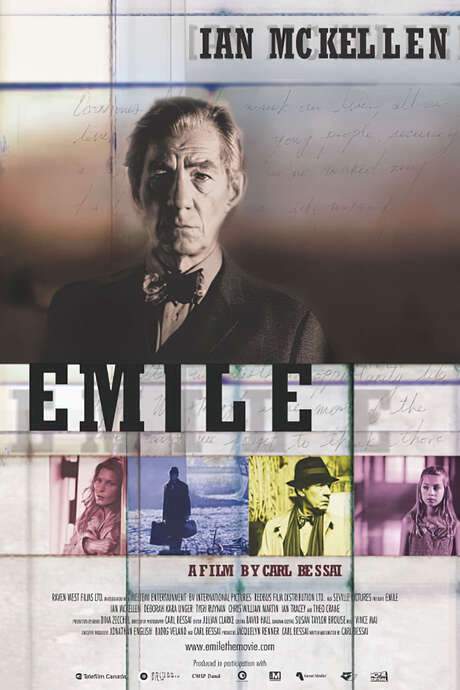
Emile leaves Saskatchewan as a young man to study in England on a university scholarship, leaving behind his brutal older brother Carl and his creative younger brother Freddy who manage the family farm. He promises to return, but the pull of academia keeps him abroad, and he gradually distances himself from his Canadian past, even adopting an English accent as his life diverges from the land he left behind.
Tragedy shadows the family as time passes: Freddy ends his life by gassing himself with exhaust fumes in his pickup, and Carl dies in a crash in the same vehicle. Emile’s absence from the prairie life contributes to the sense that the brothers’ fates are bound to the farm’s legacy, a legacy that remains unresolved while Emile pursues a life that feels increasingly detached from where he came.
On a brief return, the authorities presume he has come to adopt Carl’s young daughter, Nadia, but his real motive is tied to the land itself. He refuses the family responsibility with a stark line: > "single parent families are not allowed on campus." His visit is framed not by kinship but by the practical aim of sorting out the family land-holdings, a reminder of how distanced and transactional his ties to the past have become.
Decades later, when he is invited to receive an honorary degree by a Canadian university, the retired Emile makes an extended stop in Victoria, British Columbia. He intends to meet Nadia—now an adult who has recently separated from her husband—and her ten-year-old daughter Maria, hoping to understand the life that grew from the broken thread of his earlier choices. The encounter places Emile on the edge of a more intimate connection with the next generation, inviting him to confront the consequences of his earlier decisions and the distance that has grown between him and the family he left behind.
The discovery of an old typewriter among Nadia’s belongings becomes a quiet, stubborn catalyst. It awakens a stream of reveries—half memory, half fantasy—where Emile’s unresolved feelings about the past surface in almost dreamlike sequences. These reveries blur the line between what happened and what could have happened, pushing him to sift through regrets, pride, and the sense of duty he never fully embraced. The typewriter acts as a tangible link to the life he abandoned and the life he could still claim if he allows himself to truly engage with Nadia and Maria before the opportunity slips away.
Throughout the narrative, the film quietly but steadily examines memory’s stubborn grip and the weight of lineage. The prairie farm in Saskatchewan, the austere English academia, and the coastal calm of Victoria all serve as backdrops for a meditation on how one man’s choices ripple across generations. Emile’s journey is less about reclaiming a place and more about reconstituting relationships—between siblings, between parent and child, and between a man and the family he once forgot. The tension between leaving and returning, between practical obligations and emotional responsibility, threads through every scene, inviting viewers to consider what it means to come to terms with a legacy that never truly ends.
In the end, the question lingers: can Emile bridge the chasm time has carved between him and the family he left behind, or will the years keep him at a cautious distance? The story suggests that reconciliation may hinge on facing the past openly, listening to Nadia and Maria, and letting memory guide rather than govern the present—an invitation to see whether the old land and the new generations can coexist in a single, shared future.