Plot Explained Spoilers guaranteed!
Plot Explained

Browse by genre

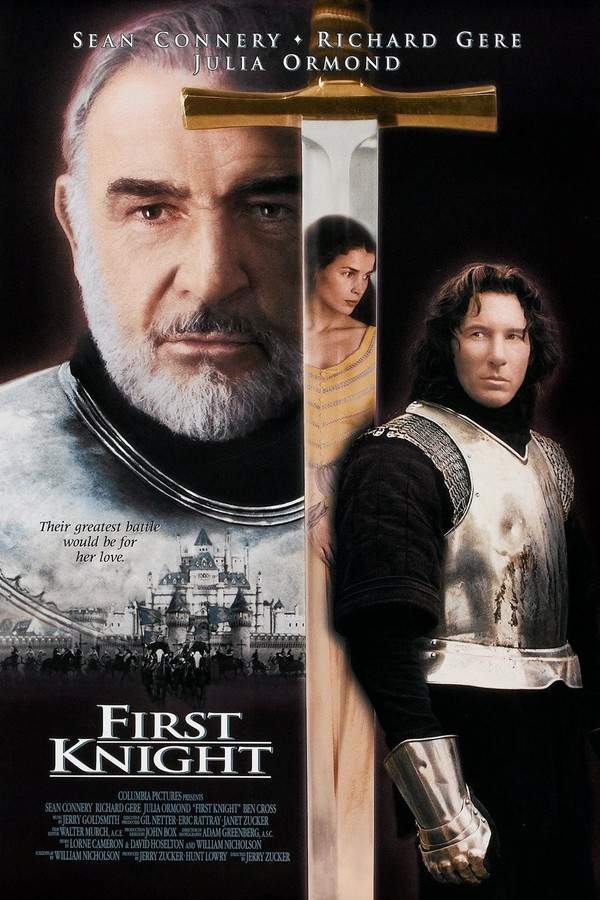
First Knight (1995) movie poster

Plot Summary

First Knight (1995) Plot Summary Explained

Release, runtime and language
1995 · 134 min · English
JustWatch #34,821
Directed by
Jerry Zucker
Starring
Sean Connery, Ralph Ineson, John Gielgud, Richard Gere, Liam Cunningham, Ben Cross

Amidst the grandeur of medieval Camelot, the valiant knight Lancelot finds himself torn between his duty and a forbidden love for the fair Guinevere. As she is betrothed to King Arthur, Lancelot must confront his feelings while protecting their realm from a growing threat of treachery and darkness. His actions will challenge his honor and the very foundation of their chivalric code, testing the strength of his love and loyalty.

On this page (6)
  1. 1 Where to watch
  2. 2 What happens: full plot
  3. 3 Plot questions answered
  4. 4 Movie threads
  5. 5 Movies like First Knight
  6. 6 Every angle

Where to watch

Where to Watch First Knight (1995)

Where can you watch First Knight? Stream, rent or buy it in the US, including on Tubi TV, YouTube Free and Amazon Video: current JustWatch availability with up-to-date prices.

Streaming availability powered by JustWatch

Full plot summary · contains spoilers

What Happens in First Knight: Full Plot Summary

The whole story of First Knight (1995) explained, from the opening scene to the final frame: every key event, every twist and what it all adds up to. Read it as a quick recap before the sequel, to check a scene you missed, or to finally understand what really happened.

As King Arthur of Camelot celebrates his recent military conquests, his attention turns towards a fresh endeavor: finding a bride. However, a former Knight of the Round Table, Malagant, driven by ambition, plots to usurp the throne. Amidst this backdrop of intrigue and power struggles, Lancelot, a daring wandering swordsman, becomes entangled in a world that extends far beyond his humble village.

Lancelot’s fate intertwines with that of Guinevere, the young ruler of Lyonesse. She is journeying to Camelot with hopes of marrying Arthur to safeguard her kingdom from Malagant’s incursions. When Lancelot fortuitously encounters Guinevere's carriage, he thwarts Malagant's kidnapping attempt and finds himself captivated by the future queen. Although Guinevere initially rebuffs his affections, Lancelot encourages her to heed her desires, all while she feels the weight of her duty to her impending marriage.

Navigating the intricate dynamics of Camelot’s court, Lancelot gradually earns Arthur’s respect, securing a seat at the Round Table, which symbolizes loyalty and brotherhood. He imparts a profound truth to Arthur: >"A man who fears nothing is a man who loves nothing." That evening, Malagant's minions execute a cunning abduction of Guinevere, compelling Lancelot to act.

In disguise as a Camelot messenger, Lancelot infiltrates Malagant's fortress to rescue Guinevere. While she remains retreating regarding his romantic advances, Lancelot’s valor wins him Arthur’s gratitude. As he reveals his painful past of being orphaned and destitute after bandits destroyed his village, Lancelot discovers a renewed purpose. He accepts Arthur’s invitation to join the Round Table, thereby replacing Malagant as a member and finding comfort in his newfound family.

As dusk falls, Arthur and Guinevere exchange vows in a sacred ceremony, sealing their bond. Yet destiny intervenes, as a messenger from Lyonesse brings alarming news: Malagant has initiated a fierce assault, threatening Camelot’s very existence. Unfazed, King Arthur rallies his forces and advances to Lyonesse to confront Malagant’s army. On the battlefield, Lancelot proves his mettle, earning the admiration of his fellow knights with his bravery and steadfast honor.

Once the battle concludes, Lancelot grapples with feelings of guilt over his growing affection for Guinevere, while being devoted to Arthur, whose loyalty he has vowed to uphold. During a private meeting, Lancelot expresses his intention to leave Camelot, but Guinevere’s eagerness to keep him close is unmistakable. Their fleeting moment of intimacy is disrupted when King Arthur unexpectedly arrives, catching them in a compromising situation, and accusing them of treason.

The subsequent trial is a spectacle of public intrigue, with Malagant’s sudden assault adding an unexpected twist to the proceedings. As Camelot’s citizens fend off the invasion, Lancelot confronts his nemesis—disarmed yet unyielding. Grabbing Arthur’s fallen sword, Lancelot strikes down Malagant, ending his tyrannical grip and triumphing for Camelot.

In the wake of victory, Arthur succumbs to his grievous injuries, passing away but not before naming Lancelot his successor, assigning him the sacred duty of safeguarding both the realm and Guinevere. As the tale draws to a close, a mournful procession heads to the shore, where Arthur’s funeral raft is set adrift, carrying the last vestiges of Camelot’s illustrious age into the vast unknown.
Last updated: November 21, 2024 at 09:39

Was this helpful?

Plot questions answered

First Knight Plot Explained: Your Questions Answered

The questions people ask most about First Knight (1995): what happens in the confusing scenes, why the characters do what they do, the twists, hidden details and what the ending means. Each answer contains spoilers.

Q1

Why does Lancelot decide to stay at Camelot after rescuing Guinevere?

Lancelot stays because he finds purpose and belonging at Camelot. After rescuing Guinevere from Malagant's fortress, he earns Arthur's gratitude and respect. More importantly, Lancelot reveals his painful past, being orphaned and destitute after bandits destroyed his village, and discovers a renewed sense of family among the knights. Arthur's invitation to join the Round Table gives him the home and brotherhood he never had.

  • lancelot
  • camelot
  • round table
  • motivation
  • belonging
Q2

What motivates Lancelot to rescue Guinevere from Malagant's fortress?

Lancelot is driven by his sense of honor and his growing feelings for Guinevere. When Malagant's minions abduct her, Lancelot cannot ignore his duty to protect her. Additionally, this act proves his loyalty to Arthur, who has welcomed him into his court, and demonstrates his commitment to the chivalric code he has adopted.

  • lancelot
  • guinevere
  • rescue
  • malagant
  • kidnapping
Q3

Why does Arthur accept Lancelot into the Round Table despite his humble origins?

Arthur accepts Lancelot because of his demonstrated courage, integrity, and genuine character. Lancelot proves himself by rescuing Guinevere from Malagant's kidnapping attempt and later infiltrating the fortress to save her. Arthur recognizes that true worth comes from one's actions and heart, not noble birth, which aligns with the Round Table's ideals of loyalty and brotherhood.

  • arthur
  • lancelot
  • round table
  • knighthood
  • honor
Q4

Why does Lancelot feel guilty about his feelings for Guinevere?

Lancelot feels guilty because he is falling in love with Guinevere while being devoted to Arthur, who has given him a home, purpose, and brotherhood. Arthur saved him from his tragic past and welcomed him into the Round Table. Lancelot's growing affection for the future queen feels like a betrayal of the loyalty and gratitude he owes his king.

  • lancelot
  • guinevere
  • arthur
  • love triangle
  • guilt
  • loyalty
Q5

How does Arthur die and why does he name Lancelot his successor?

Arthur dies from injuries sustained in the final battle against Malagant's forces. Despite the trial and accusations of treason involving Lancelot and Guinevere, Arthur recognizes that Lancelot is the only one capable of protecting the realm. On his deathbed, Arthur names Lancelot his successor, entrusting him with safeguarding both Camelot and Guinevere.

  • arthur
  • death
  • succession
  • lancelot
  • battle
  • injuries
Q6

Why does Malagant want to overthrow King Arthur?

Malagant is driven by ambition and a desire for power. As a former Knight of the Round Table, he believed he was entitled to a greater position and throne. His scheming to usurp Arthur's throne stems from resentment and his belief that he deserves to rule, making him the primary antagonist who orchestrates kidnappings and military assaults against Camelot.

  • malagant
  • arthur
  • ambition
  • throne
  • betrayal
  • villain
Q7

What is the significance of Lancelot's lesson about fear and love to Arthur?

Lancelot tells Arthur that "a man who fears nothing is a man who loves nothing," revealing his understanding of courage tied to emotional vulnerability. This lesson deepens Arthur's respect for Lancelot and strengthens their friendship. It also foreshadows the tragedy to come, Arthur will ultimately fear losing those he loves, and Lancelot's own love for Guinevere will put him at odds with his king.

Foreshadowing: The quote gains tragic weight later when Lancelot's love for Guinevere leads to the very betrayal Arthur feared.

  • lancelot
  • arthur
  • quote
  • fear
  • love
  • wisdom
Q8

Why does Guinevere agree to marry Arthur when she has feelings for Lancelot?

Guinevere agrees to marry Arthur primarily for political necessity. She rules Lyonesse and needs Arthur's protection from Malagant's threatening incursions. While she is drawn to Lancelot, her duty to her kingdom compels her to fulfill the arranged marriage that will secure her people's safety, even as her personal feelings remain conflicted.

  • guinevere
  • arthur
  • marriage
  • lyonesse
  • duty
  • politics
Q9

How does Lancelot defeat Malagant in the final confrontation?

Lancelot defeats Malagant during the climactic battle when Malagant has disarmed him. However, Lancelot remains unyielding and seizes Arthur's fallen sword. With Arthur's own weapon, Lancelot strikes down Malagant, ending his tyrannical rule and saving Camelot from the usurper's forces.

  • lancelot
  • malagant
  • battle
  • sword
  • victory
  • climax
Q10

What triggers the trial of Lancelot and Guinevere?

The trial is triggered when Arthur unexpectedly catches Lancelot and Guinevere in a compromising situation during a private meeting. Arthur accuses them of treason, and the trial becomes a public spectacle of intrigue. The timing is especially dramatic because Malagant launches another assault on Camelot during the proceedings, adding external danger to the internal crisis.

  • trial
  • arthur
  • guinevere
  • lancelot
  • accusation
  • treason
Q11

What is the significance of Arthur's funeral at the shore?

Arthur's funeral marks the end of an era for Camelot. The mournful procession carries his body to the shore where his funeral raft is set adrift into the unknown. This bittersweet ending symbolizes the close of Camelot's illustrious age, leaving Lancelot as the new king but the realm uncertain and grieving. It represents both closure and the dawn of a new, uncertain chapter.
  • arthur
  • funeral
  • camelot
  • ending
  • death
  • symbolism

Movie threads

More Movies Like First Knight, by Mood & Story

Curated lists built around what makes First Knight tick: the same mood, the same kind of story or the same emotional payoff. Each list explains why these movies belong together.

Epic Wartime Romances like First Knight

Where grand battles and forbidden passions test the limits of love and duty. If you enjoyed the romantic tension and grand scale of First Knight, explore more movies like it. These films combine epic action with heavy emotional drama, featuring love stories tested by duty, honor, and the chaos of conflict in historical or fantastical worlds.

  • epic
  • romantic
  • tense
  • heroic
  • dramatic
  • melancholic
  • Tone: tense, romantic, solemn
  • Pacing: fast, event-driven
Why these movies?

The story pattern: Stories typically follow a linear, fast-paced narrative where a central romantic relationship is threatened by external conflicts like war or societal rules. The characters face significant moral dilemmas, and the climax often involves a major battle or confrontation, leading to a bittersweet resolution that secures a victory at a great personal cost.

Why they belong together: These films are grouped together because they share a specific blend of high-stakes action, intense romantic drama, and a heavy emotional weight. They create a tense, epic atmosphere where the fate of kingdoms and the hearts of individuals are inextricably linked.

Movies about Chivalry and Honor like First Knight

Stories of knights and warriors torn between sworn duty and powerful personal passions. Discover more films similar to First Knight that explore themes of chivalry, loyalty, and moral conflict. These stories often feature knights or warriors in medieval or historical settings, grappling with forbidden love, betrayal, and the heavy weight of their vows.

  • chivalrous
  • solemn
  • dramatic
  • tense
  • heroic
  • melancholic
  • Tone: solemn, dramatic, tense
  • Pacing: fast, linear
Why these movies?

The story pattern: The narrative pattern involves a protagonist sworn to a code who encounters a temptation—often a forbidden love—that challenges their core principles. This leads to a crisis of conscience, a public test of their loyalty, and a final confrontation where they must reconcile their personal feelings with their sworn duties, frequently resulting in a pyrrhic victory.

Why they belong together: These movies are united by their focus on the theme of honor versus desire. They share a solemn, dramatic tone and explore the psychological weight of living by a strict moral code. The pacing is often fast, driven by the urgency of the protagonist's internal and external conflicts.

If you liked this

Movies Like First Knight

Similar movies to First Knight: the same genre, themes or kind of story. Each one comes with its own plot summary, timeline and ending explained.

Browse all movie summaries

Every angle

First Knight (1995) Explained: Plot, Timeline & Characters

Everything about First Knight in one place: what happens in the plot summary, the timeline in chronological order, the characters and meaning and a spoiler-free summary. What's After the Movie adds the cast, box office and post-credit scenes.

Coming soon on iOS and Android

The Plot Explained Movie Summary App

Plot summaries, endings explained and timelines on your phone. Catch up on any movie in minutes, save your favorites and never miss a twist again.

Be the first to know when we launch. Your email stays private, always.

Learn more about the app