Plot Explained Spoilers guaranteed!
Plot Explained

Browse by genre

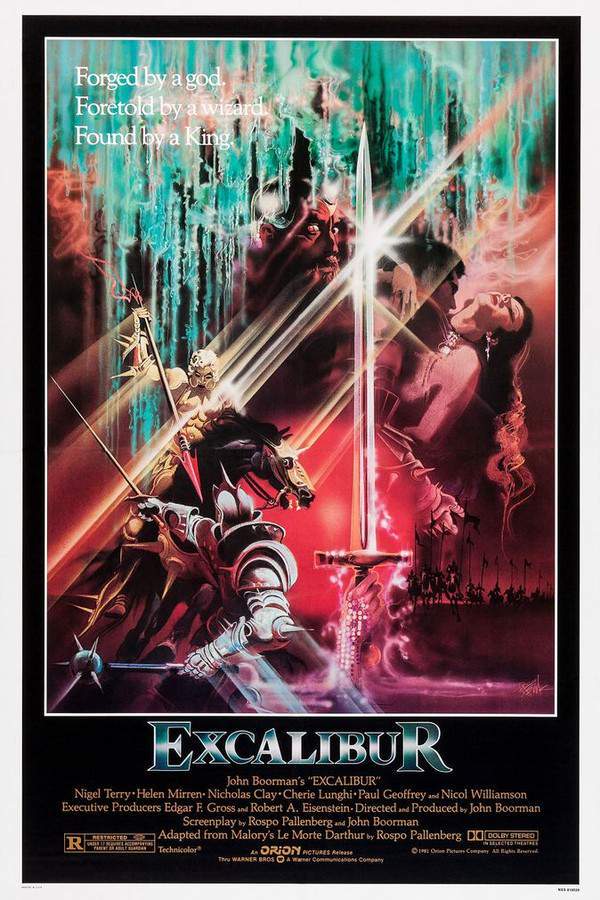
Excalibur (1981) movie poster

Plot Summary

Excalibur (1981) Plot Summary Explained

Release, runtime and language
1981 · 140 min · English
Directed by
John Boorman
Starring
Helen Mirren, Nigel Terry

A majestic retelling of the King Arthur legend, this film follows the forging of Excalibur and the rise and fall of the Round Table. Driven by the noble quest for the Holy Grail, Arthur and his knights face trials that test their limits. The story explores the conflict between Merlin's wisdom and Morgana's dark magic, revealing a timeless tale of chivalry, power, and the weight of destiny.

On this page (7)
  1. 1 Where to watch
  2. 2 What happens: full plot
  3. 3 Plot questions answered
  4. 4 The book behind the movie
  5. 5 Movie threads
  6. 6 Movies like Excalibur
  7. 7 Every angle

Where to watch

Where to Watch Excalibur (1981)

Where can you watch Excalibur? Stream, rent or buy it in the US, including on Amazon Video, Apple TV Store and Fandango At Home: current JustWatch availability with up-to-date prices.

Streaming availability powered by JustWatch

Full plot summary · contains spoilers

What Happens in Excalibur: Full Plot Summary

The whole story of Excalibur (1981) explained, from the opening scene to the final frame: every key event, every twist and what it all adds up to. Read it as a quick recap before the sequel, to check a scene you missed, or to finally understand what really happened.

In ancient England, the realm is embroiled in a brutal conflict between Uther Pendragon (Gabriel Byrne) and the Duke of Cornwall (Corin Redgrave). To restore peace, the legendary wizard Merlin (Nicol Williamson) secures the magical sword Excalibur from the Lady of the Lake (Hilary Joyalle) and bestows it upon Uther. With this symbol of power and the promise of land, Cornwall begrudgingly acknowledges Uther as king. During a celebration hosted by Cornwall, Uther becomes infatuated with Igrayne (Katrine Boorman), Cornwall's wife, breaking the delicate truce that had been established.

In a desperate attempt to possess Igrayne, Uther beseeches Merlin once more. The wizard agrees to grant Uther his desire but demands a price. That night, Uther's men lure Cornwall from his castle, ambushing and killing him. Disguised by Merlin to resemble Cornwall, Uther enters the castle, engages in a night of passion with Igrayne, and conceives a child just as Cornwall takes his last breath.

Months later, Igrayne gives birth to a son. Upon gazing at his newborn, Uther vows to become a peaceful ruler and secure his kingdom for him. However, Merlin reappears and takes the child away as promised, leaving a heartbroken Igrayne behind. As Uther tries to reclaim his son, he is attacked by loyalists of Cornwall and sustains fatal injuries. In a final act of defiance, he drives Excalibur into a stone, announcing that the sword belongs solely to him. Merlin recites an incantation, ensuring that the sword will remain in the stone until the true heir, Arthur (Nigel Terry), is worthy enough to claim it.

For the next sixteen years, no one can extract the sword from its stony prison. Each year, a joust is held to determine who might be deemed worthy to try. Sir Ector (Clive Swift) arrives at the joust with his son, Kay (Niall O'Brien), and Kay's squire, Arthur. When Arthur forgets Kay's sword, he approaches the stone and miraculously pulls Excalibur from it, astonishing the crowd. Ector discloses that Merlin had entrusted Arthur to him as a baby for protection. Although many knights resist acknowledging Arthur, as he has yet to become a knight, Leondegrance (Patrick Stewart) stands as the first to recognize him as the rightful ruler.

With newfound power, Merlin guides Arthur to Leondegrance's besieged castle. Here, Arthur showcases his bravery and earns recognition not through combat but by humbling himself and seeking assistance from Uryens (Keith Buckley). Soon after, Arthur initiates his courtship with Guenevere (Cherie Lunghi), the daughter of Leondegrance.

Under Arthur's reign, the kingdom thrives, uniting the various fiefdoms and attracting many to his grand castle, Camelot. However, the harmony is disturbed by Lancelot (Nicholas Clay), who teaches Arthur a valuable lesson in humility when he overcomes Arthur and his knights, only for Arthur to rely on Excalibur's mystical strength to claim victory. Acknowledging his flaws, Arthur discards the sword into a pond, where the Lady of the Lake offers to restore it to him while healing Lancelot, who swears loyalty to Arthur yet prefers to distance himself from Camelot due to his love for Guenevere.

The absence of Lancelot is keenly felt in Camelot, particularly by Morgana la Fey (Helen Mirren), Arthur's half-sister. Consumed by resentment from witnessing Uther's violent act against her mother, she plots to bring down Arthur's kingdom. Morgana cunningly incites Gawain (Liam Neeson) to confront Guenevere and accuse her of unfaithfulness, culminating in a joust. Though Lancelot initially evades the challenge, he arrives just in time to triumph over Gawain, succumbing to the wounds he inflicted upon himself from battling his desires for Guenevere.

As Merlin, weary of being a puppeteer of kings, succumbs to the knowledge that magic is giving way to science and faith, Morgana ensnares him and extracts his secrets, imprisoning him in his cavern. Meanwhile, Guenevere and Lancelot's affair culminates in their love-making, witnessed by Arthur, who in a moment of mercy, drives Excalibur into the ground between them. This act of restraint leaves the two lovers heartbroken, leading to a tragic turn when Morgana, disguised as Guenevere, bears a child with Arthur.

Severed from Excalibur and torn apart by betrayal, Arthur's leadership falters, plunging the land into despair. To recover the strength of his kingdom, he delegates a quest for the Holy Grail, the sacred chalice that promises restoration. While most of his knights are lost during their fruitless ten-year search, one brave knight, Perceval (Paul Geoffrey), encounters Lancelot in despair among grieving peasants. Lancelot's state reflects the anguish staining Camelot, yet through vision, Perceval learns that the Grail embodies belief in Arthur, essential for revitalizing the realm.

Upon successfully retrieving the Grail, Perceval presents it to Arthur, who is once again revitalized, allowing the land to flourish. He reconciles with Guenevere, who has turned to a life of penance in a convent, returning Excalibur to him.

Amidst this restoration, Mordred (Charley Boorman), Arthur's son with Morgana, declares war against his father, rallying a formidable army largely composed of Saxons. Using dark magic to safeguard himself, Mordred confronts Arthur in battle. The night before their clash, Arthur implores Merlin for guidance, who responds by causing Morgana to age before her time.

The ensuing battle at Camlann sees Arthur's forces, greatly outnumbered, emerging victorious through the strategic advantage of Morgana’s smoke. Lancelot courageously charges to assist, but ultimately succumbs to previous self-inflicted wounds. In a show of reconciliation, Arthur pardons him before Lancelot passes.

As the conflict comes to its climax, Arthur and Mordred meet on the battlefield. Both mortally wounded, they exchange final blows—Arthur impales Mordred with Excalibur, while Mordred mortally wounds Arthur. With his dying breath, Arthur instructs Perceval to return Excalibur to the water, ensuring its safety until the future king comes. However, unable to follow through, Perceval reassures Arthur before finally casting the sword into the lake, where the Lady of the Lake claims it once more.

As the smoke clears, the Fates arrive to transport Arthur to Avalon, leaving behind a kingdom irrevocably changed by the tales of loyalty, betrayal, love, and loss.

Last updated: October 27, 2024 at 21:51

Was this helpful?

Plot questions answered

Excalibur Plot Explained: Your Questions Answered

The questions people ask most about Excalibur (1981): what happens in the confusing scenes, why the characters do what they do, the twists, hidden details and what the ending means. Each answer contains spoilers.

Q1

Why does Merlin give Excalibur to Uther Pendragon?

Merlin gives Excalibur to Uther to end the brutal war between Uther and the Duke of Cornwall. Merlin obtains the magical sword from the Lady of the Lake and uses it as a symbol of legitimacy to unite the kingdom. However, Merlin demands a price, Uther's future child, as payment for his magical assistance, knowing that Uther's lust for Igrayne will lead to tragedy.

Foreshadowing: Merlin's pattern of granting wishes at a price is established early when he first asks for Uther's future child in exchange for Excalibur.

  • merlin
  • excalibur
  • uther pendragon
  • lady of the lake
  • king of britain
Q2

Why does Merlin take baby Arthur away from Igrayne?

Merlin takes Arthur because he promised Uther the child as payment for the magic that allowed Uther to disguise himself and seduce Igrayne. Merlin fulfills this bargain by taking the infant to Sir Ector's castle, where Arthur grows up as a squire, unaware of his royal heritage. This protects Arthur from those who would kill him as Uther's legitimate heir.

Foreshadowing: Merlin's warning to Uther that 'the price must be paid' hints at this separation.

  • merlin
  • arthur
  • igrayne
  • baby
  • sir ector
  • childhood
Q3

How does Arthur manage to pull Excalibur from the stone?

Arthur pulls Excalibur from the stone because he is the true heir to Uther, the sword was enchanted by Merlin to only be extracted by the rightful king. When Arthur approaches the stone to retrieve a replacement sword for Kay, he naturally pulls Excalibur out, proving his lineage. The enchantment specifically required someone of Uther's blood who was humble enough to seek a sword for his brother rather than for personal glory.

Foreshadowing: Uther drove Excalibur into the stone with the magical condition that only the true heir could remove it.

  • excalibur
  • stone
  • arthur
  • king
  • pull sword
  • Merlin's magic
Q4

Why does Morgana hate Arthur so much?

Morgana hates Arthur because she witnessed Uther's violence against her mother Igrayne, Uther killed Cornwall and used magic to disguise himself to rape Igrayne, conceiving Arthur. Morgana is Uther's daughter and Arthur's half-sister, making her hatred deeply personal. She blames Arthur for her mother's suffering and views his entire reign as built on the crime of her conception.

Foreshadowing: Morgana's cold observation of Arthur throughout his rise hints at her deep-seated resentment.

  • morgana
  • arthur
  • hatred
  • igrayne
  • uther
  • betrayal
  • revenge
Q5

What causes Camelot to fall?

Camelot falls due to multiple betrayals that converge. Morgana actively schemes to destroy Arthur by inciting conflict between Gawain and Guenevere, capturing Merlin to strip Arthur of magical guidance, and ultimately tricking Arthur into believing Guenevere was unfaithful. However, the deeper cause is Lancelot's affair with Guenevere, which fractures the Round Table and gives Morgana the ammunition she needs. Arthur's inability to handle these betrayals leads him to send knights on the Grail quest, leaving Camelot vulnerable.

Foreshadowing: Lancelot's refusal to stay in Camelot and Morgana's growing influence both foreshadow the kingdom's collapse.

  • camelot
  • fall
  • morgana
  • lancelot
  • guenevere
  • betrayal
  • round table
Q6

How does the Holy Grail restore Camelot?

The Holy Grail restores Camelot because it represents the belief in Arthur and the ideals he embodies. When Perceval retrieves the Grail and presents it to Arthur, the kingdom's faith in their king is revitalized. The land had been dying precisely because people had lost faith in Arthur's leadership after the scandals and betrayals. The Grail serves as a symbolic reaffirmation of Arthur's right to rule and the Round Table's noble purpose.

Foreshadowing: Merlin's fading power and the knights' desperate quest suggest the Grail holds spiritual significance beyond mere relic-hunting.

  • holy grail
  • camelot
  • perceval
  • restoration
  • faith
  • king arthur
Q7

How does Morgana capture Merlin?

Morgana captures Merlin by exploiting his weariness with being 'the puppeteer of kings.' She manipulates him when he is psychologically vulnerable, understanding that his magic is fading as science and faith rise. Morgana uses her dark magic to entrap him in his own cavern, extracting his secrets and imprisoning him. Merlin's greatest weakness is his own diminishing power and his resignation rather than any physical defeat.

Foreshadowing: Merlin admits that magic is giving way to science and faith, signaling his vulnerability.

  • merlin
  • morgana
  • capture
  • prison
  • cavern
  • magic
  • defeat
Q8

Why does Arthur forgive Lancelot and Guenevere?

Arthur forgives them because he recognizes that his own failures enabled the affair, he failed to show proper humility and allowed Morgana's schemes to fester. When Arthur witnesses Lancelot and Guenevere together, he could have killed them but instead drives Excalibur into the ground between them, choosing mercy over violence. Later, Arthur pardons Lancelot on his deathbed, showing that their friendship transcends betrayal. Arthur understands that his own flaws contributed to the tragedy.

Foreshadowing: Arthur's earlier lesson in humility from Lancelot foreshadows his ability to forgive.

  • arthur
  • lancelot
  • guenevere
  • forgiveness
  • affair
  • mercy
  • round table
Q9

How is Mordred related to Arthur?

Mordred is Arthur's son, born from a union between Arthur and Morgana (who disguised herself as Guenevere). This incestuous conception is one of the most tragic elements of the story, it represents how Morgana's scheme to destroy Arthur backfired by creating a child who would literally tear the kingdom apart. Mordred uses dark magic to protect himself and leads a Saxon army against his father, culminating in their mutual death at Camlann.

Foreshadowing: Morgana's disguised affair with Arthur plants the seed for Mordred's existence and eventual war.

  • mordred
  • arthur
  • son
  • morgana
  • battle
  • camlann
  • succession
Q10

Why does Arthur ask Perceval to return Excalibur to the lake?

Arthur instructs Perceval to return Excalibur to the Lady of the Lake because the sword must be protected for the future. With Arthur dying from his wounds at Camlann, he knows the kingdom will need its true king again someday. The sword's magical properties make it too dangerous to leave in the hands of unworthy men. The Lady of the Lake preserves Excalibur until the next rightful king arises, completing the cycle that began when Merlin first placed the sword in the stone.

Foreshadowing: The entire legend circles back to where it began, the Lady of the Lake's domain.

  • excalibur
  • perceval
  • lady of the lake
  • return
  • avolon
  • death
Q11

Why does Lancelot leave Camelot?

Lancelot leaves Camelot because his love for Guenevere becomes impossible to act upon within the Round Table's code of honor. Even though Arthur and Guenevere are not officially married in the film's version, Lancelot's feelings create an untenable situation. He teaches Arthur humility by defeating him in combat, then distances himself to avoid further temptation. However, his departure weakens Camelot and leaves Morgana to exploit the emotional void.

Foreshadowing: Lancelot's initial victory over Arthur demonstrates his superior skill, hinting at the danger his presence poses.

  • lancelot
  • camelot
  • departure
  • guenevere
  • love
  • honor
  • leave
Q12

Why does Arthur throw Excalibur into the pond after defeating Lancelot?

Arthur throws Excalibur into the pond after his confrontation with Lancelot because he recognizes that he won only through the sword's magical power, not through his own merit. Lancelot had already defeated Arthur in fair combat, exposing Arthur's reliance on Excalibur's mystical strength. To prove his worth as a true king, Arthur discards the enchanted weapon, demonstrating that he values honor and humility over magical advantages.

Foreshadowing: Arthur's earlier lesson about humility sets up this moment of self-reflection.

  • excalibur
  • pond
  • arthur
  • lancelot
  • discard
  • humility
  • magical sword

Movie threads

More Movies Like Excalibur, by Mood & Story

Curated lists built around what makes Excalibur tick: the same mood, the same kind of story or the same emotional payoff. Each list explains why these movies belong together.

Tragic Mythic Epics like Excalibur

Grand stories of legendary figures whose heroic rises are shadowed by devastating falls. If you liked the grand scale and somber downfall in Excalibur, explore these movies like it. This thread gathers epic fantasy and historical dramas featuring legendary heroes, the building of kingdoms, and their ultimate tragic collapse due to destiny, betrayal, or human frailty.

  • epic
  • tragic
  • majestic
  • somber
  • mythic
  • fated
  • Tone: dark, majestic, somber
  • Pacing: steady, epic
Why these movies?

The story pattern: Stories in this thread typically follow a hero's journey from obscurity to greatness, often centered on founding a kingdom or achieving a grand ideal. The narrative arc is ascendant, then peaks, before descending into tragedy as internal flaws, external betrayals, or the burden of power lead to a catastrophic fall.

Why they belong together: These movies are grouped by their shared commitment to a dark, majestic tone, a steady, epic pacing that allows for world-building, and a heavy emotional weight derived from the inevitable collision of idealism with a flawed reality. The bittersweet or bleak endings are a core unifying element.

Dark Medieval Fantasy movies like Excalibur

Fantasy worlds where magic is perilous, chivalry is tested, and power corrupts. For viewers who enjoyed the dark magic, chivalric conflict, and somber mood of Excalibur, this thread features similar medieval fantasy films. Discover movies with a high intensity, strong violence, and a focus on the corrupting nature of power and the heavy cost of destiny.

  • grimdark
  • somber
  • violent
  • magical
  • conflicted
  • medieval
  • Tone: dark, somber, conflicted
  • Pacing: steady, methodical
Why these movies?

The story pattern: The narrative pattern involves characters navigating a world steeped in ancient magic and brutal political realities. The central conflict often pits a vision of a noble order against the seductive forces of dark magic, personal ambition, and betrayal, leading to violent confrontations and moral compromises.

Why they belong together: Movies here share a specific world aesthetic—a grounded, often grim medieval setting—combined with a dark tone and high intensity. They are united by the presence of dark magic, themes of power and corruption, strong violence, and a generally somber or conflicted mood.

If you liked this

Movies Like Excalibur

Similar movies to Excalibur: the same genre, themes or kind of story. Each one comes with its own plot summary, timeline and ending explained.

Browse all movie summaries

Every angle

Excalibur (1981) Explained: Plot, Timeline & Characters

Everything about Excalibur in one place: what happens in the plot summary, the timeline in chronological order, the characters and meaning and a spoiler-free summary. What's After the Movie adds the cast, box office and post-credit scenes.

Coming soon on iOS and Android

The Plot Explained Movie Summary App

Plot summaries, endings explained and timelines on your phone. Catch up on any movie in minutes, save your favorites and never miss a twist again.

Be the first to know when we launch. Your email stays private, always.

Learn more about the app