Plot Explained Spoilers guaranteed!
Plot Explained

Browse by genre

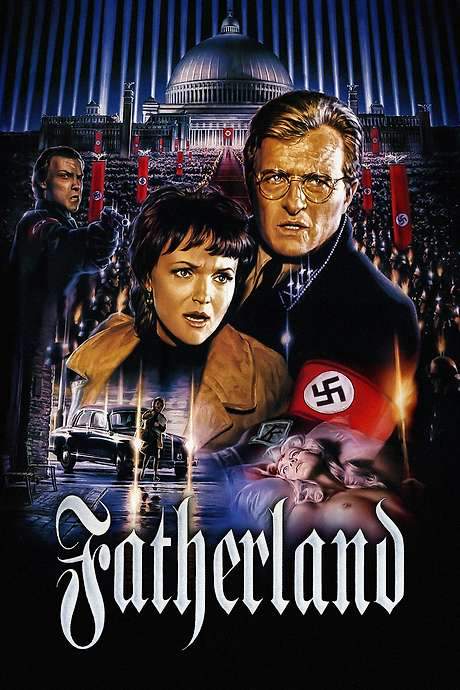
Fatherland (1994) movie poster

Timeline

Fatherland (1994) Timeline Explained – Every Event in Order

Release, runtime and language
1994 · 106 mins · English
Directed by
Christopher Menaul
Starring
Michael Shannon, Miranda Richardson, Rutger Hauer, John Woodvine, Jan Vlasák, Peter Vaughan

A speculative thriller set in the 1960s imagines a world where Hitler won World II and Germany’s war crimes stay hidden. When Hitler seeks a peace summit with the U.S. president, an American journalist and a German homicide detective become tangled in a covert plot to erase every record of the genocide and protect the regime’s dark legacy.

On this page (6)
  1. 1 Events in order (12)
  2. 2 Timeline questions answered
  3. 3 The book behind the movie
  4. 4 Movie threads
  5. 5 Movies like Fatherland
  6. 6 Every angle

12 events in order · contains spoilers

Fatherland Timeline: Events in Chronological Order

Every key event of Fatherland (1994) in order, scene by scene, with when and where it takes place. Use it to untangle flashbacks, time jumps and parallel storylines, to refresh your memory before the sequel or to find the exact scene you are thinking of.

  1. Body found in a Berlin-area lake

    A body is discovered floating in a lake near Berlin by SS cadet Hermann Jost. The deceased is Josef Bühler, a former Nazi official connected to the Jewish resettlement program. The discovery triggers a high-stakes inquiry and hints at a cover-up that reaches into the regime's inner circle.

    When
    a week before the 1964 summit
    Where
    Berlin-area lake
  2. Gestapo takes over the case and Jost dies

    The Gestapo seizes the investigation for reasons of state security, shutting down normal channels of inquiry. Jost dies in an apparent training accident, fueling rumors of a deeper conspiracy. March and other investigators sense that powerful figures are protecting dark secrets.

    When
    Berlin, a week before the summit
    Where
    Berlin
  3. Maguire receives an incriminating photograph

    Charlotte Maguire, a visiting American journalist, is handed an envelope containing a photo of several high-ranking Nazi officials outside a villa. A note points her toward Wilhelm Stuckart, a retired party official, who is later found dead in his apartment. The trail intensifies as connections to Wannsee attendees begin to surface.

    When
    in the days following the Bühler discovery
    Where
    Berlin
  4. March is reassigned; Gestapo blocks investigation

    March is reassigned to the Stuckart case, but the Gestapo asserts jurisdiction and warns him against pursuing further investigations. The case hints at a top-level plot that dwarfs a single murder. The danger grows as March presses for answers.

    When
    shortly after Stuckart's death
    Where
    Berlin
  5. Wannsee visit reveals the conference attendees are dead

    March and Maguire trace the photo to Wannsee, uncovering that all attendees of the Wannsee Conference have died under suspicious circumstances. Only one survivor remains: Franz Luther. The discovery deepens the intrigue and confirms a calculated cover-up.

    When
    before the summit
    Where
    Wannsee, Berlin
  6. Franz Luther seeks safe passage through Maguire

    Franz Luther contacts Maguire and asks to arrange safe passage to the United States in exchange for what he knows about 'the biggest secret of the war.' March cautions that Luther cannot be trusted, but Maguire decides to pursue the lead anyway. The two set up plans that move toward a dangerous train meeting.

    When
    shortly before the summit
    Where
    Berlin, en route to a train
  7. Luther is killed; March saves Maguire

    SS troops corner Luther and kill him on the way to secure his information, but March intervenes and rescues Maguire. The botched capture reveals the depth of the regime's reach and willingness to silence witnesses. The escape attempt marks a turning point in their investigation.

    When
    moments after Luther's contact
    Where
    on a train between Berlin and destination
  8. Maguire exposes Luther's papers; Hagen reveals truth

    Maguire, posing as an American embassy official to process Luther's safe passage, visits Anna von Hagen. Hagen reveals that Jews were not merely resettled but exterminated during the war, as discussed at Wannsee. The revelation shocks March and confirms the truth the regime has tried to bury.

    When
    after Luther's death
    Where
    Berlin
  9. March decides to escape with his son Pili

    Haunted by the documents, March agrees to escape Germany with his son Pili and leave the country with Maguire. The Gestapo has already manipulated Pili to betray his father, creating a trap that follows him into the escape attempt. March fights his way toward freedom, but is gravely wounded.

    When
    after Hagen's revelation
    Where
    Berlin
  10. Final confrontation and March's death

    During the escape, March kills a Gestapo agent but is mortally wounded himself. He manages to reach a phone booth and give Pili a final call, entrusting him with their fate. He dies knowing the truth has begun to reverberate beyond Berlin.

    When
    during the escape sequence
    Where
    Berlin
  11. Kennedy arrives at the Great Hall; documents reach US

    As Kennedy arrives at Berlin's Great Hall, a journalist assists Maguire in slipping the documents to the US ambassador. Kennedy reads the materials and immediately cancels the planned meeting with Hitler, returning to the United States. The moment hints at a potential detente being broken and the regime losing leverage.

    When
    1964, at the summit moment
    Where
    Berlin, Great Hall
  12. Epilogue: Pili's narration and regime collapse

    In the epilogue, Pili, now grown, narrates the story and notes that Maguire was ultimately arrested by the Gestapo. The exposure of the Jewish extermination derails any prospect of a strategic alliance with the United States, and revolutions flare across Europe. The Nazi regime collapses as its war-weariness and internal turmoil overwhelm its control.

    When
    years after 1964
    Where
    Europe

Last updated: October 09, 2025 at 10:48

Was this helpful?

Timeline questions answered

Fatherland Timeline Explained: Your Questions Answered

When does it happen, and why in that order? The questions people ask about the chronology of Fatherland (1994): time jumps, flashbacks, cause and effect between scenes and the correct order of events, each answered with spoilers.

Q1

Why does the Gestapo take over Josef Bühler's murder case?

The Gestapo seizes the investigation because Josef Bühler was a retired Nazi official who managed the Jewish 'resettlement' program in Eastern Europe. His death threatens to expose the regime's most dangerous secrets, so the Gestapo claims jurisdiction in the name of state security and shuts down normal police inquiry. This cover-up signals that powerful figures within the regime are protecting dark secrets that reach into the inner circle.

Foreshadowing: Earlier, the discovery of Bühler's body by an SS cadet already hints that something beyond a simple murder is unfolding.

  • Josef Bühler
  • Gestapo
  • murder investigation
  • cover-up
  • state security
Q2

How does Xavier March discover the truth about the Holocaust?

March uncovers the truth through Franz Luther's papers. After Luther is murdered by Gestapo agents, March retrieves his documents and learns from Anna von Hagen that Jews were not merely resettled but systematically exterminated during the war, a plan devised at the Wannsee Conference and concealed for decades. This revelation shatters March's worldview and drives his desperate decision to escape Germany with his son.

Foreshadowing: The photo of high-ranking Nazi officials and the mysterious deaths of Wannsee Conference attendees have been pointing toward this secret throughout the investigation.

  • Xavier March
  • Holocaust
  • extermination
  • Franz Luther
  • Wannsee Conference
  • documents
Q3

What is Franz Luther's secret and why does he want to go to America?

Franz Luther possesses the truth about 'the biggest secret of the war', the systematic extermination of Jews, which was decided at the Wannsee Conference and hidden from the world. As one of the few surviving attendees, Luther wants safe passage to the United States in exchange for revealing this information to American authorities, hoping to use it as protection against the regime that has silenced all the other witnesses.

Foreshadowing: The photo of Nazi officials and the deaths of all Wannsee attendees except Luther have been establishing the danger of this secret throughout the film.

  • Franz Luther
  • secret
  • America
  • Wannsee Conference
  • safe passage
  • witness
Q4

Why are all the Wannsee Conference attendees dead except Franz Luther?

The Wannsee Conference attendees have been systematically eliminated to cover up the genocide. When March and Maguire investigate the photo, they discover that every high-ranking Nazi official who attended the 1942 conference, where the 'Final Solution' was planned, has died under suspicious circumstances. Only Franz Luther, the elderly man who handed over the photograph, remains alive, making him the sole surviving witness to the regime's darkest secret.

Foreshadowing: The photo of officials gathered outside a villa and the deaths of figures like Wilhelm Stuckart have been hinting at this coordinated elimination.

  • Wannsee Conference
  • attendees
  • deaths
  • Franz Luther
  • cover-up
  • genocide
Q5

How does Pili betray his father Xavier March?

The Gestapo manipulates young Pili into betraying his father by coaxing him with promises or deception, using the boy as an unwitting tool to set a trap. During the escape attempt, this betrayal allows Gestapo agents to anticipate March's movements, leading to the deadly confrontation where March is cornered, shoots a Gestapo agent, and is mortally wounded. Pili's manipulation represents the regime's ability to exploit even the most personal relationships.

Foreshadowing: March's superior Arthur Nebe had warned him against pushing too far, and earlier warnings about the dangers of the investigation set the stage for this personal betrayal.

  • Pili
  • Xavier March
  • betrayal
  • Gestapo
  • trap
  • escape
Q6

What happens when Kennedy receives the documents about the Holocaust?

When Kennedy reads the documents exposing the systematic extermination of Jews, he immediately cancels his planned meeting with Hitler. The revelation derails the prospective Nazi-American alliance and forces Kennedy to return to the United States with the truth. This moment shatters the détente that President Kennedy's administration had been building with the Nazi regime, fundamentally altering the political landscape of this alternate history.

Foreshadowing: The entire investigation has been building toward getting this evidence to American officials before the summit.

  • Kennedy
  • documents
  • Holocaust
  • Hitler
  • summit
  • alliance
  • cancellation
Q7

Why does March decide to escape Germany with his son?

After discovering the truth about the Holocaust from Luther's papers and Anna von Hagen, March's entire worldview collapses. He realizes the regime he has served is built on mass murder and systematic lies. Determined to get his young son Pili out of Germany and to ensure the truth reaches the outside world, March risks everything on a desperate escape attempt, knowing it will likely cost him his life.

Foreshadowing: March's earlier warnings to Maguire about Luther's untrustworthiness and his growing unease with the investigation have been building toward this moral breaking point.

  • Xavier March
  • escape
  • Pili
  • Germany
  • son
  • truth
  • sacrifice
Q8

What triggers the collapse of the Nazi regime in this alternate history?

The exposure of the Holocaust derails any strategic alliance with the United States, removing the regime's key diplomatic lifeline. Combined with the strain of ongoing resistance movements, economic exhaustion from the prolonged war with the Soviet Union, and internal turmoil, the Nazi state begins to fracture. Revolutions flare across Europe, and the regime that has held continental dominance for two decades finally collapses under the weight of its crimes and contradictions.

Foreshadowing: The film has shown a world worn down by decades of war and increasingly desperate to secure American alliance as a lifeline.

  • Nazi regime
  • collapse
  • revolutions
  • Europe
  • alliance
  • exposure
  • Holocaust
Q9

How does the alternate history diverge from real history in the film?

The divergence begins with the failed Normandy invasion, which causes the United States to withdraw from Europe and concentrate on defeating Japan. Without American involvement, Germany conquers Britain, and the war with the Soviet Union grinds on for decades with Stalin still ruling into the 1960s. In America, Joseph Kennedy's anti-Semitic administration negotiates détente with Nazi Germany, culminating in a planned 1964 summit between Kennedy and Hitler.

Foreshadowing: The opening establishes this divergent path by showing Eisenhower retiring in disgrace and Churchill in exile in Canada.

  • alternate history
  • Normandy
  • Germany
  • Britain
  • Kennedy
  • Hitler
  • divergence
Q10

Who kills Franz Luther and why?

Gestapo agents kill Franz Luther on the train before he can reach safety and deliver his testimony to American authorities. The regime cannot allow the sole surviving witness to the Wannsee Conference to reach foreign soil with evidence of the Holocaust. Luther's murder demonstrates the Gestapo's reach and their willingness to silence anyone who threatens to expose the regime's darkest secrets.

Foreshadowing: March had warned Maguire that Luther couldn't be trusted, but the danger to Luther himself was clear from the moment he sought safe passage.

  • Franz Luther
  • Gestapo
  • murder
  • train
  • witness
  • silencing
Q11

What role does Charlie Maguire play in exposing the truth?

Charlie Maguire, an American journalist, serves as the critical link that brings the evidence to light. She receives the initial photograph that sets the investigation in motion, arranges Franz Luther's supposed safe passage to America, and ultimately passes the incriminating documents to a trusted journalist who delivers them to the U.S. ambassador just as Kennedy arrives at the summit. Her actions ensure the truth reaches the American President before the Nazi alliance can be sealed.

Foreshadowing: The mysterious envelope she receives at the beginning is the catalyst for the entire investigation.

  • Charlie Maguire
  • journalist
  • documents
  • truth
  • exposure
  • Kennedy
  • ambassador
Q12

Why does Kennedy cancel the meeting with Hitler?

Kennedy cancels his meeting with Hitler after reading the documents that expose the systematic extermination of Jews during the war. The evidence, delivered through Maguire to the U.S. ambassador, reveals the true nature of the regime Kennedy was about to ally with. Faced with the horror of the Holocaust, Kennedy immediately abandons the planned détente and returns to America, leaving the Nazi leadership without the diplomatic victory they expected.

Foreshadowing: The entire narrative has been building toward this moment where the truth must reach American hands before the summit concludes.

  • Kennedy
  • Hitler
  • meeting
  • cancellation
  • documents
  • summit
  • alliance

Movie threads

More Movies Like Fatherland, by Mood & Story

Curated lists built around what makes Fatherland tick: the same mood, the same kind of story or the same emotional payoff. Each list explains why these movies belong together.

Historical Conspiracy Thrillers like Fatherland

Uncovering dangerous secrets hidden by powerful, authoritarian regimes. If you liked the tense investigation and dystopian setting of Fatherland, explore more movies like it. This section features grim political thrillers where characters uncover dangerous truths in historical or alternate-history worlds defined by oppressive regimes and moral decay.

  • tense
  • paranoid
  • gripping
  • oppressive
  • investigative
  • dystopian
  • Tone: tense, bleak
  • Pacing: steady, investigative
Why these movies?

The story pattern: This narrative pattern follows a determined protagonist—often an investigator or journalist—as they methodically uncover a horrific truth that a powerful government is desperate to keep buried. The structure is typically a slow-reveal investigation, building tension and paranoia as the protagonist gets closer to a truth that could destroy them.

Why they belong together: These movies are grouped by their shared creation of an oppressive, high-stakes atmosphere, where the central conflict is an individual versus a sprawling state conspiracy. They combine the intellectual engagement of a mystery with the visceral dread of living under constant surveillance and threat.

Dystopian Movies with Bittersweet Endings like Fatherland

Tragedies where a small victory for truth comes at a devastating personal cost. For viewers who appreciated the heavy emotional weight and bittersweet conclusion of Fatherland. These movies feature similar narrative arcs where a character's sacrifice in a dark world leads to a significant, though costly, victory for truth and resistance against oppression.

  • somber
  • bittersweet
  • tragic
  • hopeful
  • heavy
  • determined
  • Tone: somber, bittersweet
  • Pacing: steady
Why these movies?

The story pattern: The emotional journey in these stories is defined by heavy moral choices and ultimate sacrifice. The protagonist achieves their goal—often exposing a hidden evil or preventing a greater catastrophe—but pays for it with their life or everything they hold dear. The ending feels somber yet meaningful, validating the struggle without softening its cost.

Why they belong together: This thread connects movies through their shared emotional trajectory and thematic focus on the cost of truth. They deliver a powerful, thought-provoking experience by balancing the devastation of personal loss with the significance of a larger, hopeful impact on a broken world.

If you liked this

Movies Like Fatherland

Similar movies to Fatherland: the same genre, themes or kind of story. Each one comes with its own plot summary, timeline and ending explained.

Browse all movie summaries

Every angle

Fatherland (1994) Explained: Plot, Timeline & Characters

Everything about Fatherland in one place: what happens in the plot summary, the timeline in chronological order, the characters and meaning and a spoiler-free summary. What's After the Movie adds the cast, box office and post-credit scenes.

Coming soon on iOS and Android

The Plot Explained Movie Summary App

Plot summaries, endings explained and timelines on your phone. Catch up on any movie in minutes, save your favorites and never miss a twist again.

Be the first to know when we launch. Your email stays private, always.

Learn more about the app