Plot Explained Spoilers guaranteed!
Plot Explained

Browse by genre

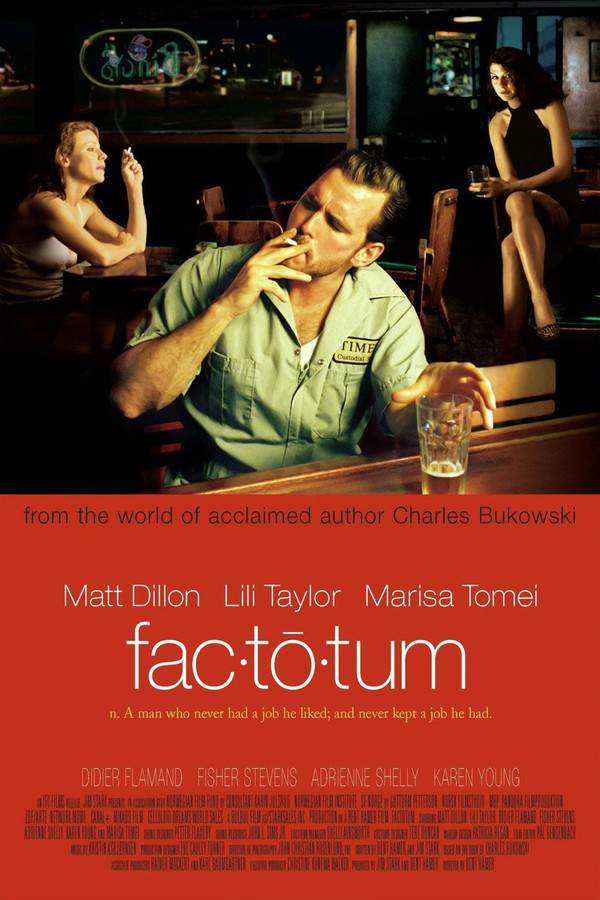
Factotum (2006) movie poster

Timeline

Factotum (2006) Timeline Explained – Every Event in Order

Release, runtime and language
2006 · 94 min · English
Loading streaming availability…
Directed by
Bent Hamer
Starring
Marisa Tomei, Lili Taylor, Matt Dillon

Driven by a restless spirit, Henry Chinaski, portrayed by Matt Dillon, drifts through a succession of odd jobs and short-lived relationships. Struggling to find purpose and financial stability, he seeks solace in life’s simple pleasures. His experiences offer a candid and poignant look at the challenges of finding meaning and connection in a world of fleeting moments.

On this page (7)
  1. 1 Where to watch
  2. 2 Events in order (12)
  3. 3 Timeline questions answered
  4. 4 The book behind the movie
  5. 5 Movie threads
  6. 6 Movies like Factotum
  7. 7 Every angle
Loading streaming availability…

12 events in order · contains spoilers

Factotum Timeline: Events in Chronological Order

Every key event of Factotum (2006) in order, scene by scene, with when and where it takes place. Use it to untangle flashbacks, time jumps and parallel storylines, to refresh your memory before the sequel or to find the exact scene you are thinking of.

  1. Hank's writer dream amid a life of short-lived jobs

    Hank Chinaski is determined to become a writer, even as he drifts through unstable, low-wage gigs and battles his alcohol addiction. The film sketches a restless quest for a vocation while he bounces from one job to the next. His days are a mix of scribbles, waiting, and the lure of the next drink.

    Where
    city/work sites
  2. Bar encounter and a lasting companion: Jan

    In a bar Hank meets Jan, a fellow drinker who becomes his most constant companion. They spark a rough, affectionate partnership built on alcohol and shared neglect of responsibility. The bar becomes their orbit as Hank searches for both chemistry and distraction.

    Where
    bar
  3. A languid, stormy relationship with Jan

    Hank and Jan fall into a settled but unstable life together, existing in languid squalor as they swap drinks and affection. They drift through a string of short jobs and nights out, never quite changing the pattern that binds them. The relationship stabilizes only in its volatility.

    Where
    city apartment and bars
  4. The racing track fight that ends a chapter

    During a confrontation at a racing track, Hank assaults a wealthy man after Jan challenges his behavior. The scene demonstrates his quick temper and willingness to risk consequences for pride or protection of Jan. After the incident, Hank withdraws from Jan and begins a new period of independence.

    Where
    racing track
  5. Alcohol help from Laura and Pierre; a boat misadventure

    Unemployed again, Hank meets Laura, who coaxes him toward more drinking with her wealthy sugar daddy Pierre. Laura and Pierre prop him up with cash and access to alcohol, pulling Hank into a bizarre ride that includes a strange boat excursion. The encounter widens Hank's circle while deepening his sense of instability.

    Where
    bar, Pierre's boat
  6. Jan returns briefly as a hotel chambermaid and a health scare

    Chinaski briefly reconnects with Jan, who is now working as a hotel chambermaid. He discovers he has contracted a case of crabs from her, a humiliating reminder of their tangled past. The moment tests both their boundaries and Hank's readiness to reengage.

    When
    brief return
    Where
    hotel
  7. A statue job begins and ends in failure

    Hank lands another steady job but chooses drink over duty, failing to finish cleaning a massive statue. The spectacle of his defiance costs him the job and underscores a recurring pattern of work interrupted by alcohol. The incident reinforces his grim view of secure employment.

    Where
    statue site
  8. Jan leaves Hank; she moves in with Pierre

    Hank and Jan realize their relationship has become predictable, prompting a breakup. Jan moves in with the wealthy Pierre, the same man who previously featured in the circle of Hank's misadventures. Hank remains alone, drifting toward self-reliance and his writing.

    Where
    apartment and Pierre's circle
  9. Solitary life shapes his writing ambitions

    With Jan out of the picture, Hank lends into solitude as the primary content of his days. He chases moments of inspiration and writes in fits, drinking as a steady companion. The absence of a stable relationship deepens his fixation on the craft.

    When
    late
    Where
    city apartment
  10. Closing monologue on sacrifice and craft

    In the final scenes Hank stands at the bar and delivers a long meditation on the costs and rewards of writing. He asserts that if you decide to pursue something, you must go all the way, even if it costs relationships. The monologue frames his commitment to the solitary, gods-haunted life of a writer.

    When
    final scene
    Where
    bar
  11. The gods, the nights, and the fight

    The narrative voiceover reinforces a creed of endurance and courage, painting a life where loneliness accompanies artistic pursuit. Hank defines creativity as a fierce, uncompromising fight against dilution. The text serves as the film’s philosophical capstone.

    When
    end
    Where
    voiceover
  12. Resolution: writing and solitude endure

    The film closes with Hank reconciled to a solitary existence, sustained by his writing and by alcohol as a constant companion. He accepts the costs of his chosen path while holding on to the possibility of a perfect, albeit lonely, laughter.

    When
    end
    Where
    apartment

Last updated: October 09, 2025 at 15:44

Was this helpful?

Timeline questions answered

Factotum Timeline Explained: Your Questions Answered

When does it happen, and why in that order? The questions people ask about the chronology of Factotum (2006): time jumps, flashbacks, cause and effect between scenes and the correct order of events, each answered with spoilers.

Q1

Why does Hank attack the wealthy man at the racing track?

Hank attacks the man after Jan challenges the wealthy patron who refuses to give up his seat or acknowledge his rude behavior toward her. The confrontation escalates when Hank, emboldened by Jan's challenge to privilege, lands a physical blow on the man. This violent outburst marks a turning point in the film, Hank chooses pride and loyalty to Jan over discretion, and the repercussions lead him to walk away from the relationship.

  • racetrack fight
  • wealthy man
  • Jan
  • Hank assault
Q2

Why does Hank leave Jan after the racing track incident?

After the fight at the racetrack, Hank decides to leave Jan because the incident has exposed the volatility of their relationship and the consequences of his quick temper. The violent outburst, though motivated by protection and pride, forces him to recognize that their dynamic has become dangerous and unsustainable. He walks away bruised but also emboldened, choosing independence over the turbulent partnership.

  • Jan breakup
  • racetrack
  • Hank leaves
  • relationship end
Q3

What does Hank discover about his health after reconnecting with Jan?

When Hank briefly reconnects with Jan, who is now working as a hotel chambermaid, he discovers he has contracted crabs from her. This humiliating health scare serves as a sharp, physical reminder of the costs associated with their lifestyle and the tangled, transactional nature of their relationship.

  • crabs
  • Jan
  • sexually transmitted infection
  • health scare
Q4

Why does Hank lose the statue cleaning job?

Hank lands a steady job cleaning a massive sculpture, but he chooses to prioritize drinking over completing his duties. He abandons the work to pursue alcohol, and this decision costs him the job. The incident reinforces his recurring pattern of choosing drink over responsibility, demonstrating how his alcoholism consistently derails any attempt at financial stability.

Foreshadowing: Earlier in the film, Hank's pattern of prioritizing alcohol over work is established through his series of short-lived gigs.

  • statue job
  • fired
  • alcohol
  • work failure
  • cleaning job
Q5

Why does Jan move in with Pierre after breaking up with Hank?

After Hank and Jan recognize their relationship has become predictable and hollow, they part ways. Jan then moves in with Pierre, the wealthy sugar daddy who previously helped Hank access alcohol through Laura. This ironic twist, Jan ending up with the very man Hank once attacked, underscores the transactional and cyclical nature of the characters' connections in the film.

  • Jan
  • Pierre
  • moves in
  • sugar daddy
  • ironic ending
Q6

Why does Hank repeatedly choose alcohol over keeping his jobs?

Hank's choice to prioritize drinking over work stems from his self-destructive lifestyle and his prioritization of immediate gratification over stability. Throughout the film, he bounces between dead-end jobs, cleaning a sculpture, delivering ice, working in a pickle factory, and a bicycle supply warehouse, always allowing alcohol to interfere with his employment. This pattern reflects his larger philosophy of living in the moment rather than pursuing conventional success.

  • alcohol
  • jobs
  • addiction
  • unemployment
  • drinking
Q7

What does Hank's closing monologue about going all the way mean?

Hank's final monologue declares that pursuing something fully means accepting the costs, losing relationships, sanity, and stability, in exchange for artistic truth. He frames creativity as a solitary, fire-lit battle against compromise. The monologue suggests he has accepted loneliness as the price of remaining true to his writer's path, choosing 'perfect laughter' over conventional happiness.

  • closing monologue
  • writing
  • sacrifice
  • philosophy
  • artistic pursuit
Q8

Why does Hank continue pursuing writing despite his chaotic life?

Hank persists with writing because it represents his only source of meaning and purpose in an aimless existence. Despite holding dead-end jobs and cycling through turbulent relationships, he continues scribbling and chasing moments of inspiration. The closing monologue makes clear that his commitment to writing is a 'fight' he refuses to abandon, even when it costs him stability and connection.

  • writing
  • dreams
  • novelist
  • creative drive
  • persistence
Q9

Why does Hank briefly return to Jan after leaving her?

Hank returns to Jan when he finds himself unemployed and seeking companionship. Their relationship, though volatile, represents a familiar anchor in his wandering life. When he discovers Jan working as a hotel chambermaid and learns he has contracted crabs from her, the encounter tests his willingness to reengage, but ultimately underscores the transitory and often transactional nature of his connections.

  • Jan reunion
  • hotel chambermaid
  • crabs
  • brief return
Q10

What does Laura and Pierre offer Hank during his unemployment?

When Hank is unemployed again, he meets Laura, a sympathetic barfly who sees him clearly. Through her relationship with Pierre, a wealthy older man, she helps Hank secure alcohol and temporary financial support. Pierre's boat becomes the setting for a strange misadventure that widens Hank's circle while deepening his sense of instability. Their assistance is generous but comes with the implicit expectation of Hank's participation in their world.

  • Laura
  • Pierre
  • alcohol
  • sugar daddy
  • financial help
Q11

Why does Hank stay in such a volatile relationship with Jan?

Hank stays with Jan because they share a deep bond forged through mutual addiction, understanding, and a willingness to accept each other's flaws. Their relationship is built on 'shared bottles and a wary tenderness,' offering moments of cheap intimacy amid their chaotic lives. Despite the volatility and eventual breakups, their connection represents something real in Hank's otherwise transient existence.

  • Jan
  • relationship
  • addiction
  • love
  • turbulence

Movie threads

More Movies Like Factotum, by Mood & Story

Curated lists built around what makes Factotum tick: the same mood, the same kind of story or the same emotional payoff. Each list explains why these movies belong together.

Movies about aimless drifters like Factotum

Character studies of people wandering through life without a clear direction. If you liked the wandering, episodic nature of Factotum, explore more movies about characters adrift in life. These films share a focus on day-to-day struggles, fleeting connections, and the search for meaning in a seemingly directionless existence, often with a similar gritty realism.

  • wandering
  • apathetic
  • lonely
  • resigned
  • gritty
  • reflective
  • Tone: melancholic, reflective, apathetic
  • Pacing: steady, episodic
Why these movies?

The story pattern: Stories in this thread are typically episodic, following a protagonist through a series of similar cycles—dead-end jobs, transient relationships, and personal vices. The plot is less about a traditional arc and more about accumulating experiences that paint a portrait of a specific kind of urban solitude and existential aimlessness.

Why they belong together: These movies are grouped by their central character archetype: the passive drifter. They share a melancholic tone, steady pacing, and a focus on the small, often squalid, details of a life without conventional purpose, creating a coherent vibe of resigned loneliness.
Movies about creative struggle and addiction like Factotum

Stories of artists wrestling with their craft amid personal turmoil and addiction. For viewers who appreciated Factotum's portrayal of a writer's battle with alcoholism, this list features similar stories of artists grappling with their demons. These films examine the gritty reality of the creative process, often showing how addiction and unstable lives both fuel and hinder artistic expression.

  • creative struggle
  • addiction
  • turbulent
  • urban loneliness
  • existential
  • gritty
  • Tone: gritty, melancholic, candid
  • Pacing: steady, character-driven
Why these movies?

The story pattern: The narrative pattern follows an artist—writer, musician, painter—as they navigate the challenges of their craft while battling personal vices, typically addiction. The story is a push-and-pull between moments of creative clarity and cycles of self-sabotage, leading to an often ambiguous ending regarding their ultimate success or failure.

Why they belong together: These films are united by their core theme: the inextricable link between artistic endeavor and personal dysfunction. They share a gritty mood, medium emotional weight, and a focus on the raw, often unglamorous, reality of the creative life, making the recommendations feel thematically cohesive.

If you liked this

Movies Like Factotum

Similar movies to Factotum: the same genre, themes or kind of story. Each one comes with its own plot summary, timeline and ending explained.

Browse all movie summaries

Every angle

Factotum (2006) Explained: Plot, Timeline & Characters

Everything about Factotum in one place: what happens in the plot summary, the timeline in chronological order, the characters and meaning and a spoiler-free summary. What's After the Movie adds the cast, box office and post-credit scenes.

Coming soon on iOS and Android

The Plot Explained Movie Summary App

Plot summaries, endings explained and timelines on your phone. Catch up on any movie in minutes, save your favorites and never miss a twist again.

Be the first to know when we launch. Your email stays private, always.

Learn more about the app