Plot Explained Spoilers guaranteed!
Plot Explained

Browse by genre

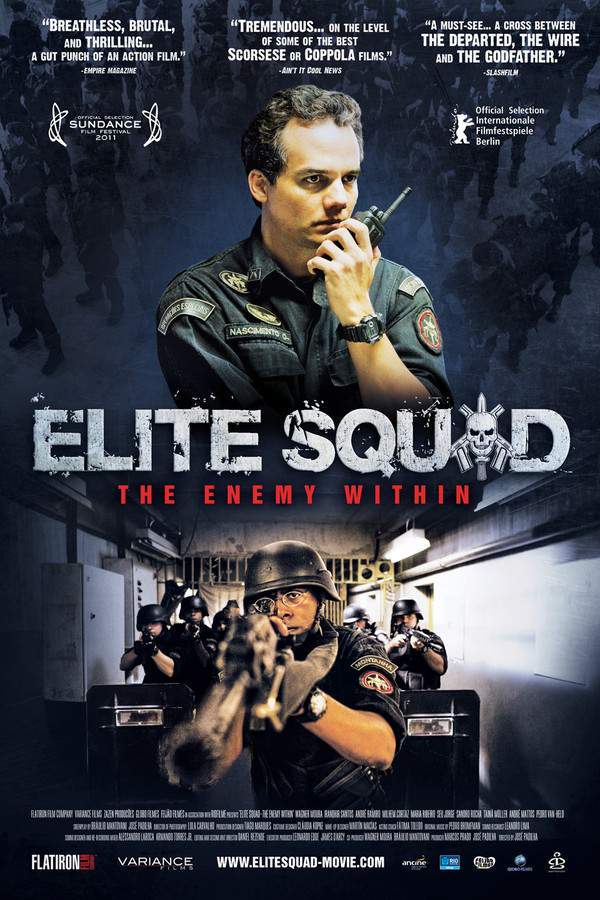
Elite Squad: The Enemy Within (2011) movie poster

Plot Summary

Elite Squad: The Enemy Within (2011) Plot Summary Explained

Release, runtime and language
2011 · 115 min · Portuguese
JustWatch #4,474 25
Directed by
José Padilha

In Rio de Janeiro’s favelas, Captain Nascimento leads an elite police unit battling violent gangs. His aggressive methods achieve results, but a transfer to a government position exposes a disturbing reality. Nascimento discovers that corruption within the police force and among government officials is the root cause of the city’s escalating violence, forcing him to confront a far more dangerous enemy than he initially imagined.

On this page (6)
  1. 1 Where to watch
  2. 2 What happens: full plot
  3. 3 Plot questions answered
  4. 4 Movie threads
  5. 5 Movies like Elite Squad: The Enemy Within
  6. 6 Every angle

Where to watch

Where to Watch Elite Squad: The Enemy Within (2011)

Where can you watch Elite Squad: The Enemy Within? Stream, rent or buy it in the US: current JustWatch availability with up-to-date prices.

Streaming availability powered by JustWatch

Full plot summary · contains spoilers

What Happens in Elite Squad: The Enemy Within: Full Plot Summary

The whole story of Elite Squad: The Enemy Within (2011) explained, from the opening scene to the final frame: every key event, every twist and what it all adds up to. Read it as a quick recap before the sequel, to check a scene you missed, or to finally understand what really happened.

Thirteen years have elapsed since the previous film, plunging Lieutenant Colonel Nascimento (formerly a BOPE Captain) into a whirlwind of chaos as he comes under fire while exiting a hospital. Amidst the tumult, Nascimento's voiceover narrates the turbulent journey that led him to this perilous moment.

The story unfolds like a complex tapestry interlaced with threads of tension and strife. Four years earlier, Nascimento finds himself at the Bangu Penitentiary Complex, tasked with quelling a riot ignited by the notorious gangleader Beirada, who insists on negotiations with Diogo Fraga, a teacher and human rights advocate. As Fraga is brought to the scene, he adeptly persuades Beirada to release the hostages. However, Nascimento's protégé, Captain André Matias, defies orders and fatally shoots Beirada, unleashing a series of consequences that resonate throughout the narrative.

As time progresses, Nascimento discovers that PMERJ commander Formoso intends to oust him due to mounting negative publicity. Unfazed, he confronts Formoso at a restaurant, where patrons applaud his resolute stand. The State Secretary for Public Safety, Guaracy, seizes the moment, promoting Nascimento while using Matias as a scapegoat by transferring him to the ordinary police. Nascimento vows to support Matias, yet Matias confides in journalist Clara Vidal about the rampant governmental corruption and BOPE's lack of backing, ultimately leading to a prison sentence. Meanwhile, Fraga, now united with Nascimento's ex-wife Rosane, ascends to the Rio State Assembly.

With newfound resources, Nascimento enhances BOPE's arsenal — increasing personnel, armored vehicles, and helicopters — hoping to eradicate police corruption by dismantling entire drug cartels operating in the favelas. However, corrupt officers under Major Rocha's command establish a militia that simultaneously eliminates drug trafficking and extorts local businesses to fortify a political stronghold.

Fast forward four years; disguised militia members steal rifles from a police station in Tanque, one of the last bastions of drug trade, thus providing a cover for their corrupt allies to press for the expulsion of heavily armed dealers and seize control of the area. Nascimento listens intently to phonetaps of the dealers, assuring Guaracy of their innocence; however, corrupt Lieutenant-Colonel Fabio Barbosa persists in claiming an informant's allegations against them, granting authorization for a raid. Matias, reinstated to BOPE by Rocha, occupies the station and ambushes fleeing dealers, resorting to torture on captured drug lord Pepa to uncover the whereabouts of the stolen weapons. As Rocha arrives and inexplicably executes Pepa, a confrontation ensues where Matias meets his untimely death at the hands of Rocha's men.

As the dark reality of Matias' death sinks in, a heartbroken Nascimento seizes control of Fraga's phone records, leveraging the investigative journalist's efforts to expose militia corruption. Vidal, meanwhile, delves into the favelas under Rocha's influence, unearthing damaging evidence for his re-election campaign. Unfortunately, her findings are abruptly silenced by Rocha's henchmen and her photographer. Eavesdropping on Fraga's call, Nascimento understands the dire threat to Vidal and realizes Fraga has also become a target. With strategic precision, he mobilizes his team to protect Fraga, Rafael, and Rosane as they come together at Fraga's residence. The ensuing drive-by attack leaves Rafael injured, prompting Nascimento to rush him to the hospital while secretly delivering the incriminating recording to Fraga. This shocking evidence compels Fraga to seek retribution against Guaracy, issuing a stark ultimatum: if his son's life is spared, nobody else will be safe.

The Assembly launches an investigation into the disappearances of Vidal and her photographer, fueled by Fraga's evidence. In the meantime, Nascimento's reputation suffers as accusations of wiretapping Rosane surface, leading him to resign from his post. Fearing his militia will be scapegoated for Rocha's actions, Nascimento prepares for an ambush during a visit to Rafael; fortunately, BOPE officers arrive just in time, thwarting Rocha's minions and allowing Nascimento to evade danger.

When summoned to testify, Nascimento unveils a complex network of corrupt officials, including Guaracy and Gregorio Fortunato, a TV personality and legislator who financially supports the militia. As the body count rises among those who possess knowledge or evidence, the Governor wins re-election, and Guaracy ascends to office in Rio. The film's closing moments find Nascimento reflecting on Brazil's political state, aptly declaring that > "as long as the conditions that sustain this system remain, it will persist." His somber contemplation is momentarily uplifted by a visit to Rafael, who slowly regains consciousness amidst the chaos.
Last updated: November 22, 2024 at 12:05

Was this helpful?

Plot questions answered

Elite Squad: The Enemy Within Plot Explained: Your Questions Answered

The questions people ask most about Elite Squad: The Enemy Within (2011): what happens in the confusing scenes, why the characters do what they do, the twists, hidden details and what the ending means. Each answer contains spoilers.

Q1

Why did Captain Matias kill gangleader Beirada during the prison riot?

Matias defied direct orders from Nascimento and fatally shot Beirada during the negotiation at Bangu Penitentiary. This impulsive act ended the riot but triggered a chain of consequences that shaped the entire narrative, including Matias's eventual downfall and the political fallout that followed.

Foreshadowing: Earlier scenes establish Matias as a hotheaded officer willing to bypass protocol for immediate results.

  • matias
  • beirada
  • prison riot
  • bope
  • bangu penitentiary
Q2

Why was Matias scapegoated and transferred to ordinary police?

After the riot, Nascimento was promoted to a government position while Secretary Guaracy used Matias as a political scapegoat to clean up the negative publicity. Matias was transferred to ordinary police despite Nascimento's vow to support him, and he later confided in journalist Clara Vidal about the corruption, which led to his imprisonment.

  • matias
  • transfer
  • scapegoat
  • corruption
  • guaracy
Q3

How did Diogo Fraga become a politician in the Rio State Assembly?

Fraga, originally a teacher and human rights advocate who negotiated with gangleader Beirada, later married Nascimento's ex-wife Rosane and ascended to the Rio State Assembly. His political career was fueled by the connections and resources he gained through his relationship with Nascimento's family.

Foreshadowing: Fraga's negotiating skills and political acumen were first demonstrated during the prison riot.

  • diogo fraga
  • rio state assembly
  • politician
  • rosane
Q4

What was Major Rocha's militia and why was it dangerous?

Major Rocha commanded corrupt police officers who formed a militia that eliminated drug trafficking in favelas while simultaneously extorting local businesses. Unlike traditional drug dealers, they operated with police resources and political connections, establishing a criminal network that posed as law enforcement while building a political stronghold.

  • rocha
  • militia
  • favelas
  • corruption
  • extortion
Q5

How did Matias die at the hands of Rocha's men?

During a raid at Tanque, Matias was reinstated to BOPE by Rocha and ambushed fleeing dealers while torturing captured drug lord Pepa for information about stolen weapons. When Rocha arrived, he executed Pepa to prevent disclosure of the militia's crimes, then ordered his men to kill Matias to silence him.

Foreshadowing: Rocha's manipulation of Matias's reinstatement was a setup to eliminate a potential witness.

  • matias death
  • rocha
  • pepa
  • bope raid
  • tanque
Q6

What happened to journalist Clara Vidal?

Clara Vidal was investigating Rocha's militia operations in the favelas and uncovered damaging evidence for his re-election campaign. Before she could publish her findings, Rocha's henchmen violently silenced her and her photographer, eliminating them to prevent the truth from surfacing.

  • clara vidal
  • journalist
  • rocha
  • militia investigation
  • murder
Q7

Why did Nascimento mobilize his team to protect Fraga and his family?

After eavesdropping on Fraga's calls, Nascimento learned that Vidal had been silenced and realized Fraga was also a target. He coordinated to protect Fraga, Rafael (Fraga's son), and Rosane at Fraga's residence. The drive-by attack that followed injured Rafael, prompting Nascimento to rush him to the hospital while delivering incriminating evidence to Fraga.

  • nascimento
  • fraga
  • rafael
  • protection
  • drive-by attack
Q8

What evidence did Nascimento give to Fraga that changed everything?

Nascimento seized Fraga's phone records to expose the militia corruption and delivered a recording to Fraga that incriminated Secretary Guaracy and other corrupt officials. This evidence forced Fraga to confront Guaracy and issue an ultimatum, ultimately leading to the Assembly investigation into the disappearances.

  • fraga
  • recording
  • evidence
  • guaracy
  • assembly investigation
Q9

Why did Nascimento resign from his position?

Nascimento resigned after accusations surfaced that he had wiretapped his ex-wife Rosane's phone, damaging his reputation. Additionally, he feared his militia would be scapegoated for Rocha's crimes, forcing him to step down despite his efforts to combat corruption.

  • nascimento
  • resignation
  • wiretapping
  • rosane
  • scandal
Q10

What did Nascimento reveal during his Assembly testimony?

During his testimony, Nascimento unveiled a complex network of corrupt officials, including Secretary Guaracy and Gregorio Fortunato, a TV personality and legislator who financially supported the militia. His testimony exposed the systemic corruption connecting police, politicians, and criminal enterprises.

  • nascimento
  • testimony
  • assembly
  • corruption
  • guaracy
  • fortunato
Q11

Why does the ending suggest Brazil's system won't change?

The film ends with the Governor winning re-election and Guaracy ascending to higher office in Rio. Despite Nascimento's exposure of corruption, the system persists because the conditions that sustain it remain intact. The movie concludes with Nascimento visiting the recovering Rafael, offering a small glimmer of hope amid the grim reality.

Foreshadowing: The opening hospital scene establishes the chaotic, dangerous reality Nascimento operates within.

  • ending
  • system corruption
  • brazil
  • governor
  • guaracy
  • political cycle

Movie threads

More Movies Like Elite Squad: The Enemy Within, by Mood & Story

Curated lists built around what makes Elite Squad: The Enemy Within tick: the same mood, the same kind of story or the same emotional payoff. Each list explains why these movies belong together.

Gritty exposés of systemic corruption like in Elite Squad: The Enemy Within

Stories where uncovering deep-seated institutional rot forces impossible moral choices. If you were captivated by the cynical unraveling of police and political rot in Elite Squad: The Enemy Within, explore these movies. This list features similar crime thrillers and dramas where protagonists confront overwhelming institutional decay, moral compromise, and the bitter reality that the true enemy is often the system itself.

  • gritty
  • tense
  • cynical
  • somber
  • frustrated
  • anxious
  • Tone: dark, cynical, tense
  • Pacing: fast, driven by conspiracy
Why these movies?

The story pattern: The narrative typically follows an insider or investigator who starts with a clear enemy but soon discovers that corruption is woven into the very fabric of the institutions meant to uphold order. The journey is one of disillusionment, where small victories are overshadowed by the scale of the problem, leading to morally ambiguous or bittersweet conclusions.

Why they belong together: Movies in this thread share a dark, cynical tone and a focus on the theme of institutional failure. They feature high-stakes investigations, complex webs of allegiances, and a heavy emotional weight stemming from the confrontation with an unbeatable system. The pacing is often fast, driven by conspiracies and betrayals.

Anxious urban dystopias and moral collapse like in Elite Squad: The Enemy Within

Films set in chaotic, violent cities where society's rules have broken down. For viewers who appreciated the gritty, tense atmosphere of Rio's favelas in Elite Squad: The Enemy Within, this collection features movies with similar dystopian urban settings. These stories explore moral decay, urban violence, and the struggle for order in a chaotic world, perfect for fans of heavy, socially conscious thrillers.

  • gritty
  • dystopian
  • tense
  • anxious
  • brutal
  • somber
  • Tone: dark, bleak, tense
  • Pacing: fast, chaotic
Why these movies?

The story pattern: These stories unfold within a hyper-violent urban environment that functions as a microcosm of larger societal failures. Characters are forced to navigate a landscape where traditional justice is absent, and they must make difficult, often brutal, choices to achieve some semblance of control or justice, leading to a pervasive sense of futility.

Why they belong together: These films are grouped by their shared world-building: they present a bleak, dystopian vision of a city on the brink. The mood is consistently gritty, tense, and anxious, with a fast pace driven by constant conflict. They share a heavy emotional weight and use their setting to deliver sharp social commentary.

If you liked this

Movies Like Elite Squad: The Enemy Within

Similar movies to Elite Squad: The Enemy Within: the same genre, themes or kind of story. Each one comes with its own plot summary, timeline and ending explained.

Browse all movie summaries

Every angle

Elite Squad: The Enemy Within (2011) Explained: Plot, Timeline & Characters

Everything about Elite Squad: The Enemy Within in one place: what happens in the plot summary, the timeline in chronological order, the characters and meaning and a spoiler-free summary. What's After the Movie adds the cast, box office and post-credit scenes.

Coming soon on iOS and Android

The Plot Explained Movie Summary App

Plot summaries, endings explained and timelines on your phone. Catch up on any movie in minutes, save your favorites and never miss a twist again.

Be the first to know when we launch. Your email stays private, always.

Learn more about the app