Year: 2003
Runtime: 130 min
Language: Portuguese
Directors: Fernando Meirelles, Kátia Lund
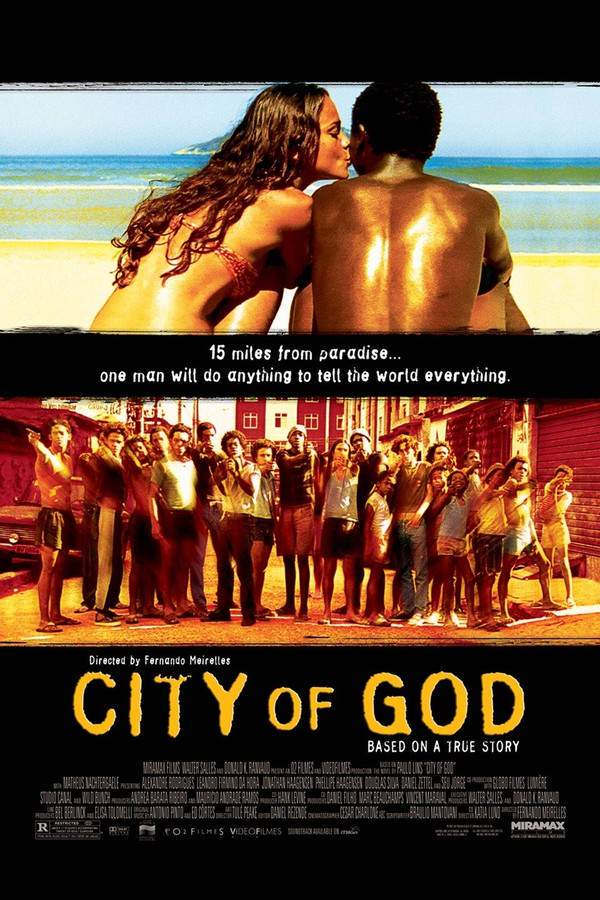
Amidst the brutal poverty and drug-fueled violence of Rio de Janeiro’s City of God, a young man seeks a way out. He begins documenting his surroundings with a camera, using photography as a means of survival and a path towards escape. The film chronicles his experiences and the lives of those around him, revealing a desperate struggle for survival in a community where hope is scarce and danger is ever-present.
Warning: spoilers below!
Haven’t seen City of God yet? This summary contains major spoilers. Bookmark the page, watch the movie, and come back for the full breakdown. If you're ready, scroll on and relive the story!
Read the complete plot breakdown of City of God (2003), including all key story events, major twists, and the ending explained in detail. Discover what really happened—and what it all means.
A chicken attempts to escape from an impending meal, only to find itself pursued by an armed gang within the vibrant yet perilous Favela known as Cidade De Deus (“City of God”). The fleeing chicken stumbles between this ruthless gang and a young man named Rocket, who harbors the belief that the gang is after his life. This dramatic moment triggers a flashback that transports us back to the late 1960s.
In this era, the Favela is a recently constructed housing project, positioned far from the lively heart of Rio De Janeiro, suffering from a severe lack of basic amenities like electricity and running water. Three desperate amateur thieves who go by the name of the “Tender Trio” - Shaggy (Jonathan Haagensen), Clipper (Jefechander Suplino), and Goose (Renato De Souza) - embark on a series of heists targeting local business owners. Their brotherhood is not devoid of morality; they share a portion of their loot with the impoverished locals who, in turn, offer them a protective shield. A group of young boys idolizes these thieves, and one ambitious boy, Li’L Dice (Douglas Silva), persuades them to rob a motel.
The gang, motivated to avoid bloodshed, designates Li’L Dice as the lookout, handing him a gun with orders to fire a warning if the police appear. However, in a moment of recklessness, Li’L Dice fires not as a warning but as an executioner, resulting in a tragic massacre. This unfortunate event draws the attention of law enforcement, prompting the trio to disperse. Clipper seeks refuge in the church, Shaggy is fatally shot during an attempted escape, and Goose meets his demise at the hands of Li’L Dice after a betrayal centered around stolen money. Thus, the saga of the Tender Trio meets a harrowing conclusion.
As Li’L Dice flees the Favela, he begins a new chapter in life, still engaging in petty crimes alongside Benny (Phellipe Haagensen) to maintain a steady income. Eventually, realizing the lucrative potential of the drug trade, he transforms into Li’L Zé (Leandro Firmino Da Hora). With Benny by his side, he crushes the competition, with the exception of one remaining dealer: Carrot (Matheus Nachtergaele), alongside his manager Blackie.
In the ensuing years, the Favela evolves into a chaotic urban jungle amidst the 1970s. Rocket, now mingling with a group of hippies, develops feelings for a girl named Angelica (Alice Braga). However, his romantic pursuits are repeatedly thwarted by a troublesome gang of petty thieves known as “The Runts.” Meanwhile, Li’L Zé has fortified his grip on the drug trade, instilling fear and eliminating rivals, all while seeking to assert dominance over Carrot’s territory.
As tensions escalate, Rocket finds employment at a supermarket while Benny contemplates a fresh start outside the Favela. During a farewell gathering, chaos ensues, and the distraught Zé accidentally orchestrates the death of his only moral anchor, Benny. Following this tragic turn, Zé’s tyranny grows unchecked, leading him to commit heinous acts, including the brutal assault of Knockout Ned (Seu Jorge) and the violation of his girlfriend, stoking the fires of vengeance.
The conflict escalates as Knockout Ned, driven by the desire for revenge against Zé, resists his tyranny with the help of Carrot, igniting a violent war for supremacy within the Favela. The turmoil deepens as both factions amass an army of soldiers, propelled by forgotten vendettas. In a crucial moment, Zé commands Rocket to immortalize his gang through photographs, ultimately leading to Rocket’s unveiling to the outside world through a published scoop.
As the grip of violence tightens, Rocket finds himself at the center of a chaotic gunfight involving the police and criminal factions. With the shocking culmination of the drug war, Zé is captured, but a tragic twist awaits him. As the Runts position themselves to commandeer the criminal enterprise, Rocket grapples with a significant choice—whether to expose the corruption within the police force or seize a chance at fame through Zé’s demise.
In a calculated decision, Rocket opts to reveal Zé’s lifeless body to the world, concluding the narrative as the Runts take their place in the Favela, penning a chilling list of targets to eliminate as they vie for control over the drug domain, as the Red Brigade looms ominously in their sights.
Last Updated: November 04, 2024 at 03:46
Discover curated groups of movies connected by mood, themes, and story style. Browse collections built around emotion, atmosphere, and narrative focus to easily find films that match what you feel like watching right now.
Movies that follow the inescapable cycle of violence and poverty in a ruthless world.If you were captivated by the raw intensity of City of God, this thread finds similar movies that explore the brutal cycles of crime and survival in impoverished settings. These films share a fast pace, dark tone, and heavy emotional weight, often featuring young protagonists navigating ruthless environments with bleak outcomes.
Narratives in this thread typically unfold over years, tracing the rise and fall of characters within a criminal ecosystem. They often feature a large ensemble cast and a structure that shows how violence begets violence, with hopeful characters gradually corrupted or crushed by their surroundings. The journey is marked by betrayals, power shifts, and the tragic loss of innocence.
Movies are grouped here because they share a specific, intense vibe: a fast-paced, high-intensity descent into desperate worlds defined by poverty and gang violence. They possess a dark, bleak tone and a heavy emotional weight, creating a cohesive experience for viewers seeking this particular brand of gritty realism.
Stories that use a observer's lens to capture the brutal truth of a community.For viewers who appreciated the documentary-like feel and the photographer protagonist of City of God, this thread finds movies that use a similar observational framework. These films immerse you in a harsh reality through the eyes of a character documenting events, creating a sense of urgent, authentic storytelling.
The narrative pattern involves a protagonist who is often an aspirational figure trying to rise above or make sense of their chaotic environment. Their tool for escape or understanding—a camera, a pen, or their own memory—becomes the vehicle for the story. The plot is frequently episodic, structured around key events that the observer captures, leading to a climax where their detachment is challenged.
These films are grouped by their shared approach to storytelling: a fast-paced, intense, and dark-toned narrative delivered with a quasi-documentary aesthetic. The central theme of witnessing and documenting trauma, combined with a heavy emotional weight and bleak outlook, creates a distinct and powerful viewing experience.
Don't stop at just watching — explore City of God in full detail. From the complete plot summary and scene-by-scene timeline to character breakdowns, thematic analysis, and a deep dive into the ending — every page helps you truly understand what City of God is all about. Plus, discover what's next after the movie.
Track the full timeline of City of God with every major event arranged chronologically. Perfect for decoding non-linear storytelling, flashbacks, or parallel narratives with a clear scene-by-scene breakdown.
Discover the characters, locations, and core themes that shape City of God. Get insights into symbolic elements, setting significance, and deeper narrative meaning — ideal for thematic analysis and movie breakdowns.
Get a quick, spoiler-free overview of City of God that covers the main plot points and key details without revealing any major twists or spoilers. Perfect for those who want to know what to expect before diving in.
Visit What's After the Movie to explore more about City of God: box office results, cast and crew info, production details, post-credit scenes, and external links — all in one place for movie fans and researchers.
Discover movies like City of God that share similar genres, themes, and storytelling elements. Whether you’re drawn to the atmosphere, character arcs, or plot structure, these curated recommendations will help you explore more films you’ll love.
City of God (2003) Scene-by-Scene Movie Timeline
City of God (2003) Movie Characters, Themes & Settings
City of God (2003) Spoiler-Free Summary & Key Flow
Movies Like City of God – Similar Titles You’ll Enjoy
Carandiru (2004) Plot Summary & Ending Explained
Ódiquê? (2004) Movie Recap & Themes
The Age of the Earth (1980) Ending Explained & Film Insights
Rio Babilonia (1982) Full Summary & Key Details
Um Dia Qualquer (2020) Full Summary & Key Details
The Adventures of a Paraíba (1982) Spoiler-Packed Plot Recap
Rio, 100 Degrees F° (1955) Detailed Story Recap
Rio, Northern Zone (1957) Story Summary & Characters
Urban Snap-Shots (2008) Ending Explained & Film Insights
Streets of Rio (2008) Story Summary & Characters
The Big City (1966) Story Summary & Characters
Mangúe-Bangúe (1971) Spoiler-Packed Plot Recap
Streets of Glória (2024) Spoiler-Packed Plot Recap
Cidade; Campo (2024) Film Overview & Timeline
My Home Is Copacabana (1965) Story Summary & Characters