Plot Explained Spoilers guaranteed!
Plot Explained

Browse by genre

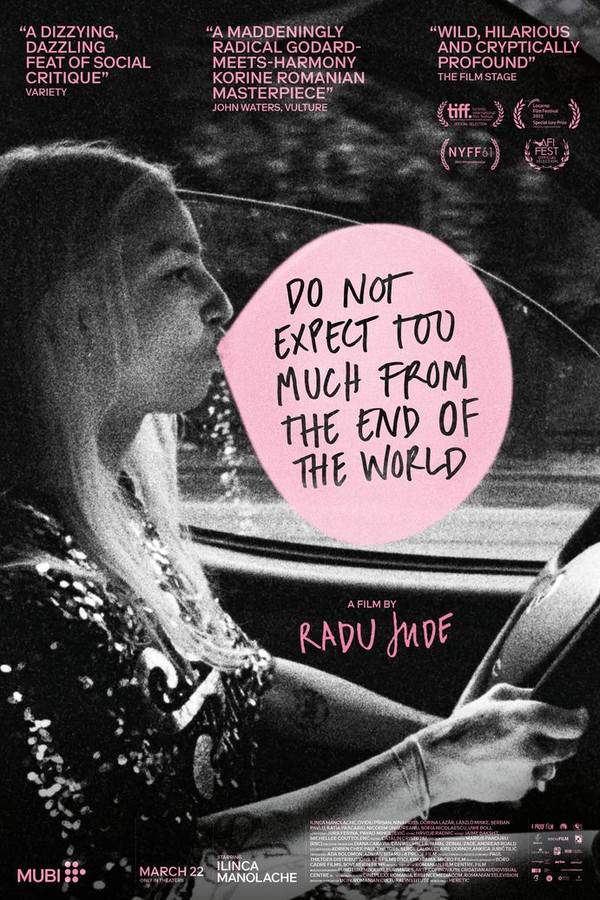
Do Not Expect Too Much From the End of the World (2024) movie poster

Characters & Themes

Do Not Expect Too Much From the End of the World (2024) Characters, Setting & Themes Explained

Release, runtime and language
2024 · 2 h 43 m · Romanian
Echo score 89
Loading streaming availability…
Directed by
Radu Jude
Starring
Nina Hoss, Ioana Iacob, Serban Pavlu, Claudia Ieremia, Andi Vasluianu, Ilinca Manolache

A production assistant working in Bucharest finds herself caught in a whirlwind of chaos while filming a workplace safety video. An offhand remark unintentionally triggers a media frenzy, forcing her to quickly adapt the project and protect her reputation amidst the escalating situation.

On this page (9)
  1. 1 Where to watch
  2. 2 Characters explained (3)
  3. 3 Character relationship map
  4. 4 Where & when it takes place
  5. 5 Themes & meaning (3)
  6. 6 Character & meaning questions
  7. 7 Movie threads
  8. 8 Movies like Do Not Expect Too Much From the End of the World
  9. 9 Every angle
Loading streaming availability…

3 main characters · contains spoilers

Do Not Expect Too Much From the End of the World Characters Explained: Who Is Who

The main characters of Do Not Expect Too Much From the End of the World (2024), heroes and villains: what drives them, how they change over the course of the story and what each of them reveals about the film's bigger ideas.

  • Angela Raducani

    played by Ilinca Manolache

    Angela is a dedicated yet overworked production assistant struggling to balance her job's demands with her personal life. Her alter ego, Bobiță, represents the pressures of social media fame, while her commitment to her family's legacy showcases her depth and emotional ties. Angela's journey reflects the complexities of modern work and personal identity.

    • 👩‍💼 Assistant
    • 💔 Personal Struggles
    • 🎬 Film Industry
  • Doris Goethe

    played by Nina Hoss

    Doris is the head of marketing for the multinational company, embodying the corporate perspective in the film. As she oversees the workplace safety video, her character highlights the tensions between corporate policies and real-life consequences for workers. Doris's interactions with Angela shed light on the disconnection often found in corporate environments.

    • 🏢 Corporate
    • 🎥 Marketing
    • 🔍 Oversight
  • Ovidiu Pîrsan

    Ovidiu is a worker who tragically became paralyzed due to a workplace accident, representing the human cost of corporate negligence. His character portrays resilience as he navigates his new reality while facing pressure from the very company responsible for his injury. His story serves as a critique of workplace safety standards and accountability.

    • 🦽 Resilience
    • ⚖️ Justice
    • 💼 Workplace

Last updated: October 21, 2026 at 14:35

Was this helpful?

5 characters · 3 connections · contains spoilers

Do Not Expect Too Much From the End of the World Character Relationship Map

Who is connected to whom in Do Not Expect Too Much From the End of the World: family, love, friendships, rivalries and hidden ties, colour-coded. Pick a character to see their side of the story, or a connection to see what brings two characters together.

ARAngela RaducaniIlinca ManolacheDGDoris GoetheNina HossOBOvidiu BucăOvidiu PîrsanOFOvidiu's familyABAngela'sboyfriend

Last updated: October 21, 2026 at 14:35

Was this helpful?

Setting

Where and When Does Do Not Expect Too Much From the End of the World Take Place?

The setting of Do Not Expect Too Much From the End of the World (2024): the year and time period, the places and locations, and how they shape the characters, the mood and the tension of the story.

Time period

The narrative takes place in contemporary times, reflected in Angela's use of social media and modern corporate dynamics. Current workplace safety issues are woven into the storyline, pointing to ongoing challenges faced by workers today. The setting captures the fast-paced lives of individuals trying to navigate their responsibilities in a demanding society.

Location

Bucharest, Austria

Bucharest, the capital of Romania, is known for its rich history and vibrant culture, blending modern architecture with historic buildings. The film's narrative unfolds within this bustling city, showcasing both its urban landscape and the struggles of its residents. Austria serves as the backdrop for the multinational company, highlighting contrasts between corporate interests and grassroots realities.

  • 🌆 City
  • 🇦🇹 Country

Last updated: October 21, 2026 at 14:35

Was this helpful?

3 major themes

Do Not Expect Too Much From the End of the World Meaning: Themes & Message Explained

What is Do Not Expect Too Much From the End of the World (2024) really about? The emotional, social and philosophical themes the film keeps returning to, its symbolism and the message beneath the surface.

  • Workplace Safety

    The theme of workplace safety pervades the film, showcasing the struggles of workers like Ovidiu who have suffered due to negligence. It explores the ethical dilemmas surrounding corporate liability and the desperate need for proper safety measures in the workplace. The narrative raises questions about accountability and the human cost of industrial accidents.

  • Social Media Influence

    Angela's alter ego, Bobiță, embodies the excesses and consequences of social media influence in today's society. The film critiques the performative nature of online personas and how they can overshadow genuine human experiences. It reflects the societal pressures and absurdities that come with trying to gain validation through social media.

  • Identity and Self-Discovery

    Angela's character grapples with her identity amidst societal expectations, shaped by her work and relationships. The film delves into the duality of her roles as a production assistant and as Bobiță, forcing her to confront her true self. This exploration of identity resonates through her interactions with others and her quest for personal meaning.

Last updated: October 21, 2026 at 14:35

Was this helpful?

Character & theme questions

Do Not Expect Too Much From the End of the World Characters & Meaning: Your Questions Answered

The questions people ask about Do Not Expect Too Much From the End of the World (2024): who the characters really are, their relationships, what the symbols mean, where it takes place and what the movie is really about. Each answer contains spoilers.

Q1

Where does most of the story take place?

The film is primarily set in Bucharest, Romania, following protagonist Angela as she navigates the city's urban landscape while working on a corporate video project. Bucharest's blend of modern and historic architecture mirrors the film's tension between everyday working people and large corporate forces. Austria also appears as a secondary setting, representing the multinational company that commissioned the workplace safety video.

  • bucharest
  • romania
  • setting
  • urban landscape
  • austria
Q2

What time period is the story set in?

Do Not Expect Too Much From the End of the World takes place in contemporary times, with Angela's reliance on social media and the modern dynamics of corporate communication anchoring it firmly in the present day. The film addresses ongoing workplace safety concerns and the pressures of digital culture that remain unresolved in today's society. Its day-long structure and current references suggest a setting without a specific year, making it feel like an immediate snapshot of modern work life.

  • contemporary
  • modern era
  • present day
  • time period
Q3

Who is Angela Raducani?

Angela Raducani is the central character and a dedicated yet overworked production assistant in Do Not Expect Too Much From the End of the World, played by Ilinca Manolache. She juggles demanding professional responsibilities and a complicated personal life, while also maintaining a provocative social media alter ego. Her journey captures the exhaustion of modern labor and the search for personal meaning under constant pressure.

  • angela raducani
  • ilinca manolache
  • production assistant
  • protagonist
Q4

What is Bobiță and why does Angela use that persona?

Bobiță is Angela's alter ego, a loud, profane online persona she performs for social media validation. In Do Not Expect Too Much From the End of the World, this exaggerated identity embodies the performative excess and absurdity of seeking attention online. The contrast between Angela's exhausted professional self and Bobiță's unfiltered persona drives much of the film's satirical edge and its exploration of identity.

  • bobita
  • alter ego
  • social media persona
  • online identity
Q5

Who is Ovidiu Pîrsan?

Ovidiu Pîrsan is a worker who was paralyzed in a workplace accident and represents the human cost of corporate negligence in the film, played by Ovidiu Pîrsan himself. His condition is the entire reason the multinational company commissions the workplace safety video in the first place. His presence anchors the story's critique of accountability and the long-term consequences industrial injuries leave on ordinary lives.

  • ovidiu pirsan
  • workplace accident
  • injured worker
  • corporate negligence
Q6

Who is Doris Goethe?

Doris Goethe is the head of marketing for the multinational company that commissioned the workplace safety video, played by Nina Hoss. She represents the corporate viewpoint in Do Not Expect Too Much From the End of the World, embodying the polished detachment of executive decision-making. Her interactions with Angela highlight the deep disconnect between boardroom priorities and the lived realities of the workers the campaign is meant to address.

  • doris goethe
  • nina hoss
  • multinational company
  • corporate marketing
Q7

What is the film criticizing about workplace safety?

Do Not Expect Too Much From the End of the World frames workplace safety as a systemic failure rather than an isolated problem, using Ovidiu's paralysis to expose how companies avoid accountability after accidents. The film questions whether corporate safety campaigns are genuine reform or reputation management, with the irony that the video itself becomes exploitative. It asks whether institutions can ever protect workers when profit motives shape every decision.

  • workplace safety
  • corporate liability
  • industrial accidents
  • accountability
Q8

How does the film critique social media culture?

Through Angela's Bobiță persona, the film satirizes the way online personas replace genuine human experience and reward outrage over substance. Social media is portrayed as a pressure valve that intensifies exploitation rather than challenging it, since visibility rarely translates into real change. The critique extends to how digital validation becomes a coping mechanism for workers trapped in exploitative systems.

  • social media
  • online validation
  • digital culture
  • performative identity
Q9

Why is Austria part of the setting?

Austria represents the multinational company's home base, standing in for the foreign corporate interests that operate in Romania but remain detached from local consequences. This geographic split lets the film contrast grassroots Romanian reality with distant boardroom decisions made abroad. It reinforces the imbalance of power between a worker like Ovidiu and the institution responsible for his injury.

  • austria
  • multinational company
  • corporate interests
  • geographic contrast
Q10

What does the title mean?

The title Do Not Expect Too Much From the End of the World captures the film's bleak worldview about systemic injustice and the limited power individuals have to change it. It reflects Angela's exhaustion as she faces corporate exploitation and social media absurdity without a clear path to resolution. The phrase also doubles as a warning to the audience not to look for tidy solutions in a story about entrenched, ongoing problems.

  • title meaning
  • bleak worldview
  • systemic injustice
  • existential tone
Q11

How does the film balance comedy with its serious subject matter?

The film uses absurdist and satirical humor as its primary tone, with Angela's profane Bobiță rants and surreal encounters providing levity against grim subject matter. Even cameos from figures like filmmaker Uwe Boll lean into absurdity rather than escapism, keeping the comedy anchored in the story's critique. The result is a darkly funny film that never lets the audience forget the human cost behind the jokes.

  • dark comedy
  • satire
  • absurdist humor
  • tonal balance
Q12

What is the central conflict driving the story?

The central conflict pits a single overworked production assistant against a multinational corporation that wants a workplace safety video but resists confronting the real damage it has caused. Angela must produce content for a company that would rather manage its image than accept responsibility, all while managing her own fracturing identity. This tension between genuine accountability and corporate performance art drives the narrative.

  • central conflict
  • corporate accountability
  • production pressure
  • identity struggle

Movie threads

More Movies Like Do Not Expect Too Much From the End of the World, by Mood & Story

Curated lists built around what makes Do Not Expect Too Much From the End of the World tick: the same mood, the same kind of story or the same emotional payoff. Each list explains why these movies belong together.

Dark corporate satire like Do Not Expect Too Much From the End of the World

Films that skewer capitalism, media, and exploitation with razor-sharp absurdist humor. Looking for movies like Do Not Expect Too Much From the End of the World? This thread features darkly funny satires that take aim at corporate exploitation, media hypocrisy, and class divide. Expect absurd humor, complex narratives, and bleak endings that refuse to soften the message.

  • satirical
  • darkly funny
  • cynical
  • absurdist
  • oppressive
  • bleak
  • Tone: dark, satirical, cynical
  • Pacing: variable, often dense
Why these movies?

The story pattern: These stories typically follow a protagonist, often overworked or morally compromised, navigating systems of exploitation while absorbing or delivering brutal social commentary. Narrative threads weave together workplace pressure, media manipulation, and class conflict, often through absurdist or ironic framing. Characters rarely win cleanly; instead, the films end in bleak or ambiguous territory, reinforcing that the systems being critiqued remain intact. Intercut historical footage, meta-commentary, and multiple storylines are common, creating layered critiques of capitalism and labor.

Why they belong together: They share a tonal commitment to dark, satirical humor that punches upward at institutions. They blend bleak, heavy themes with absurdist comedy, build complex narratives around social critique, and refuse easy resolutions. Viewers experience a mix of exhaustion and dark laughter, with endings that feel oppressively honest rather than redemptive.

Exhausting one-day character studies like Do Not Expect Too Much From the End of the World

One protagonist, one grueling day, and a pressure cooker that never fully releases. If you liked the relentless pace of Do Not Expect Too Much From the End of the World, these movies trap a protagonist in a single chaotic day with no real escape valve. Expect variable pacing, heavy emotional weight, and bleak conclusions that mirror the protagonist's exhaustion. Perfect for fans of pressure-cooker narratives.

  • exhausting
  • chaotic
  • relentless
  • oppressive
  • bleak
  • darkly funny
  • Tone: oppressive, darkly comic
  • Pacing: variable, relentless
Why these movies?

The story pattern: Narratives in this thread are built around a compressed timeline, often one workday or night, that forces the protagonist through cascading demands, moral compromises, and surreal encounters. Structure tends to be episodic within the day, with each segment escalating emotional stakes or absurdist pressure. Supporting characters function as obstacles, employers, or foils, while the protagonist's small acts of resistance rarely change the outcome. The interweaving of seemingly mundane tasks with moments of crisis mirrors the way real-life exploitation accumulates invisibly.

Why they belong together: They share a structure where one character is pinned under sustained, escalating pressure over a short window, with pacing that shifts between chaos and stillness. Intensity stays high throughout, emotional weight accumulates, and endings lean bleak or unresolved. The experience for the viewer mirrors the protagonist's: exhausting, darkly funny at times, and hard to shake.

If you liked this

Movies Like Do Not Expect Too Much From the End of the World

Similar movies to Do Not Expect Too Much From the End of the World: the same genre, themes or kind of story. Each one comes with its own plot summary, timeline and ending explained.

Browse all movie summaries

Every angle

Do Not Expect Too Much From the End of the World (2024) Explained: Plot, Timeline & Characters

Everything about Do Not Expect Too Much From the End of the World in one place: what happens in the plot summary, the timeline in chronological order, the characters and meaning and a spoiler-free summary. What's After the Movie adds the cast, box office and post-credit scenes.

Coming soon on iOS and Android

The Plot Explained Movie Summary App

Plot summaries, endings explained and timelines on your phone. Catch up on any movie in minutes, save your favorites and never miss a twist again.

Be the first to know when we launch. Your email stays private, always.

Learn more about the app