Plot Explained Spoilers guaranteed!
Plot Explained

Browse by genre

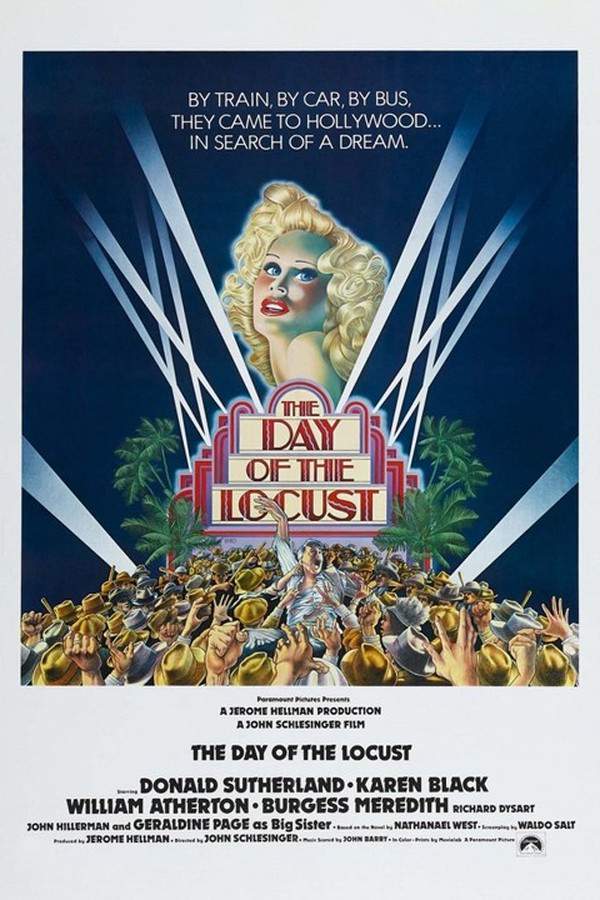
The Day of the Locust (1975) movie poster

Plot Summary

The Day of the Locust (1975) Plot Summary Explained

Release, runtime and language
1975 · 144 min · English
Loading streaming availability…
Directed by
John Schlesinger
Starring
Richard Dysart, Bo Hopkins, Burgess Meredith, Karen Black, Geraldine Page, Donald Sutherland

During the 1930s in Los Angeles, a struggling actress, an aspiring artist, and a former child star find themselves drawn together in a decaying apartment building. Observing the dark side of Hollywood and the corrosive effects of ambition, introverted accountant Homer Simpson witnesses the destructive power of greed and the unraveling of societal values as the city descends into chaos.

On this page (7)
  1. 1 Where to watch
  2. 2 What happens: full plot
  3. 3 Plot questions answered
  4. 4 The book behind the movie
  5. 5 Movie threads
  6. 6 Movies like The Day of the Locust
  7. 7 Every angle
Loading streaming availability…

Full plot summary · contains spoilers

What Happens in The Day of the Locust: Full Plot Summary

The whole story of The Day of the Locust (1975) explained, from the opening scene to the final frame: every key event, every twist and what it all adds up to. Read it as a quick recap before the sequel, to check a scene you missed, or to finally understand what really happened.

Aspiring artist Tod Hackett, a recent Yale graduate, ventures into 1930s Hollywood with dreams of making it big. He secures a position as an art department production illustrator at a prominent film studio and moves into the San Bernardino Arms, a dilapidated bungalow court filled with colorful characters who are all on the fringes of the film industry. Among the eclectic residents is Faye Greener, a struggling actress with grand ambitions, her father Harry, an ex-vaudevillian, and Abe Kusich, a dwarf embroiled in a tumultuous romance with his girlfriend, Mary. Adore Loomis, a young boy whose mother hopes to turn him into a star, resides nearby, and Homer Simpson, a repressed accountant, secretly harbors feelings for Faye.

Tod notices a crack in the wall caused by an earthquake and whimsically places a bright red flower inside it. His friendship with Faye blossoms as he accompanies her to a screening where she has a minor role, only for her to be disheartened when her appearance is drastically reduced on screen. When Tod tries to express his feelings for her, Faye gracefully deflects, stating she would only consider marriage to a wealthy man.

At a lavish party in the Hollywood Hills, the eclectic guests indulge in stag films. Although hesitant, Faye finds herself drawn to Tod, leading to an intimate campfire outing with cowboy Earle Shoop and his friend, Miguel. An inebriated Tod's jealousy surfaces when Faye dances with Miguel, resulting in a disturbing confrontation. Later, tragedy strikes when Faye and Homer take Harry to a church service, where a healer known as Big Sister attempts a cure for his heart condition—unfortunately, he dies soon after. Struggling for funeral costs, Faye resort to prostitution to make ends meet.

The shy, obsessive Homer’s affection for Faye deepens as he provides support after her father's passing. They eventually move in together while Faye continues her weary pursuit of acting opportunities. During the filming of a Waterloo-themed period drama, Faye narrowly escapes a set collapse, and Tod, who witnesses the chaos, reconnects with her afterward. The trio shares a meal where Faye confesses her relationship with Homer lacks passion, though it provides her with a sense of security.

As the trio attend a party hosted by Faye and Homer, the atmosphere thickens with tension as Faye seeks validation from the other men, including Claude Estee, a successful art director. A confrontation unfolds when Homer catches Faye in a compromising position with Miguel, leading to drama as Tod remains a passive observer.

The situation escalates during the premiere of The Buccaneer at Grauman’s Chinese Theatre. Homer, feeling lost, ignites chaos after a confrontation with young Adore, resulting in a brutal act that leaves Adore dead. The scene spirals into violence as the crowd reacts, leading to an all-out riot. Faye becomes a victim in the ensuing melee, while Tod suffers severe injuries. Amid this chaos, Tod's artistic visions manifest as Goyaesque figures descend upon the turmoil.

Days later, Faye finds herself alone in Tod's abandoned apartment, tears welling as she gazes at the solitary flower left behind, a poignant reminder of what once was.
Last updated: November 09, 2024 at 11:25

Was this helpful?

Plot questions answered

The Day of the Locust Plot Explained: Your Questions Answered

The questions people ask most about The Day of the Locust (1975): what happens in the confusing scenes, why the characters do what they do, the twists, hidden details and what the ending means. Each answer contains spoilers.

Q1

Why does Faye resort to prostitution after her father's death?

Faye turns to prostitution because she cannot afford her father Harry's funeral costs. With no money and her father's death leaving her financially stranded, she has few options in the cutthroat Hollywood environment where acting roles are scarce and unreliable.

Foreshadowing: The film earlier shows Faye's disappointment at seeing her minor role drastically reduced on screen, hinting at her struggles to survive financially.

  • faye greener
  • prostitution
  • harry's death
  • financial desperation
  • hollywood poverty
Q2

What causes Homer to attack Adore at the premiere?

Homer, feeling completely lost and displaced after confronting the glitzy Hollywood premiere, attacks young Adore Loomis in a confused violent outburst. This act represents Homer's complete psychological breakdown, triggered by his feelings of alienation, his failed relationship with Faye, and his inability to cope with the chaotic Hollywood world around him.

Foreshadowing: Earlier scenes show Homer's deepening obsession with Faye and his social awkwardness, building toward this violent release.

  • homer simpson
  • adore loomis
  • attack
  • violence
  • mental breakdown
  • premiere riot
Q3

Why does Tod see Goyaesque figures during the riot?

As chaos erupts at Grauman's Chinese Theatre, Tod's artistic vision manifests the violent scene through Goya-esque imagery, dark, apocalyptic figures descending on the turmoil. This represents Tod's perception of Hollywood's destructive power and how his artistic mind transforms reality into something from a nightmare painting.

Foreshadowing: Tod's earlier placement of the red flower in the wall crack demonstrates his artistic sensitivity and tendency to see beauty in decay.

  • tod hackett
  • goya
  • artistic vision
  • riot
  • hallucination
  • artistic perception
Q4

Why does Faye reject Tod's romantic advances?

Faye tells Tod she would only consider marriage to a wealthy man. This reflects her pragmatic view of relationships in Hollywood, she prioritizes financial security and status over romantic passion, believing wealth is the only reliable path to stability in the film industry.

Foreshadowing: Faye's disappointment at her minor screen appearance and her struggle for acting roles establish her desperate financial situation.

  • faye greener
  • tod hackett
  • marriage
  • rejection
  • gold digger
  • hollywood ambition
Q5

Why does Faye admit her relationship with Homer lacks passion?

During a shared meal, Faye confesses that while Homer provides her with security and stability, their relationship lacks passion. This reveals her disillusionment, she stays with Homer for practical reasons but yearns for the excitement and romantic validation she seeks from other men.

Foreshadowing: Earlier scenes show Faye seeking attention from multiple men, including Miguel and Claude Estee, demonstrating her emotional restlessness.

  • faye greener
  • homer simpson
  • passionless relationship
  • emotional dissatisfaction
  • security vs love
Q6

What happens to Faye during the riot at the premiere?

Faye becomes a victim of the violent mob during the riot that erupts at Grauman's Chinese Theatre. The chaotic melee claims her as a casualty, illustrating how the destructive forces of Hollywood ultimately consume her.

Foreshadowing: The tension at the party where Homer catches Faye with Miguel, and her pattern of seeking validation from dangerous men, foreshadow her tragic end.

  • faye greener
  • riot
  • death
  • grauman's chinese theatre
  • victim
  • hollywood destruction
Q7

What is the significance of the red flower Tod places in the wall?

Tod notices an earthquake crack in the wall and playfully inserts a bright red flower into it. This small act symbolizes his artistic perspective, finding beauty and meaning in decay. The flower reappears at the end when Faye finds it alone in Tod's abandoned apartment, becoming a poignant reminder of lost hope and beauty.

Foreshadowing: The flower at the end mirrors its earlier placement, creating a symbolic loop of artistic hope amid destruction.

  • red flower
  • crack
  • artistic symbolism
  • beauty in decay
  • tod hackett
  • faye greener
Q8

Why does Harry die at the church service?

Faye and Homer take Harry, who has a heart condition, to a church service where a faith healer known as Big Sister attempts to cure him. Despite their hopes, Harry dies soon after the failed healing attempt, leaving Faye devastated and without financial support.

Foreshadowing: Harry's frail health and status as an ex-vaudevillian struggling in old age set up his vulnerability.

  • harry greener
  • big sister
  • faith healer
  • death
  • heart condition
  • church
Q9

Why does Homer move in with Faye after Harry's death?

Homer, who secretly harbors deep feelings for Faye, supports her emotionally and financially after her father's death. Their living arrangement develops naturally from this support, Faye accepts his companionship for security while Homer gets to be close to her, despite knowing she doesn't love him passionately.

Foreshadowing: Homer's secret affection for Faye is established early, making his willingness to care for her predictable.

  • homer simpson
  • faye greener
  • moving in
  • support
  • unrequited love
  • relationship
Q10

What happens during the Waterloo film set collapse?

While filming a Waterloo-themed period drama, the set collapses and Faye narrowly escapes death. Tod witnesses the chaos and later reconnects with her, providing a moment where their friendship is renewed amid the dangerous realities of filmmaking.

Foreshadowing: This incident occurs after Faye has already moved in with Homer, showing how Tod still maintains a connection to her.

  • faye greener
  • set collapse
  • waterloo film
  • tod hackett
  • near death
  • film set accident
Q11

Why does Tod confront Miguel at the party?

At the Hollywood party, an inebriated Tod becomes jealous when Faye dances with the cowboy Miguel. His jealousy leads to a disturbing confrontation, revealing Tod's emotional instability and his possessiveness despite his supposed detachment from serious relationships.

Foreshadowing: This confrontation establishes the tense dynamic between Tod, Faye, and Miguel that continues throughout the story.

  • tod hackett
  • miguel
  • jealousy
  • confrontation
  • party
  • faye greener
Q12

Why does Homer confront Faye after catching her with Miguel?

At the party hosted by Faye and Homer, Homer discovers Faye in a compromising position with Miguel. This triggers a dramatic confrontation that severely tests their relationship, though Tod remains a passive observer rather than intervening.

Foreshadowing: Earlier tension between Faye and Miguel, combined with Faye's pattern of seeking validation from other men, sets up this confrontation.

  • homer simpson
  • faye greener
  • miguel
  • confrontation
  • infidelity
  • party scene
Q13

Why does Tod Hackett come to Hollywood after Yale?

Tod Hackett arrives in 1930s Hollywood immediately after graduating from Yale, filled with dreams of making it big as an artist. He secures a position as an art department production illustrator at a film studio, believing Hollywood offers the path to artistic success and fame.

Foreshadowing: The contrast between Tod's elite education and the grim reality of his apartment building establishes the gap between his expectations and Hollywood's harsh truth.

  • tod hackett
  • yale graduate
  • art department
  • hollywood dreams
  • aspirations
  • illustrator job

Movie threads

More Movies Like The Day of the Locust, by Mood & Story

Curated lists built around what makes The Day of the Locust tick: the same mood, the same kind of story or the same emotional payoff. Each list explains why these movies belong together.

Movies about shattered Hollywood dreams like The Day of the Locust

Stories exposing the seedy decay and broken promises behind the glamour of fame. If you liked The Day of the Locust's bleak portrait of 1930s Hollywood, explore more movies about fame's dark side. These similar dramas and thrillers delve into themes of ambition, corruption, and societal decay within the entertainment industry, capturing the disillusionment behind the spotlight.

  • cynical
  • decadent
  • oppressive
  • melancholic
  • anxious
  • feverish
  • Tone: cynical, dark, bleak
  • Pacing: steady, character-driven
Why these movies?

The story pattern: Narratives in this thread typically follow protagonists—aspiring actors, artists, or fading stars—as they navigate a corrupt system. Their initial hope or ambition is systematically crushed, leading to moral compromise, obsession, and often a tragic or bleak conclusion that underscores the hollowness of the dream.

Why they belong together: They are grouped by their shared focus on the dark underbelly of fame-centric worlds, a consistently cynical and oppressive tone, and the exploration of how ambition curdles into desperation. The emotional journey is one of inevitable disillusionment.

Movies about societal chaos and personal despair like The Day of the Locust

Character-driven dramas where personal unraveling mirrors a violent public breakdown. Discover more movies like The Day of the Locust that explore the connection between personal obsession and mass hysteria. These similar thrillers and dramas feature heavy emotional weight, bleak endings, and a narrative where individual stories collide with erupting societal decay and violence.

  • feverish
  • oppressive
  • anxious
  • chaotic
  • decadent
  • melancholic
  • Tone: dark, oppressive, bleak
  • Pacing: variable, building to chaos
Why these movies?

The story pattern: The pattern involves multiple character arcs—often lonely or obsessive individuals—whose personal crises unfold in parallel to growing communal anxiety. The story builds variably from a steady, character-focused setup to a chaotic, high-intensity climax where public disorder (like a riot) acts as a violent release for the pent-up tensions explored throughout.

Why they belong together: They share a specific structural and tonal blend: a variable pacing that builds to a feverish climax, a high intensity driven by both personal and collective violence, and a heavy, bleak emotional weight stemming from the theme of civilization's thin veneer cracking under pressure.

If you liked this

Movies Like The Day of the Locust

Similar movies to The Day of the Locust: the same genre, themes or kind of story. Each one comes with its own plot summary, timeline and ending explained.

Browse all movie summaries

Every angle

The Day of the Locust (1975) Explained: Plot, Timeline & Characters

Everything about The Day of the Locust in one place: what happens in the plot summary, the timeline in chronological order, the characters and meaning and a spoiler-free summary. What's After the Movie adds the cast, box office and post-credit scenes.

Coming soon on iOS and Android

The Plot Explained Movie Summary App

Plot summaries, endings explained and timelines on your phone. Catch up on any movie in minutes, save your favorites and never miss a twist again.

Be the first to know when we launch. Your email stays private, always.

Learn more about the app