Plot Explained Spoilers guaranteed!
Plot Explained

Browse by genre

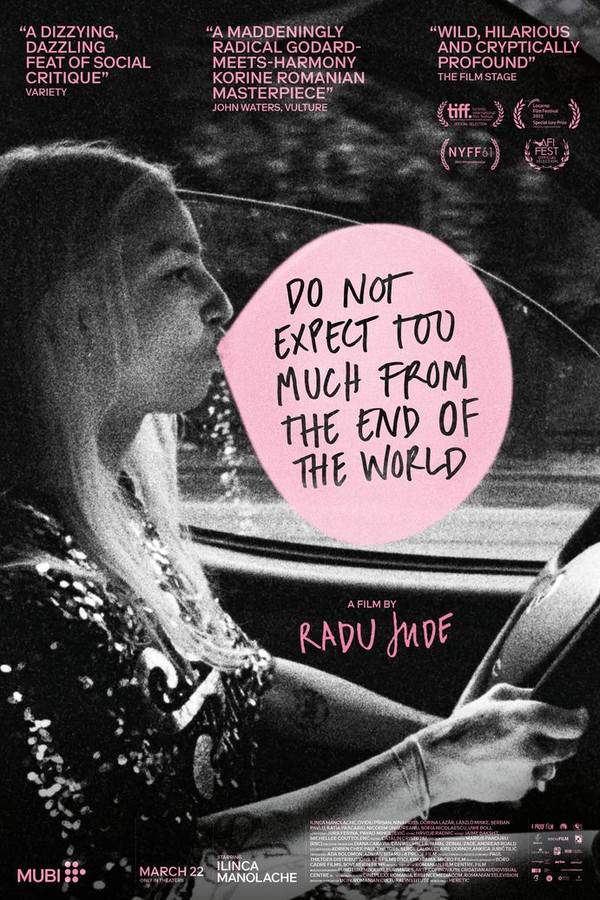
Do Not Expect Too Much From the End of the World (2024) movie poster

Plot Summary

Do Not Expect Too Much From the End of the World (2024) Plot Summary Explained

Release, runtime and language
2024 · 2 h 43 m · Romanian
Echo score 89
Loading streaming availability…
Directed by
Radu Jude
Starring
Nina Hoss, Ioana Iacob, Serban Pavlu, Claudia Ieremia, Andi Vasluianu, Ilinca Manolache

A production assistant working in Bucharest finds herself caught in a whirlwind of chaos while filming a workplace safety video. An offhand remark unintentionally triggers a media frenzy, forcing her to quickly adapt the project and protect her reputation amidst the escalating situation.

On this page (6)
  1. 1 Where to watch
  2. 2 What happens: full plot
  3. 3 Plot questions answered
  4. 4 Movie threads
  5. 5 Movies like Do Not Expect Too Much From the End of the World
  6. 6 Every angle
Loading streaming availability…

Full plot summary · contains spoilers

What Happens in Do Not Expect Too Much From the End of the World: Full Plot Summary

The whole story of Do Not Expect Too Much From the End of the World (2024) explained, from the opening scene to the final frame: every key event, every twist and what it all adds up to. Read it as a quick recap before the sequel, to check a scene you missed, or to finally understand what really happened.

Overworked and underpaid production assistant Angela is given the demanding task of casting for a workplace safety video commissioned by a multinational corporation based in Austria. Her day commences early at 5:50 AM, where she navigates the bustling streets of Bucharest, interviewing injured workers. To fuel her long hours, she relies heavily on caffeine while simultaneously using her downtime to create provocative and controversial rants on Instagram as her male influencer persona, Bobiță, reminiscent of Andrew Tate. Amidst her work duties, Angela faces personal challenges, including a detour to negotiate the reburial of her grandparents, whose grave site is at risk due to a clerical mistake involving a new housing development.

While on an errand to buy lenses, she unexpectedly encounters renowned director Uwe Boll on set, leading to a unique opportunity to film a Bobiță video with him. Further along her journey, Angela visits a candidate's apartment where she meets a retired female taxi driver, also named Angela. This encounter is interwoven with clips from the 1981 film Angela Goes On, directed by Lucian Bratu, enriching the narrative with visual storytelling.

The story deepens as Ovidiu Bucă, a worker who suffered a severe head injury and is now confined to a wheelchair, is selected to be the centerpiece of the safety video. This decision follows a Zoom call with Doris Goethe, the head of marketing for the corporation. Seizing a brief opportunity, Angela shares an intimate moment with her boyfriend in the car before heading to the airport to collect Doris, who has flown in to oversee the shoot. During their drive, Angela expresses her apprehension about driving on the DN2, a road notorious for being marked with more crosses commemorating accident victims than kilometers traveled.

As shooting begins at the site where Ovidiu’s accident occurred, chaos quickly ensues. Ovidiu is pushed to recount the details of his traumatic incident again and again, during which he reveals the abysmal workplace conditions and the company's blame-shifting liability. Unfortunately, he faces pressure to alter his story, suggesting that his failure to wear a safety helmet was the primary cause of his injury. This situation raises alarms for Ovidiu's family, who are anxious that such statements could jeopardize their ongoing lawsuit against the company, even though they desperately rely on the money from the video project. At the conclusion of the filming, the filmmakers invite the family out for lunch, but a frustrated Angela convinces them to head straight home in her car, wanting to shield them from further distress.

Last updated: September 18, 2026 at 09:00

Was this helpful?

Plot questions answered

Do Not Expect Too Much From the End of the World Plot Explained: Your Questions Answered

The questions people ask most about Do Not Expect Too Much From the End of the World (2024): what happens in the confusing scenes, why the characters do what they do, the twists, hidden details and what the ending means. Each answer contains spoilers.

Q1

Why does Angela run the Bobiță Instagram persona?

Angela creates the Bobiță alter ego as a satirical pressure valve during her exhausting, underpaid production assistant job in Do Not Expect Too Much From the End of the World. Modeled after provocative male influencers like Andrew Tate, the persona lets her deliver profane monologues about exploitation, corporate power, and Romanian society while she waits between tasks. It functions as both revenge against her grim working conditions and an indirect critique of the same influencer culture that radiates from the Western Europe her corporate client represents.

  • bobita
  • angela persona
  • instagram influencer
  • andrew tate
  • satire
  • bucharest
Q2

Why is Ovidiu Bucă chosen as the face of the safety video?

Ovidiu is selected after a Zoom call between Angela and Doris Goethe, the Austrian corporation's head of marketing, because his catastrophic workplace injury and current wheelchair-bound condition make him a visually devastating subject. His real-life trauma serves the company's narrative needs perfectly, even though casting him means repeatedly extracting emotional material from him. The choice is less about honoring injured workers and more about finding the most marketable image of workplace tragedy for Do Not Expect Too Much From the End of the World.

  • ovidiu buca
  • casting
  • safety video
  • doris goethe
  • zoom call
Q3

Why do the filmmakers pressure Ovidiu to blame his injury on not wearing a helmet?

The corporation needs Ovidiu's on-camera testimony to shift responsibility away from unsafe workplace conditions and onto his own personal negligence. If Ovidiu admits on film that failing to wear a safety helmet caused his accident, that footage becomes a public confession of fault that the company's lawyers can later use to defeat any lawsuit. The pressure is a calculated corporate strategy disguised as a straightforward safety PSA in Do Not Expect Too Much From the End of the World.

Foreshadowing: Angela's Instagram rants already rail against exactly this kind of corporate blame-shifting before the shoot even begins.

  • corporate liability
  • helmet blame
  • blame-shifting
  • ovidiu injury
  • safety video manipulation
Q4

How does the safety video project threaten Ovidiu's family's lawsuit against the company?

If Ovidiu tells the camera that not wearing a helmet caused his injury, that statement becomes a recorded admission of personal fault the corporation can present in court to defeat the family's case. Even though the family desperately needs the fee from the shoot to survive, appearing in the video could destroy their legal argument that unsafe working conditions caused the accident. Do Not Expect Too Much From the End of the World frames the entire job offer as a trap disguised as a favor.

  • ovidiu family
  • lawsuit
  • legal threat
  • safety video consequences
  • corporate exploitation
Q5

Why does Angela tell Ovidiu's family to go home instead of joining the crew for lunch?

After watching the crew repeatedly force Ovidiu to relive his injury for multiple takes, Angela recognizes the post-shoot lunch invitation as another layer of corporate performance rather than genuine camaraderie. She urges the family to leave because she wants to shield them from further emotional extraction disguised as hospitality. It is one of the small acts of defiance that gives Do Not Expect Too Much From the End of the World its moment of human resistance against an otherwise exploitative production.

Foreshadowing: Angela's protectiveness echoes her anger in earlier Instagram rants where she accuses companies of weaponizing politeness against workers.

  • ovidiu family
  • lunch invitation
  • angela protection
  • post-shoot
  • defiance
Q6

Why is Angela afraid to drive on the DN2 road?

Angela openly worries about driving on the DN2, often called the "road of death," because it is lined with more roadside crosses marking fatal accident victims than kilometers of asphalt. The crosses function as a running memorial to how casually life is lost on Romania's deadliest highway. The fear underscores the film core argument in Do Not Expect Too Much From the End of the World: that reckless systems, whether on the road or in the workplace, treat human life as disposable.

  • dn2 road
  • road of death
  • angela driving fear
  • bucharest roads
  • accident crosses
Q7

Why does Doris Goethe fly in from Austria to personally oversee the shoot?

Doris Goethe, the corporation's head of marketing, travels to Bucharest because the safety video is a high-stakes liability-management project rather than a routine corporate film. Her physical presence signals that the company views Ovidiu's on-camera testimony as critical to controlling the legal and public narrative around the accident. She cannot trust that outcome to a small local production team, which is precisely the imbalance Do Not Expect Too Much From the End of the World exposes.

  • doris goethe
  • nina hoss
  • corporate oversight
  • marketing head
  • austria
Q8

What is the significance of the retired taxi driver also named Angela?

Meeting a retired female taxi driver who shares her name creates a deliberate generational and professional mirror for the younger Angela. The encounter is intercut with footage from the 1981 Romanian film Angela Goes On, suggesting that the struggles of underpaid, overworked women navigating an indifferent system are not new. Do Not Expect Too Much From the End of the World uses the older Angela to imply that the younger one is repeating patterns of exhaustion that have defined decades of Romanian working-class life.

  • retired taxi driver
  • angela goes on
  • generational parallel
  • 1981 film
  • romanian women
Q9

Why does the movie intercut footage from the 1981 film Angela Goes On?

Director Radu Jude uses Lucian Bratu's 1981 film as a structural and thematic device to draw a direct line between socialist-era exploitation and modern capitalist exploitation. By cutting between Angela's grueling day and scenes of another underpaid Angela navigating her own era, the film argues that the exploitation of workers, and of women especially, has simply traded uniforms across decades. The intercut is not nostalgic decoration but the thesis statement of Do Not Expect Too Much From the End of the World.

  • angela goes on
  • lucian bratu
  • 1981 film intercut
  • socialist era
  • radu jude
  • meta commentary
Q10

What is the reburial subplot about and why does Angela handle it personally?

Angela is dealing with a clerical error that has placed her grandparents' grave in the path of a new housing development, requiring their exhumation and reburial. The subplot runs parallel to her workday to show how even basic property and burial rights are precarious under indifferent bureaucratic systems, compounding her exhaustion with the absurdity of administrative failure. It also explains why Angela, already stretched thin, still cannot disengage from the Ovidiu family's exploitation in Do Not Expect Too Much From the End of the World.

  • reburial
  • grandparents grave
  • housing development
  • clerical error
  • bureaucratic failure
Q11

Why does Angela rely so heavily on caffeine to get through her workday?

Angela drinks large amounts of coffee because her job as a production assistant requires her to start before 6 AM, drive across Bucharest to interview injured workers, negotiate a reburial, pick up corporate executives, and manage chaotic film shoots, all with little pay or support. The caffeine dependence is a physical marker of how the corporate project in Do Not Expect Too Much From the End of the World extracts maximum labor from a single under-resourced worker while offering no structural relief.

  • angela caffeine
  • coffee
  • overworked pa
  • exhaustion
  • long workday

Movie threads

More Movies Like Do Not Expect Too Much From the End of the World, by Mood & Story

Curated lists built around what makes Do Not Expect Too Much From the End of the World tick: the same mood, the same kind of story or the same emotional payoff. Each list explains why these movies belong together.

Dark corporate satire like Do Not Expect Too Much From the End of the World

Films that skewer capitalism, media, and exploitation with razor-sharp absurdist humor. Looking for movies like Do Not Expect Too Much From the End of the World? This thread features darkly funny satires that take aim at corporate exploitation, media hypocrisy, and class divide. Expect absurd humor, complex narratives, and bleak endings that refuse to soften the message.

  • satirical
  • darkly funny
  • cynical
  • absurdist
  • oppressive
  • bleak
  • Tone: dark, satirical, cynical
  • Pacing: variable, often dense
Why these movies?

The story pattern: These stories typically follow a protagonist, often overworked or morally compromised, navigating systems of exploitation while absorbing or delivering brutal social commentary. Narrative threads weave together workplace pressure, media manipulation, and class conflict, often through absurdist or ironic framing. Characters rarely win cleanly; instead, the films end in bleak or ambiguous territory, reinforcing that the systems being critiqued remain intact. Intercut historical footage, meta-commentary, and multiple storylines are common, creating layered critiques of capitalism and labor.

Why they belong together: They share a tonal commitment to dark, satirical humor that punches upward at institutions. They blend bleak, heavy themes with absurdist comedy, build complex narratives around social critique, and refuse easy resolutions. Viewers experience a mix of exhaustion and dark laughter, with endings that feel oppressively honest rather than redemptive.

Exhausting one-day character studies like Do Not Expect Too Much From the End of the World

One protagonist, one grueling day, and a pressure cooker that never fully releases. If you liked the relentless pace of Do Not Expect Too Much From the End of the World, these movies trap a protagonist in a single chaotic day with no real escape valve. Expect variable pacing, heavy emotional weight, and bleak conclusions that mirror the protagonist's exhaustion. Perfect for fans of pressure-cooker narratives.

  • exhausting
  • chaotic
  • relentless
  • oppressive
  • bleak
  • darkly funny
  • Tone: oppressive, darkly comic
  • Pacing: variable, relentless
Why these movies?

The story pattern: Narratives in this thread are built around a compressed timeline, often one workday or night, that forces the protagonist through cascading demands, moral compromises, and surreal encounters. Structure tends to be episodic within the day, with each segment escalating emotional stakes or absurdist pressure. Supporting characters function as obstacles, employers, or foils, while the protagonist's small acts of resistance rarely change the outcome. The interweaving of seemingly mundane tasks with moments of crisis mirrors the way real-life exploitation accumulates invisibly.

Why they belong together: They share a structure where one character is pinned under sustained, escalating pressure over a short window, with pacing that shifts between chaos and stillness. Intensity stays high throughout, emotional weight accumulates, and endings lean bleak or unresolved. The experience for the viewer mirrors the protagonist's: exhausting, darkly funny at times, and hard to shake.

If you liked this

Movies Like Do Not Expect Too Much From the End of the World

Similar movies to Do Not Expect Too Much From the End of the World: the same genre, themes or kind of story. Each one comes with its own plot summary, timeline and ending explained.

Browse all movie summaries

Every angle

Do Not Expect Too Much From the End of the World (2024) Explained: Plot, Timeline & Characters

Everything about Do Not Expect Too Much From the End of the World in one place: what happens in the plot summary, the timeline in chronological order, the characters and meaning and a spoiler-free summary. What's After the Movie adds the cast, box office and post-credit scenes.

Coming soon on iOS and Android

The Plot Explained Movie Summary App

Plot summaries, endings explained and timelines on your phone. Catch up on any movie in minutes, save your favorites and never miss a twist again.

Be the first to know when we launch. Your email stays private, always.

Learn more about the app