Plot Explained Spoilers guaranteed!
Plot Explained

Browse by genre

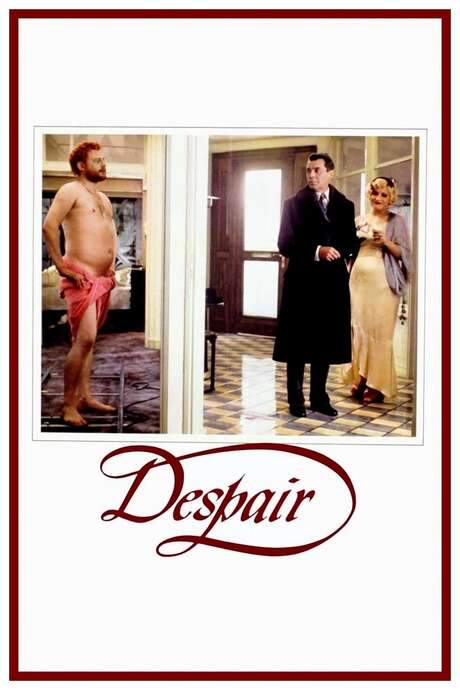
Despair (1978) movie poster

Plot Summary

Despair (1978) Plot Summary Explained

Release, runtime and language
1978 · 117 mins · English
Loading streaming availability…
Directed by
Rainer Werner Fassbinder
Starring
Andréa Ferréol, Bernhard Wicki, Klaus Löwitsch, Roger Fritz, Ingrid Caven, Hark Bohm

A hysterical comedy set in Berlin in 1930 as Nazism rises. Russian émigré Hermann Hermann, a chocolate maker married to capricious Lydia, sees his temper fray while dealing with workers and businessmen. When he meets Felix, a vagrant who is his uncanny physical double, Hermann plots a way out of the pretended world he loathes.

On this page (7)
  1. 1 Where to watch
  2. 2 What happens: full plot
  3. 3 Plot questions answered
  4. 4 The book behind the movie
  5. 5 Movie threads
  6. 6 Movies like Despair
  7. 7 Every angle
Loading streaming availability…

Full plot summary · contains spoilers

What Happens in Despair: Full Plot Summary

The whole story of Despair (1978) explained, from the opening scene to the final frame: every key event, every twist and what it all adds up to. Read it as a quick recap before the sequel, to check a scene you missed, or to finally understand what really happened.

Hermann Hermann Dirk Bogarde lives in Berlin during the Weimar Republic. A refugee from Soviet Russia, with a Baltic German father and a wealthy Jewish mother, he has inherited a business making chocolates. His wife Lydia Hermann Andréa Ferréol, voluptuous but not intelligent, has an over-close relationship with her bachelor cousin, the painter Ardalion Volker Spengler. As the Great Depression bites and Nazi thugs start targeting Jewish businesses, his firm becomes less profitable and Germany feels less hospitable, and Hermann begins to dream of escape. He already experiences moments of leaving his body—watching himself make love to his wife—and he consults a man he believes to be a Viennese psychiatrist but is in fact a life insurance salesman, who sells him a policy.

After watching a film that features a doppelgänger, he spots an unemployed drifter named Felix Klaus Löwitsch, who he decides is his double. Felix, bemused at first by the idea of any resemblance, goes along with the plan when Hermann promises him a job. The work, as it turns out, is to act as Hermann's double for a substantial lump sum.

Hermann is now ready to finalize his plan to erase all traces of his unwelcome existence. He has Ardalion write a letter that demands money to leave Lydia and go painting in Switzerland, and then shows the letter to the life insurance salesman as evidence that he is being blackmailed. He also tells Lydia that he has a troubled twin brother who is contemplating suicide. He will switch clothes with his brother so that the corpse is taken as his own, and lie low in Switzerland. When Lydia has been paid the insurance money, she is to join him there.

Having lured Felix to a secluded place in the woods, Hermann dresses Felix up in his own clothes, shaves his facial hair, adjusts his hairstyle and files his nails. Hermann then shoots him dead. Dressed as Felix and with Felix's passport, he goes to a Swiss hotel, where he learns from newspapers that Berlin police are seeking the murderer and suspect it is him. Moving in increasing desperation from village to village, in the end he is spotted by Ardalion and armed police close in. He explains that he is an actor making a film and they must stand aside to let him go on.

Last updated: October 05, 2025 at 11:51

Was this helpful?

Plot questions answered

Despair Plot Explained: Your Questions Answered

The questions people ask most about Despair (1978): what happens in the confusing scenes, why the characters do what they do, the twists, hidden details and what the ending means. Each answer contains spoilers.

Q1

Why does Hermann Hermann want to fake his own death?

Hermann wants to escape his unbearable life in Berlin. His chocolate business is failing due to the Great Depression, anti-Jewish hostility is increasing as Nazism rises, and he despises his marriage to the unintelligent Lydia. He also feels disconnected from his own identity, experiencing out-of-body episodes. Faking his death through his double Felix represents his complete escape from a life he finds repulsive.

Foreshadowing: Earlier scenes establish Hermann's detachment from his own life through his dissociative episodes, showing he already views himself as someone who could vanish.

  • escape
  • double
  • fake death
  • identity
  • despair
Q2

How does Hermann use the life insurance policy in his plan?

Hermann meets a man he believes is a psychiatrist but is actually an insurance salesman who persuades him to buy a policy. He later has his cousin Ardalion write a fake blackmail letter demanding money to leave for Switzerland. He shows this letter to the insurance salesman as proof he's being blackmailed, which justifies a large payout upon his 'death' that Lydia will collect.

Foreshadowing: The insurance meeting early in the film plants the financial mechanism that makes his entire scheme possible.

  • insurance
  • blackmail
  • policy
  • payout
  • scheme
Q3

Why does Hermann kill Felix instead of just leaving?

Hermann needs a corpse that will be mistaken for his own body to collect insurance money and complete the deception. By killing Felix, dressing him in Hermann's clothes, and altering his appearance to look more like Hermann, he creates a body that will be identified as Hermann Hermann. This allows Hermann to assume Felix's identity and passport to escape to Switzerland while everyone believes he is dead.

Foreshadowing: The film Hermann watches about a doppelganger obsesses him with the idea of a physical double who could take his place.

  • murder
  • felix
  • double
  • impersonation
  • corpse
Q4

Why does Ardalion report Hermann to the police?

Ardalion discovers Hermann in the countryside and realizes he is the murderer. Though Ardalion was part of Hermann's scheme to write the fake blackmail letter, he did not intend to aid in actual murder. When he sees Hermann alive and understands the truth, he alerts the authorities, leading to the police pursuit.

Foreshadowing: Ardalion's involvement in the blackmail scheme places him in a position to recognize when something has gone terribly wrong.

  • ardalion
  • police
  • betrayal
  • murder
  • discovery
Q5

What happens when Hermann tells police he's making a film?

As armed police close in during the final chase, Hermann claims he is an actor making a film and demands they stand aside. This desperate improvisation is an attempt to maintain his Felix identity. However, the ruse collapses under scrutiny, and the police do not believe him. The film ends with police closing in and Hermann's capture implied, not shown.

Foreshadowing: The doppelganger film Hermann obsesses over earlier reflects his belief that identity can be performed like acting.

  • film
  • police
  • capture
  • ending
  • performance
Q6

How is Lydia supposed to benefit from Hermann's plan?

Hermann tells Lydia he has a troubled twin brother who will commit suicide, and that he plans to switch clothes with the brother so the corpse appears to be Hermann. He instructs Lydia to collect the insurance money after his 'death' and join him in Switzerland. She believes the ruse and agrees to participate, not realizing Felix has been murdered.

Foreshadowing: The twin brother lie requires Lydia's cooperation to make the fake death convincing to insurance investigators.

  • lydia
  • insurance
  • switzerland
  • twins
  • deception
Q7

Why is the doppelganger film important to Hermann's plan?

After watching a film about a double, Hermann becomes fixated on the idea that someone could replace him. He then seeks out look-alikes and finds Felix, convincing himself Felix is his physical double. This obsession drives his entire scheme to swap identities and escape his life.

Foreshadowing: The film serves as the psychological catalyst that transforms Hermann's despair into a concrete plan.

  • doppelganger
  • film
  • double
  • obsession
  • felix
Q8

What do Hermann's out-of-body experiences represent?

Hermann experiences dissociative episodes where he floats above himself, watching his own body make love to Lydia. These moments show his deep detachment from his own life and identity, foreshadowing his willingness to completely abandon his existence and take on another person's identity.

Foreshadowing: The dissociative experiences establish Hermann's psychological instability and his view of himself as already half-gone.

  • dissociation
  • identity
  • mind
  • psychosis
  • escape
Q9

Why does Hermann choose Felix as his double?

Hermann spots Felix, an unemployed drifter, and becomes convinced Felix is his physical double despite Felix himself being bemused by the resemblance. Hermann offers Felix money to act as his double, and Felix agrees out of curiosity and financial desperation. Hermann's psychological need for escape makes him see a double where perhaps only a vague similarity exists.

Foreshadowing: Felix's initial bemusement contrasts with Hermann's intense conviction, showing Hermann's distorted perception.

  • felix
  • double
  • resemblance
  • choice
  • drifter
Q10

Why does Hermann's escape plan ultimately fail?

Hermann's plan fails because he cannot successfully become Felix. When he arrives in Switzerland, newspapers report that Berlin police are seeking the murderer, creating immediate suspicion. His movement from village to village draws attention, and Ardalion's recognition exposes him. His desperate claim of being an actor making a film cannot stop the police from closing in.

Foreshadowing: The insurance scheme's paper trail and the physical evidence at the murder scene make perfect escape impossible.

  • failure
  • capture
  • police
  • escape
  • switzerland

Movie threads

More Movies Like Despair, by Mood & Story

Curated lists built around what makes Despair tick: the same mood, the same kind of story or the same emotional payoff. Each list explains why these movies belong together.

Movies about psychological breakdown like Despair

Stories where a character's fragile reality completely collapses. If you were captivated by the psychological unraveling in Despair, explore more movies like it. This collection features complex thrillers and intense dramas where characters grapple with dissociative identity, business failures, and the desperate schemes born from a fractured psyche, all leading to bleak conclusions.

  • unsettling
  • claustrophobic
  • desperate
  • dissociative
  • anxious
  • paranoid
  • Tone: dark, unsettling
  • Pacing: steady, methodical
Why these movies?

The story pattern: These narratives follow a character, often under significant stress, as their perception of reality becomes distorted. Their attempts to cope or escape—through fantasies, doppelgängers, or destructive plans—only accelerate their downfall, culminating in a tragic failure that underscores their complete loss of self.

Why they belong together: Movies are grouped here for their shared focus on the internal chaos of a protagonist. They share a dark tone, heavy emotional weight, and a narrative structure built around a character's escalating dissociation and desperate, ultimately futile, attempts to regain control.


Doppelgänger thriller movies similar to Despair

Tales where a double becomes the key to a dangerous escape plan. Fascinated by the doppelgänger plot in Despair? Discover more movies with similar stories of false identities and deadly doubles. These films often explore themes of identity crisis, murderous plots for freedom, and the psychological fallout of attempting to erase one's own existence.

  • paranoid
  • unsettling
  • cerebral
  • deceptive
  • anxious
  • melancholic
  • Tone: dark, paranoid
  • Pacing: steady, cerebral
Why these movies?

The story pattern: The narrative pattern involves a discontented protagonist encountering their physical double. This meeting inspires an elaborate plan, typically involving murder and insurance fraud, to fake their own death and start anew. The plan inevitably unravels due to overlooked details or the protagonist's own psychological instability, resulting in capture or death.

Why they belong together: These films are united by the specific plot device of the doppelgänger and the thematic exploration of identity. They share a high-tension, cerebral quality, a steady pace that builds paranoia, and a generally dark tone that examines the destructive nature of escapist fantasies.

If you liked this

Movies Like Despair

Similar movies to Despair: the same genre, themes or kind of story. Each one comes with its own plot summary, timeline and ending explained.

Browse all movie summaries

Every angle

Despair (1978) Explained: Plot, Timeline & Characters

Everything about Despair in one place: what happens in the plot summary, the timeline in chronological order, the characters and meaning and a spoiler-free summary. What's After the Movie adds the cast, box office and post-credit scenes.

Coming soon on iOS and Android

The Plot Explained Movie Summary App

Plot summaries, endings explained and timelines on your phone. Catch up on any movie in minutes, save your favorites and never miss a twist again.

Be the first to know when we launch. Your email stays private, always.

Learn more about the app