Plot Explained Spoilers guaranteed!
Plot Explained

Browse by genre

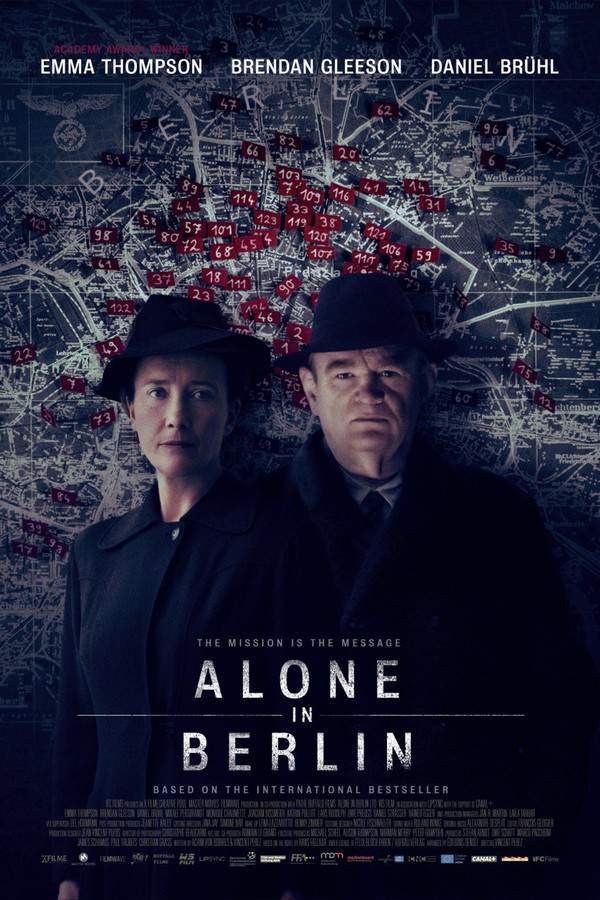
Alone in Berlin (2017) movie poster

Plot Summary

Alone in Berlin (2017) Plot Summary Explained

Release, runtime and language
2017 · 103 min · English
JustWatch #8,663 15

In 1940s Berlin, under Nazi occupation, Otto and Anna Quangel are devastated by the death of their son. Driven by grief and defiance, they begin sending anonymous anti-Nazi postcards throughout the city, subtly undermining the regime. Their quiet resistance ignites a wave of fear and suspicion, prompting a relentless police inspector to launch a desperate hunt to uncover the source of the subversive messages and quell the growing unrest.

On this page (7)
  1. 1 Where to watch
  2. 2 What happens: full plot
  3. 3 Plot questions answered
  4. 4 The book behind the movie
  5. 5 Movie threads
  6. 6 Movies like Alone in Berlin
  7. 7 Every angle

Where to watch

Where to Watch Alone in Berlin (2017)

Where can you watch Alone in Berlin? Stream, rent or buy it in the US, including on AMC+, Paramount Plus Premium and Philo: current JustWatch availability with up-to-date prices.

Streaming availability powered by JustWatch

Full plot summary · contains spoilers

What Happens in Alone in Berlin: Full Plot Summary

The whole story of Alone in Berlin (2017) explained, from the opening scene to the final frame: every key event, every twist and what it all adds up to. Read it as a quick recap before the sequel, to check a scene you missed, or to finally understand what really happened.

As World War II wreaks havoc in Berlin during 1940, the lives of Otto and Anna Quangel are irrevocably altered by the harrowing news of their only son's death. This working-class couple transitions from profound grief to burning resentment towards Adolf Hitler and the Nazi regime, ignited by the tragic fate of an elderly Jewish woman residing in their building. Despite the absence of official persecution, ruthless Nazis and common criminals exploit the situation, brutally pillaging her apartment, which ultimately drives her to a heart-wrenching leap from a high window.

The anguish experienced by the Quangels transforms into defiance as they resolve to pen postcards urging others to resist Hitler's tyranny. These secretive messages, with provocative phrases such as "Mother, Hitler Killed My Son. He Will Kill Your Son Too," are discreetly left in public places, a serious crime in such a repressive environment. Initially, Otto wishes to bear the risks of this dangerous endeavor alone, warning Anna, “They hang women too.” However, her insistence on joining him deepens their bond as they navigate the risks and responsibilities together in their shared rebellion.

Meanwhile, Gestapo inspector Escherich is assigned the task of uncovering the identity of the elusive postcard author. As a professional detective more motivated by career ambition than ideology, he finds himself intrigued by the mysterious "Hobgoblin" as he persistently follows a trail of clues over three long years. Although his investigations yield little progress, he begins to respect this unknown adversary as a formidable opponent. Unfortunately, his failure to resolve the case leads to a brutal beating by an impatient SS senior officer and the tragic execution of an innocent man, both devastating blows to his professional integrity and moral compass.

As Otto's carelessness compromises their efforts, a series of seemingly benign postcards inadvertently trigger his downfall. After accidentally dropping them at work, the authorities are alerted to his deception, resulting in his swift capture. With quiet resignation, he faces the inexorable consequences of his actions: a death sentence that looms ominously.

In a desperate effort to protect Anna from their dire circumstances, he tries to shoulder the blame entirely himself, but it proves too late. The couple is ultimately executed, leaving behind echoes of lost potential and unfulfilled dreams.

In the aftermath, Escherich finds himself isolated and desolate in his office, surrounded by the poignant remnants of the couple's fervent correspondence. Collecting the hundreds of postcards that epitomize their love, he stands at his office window overlooking the police headquarters. With great sorrow, he scatters the cards into the wind, an act symbolizing his own mortality.

This gesture amplifies Escherich's despair as he raises his gun and, with a final sense of closure, pulls the trigger. The film concludes hauntingly as the postcards swirl through the air and eventually land on the busy streets of Berlin. Unwitting passersby pick up the cards, oblivious to the tragic story interwoven with the emotions of love, loss, and despair, forever binding the Quangels together in death.
Last updated: November 22, 2024 at 18:25

Was this helpful?

Plot questions answered

Alone in Berlin Plot Explained: Your Questions Answered

The questions people ask most about Alone in Berlin (2017): what happens in the confusing scenes, why the characters do what they do, the twists, hidden details and what the ending means. Each answer contains spoilers.

Q1

Why did Otto and Anna Quangel start writing postcards against the Nazis

Otto and Anna began their postcard campaign after their son was killed in World War II. Their grief transformed into defiance when they witnessed an elderly Jewish woman in their building being brutalized by Nazis and criminals, which drove her to commit suicide. These events convinced them they needed to act against Hitler, leading them to write provocative messages like "Mother, Hitler Killed My Son" and leave them in public places throughout Berlin.

Foreshadowing: The couple's grief over their son's death directly connects to the message they choose for their postcards, showing how personal loss fueled their political act of resistance.

  • Otto Quangel
  • Anna Quangel
  • postcards
  • resistance
  • Nazi Germany
  • grief
Q2

How was Otto Quangel caught by the Gestapo

Otto was caught through his own carelessness at work. He accidentally dropped a batch of postcards while at his workplace, which fell into the hands of the authorities. This single mistake alerted the Gestapo to his identity and led to his swift capture, eventually resulting in both him and Anna being arrested and executed.

Foreshadowing: Earlier in the film, Otto warned Anna about the dangers they faced, and his insistence on carrying out the work alone foreshadows the fatal consequences of his mistake.

  • Otto Quangel
  • Gestapo
  • caught
  • arrested
  • postcards
Q3

Why did Inspector Escherich kill himself at the end

Escherich killed himself after being profoundly affected by the Quangels' case. Despite hunting them for three years, he came to respect their courage and conviction. After their execution, he collected their hundreds of postcards and, overwhelmed by guilt and despair over his role in their deaths, scattered them from his office window before turning the gun on himself.

Foreshadowing: Throughout his investigation, Escherich showed signs of moral conflict, particularly after beating an innocent man and being humiliated by his superiors, which hinted at his eventual breakdown.

  • Escherich
  • Gestapo inspector
  • suicide
  • postcards
  • guilt
Q4

Why did Anna insist on joining Otto in writing postcards

Anna insisted on joining Otto despite his warnings because she wanted to share both the risk and the responsibility of their resistance. When Otto told her "They hang women too," she refused to let him bear the danger alone. Her participation deepened their partnership and strengthened their bond as they faced the perilous work together.

Foreshadowing: The film establishes Anna as a determined character from the start, and her insistence reflects her equal commitment to confronting the regime that killed their son.

  • Anna Quangel
  • Otto Quangel
  • resistance
  • partnership
  • postcards
Q5

What happened to the elderly Jewish woman in the Quangels' building

An elderly Jewish woman living in the Quangels' building became a target of Nazi thugs and local criminals who pillaged her apartment. With no protection and facing constant persecution, she made the heartbreaking decision to leap to her death from a high window. This tragic event directly influenced the Quangels' decision to begin their resistance against the regime.

Foreshadowing: The film opens with the aftermath of this event, establishing the pervasive brutality that surrounds the Quangels and sets them on their path of defiance.

  • Jewish woman
  • persecution
  • Berlin
  • suicide
  • Nazi terror
Q6

Why were Otto and Anna Quangel executed

The Quangels were executed for committing high treason against the Nazi regime through their postcard campaign. Their messages urging resistance to Hitler were considered a serious crime in occupied Berlin. After Otto was caught and Anna was also arrested, both were sentenced to death and executed, their lives lost as consequence for their act of civil disobedience.

Foreshadowing: The film's bleak tone from the beginning establishes that resistance against the Nazis resulted in inevitable death, making their execution a foregone conclusion.

  • execution
  • death sentence
  • treason
  • postcards
  • Nazi regime
Q7

Why couldn't Inspector Escherich catch the postcard writer sooner

Escherich pursued the case for three years but struggled because the Quangels were careful and ordinary. His investigation yielded little progress due to the couple's meticulous secrecy and the sheer number of potential suspects in Berlin. His failure led to criticism from his superiors and ultimately a violent confrontation with an SS officer, but he never came close to catching them until Otto's accidental drop of postcards at work exposed their operation.

Foreshadowing: Escherich's professional ambition drove him to take on the case, but his lack of ideological motivation created an internal conflict that hampered his effectiveness.

  • Escherich
  • investigation
  • Gestapo
  • three years
  • failed hunt
Q8

What happened to the postcards at the end of the movie

After the Quangels' execution, Escherich collected all their postcards and took them to his office. In a symbolic act of mourning and defiance, he opened his window and scattered them into the wind. The postcards floated through the streets of Berlin, where unsuspecting passersby picked them up, unknowingly connecting with the Quangels' message of resistance.

Foreshadowing: The scattering of the postcards represents the continuation of the Quangels' message beyond their death, spreading their defiance to ordinary citizens.

  • postcards
  • scattered
  • Berlin
  • symbolism
  • ending
Q9

What motivated Inspector Escherich to hunt the postcard writer

Escherich was primarily motivated by professional ambition rather than ideological commitment to the Nazi cause. He took an interest in the case because it presented a challenging puzzle, referring to the unknown postcard author as "Hobgoblin" as a sign of professional respect. Over three years of investigation, he developed a grudging respect for his adversary, which eventually contributed to his psychological breakdown after their execution.

Foreshadowing: Escherich's professional motivation is established early when he chooses to pursue the case despite its difficulty, setting up his eventual moral crisis.

  • Escherich
  • motivation
  • ambition
  • Gestapo
  • Hobgoblin

Movie threads

More Movies Like Alone in Berlin, by Mood & Story

Curated lists built around what makes Alone in Berlin tick: the same mood, the same kind of story or the same emotional payoff. Each list explains why these movies belong together.

Stories of resistance against tyranny like Alone in Berlin

Stories of ordinary people risking everything to resist overwhelming state power. If you were moved by the quiet rebellion in Alone in Berlin, explore other movies about ordinary people defying oppressive regimes. These similar dramas capture the fear, courage, and high stakes of resisting overwhelming state power, often with a somber and emotionally heavy tone.

  • defiant
  • oppressive
  • anxious
  • solemn
  • despairing
  • tense
  • Tone: bleak, defiant, solemn
  • Pacing: steady, methodical
Why these movies?

The story pattern: The narrative typically follows a protagonist or small group who, driven by conscience or tragedy, begins a small-scale resistance against a powerful, oppressive government. The story is a slow-burning cat-and-mouse game, building tension as the authorities close in, often culminating in a tragic but morally resonant conclusion.

Why they belong together: These films are grouped by their shared exploration of moral courage under extreme duress, their bleak tone, and their focus on the high-stakes tension of a lone individual versus an all-powerful state. They evoke similar feelings of dread, defiance, and profound sadness.

Movies about grief and tragic consequences like Alone in Berlin

Emotionally devastating journeys where personal loss leads to fateful choices. For viewers affected by the heavy emotional weight of Alone in Berlin, this list features similar movies where a devastating loss propels the characters into a somber and fateful journey. These films share a bleak atmosphere, a focus on mourning, and stories where grief leads to irreversible moral choices.

  • grieving
  • somber
  • despairing
  • resigned
  • tragic
  • heavy
  • Tone: somber, bleak, despairing
  • Pacing: steady, slow-burn
Why these movies?

The story pattern: The narrative pattern begins with a shattering loss that defines the protagonists' world. Their subsequent actions, driven by grief, anger, or a need for meaning, set them on a collision course with an unforgiving reality. The journey is one of mounting despair, with the initial grief compounding into further tragedy, leading to a bleak and emotionally resonant ending.

Why they belong together: These films are connected by their central theme of transformative grief, their overwhelmingly somber and despairing mood, and their emotionally heavy weight. They provide a similar viewing experience of immersion in profound sorrow and the exploration of tragic fate.

If you liked this

Movies Like Alone in Berlin

Similar movies to Alone in Berlin: the same genre, themes or kind of story. Each one comes with its own plot summary, timeline and ending explained.

Browse all movie summaries

Every angle

Alone in Berlin (2017) Explained: Plot, Timeline & Characters

Everything about Alone in Berlin in one place: what happens in the plot summary, the timeline in chronological order, the characters and meaning and a spoiler-free summary. What's After the Movie adds the cast, box office and post-credit scenes.

Coming soon on iOS and Android

The Plot Explained Movie Summary App

Plot summaries, endings explained and timelines on your phone. Catch up on any movie in minutes, save your favorites and never miss a twist again.

Be the first to know when we launch. Your email stays private, always.

Learn more about the app