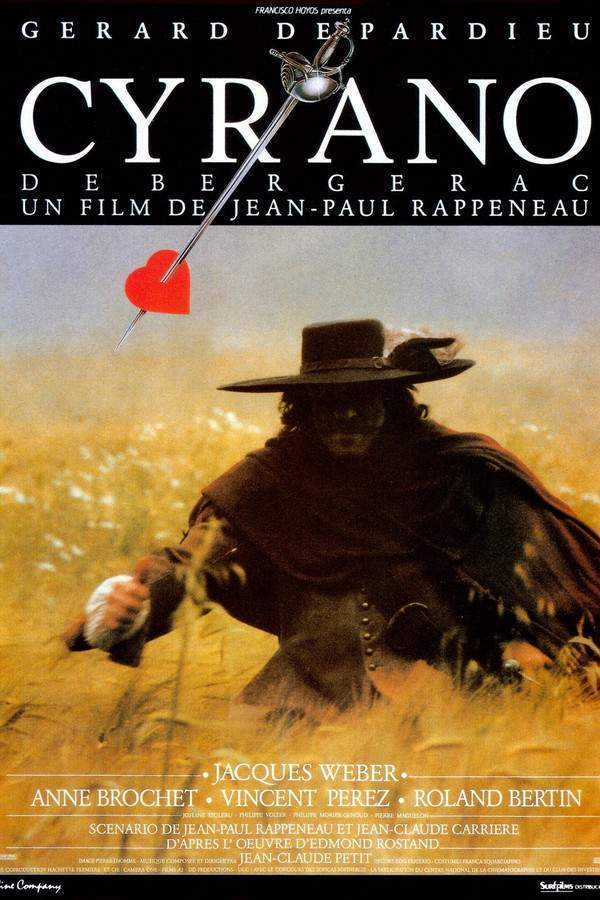
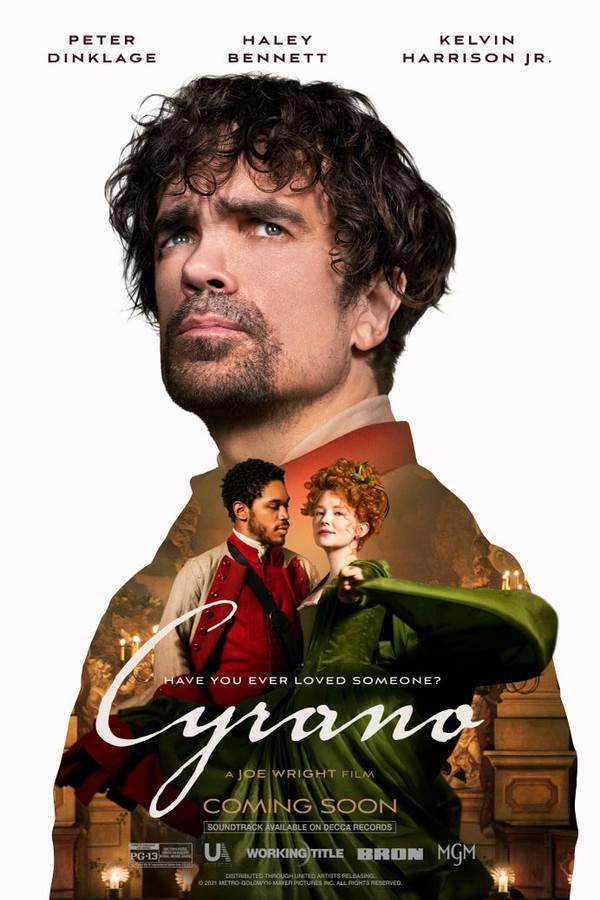
In 1640, the Gascon poet and swashbuckler Cyrano de Bergerac is self-conscious about his enormous nose, yet he projects pride and courage that earns him admiration for his bravery and expert swordsmanship. He moves through Parisian society with a blend of wit and bravado, always ready to defend others and prove his mettle in duels. Despite his public reputation as a fearless fighter, he privately fears that his appearance will keep him from winning the heart of the woman he loves.
That woman is the enchanting Roxane, Cyrano’s cousin, whose beauty and charm captivate him even as he doubts that someone like him could ever win her love. He is deeply in love with her, but he fears the obstacle of his physical appearance will forever bar his happiness. To gain a place in her eyes, he becomes entangled in a plan involving a theatrical interference at the Hôtel du Bourgogne in Paris, where his quick wit and daring help him secure a dramatic victory in a duel against a marquis, earning him respect and a deeper resolve to protect those around him.
When the second act arrives, Cyrano faces a painful truth as Roxane asks to meet him. She reveals a difficult confession: she has fallen for the handsome and bold Christian de Neuvillette, a young recruit to the Cadets de Gascogne who exudes the aura of eloquence and charm. The revelation wounds Cyrano, not because he doubts Roxane’s feelings for her cousin, but because Christian cannot express himself well in the spoken word. Seeing a chance to express his own love without exposing his scar, Cyrano agrees to a bold and generous plan: he will become the unseen author of Christian’s romantic ardor, composing the heartfelt letters and poems that will woo Roxane on Christian’s behalf.
So begins a quiet, powerful collaboration. Cyrano writes with tenderness and grace, pouring his own soul into each letter, while Christian, through these works, speaks with a voice he cannot muster on his own. Roxane grows to value not only Christian’s appearance but also the eloquence she believes he embodies, and she finds herself falling in love with the soul she imagines behind the letters. The evolving romance is tested not only by feelings but by jealousies and the political entanglements of the era. The powerful Comte de Guiche—a formidable nobleman with his own designs—also vies for Roxane’s hand, complicating every choice Cyrano faces. Comte de Guiche is determined to win Roxane, and his scheming adds pressure to an already difficult love triangle.
To complicate matters, De Guiche orders his cadets—including Cyrano and Christian—to march to war, serving at the Siege of Arras against the Spanish. The campaign quickly reveals the brutal realities of siege warfare: starvation, fatigue, and constant danger test the loyalties of the young soldiers and the depth of Cyrano’s devotion. Unbeknownst to Roxane, Cyrano makes a dangerous daily ascent behind enemy lines—twice each day—to deliver letters written by Cyrano himself but signed with Christian’s name. These letters lure Roxane from Paris to the war front to bring supplies and sustenance to the troops, while also deepening her emotional connection to the author she believes is the source of Christian’s words.
Roxane’s feelings grow further as she confronts Christian with the truth she has learned: she admires the spirit and the written voice she believes belong to the man she loves, and she is moved by the idea that the author could be someone she admires as much as he is loved. Christian, in turn, attempts to uncover whether Roxane’s affection rests on him or on the soul he has borrowed for her sake, and he asks Cyrano to uncover the truth. The tension between appearances and the truth becomes ever more poignant as battles rage around them.
Tragically, in the heat of combat, Christian is mortally wounded. The immediate aftermath of his death forces Cyrano’s secret to teeter on the edge of exposure, yet he continues to support Roxane from the shadows as the war progresses. The narrative advances to a later time, and in the final act, set in 1654, Roxane has withdrawn from the world and taken vows in a convent. Cyrano, now poorer but steadfast, keeps up a quiet vigil, visiting Roxane weekly and preserving his love for her in the only way he can.
A crucial moment comes when Cyrano is attacked by enemies who seek to silence him, yet he endures. He continues to visit Roxane at the convent, reading to her the last letter that Christian had written, a moment that reveals the depth of Cyrano’s enduring love. Roxane, listening with mounting emotion, realizes at last that the author she has adored—the soul behind the words she cherished all along—was Cyrano himself. In those final minutes, as Cyrano reads the letter aloud, the truth of his long-suffering devotion becomes undeniable, and Roxane’s long-hidden love is finally acknowledged.
The tale unfolds as a meditation on courage, love, and the cost of truths spoken softly but delivered with unwavering honesty. It traces Cyrano’s unwavering commitment—to Roxane, to Christian’s memory, and to the integrity of his own voice—through a lifetime of trials, secrets, and sacrifice. The result is a story that lingers long after the last page is read, a testament to the power of written words to bridge the gap between longing and fulfillment, and to the quiet, enduring triumph of a love that refuses to fade.