















Plot Explained Spoilers guaranteed!
Plot Explained

Browse by genre

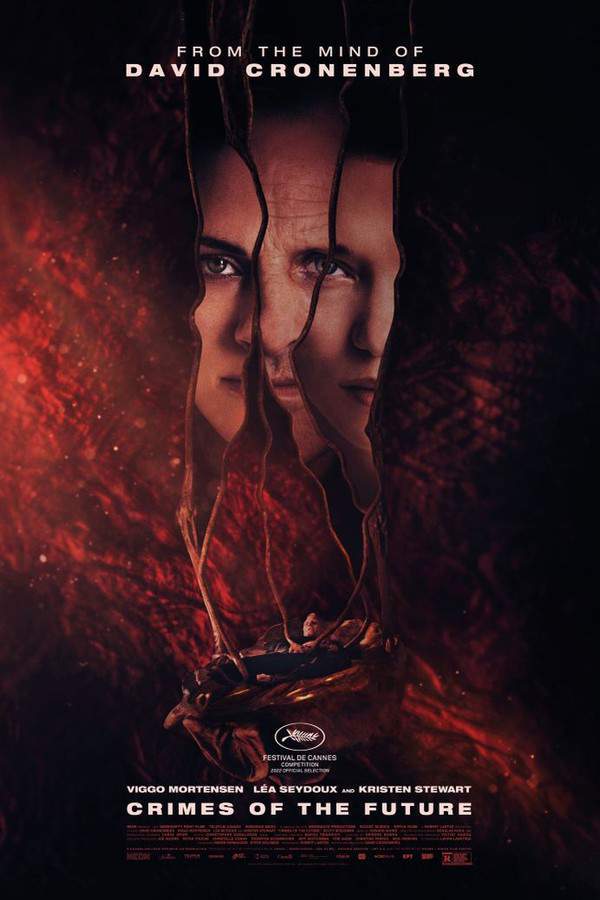
Crimes of the Future (2022) movie poster

Timeline

Crimes of the Future (2022) Timeline Explained – Every Event in Order

Release, runtime and language
2022 · 107 min · English
Echo score 71
JustWatch #3,173 18
Directed by
David Cronenberg
Starring
Léa Seydoux, Kristen Stewart, Viggo Mortensen, Giorgos Pyrpassopoulos, Denise Capezza, Don McKellar
Budget
$35M

In a dystopian future where the human body undergoes synthetic evolution, performance artist Saul Tenser showcases unsettling transformations of his own organs alongside his partner, Caprice. As Saul’s fame grows, a detective, Timlin, begins to monitor their activities. However, a shadowy organization sees an opportunity to exploit Saul's notoriety, intending to reveal a disturbing progression in human evolution and further obscure the line between biology and technology.

On this page (6)
  1. 1 Where to watch
  2. 2 Events in order (14)
  3. 3 Timeline questions answered
  4. 4 Movie threads
  5. 5 Movies like Crimes of the Future
  6. 6 Every angle

Where to watch

Where to Watch Crimes of the Future (2022)

Where can you watch Crimes of the Future? Stream, rent or buy it in the US, including on Amazon Prime Video, fuboTV and Paramount Plus Essential: current JustWatch availability with up-to-date prices.

Streaming availability powered by JustWatch

14 events in order · contains spoilers

Crimes of the Future Timeline: Events in Chronological Order

Every key event of Crimes of the Future (2022) in order, scene by scene, with when and where it takes place. Use it to untangle flashbacks, time jumps and parallel storylines, to refresh your memory before the sequel or to find the exact scene you are thinking of.

  1. Technological Advancements

    In an undetermined future, groundbreaking innovations in biotechnology transform human experiences. Machines and analogue computers have become integral in regulating bodily functions, creating a world where physical pain and diseases are largely eradicated.

    When
    Undetermined Future
  2. The Case of Brecken

    A young boy named Brecken emerges as a unique case of biological transformation, possessing the rare ability to digest plastics. Tragically, his mother, believing him to be inhuman, smothers him, leading to a heart-wrenching discovery by his father.

  3. Saul Tenser and Caprice

    Performance artists Saul Tenser and Caprice exploit Tenser's condition known as accelerated evolution syndrome. This syndrome facilitates the live removal of Tenser's organs for their art, raising questions about the boundaries of art and the human experience.

  4. Encounter with the National Organ Registry

    During discussions with officials at the National Organ Registry, Tenser meets Timlin, a bureaucrat fascinated by his performances. This meeting sparks a chain of events questioning the interplay between artistic expression and bodily autonomy.

    Where
    National Organ Registry
  5. Surgery as Sexuality

    Following a successful performance, Timlin declares that 'surgery is the new sex,' an idea that resonates deeply with Tenser. This reflects a disturbing societal shift where surgical experiences are increasingly viewed as a form of sexual fulfillment.

  6. Infiltration of Evolutionists

    A specialized police unit aims to exploit Tenser's unique condition to infiltrate a radical group advocating for evolution. Tenser, unbeknownst to Caprice, begins engaging in activities that connect him with this underground movement.

  7. Meeting Nasatir

    Tenser encounters Nasatir, a former cosmetic surgeon who performs a shocking procedure on him, creating a zippered cavity. This invasive act blurs the lines between intimacy and art as Caprice uses this access point in an intense display of connection.

  8. Plans of the Evolutionists

    Timlin reveals to Tenser the controversial plans of the evolutionists: adapting their bodies to digest plastics and synthetic materials. This plan further connects back to Brecken’s abilities, challenging societal norms regarding human transformation.

  9. Seduction and Confession

    Timlin attempts to seduce Tenser, but he hesitantly admits his lack of experience in traditional intimacy. This moment highlights Tenser's struggle with his identity amid a world where physical pleasure has fundamentally changed.

  10. Proposed Autopsy Performance

    Lang approaches Tenser with a provocative proposal: to conduct an autopsy on Brecken, showcasing his unique digestive system. After much contemplation, Tenser agrees, prompting significant anticipation from an audience.

  11. Revealing the Truth

    During the autopsy, unsettling truths are disclosed as it becomes apparent that Brecken's natural organs have been surgically replaced. This revelation sends shockwaves through the audience, particularly impacting Lang.

  12. Lang's Devastation

    Stricken with grief after witnessing the autopsy, Lang rushes away in tears. His emotional turmoil leads to a tragic confrontation with agents from Tenser's biomedical machine corporation, culminating in his brutal assassination.

  13. Heartbreaking Aftermath

    In the aftermath of Lang's death, Tenser learns the disquieting truth that Timlin orchestrated the organ replacements to suppress human evolutionary deviations. Heartbroken, he withdraws from police collaboration, aligning himself with the evolutionists' perspective.

  14. Struggle for Sustenance

    In a poignant moment, Tenser finds himself grappling with the act of eating, seeking comfort from Caprice. As he consumes plastic with a smile and a tear, it symbolizes the intertwined nature of his existence and the dark realities of their world.

Last updated: November 07, 2024 at 23:39

Was this helpful?

Timeline questions answered

Crimes of the Future Timeline Explained: Your Questions Answered

When does it happen, and why in that order? The questions people ask about the chronology of Crimes of the Future (2022): time jumps, flashbacks, cause and effect between scenes and the correct order of events, each answered with spoilers.

Q1

Why did Brecken's mother kill him?

Brecken's mother smothered him with a pillow because she believed her son was inhuman. After discovering he could consume and digest plastics like food, she concluded that his body had become something other than human and could not accept this radical biological transformation.

Foreshadowing: Earlier context establishes that society views radical biological changes with fear and suspicion.

  • brecken
  • mother
  • killing
  • plastics
  • digestion
Q2

What is accelerated evolution syndrome?

Accelerated evolution syndrome is a condition that causes Tenser to continually generate new organs inside his body. This forces him to have these organs surgically removed regularly, which he transforms into performance art alongside Caprice. The condition causes him constant pain and discomfort, requiring him to use biomechanical devices to survive.

  • saul tenser
  • accelerated evolution
  • organs
  • condition
Q3

Why does Timlin say surgery is the new sex?

Timlin declares that surgery is the new sex because in this world, physical intimacy has been fundamentally altered by radical biological changes. Many characters, including Tenser and Caprice, find greater erotic satisfaction in surgical experiences than in traditional sexual acts. The quote reflects the movie's theme of shifting definitions of pleasure and intimacy in a post-biological world.

Foreshadowing: The performances between Tenser and Caprice blur the lines between art and eroticism throughout the film.

  • timlin
  • surgery
  • sex
  • intimacy
  • quote
Q4

Who killed Lang and why?

Lang was killed outside the performance venue by two agents from the corporation that manufactures Tenser's biomedical machines. They assassinated him to silence him after he witnessed the autopsy revealing that Brecken's organs had been surgically replaced, which exposed part of the conspiracy to suppress human evolutionary deviations.

Foreshadowing: The corporation has a vested interest in controlling narratives around human evolution.

  • lang
  • assassination
  • killing
  • corporation
  • agents
Q5

What was Timlin's real role in the conspiracy?

Timlin was not just a fascinated bureaucrat, she orchestrated the replacement of Brecken's organs to suppress evidence of human evolutionary deviations. Working within the system, she manipulated events to keep the public unaware of true human biological transformation, aligning with those who wanted to control or hide such evolution.

Foreshadowing: Timlin's unusual fascination with Tenser and her access to sensitive information hint at deeper motivations.

  • timlin
  • conspiracy
  • organ replacement
  • evolution
Q6

Why did Tenser agree to perform the autopsy on Brecken?

Tenser agreed to publicly demonstrate the autopsy after Lang approached him with the proposal to showcase the evolutionists' agenda. After witnessing Timlin's revelations about their plans to adapt humans to digest plastics, Tenser saw value in exposing the truth about Brecken's unique digestive system, though the decision clearly weighed heavily on him.

Foreshadowing: Timlin had earlier revealed the evolutionists' plans to adapt humans to ingest plastics and synthetic materials.

  • tenser
  • autopsy
  • brecken
  • performance
  • demonstration
Q7

What was revealed during Brecken's autopsy?

During the autopsy, Tenser discovered that Brecken's natural organs had been surgically replaced. This shocking revelation indicated that someone had modified the boy's body, connecting back to the conspiracy to suppress evidence of human evolutionary changes. The discovery devastated Lang, who rushed away in tears.

Foreshadowing: The autopsy was meant to showcase Brecken's unique digestive system, but the surgical modifications were unexpected.

  • autopsy
  • brecken
  • organs
  • surgical replacement
  • revelation
Q8

Why does Tenser eat plastic at the end?

At the end, Tenser asks Caprice for a piece of plastic and eats it while she records him. This moment symbolizes his acceptance of his new reality and the merging of human biology with synthetic materials. It represents the culmination of his journey toward embracing evolution rather than fighting it, even as he struggles with the act.

Foreshadowing: Earlier, Timlin revealed the evolutionists' plans to adapt their bodies to digest plastics and synthetic materials.

  • tenser
  • plastic
  • eating
  • ending
  • acceptance
Q9

What is the National Organ Registry?

The National Organ Registry is the government body responsible for managing state limitations on human evolution. They monitor and regulate cases of radical biological transformation, keeping track of individuals like Tenser who possess unusual conditions. The organization represents the institutional attempt to control and understand the rapid biological changes occurring in humanity.

Foreshadowing: Tenser's condition brings him into regular contact with officials from this organization.

  • national organ registry
  • government
  • regulation
  • evolution
Q10

What are the evolutionists trying to accomplish?

The evolutionists are a radical group advocating for human biological transformation. They plan to adapt human systems to ingest plastics and synthetic materials, using a toxic purple candy bar as their main sustenance. Their agenda challenges government narratives that deny or suppress human evolution, and they see individuals like Brecken as proof that evolution is already happening.

Foreshadowing: The evolutionists' plans are revealed through Timlin's interactions with Tenser.

  • evolutionists
  • plastics
  • synthetic materials
  • radical group
Q11

Why was Brecken able to digest plastics?

Brecken possessed an extraordinary biological transformation that allowed him to consume and digest plastics as if they were food. This ability represented a radical leap in human evolution, making his body capable of processing synthetic materials. His mother perceived this as evidence that he was no longer human, though the film presents it as the next stage in human development.

Foreshadowing: The evolutionists specifically reference Brecken's abilities as proof of human transformation.

  • brecken
  • plastics
  • digestion
  • ability
  • transformation

Movie threads

More Movies Like Crimes of the Future, by Mood & Story

Curated lists built around what makes Crimes of the Future tick: the same mood, the same kind of story or the same emotional payoff. Each list explains why these movies belong together.

Bleak Transhumanist Futures like Crimes of the Future

Stories exploring the dark and painful consequences of technological evolution. Explore more movies like Crimes of the Future that delve into dystopian futures shaped by transhumanism. These similar sci-fi stories feature body horror and philosophical themes, presenting heavy, dark tales about the merging of technology and humanity.

  • dystopian
  • unsettling
  • philosophical
  • somber
  • clinical
  • transgressive
  • Tone: dark, somber, unsettling
  • Pacing: slow, meditative
Why these movies?

The story pattern: Narratives involve characters grappling with radical bodily or societal changes, often framed as a disturbing new normal. The central conflict arises from the clash between an evolving reality and the remnants of human nature, leading to explorations of grief, loss, and the search for meaning in a synthetic world.

Why they belong together: These films are grouped by their shared focus on the dark side of transhumanism, using dystopian settings to explore heavy themes of identity, loss, and the clinical, painful intersection of the organic and the artificial.


Movies about Transgressive Art like Crimes of the Future

Stories where avant-garde art blurs the line between creation and suffering. If you liked the performance art themes in Crimes of the Future, discover more movies featuring transgressive art. These similar dramas and thrillers explore artists who use pain, their bodies, or shocking acts to create, often within a dark and complex narrative.

  • transgressive
  • unsettling
  • painful
  • clinical
  • somber
  • psychological
  • Tone: dark, transgressive, melancholic
  • Pacing: slow, deliberate
Why these movies?

The story pattern: The plot follows an artist or performer whose controversial work attracts scrutiny, admiration, and danger. Their artistic journey is intertwined with personal trauma, leading to a narrative that questions the nature of art, pain, and the limits of the human body or spirit.

Why they belong together: These films share a focus on the process and impact of extreme, boundary-pushing art. They are united by a dark, complex tone, a slow build of unease, and a deep exploration of the connection between creativity and suffering.

If you liked this

Movies Like Crimes of the Future

Similar movies to Crimes of the Future: the same genre, themes or kind of story. Each one comes with its own plot summary, timeline and ending explained.

Browse all movie summaries

Every angle

Crimes of the Future (2022) Explained: Plot, Ending, Timeline & Characters

Everything about Crimes of the Future in one place: what happens in the plot summary, the timeline in chronological order, the characters and meaning, the ending explained and a spoiler-free summary. What's After the Movie adds the cast, box office and post-credit scenes.

Coming soon on iOS and Android

The Plot Explained Movie Summary App

Plot summaries, endings explained and timelines on your phone. Catch up on any movie in minutes, save your favorites and never miss a twist again.

Be the first to know when we launch. Your email stays private, always.

Learn more about the app