Plot Explained Spoilers guaranteed!
Plot Explained

Browse by genre

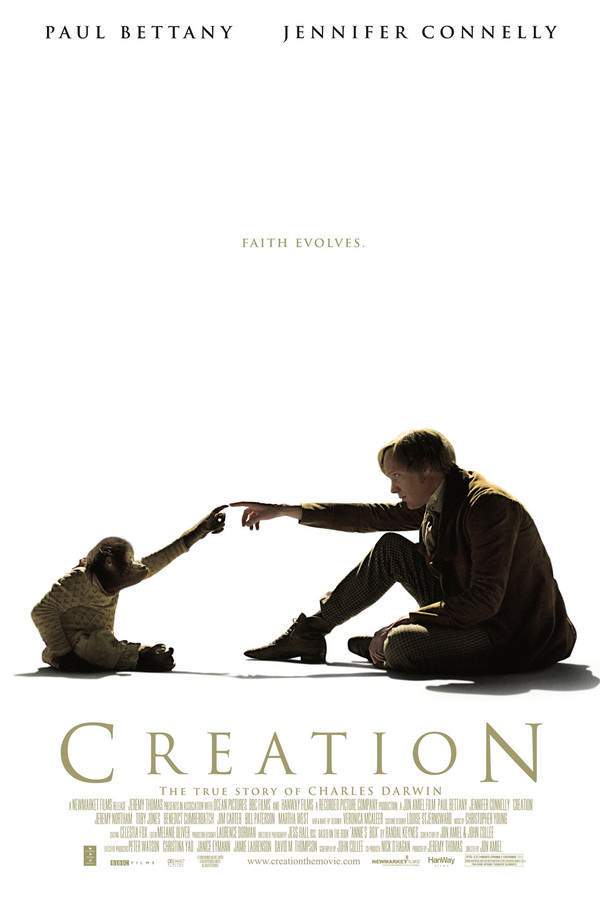
Creation (2010) movie poster

Plot Summary

Creation (2010) Plot Summary Explained

Release, runtime and language
2010 · 108 min · English
JustWatch #12,370 14
Directed by
Jon Amiel
Starring
Paul Bettany, Jennifer Connelly

While mourning the death of his daughter, Charles Darwin faces a profound crisis of faith. His emerging theories about evolution clash with his wife's religious beliefs, creating a deep personal conflict as he struggles to reconcile his scientific observations with his devotion to her. The emotional turmoil fuels his groundbreaking work, forever changing our understanding of the natural world.

On this page (6)
  1. 1 Where to watch
  2. 2 What happens: full plot
  3. 3 Plot questions answered
  4. 4 Movie threads
  5. 5 Movies like Creation
  6. 6 Every angle

Where to watch

Where to Watch Creation (2010)

Where can you watch Creation? Stream, rent or buy it in the US, including on Amazon Prime Video, Hoopla and Kanopy: current JustWatch availability with up-to-date prices.

Streaming availability powered by JustWatch

Full plot summary · contains spoilers

What Happens in Creation: Full Plot Summary

The whole story of Creation (2010) explained, from the opening scene to the final frame: every key event, every twist and what it all adds up to. Read it as a quick recap before the sequel, to check a scene you missed, or to finally understand what really happened.

Charles Darwin is a British naturalist living a quiet, almost pastoral life in an idyllic village, a man who is as brilliant as he is deeply emotional. He is devoted to his wife, Emma, and to their children, especially his eldest daughter Annie, a bright and inquisitive ten-year-old who loves learning about nature and the world. He shares with her stories from his travels and, most of all, his evolving ideas about life, including his theory of evolution. Annie’s favorite tale—though it ends sadly—centers on Jenny, a young orangutan brought from Borneo to the London Zoo, a story that hints at the fragility of life and the mysteries of science. Yet a moment of anger reveals a rift: when the family clergyman makes Annie kneel on rock salt for challenging the church’s view that life is unchanging, Darwin’s faith in a fixed order of creation is shaken.

[Darwin] is not just a man of science but a husband who carries the tension of a looming conflict with Emma, whose devout beliefs set a high bar for where their ideas can live in the world. Fifteen years have passed since his expedition to the Galapagos Islands, and he remains haunted by the unfinished manuscript that would articulate his most controversial conclusions about natural selection. The delay is not just academic; it strains his marriage, as Emma fears for their souls and their future, worrying that his theories could jeopardize their own place in Heaven and the peace of their family.

The film follows Annie—seen through flashbacks and Darwin’s own visions—as a luminous presence who spurs her father to confront his fears and finish his work. It becomes clear that Annie’s death casts a long shadow over the couple, and the grief is a force that both estranges and binds them. The pair’s relationship becomes cooler, and their sexual intimacy fades, even as Darwin struggles with a mysterious, draining illness that seems to mirror his inner turmoil.

Darwin’s journey takes him to Malvern for James Manby Gully’s water cure, a treatment Emma initially resists, as Annie’s illness deepens. Annie’s condition worsens, and, at her request, Darwin shares Jenny’s story once more before she dies. Her death leaves him devastated but also sharpens his conviction that natural laws operate without divine intervention. To observers of his time, such a view appears to threaten belief in God, even though many who support him are faithful. In a quiet box in Darwin’s study, the notes and observations that will form On the Origin of Species begin to take shape, marking the emergence of a work that could alter mankind’s understanding of life.

Darwin’s scientific circle—friends like Joseph Dalton Hooker and Thomas Henry Huxley—encourage him to proceed. Huxley’s admiring line, that with his theory Darwin has “killed God,” injects both awe and dread into his conscience, and the visions of Annie continue to challenge him as he weighs the consequences of his path. A pivotal moment arrives with a letter from Alfred Russel Wallace in 1858, which outlines similar findings in a condensed form. Darwin experiences a mix of relief and anxiety: perhaps his own labor could be viable without repeating the same work, yet he also fears that his efforts might be in vain if others publish first. Still, his friends urge him to persevere, recognizing that his manuscript will be far more comprehensive.

After Darwin has his own treatment, he makes a pilgrimage to the hotel where Annie died, a journey that becomes a turning point. Upon his return home, he reconnects with Emma, and the couple finally speaks openly about their fears and the grief that has bound them for so long. They discuss the possibility that Annie’s death might reflect genetic weakness, given that they are first cousins, a realization that tests their beliefs but also brings them closer. Emma finds the strength to support his controversial work, and the two come to an understanding: Darwin will publish, but Emma must decide how to align herself with the project. Reading the manuscript, she returns it to him, addressing it to a publisher in London and accepting a shared responsibility in what lies ahead. She chooses to be an accomplice, hoping for forgiveness from God.

As Darwin carries the package home, the postman approaches, and the moment of decision feels almost suspended—Darwin hesitates, almost letting the postman leave with an empty hand. The postal rider rides away, unaware of the revolutionary idea about to enter the world. In the end, Darwin walks back to his home with the weight of Annie beside him, a silent companion whose presence remains a guiding force as the story moves toward its historic culmination.
Last updated: October 09, 2025 at 15:41

Was this helpful?

Plot questions answered

Creation Plot Explained: Your Questions Answered

The questions people ask most about Creation (2010): what happens in the confusing scenes, why the characters do what they do, the twists, hidden details and what the ending means. Each answer contains spoilers.

Q1

Why does Darwin delay publishing his theory for so many years?

Darwin procrastinates primarily due to his deep emotional conflict with his wife Emma, whose devout Christian faith makes her fear that his evolutionary theory could damn their souls to hell. Additionally, Darwin experiences self-doubt about whether his ideas are correct, and he worries about the social and religious consequences of challenging the established order of creation. The tension with Emma creates an environment where he cannot easily bring himself to complete work that he knows will hurt her deeply.
Foreshadowing: Earlier, the clergyman's punishment of Annie for questioning church doctrine foreshadows the broader conflict between scientific inquiry and religious authority that Darwin faces.

  • darwin
  • manuscript
  • publishing delay
  • emma
  • faith
Q2

Why does Annie's death convince Darwin to finally complete his work?

Annie's death from illness, likely related to genetic weakness from Darwin and Emma being first cousins, devastates Darwin but also crystallizes his thinking about natural laws. Watching his daughter die despite prayer and faith leads him to conclude that natural processes operate without divine intervention. Her death removes any remaining hesitation about challenging religious doctrine, as he now believes his theory can honor truth over comfortable illusions.

Foreshadowing: The film hints at this earlier when Darwin tells Annie the sad ending of Jenny's story, connecting youthful death to the harsh realities of nature.

  • annie
  • death
  • evolution
  • natural laws
  • grief
Q3

What does Thomas Huxley mean when he tells Darwin he has 'killed God'?

Huxley's provocative statement reflects the explosive implications of Darwin's theory of natural selection. By proposing that species evolve through natural processes rather than divine creation, Darwin's work fundamentally challenges the religious belief that God created all life in its current form. Huxley recognizes that if evolution is true, it removes the need for a creator, effectively 'killing' the traditional concept of God as the designer of life.
Foreshadowing: The rock salt incident in church, where rigid doctrine is enforced, establishes the religious establishment that Darwin's theory would ultimately challenge.

  • huxley
  • killed god
  • natural selection
  • religion
Q4

Why does Emma Darwin oppose her husband's evolutionary theory?

Emma's opposition stems from her deep religious conviction that Darwin's theory threatens their place in heaven and the moral fabric of their family. As a devout Christian, she believes that accepting evolution could damn them both spiritually. Her fears are not merely intellectual, she genuinely worries about eternal consequences and sees Darwin's work as potentially destructive to their souls and to society's moral foundation.
Foreshadowing: The tension between Darwin's scientific observations and Emma's faith is established early through their differing reactions to Annie's education about the natural world.

  • emma
  • opposition
  • faith
  • heaven
  • religion
Q5

Why does Darwin make a pilgrimage to the hotel where Annie died?

After undergoing the water cure treatment himself, Darwin returns to the hotel in Malvern where his daughter Annie died. This pilgrimage represents a confrontational reckoning with his grief and guilt. By physically returning to the place of his greatest loss, he finally processes the emotional burden that has been blocking his work. The journey becomes essential to his psychological recovery and allows him to move forward with publication.
Foreshadowing: The earlier trip to Malvern for Annie's treatment establishes the location as a site of both hope and tragedy in the family's story.
  • pilgrimage
  • malvern
  • hotel
  • grief
  • recovery
Q6

What brings Darwin and Emma back together after years of emotional distance?

Their reconciliation emerges from an honest conversation about Annie, specifically their realization that her death may have resulted from genetic weakness due to their first-cousin marriage. This painful revelation becomes a turning point because it allows them to share blame and grief equally, breaking through the emotional wall between them. Emma also gains perspective on the importance of Darwin's work, recognizing that suppressing truth would be a greater harm.

Foreshadowing: The couple's growing distance after Annie's death has been evident throughout the film, making this reconciliation a crucial emotional climax.

  • reconciliation
  • emma
  • genetic weakness
  • first cousins
  • marriage
Q7

Why does Emma decide to support Darwin's controversial work after years of opposition?

Emma chooses to support Darwin after reading his complete manuscript because she recognizes the importance of his discoveries even while maintaining her religious doubts. She addresses the manuscript to publisher John Murray, marking herself as an 'accomplice' who hopes for God's forgiveness. Her support comes from love and partnership rather than changed beliefs, she accepts that the work will be controversial but believes truth must be revealed despite personal cost.

Foreshadowing: Earlier fears about heaven and damnation make Emma's eventual support a significant character development that requires her to accept spiritual uncertainty.

  • emma
  • support
  • publication
  • manuscript
  • accomplice
Q8

Why is the story of Jenny the orangutan important to the film?

Jenny represents Darwin's evolutionary ideas in personal, emotional form. The young orangutan brought from Borneo to the London Zoo becomes a metaphor for the mysteries of life that Darwin studies. The sad ending of Jenny's story mirrors Annie's own fate, creating a thematic connection between the fragility of life and the natural processes Darwin theorizes. Annie loves this story because it reflects her own curiosity about the world and foreshadows her father's conclusions about natural selection.

Foreshadowing: The repeated telling of Jenny's story establishes the connection between Darwin's scientific observations and the personal losses he experiences.

  • jenny
  • orangutan
  • evolution
  • metaphor
  • london zoo
Q9

What does the scene with Darwin hesitating to give the postman the manuscript represent?

The moment when Darwin nearly lets the postman leave with an empty hand represents his final hesitation before committing to publication. The postal rider rides away unknowingly carrying a revolutionary idea that will transform humanity's understanding of life. Darwin's brief pause captures the weight of his decision, he has chosen to challenge religious orthodoxy, and the act of sending the manuscript makes his theory real and public.

Foreshadowing: The scene occurs after Emma's support is secured, representing the culmination of both Darwin's personal journey and his scientific breakthrough.

  • postman
  • manuscript
  • publication
  • hesitation
  • origin of species
Q10

Why does Darwin continue to see visions of Annie after her death?

Darwin's visions of Annie represent his psychological processing of grief and guilt, as well as the ways his personal loss fuels his scientific mission. Throughout the film, Annie appears as a guiding presence, encouraging him to complete his work. These visions function both as a natural depiction of parental grief and as a narrative device showing how the memory of his daughter propels him toward finishing a theory that honors truth over comfortable belief.

Foreshadowing: Annie's bright, inquisitive nature established early in the film makes her persistent presence in Darwin's mind feel like a natural continuation of their intellectual bond.

  • annie
  • visions
  • grief
  • guilt
  • presence

Movie threads

More Movies Like Creation, by Mood & Story

Curated lists built around what makes Creation tick: the same mood, the same kind of story or the same emotional payoff. Each list explains why these movies belong together.

Movies about Grief-Stricken Geniuses like Creation

Historical figures whose profound personal loss fuels their world-changing work. Explore movies like Creation that delve into the lives of historical figures wrestling with monumental ideas amid profound personal loss. If you liked the emotional conflict between Darwin's scientific theories and his family tragedy, these dramas offer similar depth.

  • grieving
  • reflective
  • somber
  • strained
  • haunting
  • intimate
  • Tone: melancholic, somber, reflective
  • Pacing: slow, introspective
Why these movies?

The story pattern: Stories in this thread follow brilliant individuals at a crossroads, where a deep personal crisis—often the death of a loved one—forces a reckoning with their life's work. The narrative weaves together flashbacks of loss with the present-day struggle to complete a transformative project, highlighting the human cost of greatness.

Why they belong together: These films are grouped by their shared focus on the heavy emotional weight of genius, blending historical biography with intimate family drama. They share a melancholic tone, slow pacing for introspection, and a central theme of reconciling public legacy with private pain.

Movies about Marital Ideological Conflict like Creation

Stories where a couple's deepest beliefs threaten to tear them apart. Find movies similar to Creation that focus on a marriage strained by a clash of fundamental beliefs, such as science versus faith. If you appreciated the intimate portrait of the Darwins' relationship crisis, these films explore love tested by intellectual divides.

  • strained
  • intimate
  • somber
  • reflective
  • grieving
  • thoughtful
  • Tone: melancholic, strained, bittersweet
  • Pacing: slow, character-driven
Why these movies?

The story pattern: The narrative pattern revolves around a central couple whose relationship is the primary setting for a larger philosophical conflict. The story unfolds through quiet conversations, strained silences, and the painful process of navigating respect for a partner while holding true to a conflicting, deeply held conviction.

Why they belong together: Movies here share a specific dynamic: an intimate, slow-burn portrait of a marriage where the central conflict is ideological. They are characterized by heavy emotional weight, a focus on dialogue over action, and a bittersweet resolution that acknowledges the lasting impact of the rift.

If you liked this

Movies Like Creation

Similar movies to Creation: the same genre, themes or kind of story. Each one comes with its own plot summary, timeline and ending explained.

Browse all movie summaries

Every angle

Creation (2010) Explained: Plot, Timeline & Characters

Everything about Creation in one place: what happens in the plot summary, the timeline in chronological order, the characters and meaning and a spoiler-free summary. What's After the Movie adds the cast, box office and post-credit scenes.

Coming soon on iOS and Android

The Plot Explained Movie Summary App

Plot summaries, endings explained and timelines on your phone. Catch up on any movie in minutes, save your favorites and never miss a twist again.

Be the first to know when we launch. Your email stays private, always.

Learn more about the app