










Plot Explained Spoilers guaranteed!
Plot Explained

Browse by genre

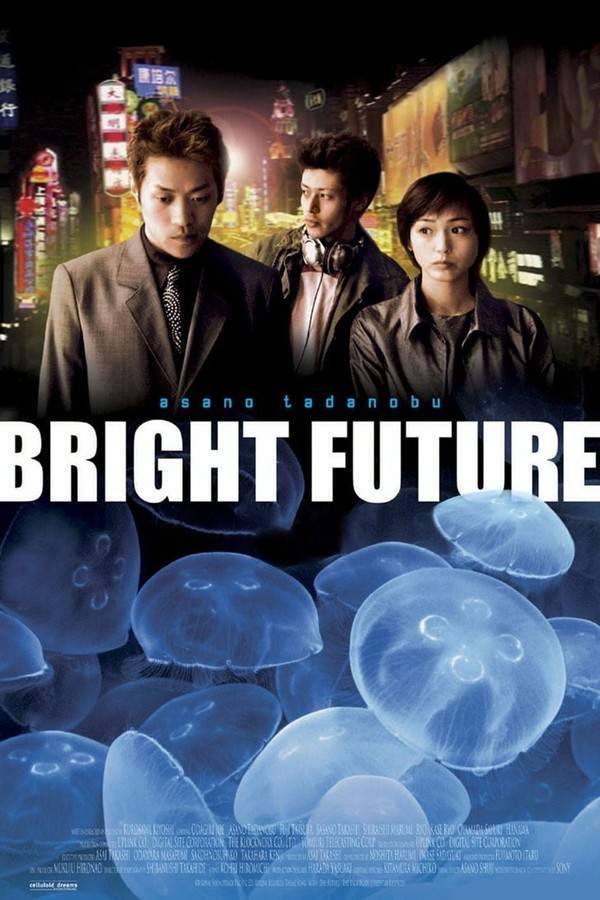
Bright Future (2004) movie poster

Plot Summary

Bright Future (2004) Plot Summary Explained

Release, runtime and language
2004 · 92 min · Japanese
JustWatch #15,801 5
Directed by
Kiyoshi Kurosawa

A tragic mistake leads to imprisonment, irrevocably changing the lives of two close friends. As one serves time, their bond is strained by the repercussions of their shared past and the challenges of separation. Simultaneously, an unusual event—the appearance of a toxic jellyfish—disrupts the city below, creating a parallel to the emotional turmoil and forcing both men to examine the uncertain path ahead.

On this page (6)
  1. 1 Where to watch
  2. 2 What happens: full plot
  3. 3 Plot questions answered
  4. 4 Movie threads
  5. 5 Movies like Bright Future
  6. 6 Every angle

Where to watch

Where to Watch Bright Future (2004)

Where can you watch Bright Future? Stream, rent or buy it in the US, including on AsianCrush, Fandor and Metrograph: current JustWatch availability with up-to-date prices.

Streaming availability powered by JustWatch

Full plot summary · contains spoilers

What Happens in Bright Future: Full Plot Summary

The whole story of Bright Future (2004) explained, from the opening scene to the final frame: every key event, every twist and what it all adds up to. Read it as a quick recap before the sequel, to check a scene you missed, or to finally understand what really happened.

Yuji Nimura, portrayed by Joe Odagiri, and Mamoru Arita, played by Tadanobu Asano, are two fatigued factory workers who consistently clash with their domineering boss, played by Takashi Sasano. In an unexpected twist, Mamoru decides to share his greatest treasure with Nimura: a carefully nurtured, poisonous jellyfish that he's been cultivating in freshwater. This peculiar gesture sets off a series of events that irreversibly change their destinies.

On a pivotal night, Nimura visits Fujiwara's home, driven by a desire for revenge against their boss's unrelenting tyranny. However, upon arrival, he discovers that Mamoru has taken drastic actions by brutally murdering both Fujiwara and his wife. The aftermath is tragic: Mamoru faces the death penalty, yet in a final act of rebellion, he ends his own life on death row, leaving behind a cryptic directive for Nimura to "proceed" with his own fate.

In the wake of these events, Mamoru’s estranged father, Shinichiro, portrayed by Tatsuya Fuji, reaches out to Nimura, inviting him to stay and offering a glimmer of hope for redemption. Nimura begins to find comfort in aiding Shinichiro with his electronics salvage business; however, their contrasting dreams for the future ultimately drive a wedge between them.

Longing for a new beginning, Nimura moves into his sister's office, where he gets involved with a group of discontented youths. Leveraging his savvy, he orchestrates after-hours access to the office, which they then proceed to ransack and vandalize. The police soon intervene, capturing the gang, while Nimura cleverly evades arrest.

With nowhere else to go, Nimura finds his way back to Shinichiro's welcoming home, where he is embraced and offered another chance at life. During a moment of tranquility along the riverbank, they witness an enchanting sight: a stunning school of jellyfish gracefully departing for the open sea. Shinichiro, brimming with excitement, cannot resist the temptation to wade into the water, only to be stung and rendered temporarily unconscious.

As the scene fades, we follow the group of youths roaming the city streets, leaving a wake of disorder behind them.

Last updated: November 18, 2024 at 20:20

Was this helpful?

Plot questions answered

Bright Future Plot Explained: Your Questions Answered

The questions people ask most about Bright Future (2004): what happens in the confusing scenes, why the characters do what they do, the twists, hidden details and what the ending means. Each answer contains spoilers.

Q1

Why did Mamoru kill Fujiwara and his wife instead of waiting for Nimura?

Mamoru took matters into his own hands before Nimura could carry out his planned revenge. When Nimura arrived at Fujiwara's home, he discovered that Mamoru had already committed the murders. The precise motivation is ambiguous, Mamoru may have wanted to spare Nimura from the guilt of killing, or he may have been acting on his own accumulated rage toward their oppressive boss. The timing suggests Mamoru acted impulsively, arriving before Nimura and taking the violent action that both men had contemplated.

Foreshadowing: Earlier scenes establish Mamoru as the more volatile of the two friends, quicker to embrace extreme measures.

  • mamoru
  • fujiwara
  • murder
  • revenge
  • killing
Q2

What happened to Mamoru after the murders?

Mamoru was arrested and sentenced to death for the brutal murder of Fujiwara and his wife. Rather than waiting for execution, he chose to take his own life on death row. Before dying, he left Nimura a cryptic directive to "proceed" with his own fate, suggesting he wanted Nimura to continue living and find his own path forward.

  • mamoru
  • death penalty
  • suicide
  • execution
  • death row
Q3

What does Mamoru's message for Nimura to "proceed" mean?

Mamoru's final message to Nimura, simply telling him to "proceed", appears to be an encouragement to keep living rather than follow Mamoru into death. It suggests Mamoru wanted Nimura to find his own way forward and not be consumed by guilt or grief over the events. The ambiguous phrasing allows for interpretation that Nimura should continue existing, or perhaps continue seeking his own version of freedom and meaning.

  • mamoru
  • message
  • proceed
  • nimura
  • final words
Q4

Why does Nimura return to Shinichiro's home after the vandalism?

After orchestrating the vandalism at his sister's office and evading police arrest, Nimura has nowhere else to turn. His involvement with the group of youths led to chaos and criminal consequences, leaving him isolated and without resources. Shinichiro had previously offered him shelter and a chance at redemption, making his home the only remaining option for someone seeking a fresh start.

  • nimura
  • shinichiro
  • return
  • home
  • shelter
Q5

Why does Nimura get involved with the group of youths?

After moving into his sister's office following Mamoru's death, Nimura becomes directionless and emotionally adrift. The discontented youths represent a form of rebellious companionship that appeals to his desperate state. Nimura uses his skills to help them gain after-hours access to the office, becoming their leader in acts of vandalism, perhaps seeking a release for his accumulated frustration and a sense of purpose, however destructive.

  • nimura
  • youths
  • gang
  • vandalism
  • office
Q6

What is the significance of the poisonous jellyfish in the story?

The jellyfish serves as a central symbol throughout the film. Mamoru carefully cultivates this poisonous creature in freshwater, a strange, beautiful, and dangerous thing he chooses to share with his closest friend. The jellyfish represents both the men's desire for something extraordinary in their suffocating lives and the destructive potential that lies within seemingly fragile things. The parallel between the jellyfish and the men's fates suggests themes of captivity, beauty in danger, and the unpredictability of life.

Foreshadowing: The jellyfish appears early as Mamoru's greatest treasure, foreshadowing its symbolic importance to the entire narrative.

  • jellyfish
  • poison
  • symbolism
  • mamoru
  • nimiria
Q7

What happens when Shinichiro is stung by the jellyfish at the river?

During a peaceful moment by the riverbank, Shinichiro and Nimura witness a stunning school of jellyfish preparing to depart for the open sea. Excited by the sight, Shinichiro wades into the water and is stung by the jellyfish, rendering him temporarily unconscious. This moment echoes Mamoru's poisonous jellyfish and creates an ambiguous ending, representing either a natural consequence of meddling with beautiful but dangerous things, or potentially something more ominous about the future.

Foreshadowing: The earlier cultivation of the poisonous jellyfish by Mamoru establishes the danger these creatures pose.

  • shinichiro
  • jellyfish
  • sting
  • river
  • unconscious
Q8

Why do Nimura and Shinichiro argue despite their bond?

While Nimura finds temporary solace helping Shinichiro with his electronics salvage business, their contrasting dreams for the future create tension. Shinichiro represents a modest, practical existence focused on survival, while Nimura, young and restless, struggles to accept such a constrained life. Their conflicting visions of what a meaningful life looks like ultimately drive them apart, at least temporarily.

  • nimura
  • shinichiro
  • conflict
  • dreams
  • tension
Q9

What does the title "Bright Future" mean given the dark story?

The title appears deeply ironic. Despite the murder, suicide, and chaos that dominate the narrative, the film ends with images of jellyfish gracefully moving toward the open sea and characters given second chances at redemption. The "bright future" may refer to the possibility of change, even after tragic mistakes, characters are offered opportunities to transform. Alternatively, it could be dark irony, as the future remains uncertain and potentially dangerous, as suggested by the final chaotic images of youths roaming the city.

  • title
  • bright future
  • irony
  • meaning
  • theme
Q10

Why does the murder target Fujiwara instead of the factory boss?

Fujiwara appears to be the factory boss himself, the domineering figure whom Nimura and Mamoru consistently clash with at work. The summary references their boss played by Takashi Sasano, and Fujiwara is described as their "tyrannical" boss. The revenge mission was aimed at Fujiwara, but Mamoru arrived first and killed both Fujiwara and his wife before Nimura could confront him.

  • fujiwara
  • boss
  • revenge
  • killing
  • factory
Q11

What do the final scenes with the youths roaming the city signify?

The closing images show the group of discontented youths wandering the city streets, leaving chaos and destruction in their wake. This suggests a continuation of the cycle of aimless rebellion and destructiveness that Nimura briefly led. With Nimura now back at Shinichiro's home and potentially on a path toward redemption, the youths represent the path he chose but left behind, suggesting that while one person may find a way forward, others continue their destructive patterns.

  • youths
  • city
  • chaos
  • ending
  • cycle

Movie threads

More Movies Like Bright Future, by Mood & Story

Curated lists built around what makes Bright Future tick: the same mood, the same kind of story or the same emotional payoff. Each list explains why these movies belong together.

Dreamlike urban decay movies like Bright Future

Gritty character studies set against a bleak and symbolic cityscape. If you liked the gritty, melancholic vibe of Bright Future, this thread features movies that explore alienation and emotional turmoil within bleak cityscapes. These films often blend stark realism with dreamlike symbolism, creating a heavy, atmospheric experience for viewers seeking similar moody dramas.

  • gritty
  • melancholic
  • dreary
  • dreamlike
  • oppressive
  • alienation
  • Tone: dark, melancholic, oppressive
  • Pacing: steady, deliberate
Why these movies?

The story pattern: Stories in this thread often follow characters adrift in a hostile or indifferent urban setting, grappling with alienation, fate, and the consequences of past actions. The city itself becomes a character, with its decay and strange occurrences paralleling the protagonists' psychological states.

Why they belong together: These films are grouped by their shared atmosphere of urban melancholy, a heavy emotional weight, and a tone that blends stark realism with poetic, sometimes surreal, imagery. They create a specific, immersive feeling of being lost in a city that reflects inner despair.

Movies about crime's heavy fallout like Bright Future

Stories where one violent act irreversibly shatters lives and relationships. For viewers who appreciated Bright Future's exploration of a crime's devastating aftermath, this thread collects movies where a single mistake irrevocably changes lives. These dramas are emotionally heavy, often bleak, and focus on the moral and relational consequences rather than the crime itself.

  • sad
  • desperate
  • gritty
  • heavy
  • uncertain
  • moral dilemma
  • Tone: dark, bleak, desperate
  • Pacing: steady, character-driven
Why these movies?

The story pattern: The narrative pattern begins with a pivotal act of violence that casts a long shadow over everything that follows. The story then meticulously explores the fallout—incarceration, broken bonds, guilt, and a struggle for meaning—leading to an ending that is often ambiguous rather than neatly resolved.

Why they belong together: They share a focus on the heavy, long-term emotional consequences of a violent act, rather than the thrill of the crime itself. The tone is dark, the emotional weight is heavy, and they often feature strained relationships and an ambiguous sense of justice or redemption.

If you liked this

Movies Like Bright Future

Similar movies to Bright Future: the same genre, themes or kind of story. Each one comes with its own plot summary, timeline and ending explained.

Browse all movie summaries

Every angle

Bright Future (2004) Explained: Plot, Timeline & Characters

Everything about Bright Future in one place: what happens in the plot summary, the timeline in chronological order, the characters and meaning and a spoiler-free summary. What's After the Movie adds the cast, box office and post-credit scenes.

Coming soon on iOS and Android

The Plot Explained Movie Summary App

Plot summaries, endings explained and timelines on your phone. Catch up on any movie in minutes, save your favorites and never miss a twist again.

Be the first to know when we launch. Your email stays private, always.

Learn more about the app